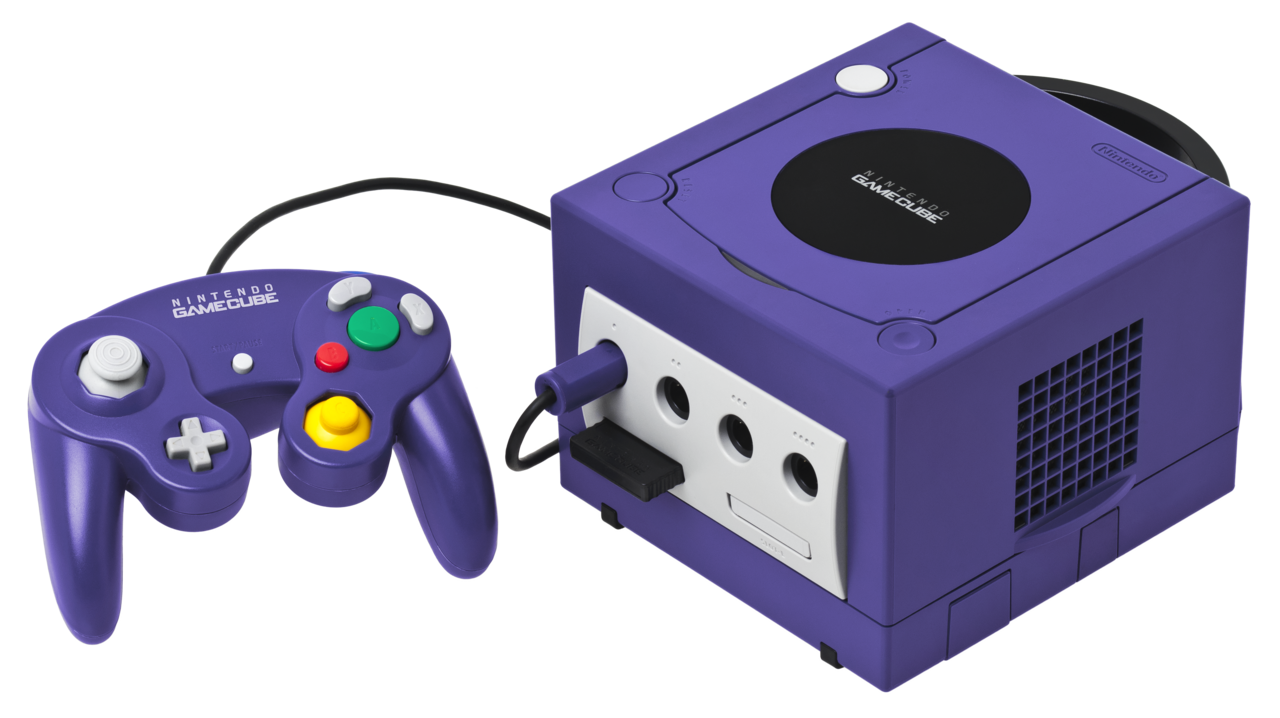
Picture this: September 2001. You walk into a store in Japan and sitting on the shelf is this little purple cube with a handle on the back. It looks like a lunchbox. It looks like a toy. And honestly, that was sort of the problem.
The Nintendo GameCube launched on September 14, 2001 in Japan and November 18, 2001 in North America at a price of $199. For context, the PlayStation 2 had already been out for over a year by that point, building a massive library and an installed base that was growing by the week. And Microsoft's Xbox was about to land just three days earlier, on November 15, with a little game called Halo: Combat Evolved that would change console gaming forever. Nintendo wasn't just late to the party. They showed up wearing the wrong outfit.
The Console That Refused to Grow Up
Let's back up a bit. After the Nintendo 64, Nintendo had a very real problem. The N64 was a great console with some all-time classic games: Ocarina of Time, GoldenEye 007, Super Mario 64. But its stubborn insistence on using cartridges instead of CDs had pushed away third-party developers in droves. Square jumped ship to Sony with Final Fantasy VII. That one decision alone shifted millions of gamers to the PlayStation. Konami, Capcom, EA: they all followed. The N64 ended up feeling like the Nintendo-and-Rare show, with almost everything worth playing coming from first-party studios.
So when Nintendo started designing its next console, codenamed "Dolphin" in development, the message from leadership was clear: we need to fix the third-party problem. We need to show developers that Nintendo is serious about supporting them. We need optical media. We need modern hardware.
And in some ways, they delivered on that promise. The GameCube ditched cartridges for optical discs. It used a PowerPC processor developed with IBM. It had a GPU built by ATI (now AMD). On paper, it was competitive with, and in some respects more capable than, the PlayStation 2. But here's where things get interesting, and where Nintendo made the decisions that would define the GameCube's fate.
The Mini-DVD Gamble
Nintendo didn't use standard DVDs. They went with a proprietary mini-DVD format, developed in partnership with Matsushita (the parent company of Panasonic), that held about 1.5 GB of data per disc. A standard DVD held 4.7 GB. The reasoning was anti-piracy: by using a non-standard disc format, it would be much harder for people to copy games. The N64 had struggled with piracy on cartridges, and the PS1 piracy scene was absolutely massive. Nintendo wanted to close that door.
But the trade-off was brutal, and it played out on two fronts. First, the smaller disc capacity meant that some multiplatform games had to be compressed or, in a few cases, split across multiple discs. Developers already had concerns about porting to the GameCube, and the format limitations didn't help their enthusiasm.
Second, and more importantly, because the GameCube used proprietary mini-DVDs, it couldn't play DVD movies. In 2001, this was a genuinely big deal. The PlayStation 2 had become the cheapest DVD player on the market when it launched in 2000, and millions of people bought it partly for that reason. Parents could justify the $299 purchase to their spouses: "It's also a DVD player, honey." The Xbox could play DVDs too, with a $30 remote accessory. The GameCube? It was just a game console. In an era where multimedia functionality was becoming the expectation, Nintendo built a machine that only did one thing.
There was one exception: the Panasonic Q, a Japan-exclusive GameCube variant that included full DVD playback. It launched in December 2001 at 39,800 yen (about $300 at the time) and sold poorly. Panasonic discontinued it in 2003 after moving only a fraction of the units they'd projected. It's become a collector's item now, which is kind of ironic.
The $199 Question
To be fair, Nintendo priced the GameCube aggressively. At $199, it was $100 cheaper than the PS2 at launch and $100 cheaper than the Xbox. And later, Nintendo would slash the price even further, dropping it to $149 in 2002 and eventually to $99 by 2003. In terms of raw value for your dollar, the GameCube was a genuine bargain.
It was also, pound for pound, a powerful little machine. Developer Factor 5, the studio behind the Star Wars Rogue Squadron games, called the GameCube one of the best pieces of hardware they'd ever worked with. Rogue Squadron II: Rogue Leader was a launch title, and if you were there, if you saw those Star Wars battles running in real-time on a home console for the first time, you know. It looked absolutely stunning for 2001. Factor 5 pushed the hardware so hard that their GameCube games were used as technical demonstrations of what the console could do.
But power and price don't matter if people don't walk into a store and pick your console off the shelf. And that's where the GameCube ran headfirst into its biggest problem: perception.
The Lunchbox Problem
Let's talk about the design. That little cube, available in indigo purple, jet black, platinum silver, and (in Japan) a striking orange called "spice," was polarizing from the start. With its carry handle molded into the back and its compact, almost toy-like proportions, the GameCube looked friendly. Approachable. Almost cute. Nintendo leaned into this with marketing that emphasized fun, color, and family-friendly gaming experiences.
Meanwhile, Sony was marketing the PS2 as this sleek, black, multimedia hub for mature gamers and serious entertainment. The PS2's marketing was mysterious, cool, almost avant-garde. And the Xbox? A hulking, massive black box that screamed "power" and launched alongside Halo, a game that single-handedly proved console first-person shooters could work brilliantly and gave the Xbox an identity from day one.
And Nintendo? They launched the GameCube with Luigi's Mansion. A charming, inventive little game where Luigi, Mario's perpetually overshadowed brother, vacuums ghosts in a haunted house with a modified vacuum cleaner called the Poltergust 3000. It was good. Critics liked it. It sold well for a launch title, moving over 3.3 million copies. But it wasn't the system seller Nintendo needed. It wasn't a Mario platformer. It wasn't Zelda. It was Luigi, looking scared, holding a vacuum cleaner. As a statement of intent for the console's identity, it told the market exactly what the GameCube was: the kiddie console.
This reputation haunted the GameCube for its entire lifespan. Kids asked their parents for a PS2. Teenagers saved up for an Xbox. The GameCube became the "other" console, the one you maybe had alongside your main system, the one your younger sibling played. And it wasn't entirely fair.
The Games That Deserved Better
Because here's the truth: the GameCube had an absolutely incredible library of exclusive games. Resident Evil 4, one of the greatest action games ever made, launched as a timed exclusive on GameCube in January 2005. Metroid Prime, developed by the relatively unknown Retro Studios in Austin, Texas, reinvented the Metroid franchise in first-person 3D and became an instant classic. It won near-universal critical acclaim and proved that Nintendo could do "mature" when they wanted to.
The Legend of Zelda: The Wind Waker was deeply controversial at its 2002 reveal. Fans who had been expecting a realistic, adult-oriented Zelda (based on a tech demo Nintendo had shown at Space World 2000) were furious about the cel-shaded, cartoon-like art style. Message boards erupted. Fans called it "Celda." But when the game actually released in 2003, critics and players discovered one of the most beautiful, emotionally resonant adventure games ever made. Time has vindicated The Wind Waker completely; it's now widely considered one of the best Zelda games in the entire franchise.
And then there was Super Smash Bros. Melee. Released in December 2001 as a launch window title, Melee became a competitive gaming phenomenon that nobody at Nintendo anticipated. The game's deep, technical fighting mechanics, discovered and refined by a passionate community over years of play, turned it into one of the most enduring competitive games in history. People are still playing Melee in tournaments in 2026. That's a 25-year-old GameCube game with a thriving competitive scene. Let that sink in.
Other highlights include Mario Kart: Double Dash, Pikmin (which introduced an entirely new Nintendo franchise), Animal Crossing (which brought the series to Western audiences for the first time and planted the seeds for the massive cultural phenomenon it became during COVID-19 lockdowns), Paper Mario: The Thousand-Year Door (one of the greatest RPGs on any platform), and F-Zero GX (the fastest, most intense racing game ever made, developed in collaboration with Sega's Amusement Vision studio).
The Third-Party Curse
Despite Nintendo's efforts to court developers, the third-party situation never fully recovered from the N64 era. The mini-DVD format was one factor, but the larger issue was the installed base. As the PS2 pulled away in sales, publishers naturally prioritized the platform with the biggest audience. EA kept supporting the GameCube with most of its major franchises, but other publishers gradually pulled back.
The biggest gap? Grand Theft Auto. Rockstar never brought GTA III, Vice City, or San Andreas to the GameCube. In a generation largely defined by the GTA franchise, which was by far the most culturally significant gaming series of the early 2000s, this was devastating. If you wanted to play GTA (and tens of millions of people did), you bought a PS2. Period. No amount of Zelda or Metroid could offset that kind of must-have third-party exclusive.
And then there was the Capcom saga, which is one of the most frustrating stories in GameCube history. In November 2002, Capcom announced the "Capcom Five," a slate of five exclusive GameCube games designed to boost the console's mature gaming credentials. The lineup was Resident Evil 4, Viewtiful Joe, P.N.03, Dead Phoenix, and Killer7. It was supposed to be a massive win for Nintendo, a signal that the GameCube was a serious platform for adult gamers.
But then things fell apart, publicly and painfully. Dead Phoenix was cancelled entirely. Viewtiful Joe, after launching as a GameCube exclusive, was ported to PS2 less than a year later. Killer7 went multiplatform. And Resident Evil 4, the crown jewel of the deal, the game that was supposed to be THE reason to own a GameCube, was announced for PS2 while the GameCube version was still on shelves. The PS2 version released in October 2005, just nine months after the GameCube original. Only P.N.03 remained truly exclusive to GameCube, and it was by far the weakest game in the bunch, receiving mediocre reviews. GameCube owners who had bought the console partly on the promise of those exclusives felt genuinely betrayed.
The Numbers Don't Lie
When the dust settled on the sixth generation console war, the GameCube sold 21.74 million units worldwide. For comparison, the PlayStation 2 moved over 155 million units, making it the best-selling console of all time. Even the original Xbox, which was Microsoft's very first console with no established brand loyalty and no track record in the gaming market, outsold the GameCube at roughly 24 million units. Nintendo had initially projected selling 50 million GameCubes by 2005. They didn't even come close to half of that target.
The market share numbers tell the story even more starkly. The PS2 held approximately 49% of the sixth generation market. The Xbox had about 7.6%. The GameCube had 6.7%. Nintendo, the company that had essentially created the modern gaming industry with the NES in 1985, was now in third place, behind a newcomer.
Nintendo ceased production of the GameCube in February 2007, right as the Wii was starting its explosive ascent. The Wii, of course, became a massive phenomenon, selling over 101 million units worldwide. Some people like to frame the Wii as Nintendo's comeback story. But the truth is more interesting than that. The Wii succeeded by doing the exact opposite of what the GameCube had tried to do. Instead of competing head-to-head with Sony and Microsoft on graphics, power, and third-party support, the Wii went all-in on motion controls and casual, accessible gaming. It was a strategy born directly from the hard lessons and painful failures of the GameCube era. Satoru Iwata, Nintendo's president, explicitly said that Nintendo could not continue competing on the same axis as its rivals. The GameCube had proven that.
Why the GameCube Still Matters
Here's the thing about the GameCube. It lost the console war badly, and nobody with a straight face is going to argue otherwise. But in terms of pure game quality, first-party output, and lasting cultural impact, it might have had the strongest lineup of its generation. Super Smash Bros. Melee, which sold over 7.41 million copies, remains a competitive staple. Metroid Prime 1 and 2 redefined what a first-person adventure could be. The Wind Waker's art style, once mocked, is now universally praised as timeless. Mario Kart: Double Dash introduced the two-character mechanic. Pikmin spawned a beloved franchise. Animal Crossing became a global phenomenon. Paper Mario: The Thousand-Year Door is getting remakes decades later because the demand never went away.
And then there's the controller. The GameCube controller is, to this day, considered one of the best game controllers ever designed. The offset analog sticks, the satisfying click of the analog triggers, the way the face buttons were arranged with one large A button surrounded by smaller contextual buttons: it felt intuitive in a way that no other controller quite matched. The ergonomics were superb. It fit in your hands like it was designed for you specifically.
Nintendo has kept making GameCube controller adapters for the Wii U and the Switch specifically because the competitive Smash Bros. community refused to play with anything else. Think about that. A controller designed for a console from 2001 is still the preferred input device for a major competitive gaming community in 2026. That's not nostalgia. That's just good design.
The GameCube also pioneered connectivity experiments that were genuinely ahead of their time. The Game Boy Advance link cable let you connect your GBA to the GameCube, turning the handheld into a second screen or controller. The Legend of Zelda: Four Swords Adventures used this feature brilliantly, and so did Final Fantasy Crystal Chronicles. It was clunky, sure, requiring each player to own their own GBA and link cable. But the concept of asymmetric gameplay, where one player has different information on a personal screen than what's shown on the TV, was a precursor to the Wii U GamePad and, arguably, to the entire concept of second-screen gaming.
The Collector's Revenge
There's a certain poetic justice to what happened next. The console that nobody wanted in 2003, the one that sat on store shelves while PS2s and Xboxes flew off them, became one of the most sought-after retro gaming consoles by the 2020s.
GameCube game prices have gone absolutely through the roof. A complete copy of Fire Emblem: Path of Radiance regularly sells for over $200. Skies of Arcadia Legends, Chibi-Robo, Gotcha Force, Pokemon Colosseum, Pokemon XD: Gale of Darkness: these games that sat on clearance racks when they were new are now collector's items worth serious money. Paper Mario: The Thousand-Year Door, before it got its Switch remake, was commanding prices north of $100 for a used copy.
The consoles themselves have appreciated too. A boxed GameCube in good condition, especially in the original indigo or the rare spice orange, can fetch premium prices from collectors. It's the same pattern that plays out with almost every Nintendo product: the Virtual Boy was a disaster when it launched, and now it's a sought-after collector's piece. The GameCube was a commercial disappointment that finished last in its generation, and now people pay premium prices for one in good condition, controller included, ready to play Melee the way it was meant to be played.
The GameCube deserved better than what the market gave it in 2001. But maybe that's the point. Sometimes the things that matter most aren't the things that sell the best. Sometimes, a purple lunchbox with a handle on the back turns out to be something people carry with them for the rest of their lives.
FAQ
How many GameCube consoles were sold worldwide?
Nintendo sold 21.74 million GameCube units worldwide between 2001 and 2007. This placed it third in its generation, behind the PlayStation 2 (over 155 million) and the original Xbox (roughly 24 million).
Why couldn't the GameCube play DVDs?
The GameCube used a proprietary mini-DVD format developed with Matsushita (Panasonic) that held about 1.5 GB per disc. To include DVD playback, Nintendo would have had to pay approximately $20 per unit in licensing fees to the DVD Forum. The only exception was the Panasonic Q, a Japan-exclusive GameCube variant that could play DVDs, which launched at 39,800 yen and was discontinued in 2003.
What was the GameCube's launch price?
The GameCube launched at $199 in North America on November 18, 2001. This was $100 less than both the PlayStation 2 and the Xbox at their respective launch prices. The price was later reduced to $149 in 2002 and $99 in 2003.
Why is the GameCube controller so popular with Smash Bros. players?
The GameCube controller's design, with its offset analog sticks, large A button, and responsive analog triggers, became the gold standard for competitive Super Smash Bros. play. The community has kept it alive for over two decades, and Nintendo has continued manufacturing official adapters for newer consoles to support it.
What were the best-selling GameCube games?
Super Smash Bros. Melee was the console's best-selling game at over 7.41 million copies worldwide. Other top sellers included Mario Kart: Double Dash, Super Mario Sunshine, The Legend of Zelda: The Wind Waker, and Luigi's Mansion.