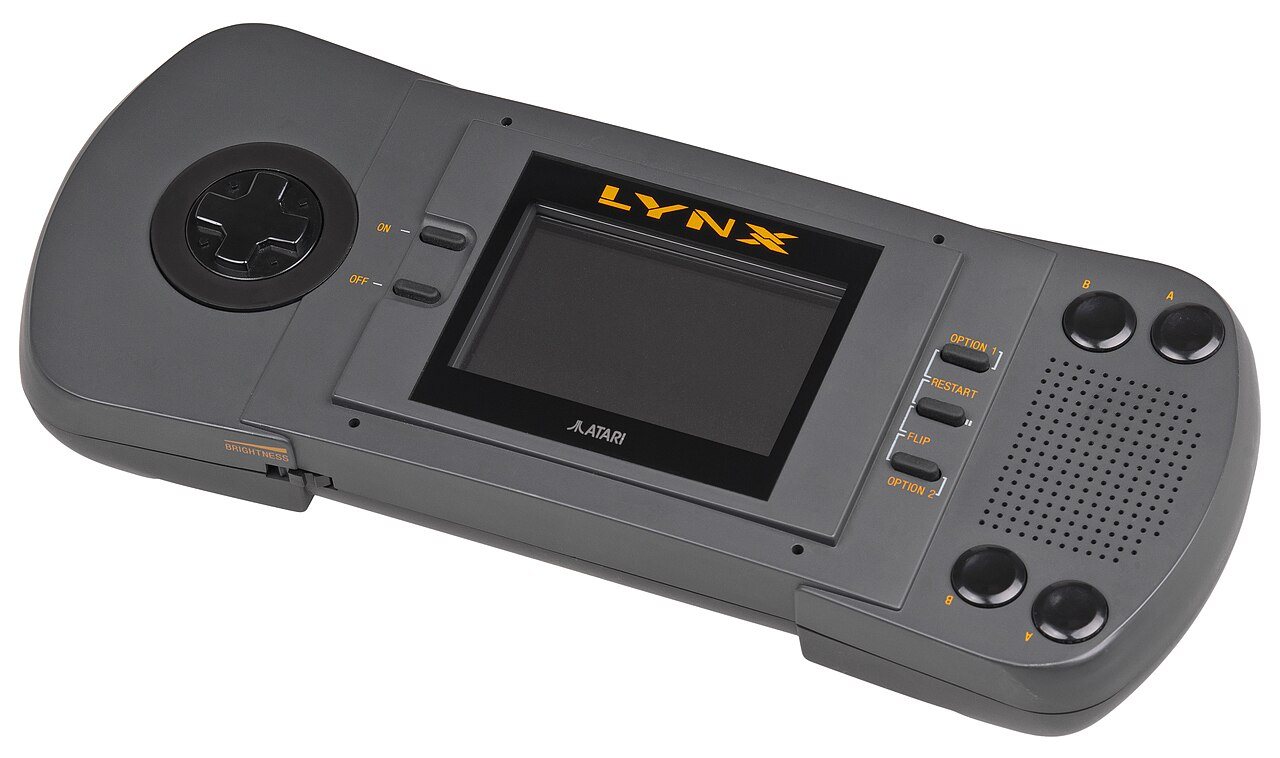
Picture this: it's the fall of 1989. You're standing in the handheld aisle at Toys R Us, and there are exactly two things you have never seen before in your life. On one peg, in a tiny cardboard box, there's the Nintendo Game Boy. Gray, the size of a Walkman, four shades of green, $89.99. Next to it, taking up about three times the shelf space, is a thing called the Atari Lynx. It's the size of a paperback novel, has a backlit color screen, costs $179.95, and somebody at Atari has decided to advertise it as the future of portable gaming.
Reader, I have to tell you something. The Atari Lynx was, by every spec sheet you could throw at it, the better machine. It was not even close. The Game Boy looked like a calculator. The Lynx looked like the year 2000.
And the Lynx got destroyed.
This is the story of a handheld that was years ahead of its time, was built by ex-Amiga engineers in a shed at a struggling software company, was launched by an Atari that was already losing the plot, and was buried by a $90 brick that played Tetris. If you were there, in the GameStops and Electronics Boutiques and Babbage's of the early '90s, you saw the whole thing happen in slow motion. The Lynx deserved better. Pull up a chair.
How a Bankrupt Software Company Built the Most Advanced Handheld of the 1980s
To understand the Lynx you have to go back to 1986, and a place called Epyx. If that name doesn't ring a bell for you, that's fine. Epyx made California Games, Summer Games, Winter Games, the Olympic-style sports titles you played on your Commodore 64 in the back room of somebody's house. They were a software company, not a hardware company, and by the mid-'80s they were starting to feel the squeeze of the post-crash console market.
So Epyx hired two guys nobody outside of Silicon Valley had heard of: RJ Mical and Dave Needle. These two were not normal engineers. They had just come off building the Commodore Amiga, which is to say they had built one of the most beautiful, most ahead-of-its-time computers ever made. Epyx wanted them to design a portable game system. Mical and Needle started in 1986. They had a working prototype by 1987. The internal codename was Handy.
Here's what Handy was: a custom 8-bit 65SC02 CPU running at 4 MHz, paired with two custom chips Mical and Needle named Mikey and Suzy. Mikey did sound and video. Suzy was the wild one, a 16-bit blitter chip that handled sprite scaling, distortion, and rotation in hardware. The screen was a 3.5-inch backlit color LCD with a 4,096-color palette, displaying 16 colors on screen at once from that palette. You could rotate the whole machine, and the screen would flip with it, so left-handed players could just turn the whole thing around and play. You could daisy-chain up to eight units together with a cable called ComLynx for multiplayer.
In 1987, in a backpack, this was insane. Nintendo's R&D2 team in Kyoto was working on the Game Boy at the same time, and Gunpei Yokoi's design philosophy was the polar opposite. Yokoi famously preached "lateral thinking with withered technology," which is a Japanese way of saying use the cheap stuff that already works. The Game Boy ran a Sharp LR35902 at 4.19 MHz, had a 160x144 monochrome dot matrix LCD, no backlight, and was designed to sip AA batteries.
The Lynx ate AA batteries. Six of them. For about four to five hours.
That single design choice, that one tradeoff, is the whole movie. But we're getting ahead of ourselves.
How the Handy Became the Atari Lynx
By 1988, Epyx was in trouble. They had a finished portable game system in their hands and no money to manufacture it. They started shopping it. Nintendo, who was secretly working on the Game Boy, took a look and said no. Sega, who would later launch the Game Gear in 1990, took a look and said no. A few other companies passed.
The buyer that finally said yes was Atari Corporation, which by 1988 was a different beast than the Atari that ruled your living room in 1982. After the video game crash of 1983, the original Atari had been split up and sold off. Jack Tramiel, the legendary and famously combative founder of Commodore, bought the consumer division in 1984 and renamed it Atari Corp. By 1988, Atari Corp was making the Atari ST line of computers and the 7800 console, and they were getting absolutely lapped by Nintendo in the home market.
Atari and Epyx struck a deal. Atari would handle manufacturing, distribution, and marketing. Epyx would handle the software development. By the end of 1989, Epyx had filed for Chapter 11 bankruptcy anyway, and Atari essentially owned the whole project. They renamed it the Atari Lynx and brought it to market in September 1989. Price: $179.95. Pack-in game: California Games, the Epyx classic, ported beautifully.
I want you to understand the timing here, because it matters. The Game Boy launched in Japan in April 1989 and in North America on July 31, 1989. The Lynx launched in September 1989. They were almost the same Christmas. Two completely different visions of what a portable game console should be, sitting on the same shelf, six weeks apart.
The Lynx was twice the price of the Game Boy, three times the size, ate six batteries instead of four, and lasted half as long. It also had color, hardware sprite scaling, and looked like a piece of Star Trek equipment. Both of these were true at the same time.
Christmas 1989, and the First Sign of Trouble
Atari had a problem at launch, and it was not the product. It was that they could not make enough of them. Christmas 1989 was supposed to be the Lynx's coming-out party. Instead, what showed up was a national supply shortage. Stores got tiny allocations. Most people who walked into Toys R Us looking for a Lynx walked out with a Game Boy, because that's what was actually in stock.
Nintendo, by contrast, was Nintendo. They had been manufacturing electronics and toys at industrial scale since the late 1800s. They had the Game Boy stacked in pyramids in every retail aisle in America. They had Tetris bundled in every box.
And here's where it gets interesting. By the end of 1990, Atari had moved roughly 500,000 Lynx units in the US. That's a real number. That is also a number that gets dwarfed by Game Boy units shipped in just the first six months of 1990. By late 1991, total Lynx sales were estimated at around 800,000. The Game Boy, in the same window, was selling that many units in good months.
The math was already against the Lynx and we were only two Christmases in.
The Lynx II, and the Doomed Comeback
In July 1991, Atari did the thing every struggling console maker eventually does. They put out a revision. The Lynx II.
The Lynx II was actually pretty good. They shrunk the chassis, added rubberized hand grips on the back, swapped in a clearer backlit screen, added a stereo headphone jack to replace the original's mono output, and put in a power-save mode that turned the screen off when you weren't using it. They also dropped the launch price to $99.99, which is the price the original Lynx probably should have been all along.
For about ten minutes, this looked like it might work. The smaller form factor felt better in your hands. The new screen looked cleaner. The price was finally in Game Boy territory. Magazine reviewers gave it polite second looks and said things like "Atari has finally made the Lynx the system it should have been."
And then, in April 1991, Sega launched the Game Gear in North America for $149.99, also color, also backlit, also chewing through batteries, also starring Sonic eventually. Now the Lynx wasn't even the only color handheld on the shelf. It was the third option, behind the Nintendo juggernaut and the Sega challenger.
By 1995, total combined sales of the Lynx and the Game Gear were under 7 million units. The Game Boy, by itself, in the same period, sold over 16 million. And that's before you count the Game Boy Pocket, the Game Boy Color, and eventually the Advance, all of which would extend that platform into the 2000s.
The Games Were Actually Good
Here's the part that hurts. The Lynx had genuinely great games. Not enough of them, not advertised loudly enough, but they existed and they were special. Blue Lightning, an after-burner-style flight combat game, was the launch demo most stores looped on the kiosk and it was the closest thing to a polygonal arcade experience anybody had seen on a portable. Klax on the Lynx is, depending on who you ask, the definitive port of Klax. Todd's Adventures in Slime World, Chip's Challenge, Lemmings, Rampage, Toki, Xenophobe, all of these landed on the Lynx.
The library got to about 75 official commercial releases over the lifetime of the system. For comparison, the Game Boy library had cleared 1,000 titles by the late '90s. So even when the Lynx had a great game, you had eight Game Boy games to choose from in the same slot at Funcoland. The shelf space told the whole story.
The other thing that hurts: ComLynx multiplayer was, for its time, beyond anything else available. You could plug eight Lynx units together with cables and play head-to-head. In 1990. On a portable. Kids playing Game Boy multiplayer needed a Game Link cable and a friend, and they got two-player. Lynx kids could in theory get a school cafeteria full of Slime World running at lunchtime. The catch was that you needed eight Lynx units in the same room, which, in a world where the Lynx was outsold ten-to-one, meant nobody actually did this in practice. Beautiful idea, no install base.
Why It Lost: A Plain English Postmortem
People love to argue about why the Lynx lost. Some of the answers are technical, some of them are about marketing, and some of them are about Nintendo just being Nintendo. Here is what actually killed it, in order of how much it mattered:
1. Battery life. Game Boy: 15 to 30 hours on four AAs. Lynx: 4 to 5 hours on six AAs. If you are 11 years old at summer camp with no outlet, this difference is the entire ballgame. Color was cool. Battery anxiety was death.
2. Price. $179.95 versus $89.99 in 1989. This is roughly $475 versus $235 in today's money. For the same kid in the same store with the same allowance, only one of those two prices was a real option.
3. Software pipeline. Nintendo had Tetris, Mario, Zelda, Pokรฉmon, Final Fantasy Legend, Kirby, the entire third-party world following them onto the platform. Atari had a few hundred third-party developers and a frequently rotating internal team. The Lynx never got a single killer app on the level of Tetris or Pokรฉmon, and Tetris alone moved more Game Boys than the entire Lynx library moved Lynxes.
4. Atari itself. By 1991, Atari Corp was bleeding money, fighting Nintendo in a federal antitrust lawsuit, getting ready to launch the Jaguar console (spoiler: that didn't go well either), and giving the Lynx less and less marketing oxygen each year. By 1994, the Lynx was effectively abandoned. By 1996, Atari Corp itself was being merged into JT Storage and would soon disappear as an active company.
5. Distribution. Nintendo had relationships with every toy and electronics retailer in North America, and they enforced exclusivity terms that made carrying competitors difficult. Atari had Atari's relationships, which is to say less leverage and less shelf space.
Pick whichever one you like. The honest answer is that all five mattered, and they compounded.
The Long Tail: Lynx After the Lynx
Officially, the Lynx died around 1995. Atari Corp stopped active marketing. The last commercially released cartridge in the original era was around 1995 to 1996. The system was quietly retired with about 75 official releases and a couple million units in homes worldwide.
But here's the thing about the Lynx. It refused to fully die.
The homebrew community for the Lynx is one of the most active in retro gaming. Songbird Productions, run by Carl Forhan since the late '90s, has been releasing brand-new commercial Lynx games into the 2000s and 2010s. Atari Age and the Lynx homebrew scene have produced new cartridges, new demos, and entire new game releases decades after Atari left the room. There are Lynx tournaments at retro game conventions. There are people who still gather with their ComLynx cables and play Battlewheels in 2026. If you have ever been in a room of those people, you understand. They are not letting it go. They are not going to.
And in 2019, on the Lynx's 30th anniversary, RJ Mical and Dave Needle did a series of interviews and conference appearances reflecting on what they had built. Sadly, Dave Needle passed away in 2016, but Mical has spoken extensively about the Lynx and the Amiga at conventions including the Game Developers Conference, and he has a real, justified pride about the thing he built. He should. They invented the modern color portable. The world just wasn't ready to pay for it.
Every time you flip open a Switch and play in handheld mode, every time you boot up a Steam Deck on a flight, you are using something that the Atari Lynx prototyped in 1989. Color screen. Backlit. Networked multiplayer. Hardware sprite scaling. Battery anxiety. All of it.
What the Lynx Tells Us About Hardware Wars
Look, the Lynx vs Game Boy story gets told two ways. The first way is "Atari mismanaged a great product." That is partly true. The second way is "the better technology doesn't always win." That is also partly true. But neither of those is quite right on its own.
The real lesson is that hardware is a system, not a spec sheet. You can have the better display and lose because of the worse battery. You can have the better software and lose because the price is wrong. You can have the better idea and lose because your distributor can't get the product on the shelf in October. Nintendo didn't beat Atari in 1989 because the Game Boy was a better console. They beat Atari because the Game Boy was a better product: cheaper, longer-lasting, more available, with better games coming, sold by a company that knew what to do with all of that.
Atari shipped the future and forgot to also ship the present. The Lynx was a portable Star Trek display that needed to live in 1989, when 1989 wanted Tetris on a green screen for under a hundred bucks.
Frequently Asked Questions About the Atari Lynx
When was the Atari Lynx released? The original Atari Lynx launched in North America in September 1989, with a retail price of $179.95. The Lynx II revision arrived in July 1991 at $99.99. The European launch followed in 1990.
How many Atari Lynx units were sold? Atari never released official lifetime sales figures. Industry estimates put US sales at roughly 500,000 units by the end of 1990 and around 800,000 by late 1991. Combined lifetime sales of the Lynx and Sega Game Gear together were estimated at under 7 million by 1995, against more than 16 million Game Boys in the same window.
Who designed the Atari Lynx? The Lynx was designed by RJ Mical and Dave Needle, both of whom previously designed the Commodore Amiga. They started the project at Epyx in 1986 under the codename Handy, and it was sold to Atari Corporation when Epyx ran into financial trouble.
Why did the Atari Lynx fail? It came down to four big things: a much higher price than the Game Boy ($179.95 vs $89.99 at launch), much shorter battery life (about 4 to 5 hours on six AAs vs 15 to 30 hours on four), a smaller and weaker software library, and Atari's inability to match Nintendo on manufacturing scale, retail distribution, and marketing.
Was the Atari Lynx 16-bit? Mostly marketing. The CPU was an 8-bit 65SC02 running at 4 MHz. The Suzy graphics co-processor handled some graphics operations in 16-bit chunks via its custom blitter, and Atari leaned on that to call the system 16-bit in advertising. By modern standards it sat between the 8-bit Game Boy and the true 16-bit consoles like the SNES and Genesis.
What was the Lynx's pack-in game? California Games, ported by Epyx, came in the box with the original 1989 Lynx. It featured surfing, BMX, halfpipe, and footbag events, and it was widely considered one of the best showcases of the Lynx's color hardware.
Are people still making games for the Atari Lynx? Yes. Songbird Productions, founded by Carl Forhan in the late '90s, has continued to release new commercial Lynx cartridges into the 2010s and beyond, and the broader homebrew community on AtariAge has produced demos, new games, and re-releases for decades.
Is the Atari Lynx worth collecting today? Working original Lynx and Lynx II units in clean condition typically sell in the $100 to $300 range as of recent years, depending on condition and bundled games. Boxed launch titles and rarer late-life releases like Battlewheels can run higher. The screens often need recapping or rubber dome replacement to stay usable, which is its own little community of repair tutorials.
What other handhelds were on the market at the same time? The Nintendo Game Boy launched in 1989 at $89.99. The Sega Game Gear launched in 1990 in Japan and 1991 in North America at around $149.99. The NEC TurboExpress, a true portable TurboGrafx-16, launched in 1990 at $249.99 and is its own forgotten chapter. The Lynx was technically the first color handheld of that generation.
The Lynx deserved better. It just had the misfortune of being right at the wrong time, in the wrong company's hands, against the most disciplined consumer electronics outfit on the planet. Pour one out, plug six AAs in, and load up California Games. The screen still pops.