What Happened to Geocaching, the GPS Treasure Hunt That Started With a Bucket and a Can of Beans

At midnight on May 1, 2000, the United States government did something that should have made the front page of every newspaper and instead made almost no news at all. It turned off a setting on its global positioning satellites called Selective Availability. In the time it took the satellites to receive the order and apply it, the typical accuracy of every civilian GPS receiver on Earth jumped from about 100 meters to under 20 meters, roughly a ten-fold improvement. A device that previously could only tell you, vaguely, what neighborhood you were standing in could now point to a specific tree in that neighborhood.

The next day, a computer consultant in Beavercreek, Oregon named Dave Ulmer drove to a wooded clearing off the side of the road, dropped a black plastic bucket into a depression in the ground, put a logbook and some small trinkets inside it, covered it with branches, and posted the latitude and longitude coordinates to an internet newsgroup with the subject line "GPS Stash."

Within three days, two people had driven out to Oregon to find it. Within ten years, what Ulmer had invented would have over five million participants and would become the first true mass-market activity to require a satellite signal, an internet connection, and a willingness to walk into the woods looking for things.

The activity was called geocaching, eventually. And the story of how it grew, how it survived the smartphone, and what it tells us about the early consumer internet is one of the more under-told case studies in user-generated platform design.

The policy change that started everything

To understand geocaching, you have to understand that for most of the 1990s, the United States military deliberately broke its own technology for non-military users.

GPS, the Global Positioning System, was built by the US Department of Defense. By the early 1990s the satellite constellation was operational and civilians could buy receivers that talked to it. The catch was that the government did not want enemy militaries piggybacking on American satellites to guide weapons or troops. So the Pentagon introduced something called Selective Availability, which intentionally degraded the civilian-accessible portion of the signal. The military got the precise version. Everyone else got noise added to their location data, deliberately, by design.

In practice, civilian GPS receivers had a typical accuracy of about 100 meters horizontally. That is fine for an airplane finding an airport. It is useless for a hiker trying to navigate a trail or a driver trying to find a specific address. The civilian market for GPS had been a slow burn through the 1990s for exactly this reason. Nobody could justify paying for a device that could only tell them roughly where on a football field they were.

On May 1, 2000, President Bill Clinton issued a statement announcing that Selective Availability would be discontinued, effective immediately. The Pentagon, after years of internal debate, had concluded that the technology to degrade civilian signals could be replicated cheaply and that the strategic value was now lower than the economic value of an unleashed civilian GPS market. The downgrade went away overnight. Civilian accuracy went from useless to genuinely useful.

"The decision to discontinue SA is the latest measure in an ongoing effort to make GPS more responsive to civil and commercial users worldwide," the official White House statement read. The word "geocaching" did not appear in the press release. The activity did not yet exist.

The press coverage was modest. Most consumer media did not run the story at all. The people who did notice, immediately, were the small but obsessive community of GPS hobbyists who had been hanging out on Usenet newsgroups like sci.geo.satellite-nav.

Dave Ulmer hides a bucket in the woods

Dave Ulmer was one of those hobbyists. He had been running test routes in Oregon to measure the new accuracy of his GPS receiver, and on May 3, 2000, he decided to test the social possibilities of the new system. He stashed a five-gallon black plastic bucket near a forest road in Beavercreek. Into the bucket he put a logbook and pencil, two CD-ROMs of DeLorme Topo USA mapping software, a George of the Jungle VHS tape, a book, four dollars, a cassette recorder, a slingshot, and a can of beans. He posted the coordinates to the newsgroup along with what is now treated as the founding principle of the whole activity:

"Take some stuff, leave some stuff. Record it all in the logbook."

Within 24 hours, a Vancouver, Washington reader named Mike Teague had driven to Beavercreek, found the bucket, signed the log, and traded items. Teague then started a website to track other people doing the same thing. Hobbyists in California, Illinois, and Kansas hid their own caches within a week. Teague's site listed them all.

For about four months, that was the entire community. A few dozen people, mostly engineers and outdoor types, scattered across the United States, hiding plastic boxes in the woods and trading the coordinates on a single ad-hoc website run by one guy in his spare time.

That is when Jeremy Irish entered the story.

How a Seattle web developer built the platform

Jeremy Irish was a 28-year-old web developer at a Seattle interactive agency called Sunrise Identity. In July 2000, a friend forwarded him a link to Mike Teague's GPS Stash Hunt website. Irish read it, immediately bought a Garmin eTrex, drove out to find a cache near his Seattle home, and got hooked in the way that people get hooked on things that combine a treasure hunt, a hike, and a community of strangers who are all in on the same secret.

Irish offered to take over the website. Teague, who was running it alone and getting overwhelmed by traffic, agreed. In September 2000, Irish registered the domain Geocaching.com and launched the rebranded site on September 2, 2000. At launch, there were 75 known geocaches in the world. This was a brand decision that mattered. "Stash hunt" sounded faintly illegal. "Geocaching" sounded scientific. Irish later said the name had to be searchable and had to not freak out parents.

Irish co-founded a company called Groundspeak with Bryan Roth and Elias Alvord to operate the site. There was no revenue model for the first few years. Irish kept his day job. The site's initial server costs were funded by selling 144 geocaching t-shirts to early community members. Listings grew through word of mouth on outdoor forums and through coverage in early 2000s tech magazines that were hungry for stories about novel uses of the new accurate GPS.

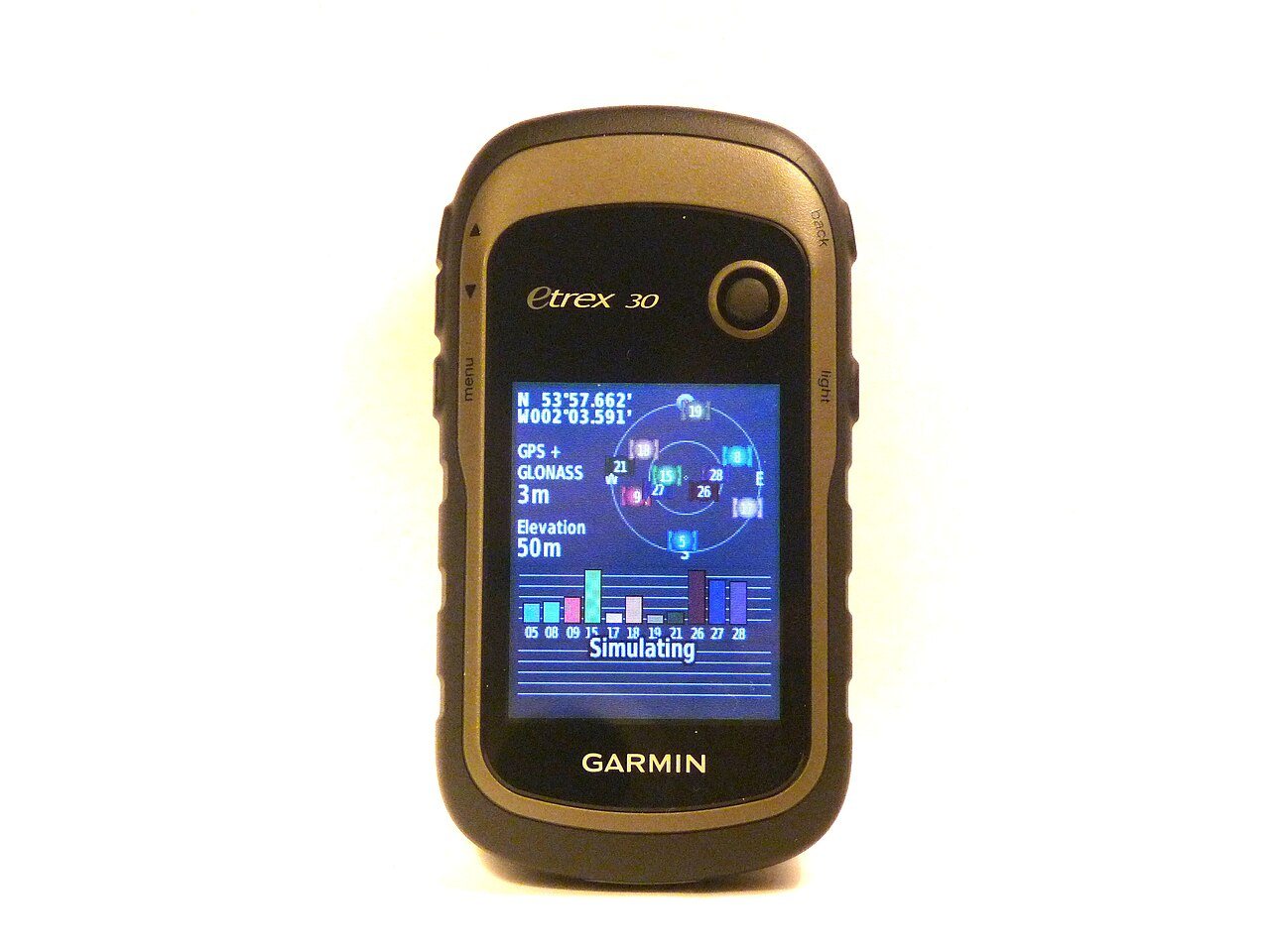
A Garmin eTrex handheld GPS receiver, the iconic device of early geocaching
The Garmin eTrex line, launched in 2000 at around $120, became the first mass-market handheld GPS receiver. It was small, yellow, weatherproof, and ran for 22 hours on two AA batteries. Almost every early geocacher owned one.

The device that made it work

The unsung hero of geocaching's first decade was the Garmin eTrex. Garmin had been making professional GPS units for marine and aviation use since 1989 (the company was founded in Lenexa, Kansas in 1989 by Gary Burrell and Min Kao (the company name is a portmanteau of their first names) and later moved to nearby Olathe in 1996). In late 1999 and into 2000 they launched the eTrex, a 5.3-ounce handheld receiver priced at about $120 to $150 depending on the configuration.

The eTrex was the right device at the right moment. It was cheap enough to be impulse-bought by hobbyists. It ran for 22 hours on two AA batteries. It was waterproof enough to survive Oregon rain. It had a high-contrast LCD that worked in direct sunlight. And it could store hundreds of waypoints, which was exactly what a geocacher needed to do.

The dependence on the eTrex is the kind of detail that gets missed in retellings of geocaching's history. Without a sub-$200 handheld GPS that worked reliably in the woods, geocaching would have stayed inside the hobbyist niche forever. The platform side of the activity, hosted at Geocaching.com, was completely conventional 2000-era web infrastructure. The hardware side was the actual enabling technology. Geocaching grew at the speed of the eTrex sales curve, and the eTrex sales curve grew at the speed of word-of-mouth among the people Geocaching.com brought into the hobby. The two systems reinforced each other.

Garmin did not sponsor geocaching, did not advertise to geocachers specifically, and never publicly tied its sales numbers to the activity. But the company's revenue from consumer-grade handhelds went from a rounding error in 1999 to a meaningful product line by 2003, and geocachers were a measurable chunk of that growth.

The platform that grew under it

Geocaching.com is interesting as a piece of platform design because it does almost nothing on its own. The platform does not generate caches. The platform does not place caches in the world. The platform does not verify caches exist or that they have not been muggled (geocaching slang for "discovered by a non-participant who removes or destroys it"). All of that work is done by users.

What the platform does is run the database, the search interface, the user accounts, the maps, and the logging system. A cache hider creates a listing with coordinates and a description. A reviewer (a volunteer) approves it. The cache appears on the public map. Finders log their visits, upload photos, trade items, and mark whether the cache was found, not found, or needs maintenance. The cache owner is notified of every log and is expected to manage the cache's lifecycle in the real world.

This is a remarkably hands-off design for a 2000-era website. Most internet hobby communities of that era had centralized moderators and a lot of top-down editorial work. Geocaching.com pushed almost all of that responsibility onto the users themselves. Volunteer reviewers in each region handled cache approvals. Cache owners handled their own maintenance. Finders handled their own logs and disputes. The platform mostly just held the data and ran the search.

This is essentially the model that Wikipedia would popularize a few months later (Wikipedia launched in January 2001) and that platforms like Yelp, Reddit, and TripAdvisor would build entire businesses on. Geocaching.com was doing community-curated, user-generated, peer-moderated content in 2000, with a paid subscription tier introduced in 2001, and the whole thing was running out of a Seattle office that fit under a dozen employees for years.

The money question

For the first year, Groundspeak operated as a hobby. By 2001, server costs and traffic were getting unsustainable. Irish and his co-founders introduced Premium Membership, a $30-per-year subscription that gave paying users access to additional features (advanced search, instant notification of new caches in a region, certain "members-only" cache types). The basic experience stayed free.

This freemium structure was unusual in 2001. Most consumer websites of the era were either ad-supported portals or paid-only services. Charging a fraction of users for premium features while keeping the core product free was the kind of model that would become standard in mobile apps a decade later. Groundspeak got there early, partly because there was no good way to monetize a non-commercial outdoor activity with banner ads.

Groundspeak never raised venture capital. Irish said publicly, multiple times, that the team was not interested in growth-at-all-costs and preferred to remain private and independent. The company stayed in Seattle, in a brick building in Fremont, with maybe 80 employees at its peak. Geocaching.com became, for a long stretch, the largest content-driven hobby community on the internet that nobody in venture capital had ever paid for a piece of.

The smartphone problem

The transition to smartphones around 2008 to 2010 was, on paper, the moment geocaching should have collapsed. Smartphones killed dedicated MP3 players, dedicated cameras, dedicated GPS units, and dedicated handheld games. The Garmin eTrex was exactly the kind of product whose entire job was now a free app on the device in your pocket.

Groundspeak's response was the official Geocaching app, released for iPhone in 2008 and Android in 2010. The app cost $10, which by the standards of 2010 app pricing was on the high end. It worked well. Geocaching.com did not lose its community. It just migrated.

What is interesting is that smartphone GPS killed dedicated GPS hardware for almost every market segment except the one geocaching actually used. Smartphones are excellent for navigation when you have a cell signal and a battery and good weather. They are mediocre to bad for the conditions that actual geocaching often requires: deep woods, no cell signal, all-day battery, rain, freezing temperatures, dropped on rocks. The Garmin eTrex line survived the smartphone era specifically because of the segment of geocachers who needed the durability.

The result was a strange hybrid. New geocachers came in through the smartphone app and treated it as an urban scavenger hunt. Experienced geocachers kept their handheld receivers for the harder, remoter caches. The platform supported both modes simultaneously, and the database kept growing.

What the data looks like today

As of the current Geocaching.com public statistics, there are over three million active geocaches hidden in 191 countries. There are more than 200,000 active caches in the United States. The site has logged over a billion individual "found it" logs across all caches in its history. Cache types have expanded well beyond the original plastic bucket model: traditional, multi-cache, mystery, EarthCache, Letterbox Hybrid, virtual, Wherigo, and a few more.

The activity has changed substantially since 2000. There are now Adventure Labs, which use GPS to send participants to specific spots without requiring a physical container. There is a thriving secondary economy in Geocoins and Trackable items, which are coins or tags with unique numbers that travel from cache to cache and are logged as they move. There are official events and competitions. There is a global ranking system. There is even an annual film festival of geocaching videos.

What has not changed is the basic loop. Somebody hides something. Somebody else uses coordinates to find it. Both of them sign a logbook. The platform records that it happened. The trust required between strangers, for the whole thing to work, has not been re-engineered in 25 years. It is the same trust that Dave Ulmer asked for when he posted the original GPS Stash coordinates to a Usenet newsgroup.

A geocacher finding a small container hidden in the underbrush
A typical traditional cache: a small waterproof container, a logbook, and trade items, hidden where the coordinates point. Cache containers range from "nano" magnetic capsules the size of a thumbnail to full ammunition cans.

Why geocaching matters as a piece of internet history

Geocaching is small compared to the platforms that came after it. Three million active caches and a few million active participants is not big-tech scale. But the activity matters out of proportion to its size, for three reasons.

First, it is one of the first popular consumer activities that required both the open internet and the open GPS system to exist simultaneously. The Department of Defense unlocked the satellites on May 2, 2000. Dave Ulmer published coordinates to Usenet on May 3. Mike Teague found the bucket within a day. The lag time between a major government policy change and a viable consumer internet activity built on top of it was effectively zero. That speed is not normal. It happened because the right hobbyist community was already there, waiting, with the receivers in hand.

Second, Geocaching.com was an early proof that a small independent platform could build and sustain a global community without venture funding, advertising revenue, or a public exit. Groundspeak has been operating Geocaching.com for over 25 years on a freemium subscription model. Most platforms of that era either got acquired, pivoted, raised mega-rounds, or died. Geocaching.com just kept running.

Third, geocaching demonstrated that user-generated, peer-moderated platforms could work for activities that have a physical, real-world component. Wikipedia proved it for text. Geocaching proved it for objects in the actual world. That model is now everywhere. AirBnB is essentially "Geocaching.com for spare bedrooms with money attached." OpenStreetMap is essentially "Geocaching.com for roads and buildings." iNaturalist is essentially "Geocaching.com for living things." The pattern works because Dave Ulmer's original loop works: somebody puts something in the world, somebody else finds it, both events get logged, the platform holds the data.

The activity that emerged from a single bucket in the Oregon woods is now a model that runs an enormous fraction of the modern consumer internet. Whether the people who built those bigger platforms knew they were copying from a 2000-era hobbyist site is a different question. The pattern was there. Geocaching demonstrated it first.

Frequently Asked Questions

When did geocaching officially start?

Dave Ulmer hid the first cache, then called a "GPS Stash," on May 3, 2000, near Beavercreek, Oregon. He posted the coordinates to the sci.geo.satellite-nav Usenet newsgroup that day. The activity was renamed "geocaching" in September 2000 when Jeremy Irish registered the domain Geocaching.com.

What was Selective Availability and why did it matter?

Selective Availability was a feature of the United States military's GPS satellites that intentionally degraded the accuracy of civilian signals to about 100 meters. President Bill Clinton announced on May 1, 2000 that Selective Availability would be discontinued at midnight that day, immediately improving civilian GPS accuracy by roughly a factor of ten. Geocaching emerged within 24 hours of the change because hobbyists had been waiting for civilian-grade GPS to become precise enough to make the activity possible.

Who owns Geocaching.com?

Geocaching.com is operated by Groundspeak, Inc., a privately held company based in Seattle, Washington. Groundspeak was founded in 2000 by Jeremy Irish, Bryan Roth, and Elias Alvord. The company has never raised institutional venture funding and has remained independently owned and operated.

How does Groundspeak make money?

Geocaching.com offers a free tier and a Premium Membership tier, currently around $30 per year. Premium members get expanded search tools, member-only cache types, instant notifications, and additional features. The company also sells merchandise, trackable items like Geocoins, and event licenses.

What is the Garmin eTrex and why is it associated with geocaching?

The eTrex is a line of handheld GPS receivers launched by Garmin in late 1999, with broader availability in 2000. The original model was small, ran 22 hours on two AA batteries, was weatherproof, and cost roughly $120. It became the default early-2000s device for the new geocaching community because it was the first GPS unit that combined consumer-grade pricing with field-grade durability.

Did smartphones kill geocaching?

No, though they came close to killing dedicated GPS hardware overall. Geocaching.com released official mobile apps for iPhone in 2008 and Android in 2010, which brought a new generation of casual urban geocachers into the activity. Experienced geocachers continued to use dedicated handhelds for harder, remoter caches where smartphones suffer from battery, signal, and durability limitations. The hybrid mode has kept the community growing across both device types.

How many caches and players are there today?

Geocaching.com lists more than three million active geocaches in 191 countries. Over a billion individual "found it" logs have been recorded across the history of the platform. Groundspeak does not publish exact active-user counts, but the community is widely estimated in the low single-digit millions of regular participants worldwide.

What was in the original cache that Dave Ulmer hid?

The original five-gallon bucket cache included a logbook and pencil, two CD-ROMs of DeLorme Topo USA mapping software, a George of the Jungle VHS tape, a book, four dollars, a cassette recorder, a slingshot, and a can of beans. The "can of beans" became a meme inside the geocaching community and is still referenced in modern Beavercreek tribute caches placed near the original hide location.

๐Ÿ“– What Happened to Geocaching, the GPS Treasure Hunt That Started With a Bucket and a Can of Beans
_ โ–ก ร—
← Back

What Happened to Geocaching, the GPS Treasure Hunt That Started With a Bucket and a Can of Beans

2026-05-12 by 404 Memory Found

At midnight on May 1, 2000, the United States government did something that should have made the front page of every newspaper and instead made almost no news at all. It turned off a setting on its global positioning satellites called Selective Availability. In the time it took the satellites to receive the order and apply it, the typical accuracy of every civilian GPS receiver on Earth jumped from about 100 meters to under 20 meters, roughly a ten-fold improvement. A device that previously could only tell you, vaguely, what neighborhood you were standing in could now point to a specific tree in that neighborhood.

The next day, a computer consultant in Beavercreek, Oregon named Dave Ulmer drove to a wooded clearing off the side of the road, dropped a black plastic bucket into a depression in the ground, put a logbook and some small trinkets inside it, covered it with branches, and posted the latitude and longitude coordinates to an internet newsgroup with the subject line "GPS Stash."

Within three days, two people had driven out to Oregon to find it. Within ten years, what Ulmer had invented would have over five million participants and would become the first true mass-market activity to require a satellite signal, an internet connection, and a willingness to walk into the woods looking for things.

The activity was called geocaching, eventually. And the story of how it grew, how it survived the smartphone, and what it tells us about the early consumer internet is one of the more under-told case studies in user-generated platform design.

The policy change that started everything

To understand geocaching, you have to understand that for most of the 1990s, the United States military deliberately broke its own technology for non-military users.

GPS, the Global Positioning System, was built by the US Department of Defense. By the early 1990s the satellite constellation was operational and civilians could buy receivers that talked to it. The catch was that the government did not want enemy militaries piggybacking on American satellites to guide weapons or troops. So the Pentagon introduced something called Selective Availability, which intentionally degraded the civilian-accessible portion of the signal. The military got the precise version. Everyone else got noise added to their location data, deliberately, by design.

In practice, civilian GPS receivers had a typical accuracy of about 100 meters horizontally. That is fine for an airplane finding an airport. It is useless for a hiker trying to navigate a trail or a driver trying to find a specific address. The civilian market for GPS had been a slow burn through the 1990s for exactly this reason. Nobody could justify paying for a device that could only tell them roughly where on a football field they were.

On May 1, 2000, President Bill Clinton issued a statement announcing that Selective Availability would be discontinued, effective immediately. The Pentagon, after years of internal debate, had concluded that the technology to degrade civilian signals could be replicated cheaply and that the strategic value was now lower than the economic value of an unleashed civilian GPS market. The downgrade went away overnight. Civilian accuracy went from useless to genuinely useful.

"The decision to discontinue SA is the latest measure in an ongoing effort to make GPS more responsive to civil and commercial users worldwide," the official White House statement read. The word "geocaching" did not appear in the press release. The activity did not yet exist.

The press coverage was modest. Most consumer media did not run the story at all. The people who did notice, immediately, were the small but obsessive community of GPS hobbyists who had been hanging out on Usenet newsgroups like sci.geo.satellite-nav.

Dave Ulmer hides a bucket in the woods

Dave Ulmer was one of those hobbyists. He had been running test routes in Oregon to measure the new accuracy of his GPS receiver, and on May 3, 2000, he decided to test the social possibilities of the new system. He stashed a five-gallon black plastic bucket near a forest road in Beavercreek. Into the bucket he put a logbook and pencil, two CD-ROMs of DeLorme Topo USA mapping software, a George of the Jungle VHS tape, a book, four dollars, a cassette recorder, a slingshot, and a can of beans. He posted the coordinates to the newsgroup along with what is now treated as the founding principle of the whole activity:

"Take some stuff, leave some stuff. Record it all in the logbook."

Within 24 hours, a Vancouver, Washington reader named Mike Teague had driven to Beavercreek, found the bucket, signed the log, and traded items. Teague then started a website to track other people doing the same thing. Hobbyists in California, Illinois, and Kansas hid their own caches within a week. Teague's site listed them all.

For about four months, that was the entire community. A few dozen people, mostly engineers and outdoor types, scattered across the United States, hiding plastic boxes in the woods and trading the coordinates on a single ad-hoc website run by one guy in his spare time.

That is when Jeremy Irish entered the story.

How a Seattle web developer built the platform

Jeremy Irish was a 28-year-old web developer at a Seattle interactive agency called Sunrise Identity. In July 2000, a friend forwarded him a link to Mike Teague's GPS Stash Hunt website. Irish read it, immediately bought a Garmin eTrex, drove out to find a cache near his Seattle home, and got hooked in the way that people get hooked on things that combine a treasure hunt, a hike, and a community of strangers who are all in on the same secret.

Irish offered to take over the website. Teague, who was running it alone and getting overwhelmed by traffic, agreed. In September 2000, Irish registered the domain Geocaching.com and launched the rebranded site on September 2, 2000. At launch, there were 75 known geocaches in the world. This was a brand decision that mattered. "Stash hunt" sounded faintly illegal. "Geocaching" sounded scientific. Irish later said the name had to be searchable and had to not freak out parents.

Irish co-founded a company called Groundspeak with Bryan Roth and Elias Alvord to operate the site. There was no revenue model for the first few years. Irish kept his day job. The site's initial server costs were funded by selling 144 geocaching t-shirts to early community members. Listings grew through word of mouth on outdoor forums and through coverage in early 2000s tech magazines that were hungry for stories about novel uses of the new accurate GPS.

A Garmin eTrex handheld GPS receiver, the iconic device of early geocaching
The Garmin eTrex line, launched in 2000 at around $120, became the first mass-market handheld GPS receiver. It was small, yellow, weatherproof, and ran for 22 hours on two AA batteries. Almost every early geocacher owned one.

The device that made it work

The unsung hero of geocaching's first decade was the Garmin eTrex. Garmin had been making professional GPS units for marine and aviation use since 1989 (the company was founded in Lenexa, Kansas in 1989 by Gary Burrell and Min Kao (the company name is a portmanteau of their first names) and later moved to nearby Olathe in 1996). In late 1999 and into 2000 they launched the eTrex, a 5.3-ounce handheld receiver priced at about $120 to $150 depending on the configuration.

The eTrex was the right device at the right moment. It was cheap enough to be impulse-bought by hobbyists. It ran for 22 hours on two AA batteries. It was waterproof enough to survive Oregon rain. It had a high-contrast LCD that worked in direct sunlight. And it could store hundreds of waypoints, which was exactly what a geocacher needed to do.

The dependence on the eTrex is the kind of detail that gets missed in retellings of geocaching's history. Without a sub-$200 handheld GPS that worked reliably in the woods, geocaching would have stayed inside the hobbyist niche forever. The platform side of the activity, hosted at Geocaching.com, was completely conventional 2000-era web infrastructure. The hardware side was the actual enabling technology. Geocaching grew at the speed of the eTrex sales curve, and the eTrex sales curve grew at the speed of word-of-mouth among the people Geocaching.com brought into the hobby. The two systems reinforced each other.

Garmin did not sponsor geocaching, did not advertise to geocachers specifically, and never publicly tied its sales numbers to the activity. But the company's revenue from consumer-grade handhelds went from a rounding error in 1999 to a meaningful product line by 2003, and geocachers were a measurable chunk of that growth.

The platform that grew under it

Geocaching.com is interesting as a piece of platform design because it does almost nothing on its own. The platform does not generate caches. The platform does not place caches in the world. The platform does not verify caches exist or that they have not been muggled (geocaching slang for "discovered by a non-participant who removes or destroys it"). All of that work is done by users.

What the platform does is run the database, the search interface, the user accounts, the maps, and the logging system. A cache hider creates a listing with coordinates and a description. A reviewer (a volunteer) approves it. The cache appears on the public map. Finders log their visits, upload photos, trade items, and mark whether the cache was found, not found, or needs maintenance. The cache owner is notified of every log and is expected to manage the cache's lifecycle in the real world.

This is a remarkably hands-off design for a 2000-era website. Most internet hobby communities of that era had centralized moderators and a lot of top-down editorial work. Geocaching.com pushed almost all of that responsibility onto the users themselves. Volunteer reviewers in each region handled cache approvals. Cache owners handled their own maintenance. Finders handled their own logs and disputes. The platform mostly just held the data and ran the search.

This is essentially the model that Wikipedia would popularize a few months later (Wikipedia launched in January 2001) and that platforms like Yelp, Reddit, and TripAdvisor would build entire businesses on. Geocaching.com was doing community-curated, user-generated, peer-moderated content in 2000, with a paid subscription tier introduced in 2001, and the whole thing was running out of a Seattle office that fit under a dozen employees for years.

The money question

For the first year, Groundspeak operated as a hobby. By 2001, server costs and traffic were getting unsustainable. Irish and his co-founders introduced Premium Membership, a $30-per-year subscription that gave paying users access to additional features (advanced search, instant notification of new caches in a region, certain "members-only" cache types). The basic experience stayed free.

This freemium structure was unusual in 2001. Most consumer websites of the era were either ad-supported portals or paid-only services. Charging a fraction of users for premium features while keeping the core product free was the kind of model that would become standard in mobile apps a decade later. Groundspeak got there early, partly because there was no good way to monetize a non-commercial outdoor activity with banner ads.

Groundspeak never raised venture capital. Irish said publicly, multiple times, that the team was not interested in growth-at-all-costs and preferred to remain private and independent. The company stayed in Seattle, in a brick building in Fremont, with maybe 80 employees at its peak. Geocaching.com became, for a long stretch, the largest content-driven hobby community on the internet that nobody in venture capital had ever paid for a piece of.

The smartphone problem

The transition to smartphones around 2008 to 2010 was, on paper, the moment geocaching should have collapsed. Smartphones killed dedicated MP3 players, dedicated cameras, dedicated GPS units, and dedicated handheld games. The Garmin eTrex was exactly the kind of product whose entire job was now a free app on the device in your pocket.

Groundspeak's response was the official Geocaching app, released for iPhone in 2008 and Android in 2010. The app cost $10, which by the standards of 2010 app pricing was on the high end. It worked well. Geocaching.com did not lose its community. It just migrated.

What is interesting is that smartphone GPS killed dedicated GPS hardware for almost every market segment except the one geocaching actually used. Smartphones are excellent for navigation when you have a cell signal and a battery and good weather. They are mediocre to bad for the conditions that actual geocaching often requires: deep woods, no cell signal, all-day battery, rain, freezing temperatures, dropped on rocks. The Garmin eTrex line survived the smartphone era specifically because of the segment of geocachers who needed the durability.

The result was a strange hybrid. New geocachers came in through the smartphone app and treated it as an urban scavenger hunt. Experienced geocachers kept their handheld receivers for the harder, remoter caches. The platform supported both modes simultaneously, and the database kept growing.

What the data looks like today

As of the current Geocaching.com public statistics, there are over three million active geocaches hidden in 191 countries. There are more than 200,000 active caches in the United States. The site has logged over a billion individual "found it" logs across all caches in its history. Cache types have expanded well beyond the original plastic bucket model: traditional, multi-cache, mystery, EarthCache, Letterbox Hybrid, virtual, Wherigo, and a few more.

The activity has changed substantially since 2000. There are now Adventure Labs, which use GPS to send participants to specific spots without requiring a physical container. There is a thriving secondary economy in Geocoins and Trackable items, which are coins or tags with unique numbers that travel from cache to cache and are logged as they move. There are official events and competitions. There is a global ranking system. There is even an annual film festival of geocaching videos.

What has not changed is the basic loop. Somebody hides something. Somebody else uses coordinates to find it. Both of them sign a logbook. The platform records that it happened. The trust required between strangers, for the whole thing to work, has not been re-engineered in 25 years. It is the same trust that Dave Ulmer asked for when he posted the original GPS Stash coordinates to a Usenet newsgroup.

A geocacher finding a small container hidden in the underbrush
A typical traditional cache: a small waterproof container, a logbook, and trade items, hidden where the coordinates point. Cache containers range from "nano" magnetic capsules the size of a thumbnail to full ammunition cans.

Why geocaching matters as a piece of internet history

Geocaching is small compared to the platforms that came after it. Three million active caches and a few million active participants is not big-tech scale. But the activity matters out of proportion to its size, for three reasons.

First, it is one of the first popular consumer activities that required both the open internet and the open GPS system to exist simultaneously. The Department of Defense unlocked the satellites on May 2, 2000. Dave Ulmer published coordinates to Usenet on May 3. Mike Teague found the bucket within a day. The lag time between a major government policy change and a viable consumer internet activity built on top of it was effectively zero. That speed is not normal. It happened because the right hobbyist community was already there, waiting, with the receivers in hand.

Second, Geocaching.com was an early proof that a small independent platform could build and sustain a global community without venture funding, advertising revenue, or a public exit. Groundspeak has been operating Geocaching.com for over 25 years on a freemium subscription model. Most platforms of that era either got acquired, pivoted, raised mega-rounds, or died. Geocaching.com just kept running.

Third, geocaching demonstrated that user-generated, peer-moderated platforms could work for activities that have a physical, real-world component. Wikipedia proved it for text. Geocaching proved it for objects in the actual world. That model is now everywhere. AirBnB is essentially "Geocaching.com for spare bedrooms with money attached." OpenStreetMap is essentially "Geocaching.com for roads and buildings." iNaturalist is essentially "Geocaching.com for living things." The pattern works because Dave Ulmer's original loop works: somebody puts something in the world, somebody else finds it, both events get logged, the platform holds the data.

The activity that emerged from a single bucket in the Oregon woods is now a model that runs an enormous fraction of the modern consumer internet. Whether the people who built those bigger platforms knew they were copying from a 2000-era hobbyist site is a different question. The pattern was there. Geocaching demonstrated it first.

Frequently Asked Questions

When did geocaching officially start?

Dave Ulmer hid the first cache, then called a "GPS Stash," on May 3, 2000, near Beavercreek, Oregon. He posted the coordinates to the sci.geo.satellite-nav Usenet newsgroup that day. The activity was renamed "geocaching" in September 2000 when Jeremy Irish registered the domain Geocaching.com.

What was Selective Availability and why did it matter?

Selective Availability was a feature of the United States military's GPS satellites that intentionally degraded the accuracy of civilian signals to about 100 meters. President Bill Clinton announced on May 1, 2000 that Selective Availability would be discontinued at midnight that day, immediately improving civilian GPS accuracy by roughly a factor of ten. Geocaching emerged within 24 hours of the change because hobbyists had been waiting for civilian-grade GPS to become precise enough to make the activity possible.

Who owns Geocaching.com?

Geocaching.com is operated by Groundspeak, Inc., a privately held company based in Seattle, Washington. Groundspeak was founded in 2000 by Jeremy Irish, Bryan Roth, and Elias Alvord. The company has never raised institutional venture funding and has remained independently owned and operated.

How does Groundspeak make money?

Geocaching.com offers a free tier and a Premium Membership tier, currently around $30 per year. Premium members get expanded search tools, member-only cache types, instant notifications, and additional features. The company also sells merchandise, trackable items like Geocoins, and event licenses.

What is the Garmin eTrex and why is it associated with geocaching?

The eTrex is a line of handheld GPS receivers launched by Garmin in late 1999, with broader availability in 2000. The original model was small, ran 22 hours on two AA batteries, was weatherproof, and cost roughly $120. It became the default early-2000s device for the new geocaching community because it was the first GPS unit that combined consumer-grade pricing with field-grade durability.

Did smartphones kill geocaching?

No, though they came close to killing dedicated GPS hardware overall. Geocaching.com released official mobile apps for iPhone in 2008 and Android in 2010, which brought a new generation of casual urban geocachers into the activity. Experienced geocachers continued to use dedicated handhelds for harder, remoter caches where smartphones suffer from battery, signal, and durability limitations. The hybrid mode has kept the community growing across both device types.

How many caches and players are there today?

Geocaching.com lists more than three million active geocaches in 191 countries. Over a billion individual "found it" logs have been recorded across the history of the platform. Groundspeak does not publish exact active-user counts, but the community is widely estimated in the low single-digit millions of regular participants worldwide.

What was in the original cache that Dave Ulmer hid?

The original five-gallon bucket cache included a logbook and pencil, two CD-ROMs of DeLorme Topo USA mapping software, a George of the Jungle VHS tape, a book, four dollars, a cassette recorder, a slingshot, and a can of beans. The "can of beans" became a meme inside the geocaching community and is still referenced in modern Beavercreek tribute caches placed near the original hide location.

๐Ÿ“– What Happened to Geocaching, the GPS Treasure Hunt That Started With a Bucket and a Can of Beans

At midnight on May 1, 2000, the United States government did something that should have made the front page of every newspaper and instead made almost no news at all. It turned off a setting on its global positioning satellites called Selective Availability. In the time it took the satellites to receive the order and apply it, the typical accuracy of every civilian GPS receiver on Earth jumped from about 100 meters to under 20 meters, roughly a ten-fold improvement. A device that previously could only tell you, vaguely, what neighborhood you were standing in could now point to a specific tree in that neighborhood.

The next day, a computer consultant in Beavercreek, Oregon named Dave Ulmer drove to a wooded clearing off the side of the road, dropped a black plastic bucket into a depression in the ground, put a logbook and some small trinkets inside it, covered it with branches, and posted the latitude and longitude coordinates to an internet newsgroup with the subject line "GPS Stash."

Within three days, two people had driven out to Oregon to find it. Within ten years, what Ulmer had invented would have over five million participants and would become the first true mass-market activity to require a satellite signal, an internet connection, and a willingness to walk into the woods looking for things.

The activity was called geocaching, eventually. And the story of how it grew, how it survived the smartphone, and what it tells us about the early consumer internet is one of the more under-told case studies in user-generated platform design.

The policy change that started everything

To understand geocaching, you have to understand that for most of the 1990s, the United States military deliberately broke its own technology for non-military users.

GPS, the Global Positioning System, was built by the US Department of Defense. By the early 1990s the satellite constellation was operational and civilians could buy receivers that talked to it. The catch was that the government did not want enemy militaries piggybacking on American satellites to guide weapons or troops. So the Pentagon introduced something called Selective Availability, which intentionally degraded the civilian-accessible portion of the signal. The military got the precise version. Everyone else got noise added to their location data, deliberately, by design.

In practice, civilian GPS receivers had a typical accuracy of about 100 meters horizontally. That is fine for an airplane finding an airport. It is useless for a hiker trying to navigate a trail or a driver trying to find a specific address. The civilian market for GPS had been a slow burn through the 1990s for exactly this reason. Nobody could justify paying for a device that could only tell them roughly where on a football field they were.

On May 1, 2000, President Bill Clinton issued a statement announcing that Selective Availability would be discontinued, effective immediately. The Pentagon, after years of internal debate, had concluded that the technology to degrade civilian signals could be replicated cheaply and that the strategic value was now lower than the economic value of an unleashed civilian GPS market. The downgrade went away overnight. Civilian accuracy went from useless to genuinely useful.

"The decision to discontinue SA is the latest measure in an ongoing effort to make GPS more responsive to civil and commercial users worldwide," the official White House statement read. The word "geocaching" did not appear in the press release. The activity did not yet exist.

The press coverage was modest. Most consumer media did not run the story at all. The people who did notice, immediately, were the small but obsessive community of GPS hobbyists who had been hanging out on Usenet newsgroups like sci.geo.satellite-nav.

Dave Ulmer hides a bucket in the woods

Dave Ulmer was one of those hobbyists. He had been running test routes in Oregon to measure the new accuracy of his GPS receiver, and on May 3, 2000, he decided to test the social possibilities of the new system. He stashed a five-gallon black plastic bucket near a forest road in Beavercreek. Into the bucket he put a logbook and pencil, two CD-ROMs of DeLorme Topo USA mapping software, a George of the Jungle VHS tape, a book, four dollars, a cassette recorder, a slingshot, and a can of beans. He posted the coordinates to the newsgroup along with what is now treated as the founding principle of the whole activity:

"Take some stuff, leave some stuff. Record it all in the logbook."

Within 24 hours, a Vancouver, Washington reader named Mike Teague had driven to Beavercreek, found the bucket, signed the log, and traded items. Teague then started a website to track other people doing the same thing. Hobbyists in California, Illinois, and Kansas hid their own caches within a week. Teague's site listed them all.

For about four months, that was the entire community. A few dozen people, mostly engineers and outdoor types, scattered across the United States, hiding plastic boxes in the woods and trading the coordinates on a single ad-hoc website run by one guy in his spare time.

That is when Jeremy Irish entered the story.

How a Seattle web developer built the platform

Jeremy Irish was a 28-year-old web developer at a Seattle interactive agency called Sunrise Identity. In July 2000, a friend forwarded him a link to Mike Teague's GPS Stash Hunt website. Irish read it, immediately bought a Garmin eTrex, drove out to find a cache near his Seattle home, and got hooked in the way that people get hooked on things that combine a treasure hunt, a hike, and a community of strangers who are all in on the same secret.

Irish offered to take over the website. Teague, who was running it alone and getting overwhelmed by traffic, agreed. In September 2000, Irish registered the domain Geocaching.com and launched the rebranded site on September 2, 2000. At launch, there were 75 known geocaches in the world. This was a brand decision that mattered. "Stash hunt" sounded faintly illegal. "Geocaching" sounded scientific. Irish later said the name had to be searchable and had to not freak out parents.

Irish co-founded a company called Groundspeak with Bryan Roth and Elias Alvord to operate the site. There was no revenue model for the first few years. Irish kept his day job. The site's initial server costs were funded by selling 144 geocaching t-shirts to early community members. Listings grew through word of mouth on outdoor forums and through coverage in early 2000s tech magazines that were hungry for stories about novel uses of the new accurate GPS.

A Garmin eTrex handheld GPS receiver, the iconic device of early geocaching
The Garmin eTrex line, launched in 2000 at around $120, became the first mass-market handheld GPS receiver. It was small, yellow, weatherproof, and ran for 22 hours on two AA batteries. Almost every early geocacher owned one.

The device that made it work

The unsung hero of geocaching's first decade was the Garmin eTrex. Garmin had been making professional GPS units for marine and aviation use since 1989 (the company was founded in Lenexa, Kansas in 1989 by Gary Burrell and Min Kao (the company name is a portmanteau of their first names) and later moved to nearby Olathe in 1996). In late 1999 and into 2000 they launched the eTrex, a 5.3-ounce handheld receiver priced at about $120 to $150 depending on the configuration.

The eTrex was the right device at the right moment. It was cheap enough to be impulse-bought by hobbyists. It ran for 22 hours on two AA batteries. It was waterproof enough to survive Oregon rain. It had a high-contrast LCD that worked in direct sunlight. And it could store hundreds of waypoints, which was exactly what a geocacher needed to do.

The dependence on the eTrex is the kind of detail that gets missed in retellings of geocaching's history. Without a sub-$200 handheld GPS that worked reliably in the woods, geocaching would have stayed inside the hobbyist niche forever. The platform side of the activity, hosted at Geocaching.com, was completely conventional 2000-era web infrastructure. The hardware side was the actual enabling technology. Geocaching grew at the speed of the eTrex sales curve, and the eTrex sales curve grew at the speed of word-of-mouth among the people Geocaching.com brought into the hobby. The two systems reinforced each other.

Garmin did not sponsor geocaching, did not advertise to geocachers specifically, and never publicly tied its sales numbers to the activity. But the company's revenue from consumer-grade handhelds went from a rounding error in 1999 to a meaningful product line by 2003, and geocachers were a measurable chunk of that growth.

The platform that grew under it

Geocaching.com is interesting as a piece of platform design because it does almost nothing on its own. The platform does not generate caches. The platform does not place caches in the world. The platform does not verify caches exist or that they have not been muggled (geocaching slang for "discovered by a non-participant who removes or destroys it"). All of that work is done by users.

What the platform does is run the database, the search interface, the user accounts, the maps, and the logging system. A cache hider creates a listing with coordinates and a description. A reviewer (a volunteer) approves it. The cache appears on the public map. Finders log their visits, upload photos, trade items, and mark whether the cache was found, not found, or needs maintenance. The cache owner is notified of every log and is expected to manage the cache's lifecycle in the real world.

This is a remarkably hands-off design for a 2000-era website. Most internet hobby communities of that era had centralized moderators and a lot of top-down editorial work. Geocaching.com pushed almost all of that responsibility onto the users themselves. Volunteer reviewers in each region handled cache approvals. Cache owners handled their own maintenance. Finders handled their own logs and disputes. The platform mostly just held the data and ran the search.

This is essentially the model that Wikipedia would popularize a few months later (Wikipedia launched in January 2001) and that platforms like Yelp, Reddit, and TripAdvisor would build entire businesses on. Geocaching.com was doing community-curated, user-generated, peer-moderated content in 2000, with a paid subscription tier introduced in 2001, and the whole thing was running out of a Seattle office that fit under a dozen employees for years.

The money question

For the first year, Groundspeak operated as a hobby. By 2001, server costs and traffic were getting unsustainable. Irish and his co-founders introduced Premium Membership, a $30-per-year subscription that gave paying users access to additional features (advanced search, instant notification of new caches in a region, certain "members-only" cache types). The basic experience stayed free.

This freemium structure was unusual in 2001. Most consumer websites of the era were either ad-supported portals or paid-only services. Charging a fraction of users for premium features while keeping the core product free was the kind of model that would become standard in mobile apps a decade later. Groundspeak got there early, partly because there was no good way to monetize a non-commercial outdoor activity with banner ads.

Groundspeak never raised venture capital. Irish said publicly, multiple times, that the team was not interested in growth-at-all-costs and preferred to remain private and independent. The company stayed in Seattle, in a brick building in Fremont, with maybe 80 employees at its peak. Geocaching.com became, for a long stretch, the largest content-driven hobby community on the internet that nobody in venture capital had ever paid for a piece of.

The smartphone problem

The transition to smartphones around 2008 to 2010 was, on paper, the moment geocaching should have collapsed. Smartphones killed dedicated MP3 players, dedicated cameras, dedicated GPS units, and dedicated handheld games. The Garmin eTrex was exactly the kind of product whose entire job was now a free app on the device in your pocket.

Groundspeak's response was the official Geocaching app, released for iPhone in 2008 and Android in 2010. The app cost $10, which by the standards of 2010 app pricing was on the high end. It worked well. Geocaching.com did not lose its community. It just migrated.

What is interesting is that smartphone GPS killed dedicated GPS hardware for almost every market segment except the one geocaching actually used. Smartphones are excellent for navigation when you have a cell signal and a battery and good weather. They are mediocre to bad for the conditions that actual geocaching often requires: deep woods, no cell signal, all-day battery, rain, freezing temperatures, dropped on rocks. The Garmin eTrex line survived the smartphone era specifically because of the segment of geocachers who needed the durability.

The result was a strange hybrid. New geocachers came in through the smartphone app and treated it as an urban scavenger hunt. Experienced geocachers kept their handheld receivers for the harder, remoter caches. The platform supported both modes simultaneously, and the database kept growing.

What the data looks like today

As of the current Geocaching.com public statistics, there are over three million active geocaches hidden in 191 countries. There are more than 200,000 active caches in the United States. The site has logged over a billion individual "found it" logs across all caches in its history. Cache types have expanded well beyond the original plastic bucket model: traditional, multi-cache, mystery, EarthCache, Letterbox Hybrid, virtual, Wherigo, and a few more.

The activity has changed substantially since 2000. There are now Adventure Labs, which use GPS to send participants to specific spots without requiring a physical container. There is a thriving secondary economy in Geocoins and Trackable items, which are coins or tags with unique numbers that travel from cache to cache and are logged as they move. There are official events and competitions. There is a global ranking system. There is even an annual film festival of geocaching videos.

What has not changed is the basic loop. Somebody hides something. Somebody else uses coordinates to find it. Both of them sign a logbook. The platform records that it happened. The trust required between strangers, for the whole thing to work, has not been re-engineered in 25 years. It is the same trust that Dave Ulmer asked for when he posted the original GPS Stash coordinates to a Usenet newsgroup.

A geocacher finding a small container hidden in the underbrush
A typical traditional cache: a small waterproof container, a logbook, and trade items, hidden where the coordinates point. Cache containers range from "nano" magnetic capsules the size of a thumbnail to full ammunition cans.

Why geocaching matters as a piece of internet history

Geocaching is small compared to the platforms that came after it. Three million active caches and a few million active participants is not big-tech scale. But the activity matters out of proportion to its size, for three reasons.

First, it is one of the first popular consumer activities that required both the open internet and the open GPS system to exist simultaneously. The Department of Defense unlocked the satellites on May 2, 2000. Dave Ulmer published coordinates to Usenet on May 3. Mike Teague found the bucket within a day. The lag time between a major government policy change and a viable consumer internet activity built on top of it was effectively zero. That speed is not normal. It happened because the right hobbyist community was already there, waiting, with the receivers in hand.

Second, Geocaching.com was an early proof that a small independent platform could build and sustain a global community without venture funding, advertising revenue, or a public exit. Groundspeak has been operating Geocaching.com for over 25 years on a freemium subscription model. Most platforms of that era either got acquired, pivoted, raised mega-rounds, or died. Geocaching.com just kept running.

Third, geocaching demonstrated that user-generated, peer-moderated platforms could work for activities that have a physical, real-world component. Wikipedia proved it for text. Geocaching proved it for objects in the actual world. That model is now everywhere. AirBnB is essentially "Geocaching.com for spare bedrooms with money attached." OpenStreetMap is essentially "Geocaching.com for roads and buildings." iNaturalist is essentially "Geocaching.com for living things." The pattern works because Dave Ulmer's original loop works: somebody puts something in the world, somebody else finds it, both events get logged, the platform holds the data.

The activity that emerged from a single bucket in the Oregon woods is now a model that runs an enormous fraction of the modern consumer internet. Whether the people who built those bigger platforms knew they were copying from a 2000-era hobbyist site is a different question. The pattern was there. Geocaching demonstrated it first.

Frequently Asked Questions

When did geocaching officially start?

Dave Ulmer hid the first cache, then called a "GPS Stash," on May 3, 2000, near Beavercreek, Oregon. He posted the coordinates to the sci.geo.satellite-nav Usenet newsgroup that day. The activity was renamed "geocaching" in September 2000 when Jeremy Irish registered the domain Geocaching.com.

What was Selective Availability and why did it matter?

Selective Availability was a feature of the United States military's GPS satellites that intentionally degraded the accuracy of civilian signals to about 100 meters. President Bill Clinton announced on May 1, 2000 that Selective Availability would be discontinued at midnight that day, immediately improving civilian GPS accuracy by roughly a factor of ten. Geocaching emerged within 24 hours of the change because hobbyists had been waiting for civilian-grade GPS to become precise enough to make the activity possible.

Who owns Geocaching.com?

Geocaching.com is operated by Groundspeak, Inc., a privately held company based in Seattle, Washington. Groundspeak was founded in 2000 by Jeremy Irish, Bryan Roth, and Elias Alvord. The company has never raised institutional venture funding and has remained independently owned and operated.

How does Groundspeak make money?

Geocaching.com offers a free tier and a Premium Membership tier, currently around $30 per year. Premium members get expanded search tools, member-only cache types, instant notifications, and additional features. The company also sells merchandise, trackable items like Geocoins, and event licenses.

What is the Garmin eTrex and why is it associated with geocaching?

The eTrex is a line of handheld GPS receivers launched by Garmin in late 1999, with broader availability in 2000. The original model was small, ran 22 hours on two AA batteries, was weatherproof, and cost roughly $120. It became the default early-2000s device for the new geocaching community because it was the first GPS unit that combined consumer-grade pricing with field-grade durability.

Did smartphones kill geocaching?

No, though they came close to killing dedicated GPS hardware overall. Geocaching.com released official mobile apps for iPhone in 2008 and Android in 2010, which brought a new generation of casual urban geocachers into the activity. Experienced geocachers continued to use dedicated handhelds for harder, remoter caches where smartphones suffer from battery, signal, and durability limitations. The hybrid mode has kept the community growing across both device types.

How many caches and players are there today?

Geocaching.com lists more than three million active geocaches in 191 countries. Over a billion individual "found it" logs have been recorded across the history of the platform. Groundspeak does not publish exact active-user counts, but the community is widely estimated in the low single-digit millions of regular participants worldwide.

What was in the original cache that Dave Ulmer hid?

The original five-gallon bucket cache included a logbook and pencil, two CD-ROMs of DeLorme Topo USA mapping software, a George of the Jungle VHS tape, a book, four dollars, a cassette recorder, a slingshot, and a can of beans. The "can of beans" became a meme inside the geocaching community and is still referenced in modern Beavercreek tribute caches placed near the original hide location.

00:00