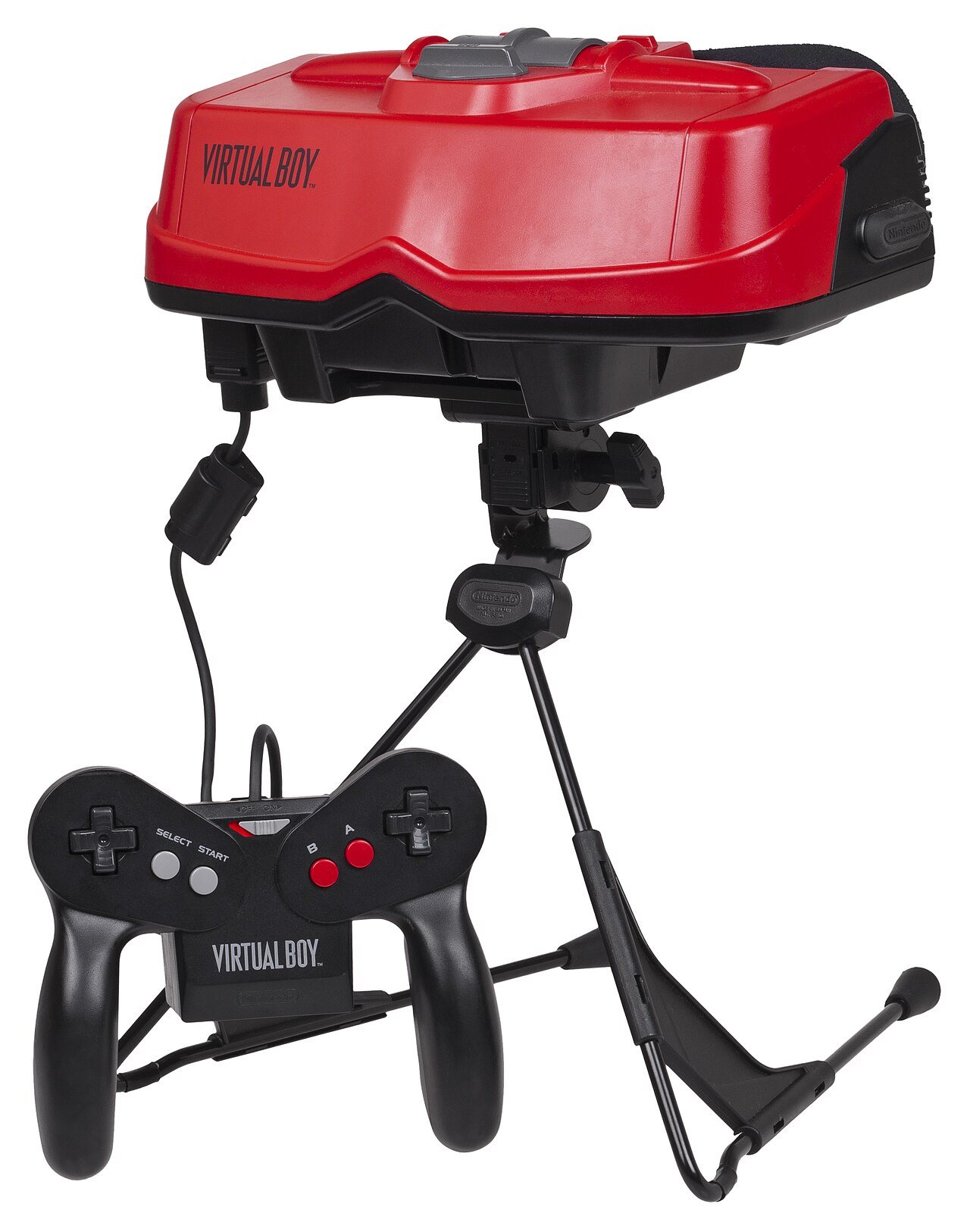
You're standing in the electronics section of a big-box retailer in the summer of 1995. The shelves are packed with the usual Game Boy cartridges, Nintendo magazines with crease-worn spines, bright yellow price tags on everything. And then you see it. This weird red thing sitting on a stand, like some kind of office equipment that escaped from a failed startup. It's got weight to it when you pick it up, heavier than you'd expect for something called "Virtual Boy." It's got this thick headset aesthetic, something between a View-Master you'd use as a kid and a pair of ski goggles designed by someone who'd never actually seen ski goggles. You look around to see if other people are noticing what you're noticing. Some are. Most aren't. One kid is trying to put it on without asking permission, which is exactly what you wanted to do but were too self-conscious to attempt.
This is the story of how Nintendo took a legendary engineer, gave him a revolutionary technology, and created something so bewildering that it would basically disappear from gaming history in less than a year. This is also the story of how you could walk into that electronics section, see the future of gaming, completely not understand what it was, and walk right back out.
When Nintendo Handed Gunpei Yokoi an Impossible Dream
Let's talk about Gunpei Yokoi for a second because this whole story falls apart if you don't understand who this person was and what he meant to Nintendo. Yokoi wasn't just some engineer. He was the guy who looked at the concept of the Game Boy, looked at everything everyone was saying about how it needed a color screen and more processing power and flashy graphics, and then went ahead and made it anyway, knowing exactly what he was doing. He created the D-pad. He created Game & Watch, which was basically just blinking LED lights that somehow managed to be one of the most addictive entertainment products ever made. He understood something about Nintendo that a lot of people still don't understand: the innovation isn't always about raw power. Sometimes the innovation is about understanding what people actually want to hold in their hands and what will actually keep them entertained.
By 1995, Yokoi had already proven this philosophy about thirty different ways. He'd made billions of dollars for Nintendo through restraint and cleverness rather than brute force. And then he got interested in 3D technology. Specifically, he got interested in parallax barriers and red LED displays, which is kind of insane when you think about it, because that's such a specific, weird technical corner to decide is your future. But Yokoi believed in it. He believed that you could create a 3D gaming experience without needing an expensive LCD screen or some kind of special glasses. You could do it with red lights. Red LEDs that create a stereoscopic 3D effect through something called parallax, which is basically when your two eyes see slightly different images at slightly different times, and your brain interprets that as depth.
This was actually brilliant technology. Like, genuinely clever. Which makes what happened next so much worse.
August 14, 1995: The Day That Would Haunt Nintendo
The Virtual Boy released in North America on August 14, 1995, for $179.95, which was actually a pretty reasonable price for what Nintendo was claiming to deliver. What they were claiming to deliver was the future. "Experience a remarkable leap in gaming entertainment," the marketing copy promised. This is the language of transformation. This is the language of revolution. And here's where it gets interesting, because what Nintendo was actually delivering was a headset that you had to hold with a stand. You couldn't play it in bed. You couldn't play it on the school bus. You could basically only play it sitting at a table in front of the stand while you held this weird binocular thing up to your face.
Think about that for a second. Think about the absolute insanity of that design choice in 1995. The Game Boy, Yokoi's previous masterpiece, was literally defined by portability. You could play it anywhere. It was the whole point. It was the entire philosophy. And now here's the Virtual Boy, marketed as a handheld system, except it isn't handheld at all. It requires furniture. It requires a stand. It's a portable system that needs to be installed before you can use it, which is kind of insane.
And the 3D effect, which was supposed to be the whole reason for existence? Yeah, it worked, technically. You'd put the thing up to your face and you'd see this red monochromatic 3D environment, and yeah, it was three-dimensional. It also gave most people headaches within about twenty minutes. It caused eye strain. The packaging came with warnings about limiting play sessions to thirty minutes. A thirty-minute limit on a gaming console. A built-in instruction that your product is only tolerable for half an hour at a time. If that doesn't tell you everything you need to know about the Virtual Boy, I don't know what would.
The Library That Never Was
Here's the problem with hardware: it doesn't matter how clever your technology is if you don't have software worth playing. And the Virtual Boy had a software library that would generously be described as "sparse." In total, across the entire lifespan of the system, Nintendo released exactly twenty-two games. Twenty-two. The Nintendo Entertainment System had hundreds. The Game Boy had dozens right at launch. The Virtual Boy had, essentially, nothing.
The best game on the system, by most accounts, was Wario Land: Virtual Boy. Which is funny because even in 1995, when Wario was still relatively young as a character, the fact that your flagship title was a Wario game instead of a Mario game said something about the console's positioning. This wasn't the main event. This was a spinoff. In some regions, Mario Tennis shipped as the pack-in title, which was fine but also felt like an attempt to create legitimacy through familiar branding rather than through actual innovation.
But here's the thing about the Virtual Boy's software library: it wasn't small because Nintendo couldn't develop games. It was small because developers saw where this was headed almost immediately. You know what it takes to get people excited about buying a console? You need a pipeline of games. You need developers pumped up about the technology. You need momentum. The Virtual Boy had none of that. Even Nintendo's own internal teams seemed confused about what this thing was supposed to be. You could feel it in the software. There was nothing that felt essential, nothing that felt like it could only exist on the Virtual Boy. Everything felt like a demo. Everything felt like a proof of concept. And in the consumer market, proof of concept doesn't translate to sales.
The Red Monochrome Headache That Wouldn't Go Away
Let's talk about the actual experience of using the Virtual Boy, because the technical specifications don't tell the story. The 3D effect looked wild. It was impressive in the moment. You'd see these layers of depth, these game worlds that seemed to have actual space in them, and yeah, it was something you'd never seen on a Game Boy before. But that impression lasted about fifteen minutes. After that, you'd start to notice the eye strain. The red monochrome display would create this persistent afterimage in your vision when you looked away. The weight of holding the device up to your face would start to matter. Your neck would get tired. Your hands would cramp. The thirty-minute warning on the packaging started to feel less like a recommendation and more like a threat.
And the red, specifically. This was a weird choice. Historically, red gets used in displays because it's the easiest color to produce at high brightness, but that doesn't mean red is the color you want to stare directly into for any length of time. There's something almost aggressive about it, something that feels wrong for extended play sessions. You know that feeling when you've been looking at something red and bright for too long and your eyes feel kind of raw? That was the Virtual Boy experience. That was what Nintendo asked gamers to accept as the future.
The controller was actually pretty innovative, with those dual D-pads and the way it was designed to work with the system's specific input needs. The problem was that innovation in one area doesn't matter when the entire experience is fundamentally flawed. It's like designing an amazing seat for a car with no engine. Sure, the seat is great, but you're not going anywhere.
The Collapse That Happened in Slow Motion
The Virtual Boy launched in August of 1995. By early 1996, it was clear that something had gone catastrophically wrong. The system had sold roughly 770,000 units worldwide, which sounds like a real number until you realize that the Game Boy was already in its seventh year and had sold millions upon millions more. The Virtual Boy was supposed to be the future. Instead, it was becoming a clearance item. Nintendo discontinued it in 1996, basically admitting defeat in a medium that they'd previously owned completely.
The numbers don't fully capture the humiliation, though. This wasn't just a failed product. This was Nintendo's biggest hardware flop at the time, and coming from a company that had basically defined home and portable gaming for the previous decade, it felt like a massive crack in the foundation. There were jokes in the gaming press. Gamers had opinions, which is to say that gamers had made jokes and moved on. Within a year, the Virtual Boy had become a punchline. Within two years, it was basically forgotten. People who'd bought one early tried to resell them and found almost no market. It became one of those things that showed up at yard sales, the weird tech that nobody wanted, the thing you'd pick up sometimes just to remind yourself that it had actually existed.
What This Meant for Gunpei Yokoi
And here's where the story gets genuinely sad. Gunpei Yokoi, this legendary engineer who'd basically created Nintendo's entire handheld dominance, who'd invented the D-pad and Game & Watch and the Game Boy, who'd been right about so many things for so long, was now associated with the company's most spectacular hardware failure. He left Nintendo after the Virtual Boy's failure. He didn't stay to fight for it or to iterate on it. He just left. And then on October 4, 1997, he died in a car accident, which is just the kind of coda that makes this whole story feel even more tragic than it already was.
The Virtual Boy stands as this weird monument to what happens when innovation, technology, and market understanding don't align. Yokoi was brilliant at understanding what people wanted to hold in their hands. The Virtual Boy proved that even brilliant people can miss the mark, especially when they fall in love with a specific technology without asking if that technology actually solves any problems that people need solved.
The Legacy That Almost Isn't There
Here's what's interesting about the Virtual Boy now, in hindsight. The technology wasn't actually bad. The parallax barrier 3D effect is still used in some displays. The engineering was clever. The design philosophy of trying to create 3D without expensive LCD screens or cumbersome glasses was genuinely forward-thinking. But none of that matters because the product itself was fundamentally unpleasant to use. You can have the best technology in the world, but if holding it makes your eyes hurt and your neck tired and your hands cramp, people aren't going to want it. This is kind of a lesson that the tech industry needs to relearn about once a decade, which is hilarious and also sort of depressing.
The Virtual Boy disappeared from stores. It disappeared from warehouses. It disappeared from collective memory so thoroughly that most people born after 1995 have never actually seen one, let alone used one. When it shows up now, it's usually in the context of "weird Nintendo failures" or "gaming history's biggest flops." There are collectors who seek them out, who appreciate them as technical oddities, who admire what Yokoi was trying to do even if the execution was catastrophic. But that's a niche appreciation at best.
What the Virtual Boy actually proved was that Nintendo was human. They could fail. They could miscalculate. They could believe too much in a technology and not enough in the actual user experience. And in some ways, that's reassuring. It means that even the companies that seem to know everything about what people want are basically just guessing, like the rest of us. They just have bigger budgets and more to lose when the guess is wrong.
FAQ
Why was the Virtual Boy red and not some other color?
The red color came directly from the technology. The display used red LED technology to create the 3D effect, so the entire visual output was, by necessity, red. You couldn't have made it blue or green or any other color without completely changing the underlying technology, which would have defeated the whole purpose. The red was the point. It was also, as it turned out, not a great color to stare into for extended periods.
Could modern technology make a Virtual Boy that actually works?
Technically, sure. Modern LCD screens and processing power could create a 3D handheld experience that doesn't cause headaches and doesn't require a stand. In fact, the Nintendo 3DS did exactly that, using a similar parallax barrier technology but with a color display and without the physical restrictions. But the Virtual Boy didn't fail because the technology was impossible. It failed because the execution was wrong.
Did any games actually take good advantage of the 3D?
Some tried. Wario Land did a decent job of using the depth perception for puzzle-solving and navigation. Mario's Tennis used the 3D to give you a sense of where the ball was in space. But the problem was that thirty-minute play session limit kind of prevented any game from developing complex mechanics that really required the 3D. You never got a full experience because the hardware itself prevented that full experience.
Why did Nintendo think this would work as a portable system?
Marketing strategy. The Game Boy had proven that "portable" was a magic word in gaming. Developers and consumers alike associated portability with Nintendo's success. So even though the Virtual Boy required a stand and a thirty-minute play limit and would give you a headache, Nintendo still called it a handheld system. It was kind of insane, but it also allowed them to position this weird lab experiment as part of the Game Boy legacy.
Is the Virtual Boy worth anything now?
Depending on condition and whether it includes original packaging, a Virtual Boy can go for anywhere from $200 to $800 or more on the used market. The games are also collectible, especially the rarer titles. But this isn't because anyone wants to actually use the system. This is purely nostalgia and hardware collecting.