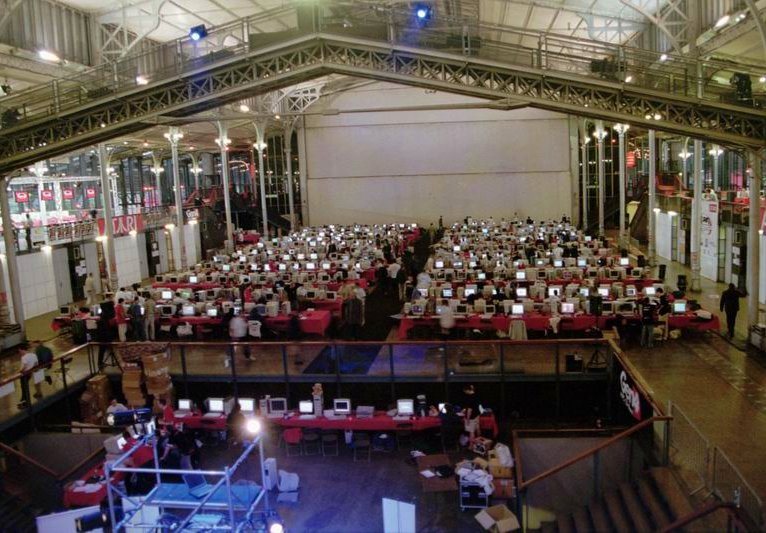
You know that feeling when you're about to do something monumentally stupid but everyone around you is also doing it, so it feels like the smartest idea in the world? That was basically the entire premise of LAN parties in the late 1990s and early 2000s. Here I was, a lanky teenager with dreams of digital dominance, standing in my driveway with a tower case the size of a small refrigerator, a CRT monitor that weighed approximately as much as a small child, a tangled nest of cables that I'm pretty sure I still haven't fully untangled, and the unshakeable conviction that yes, I absolutely needed to transport all of this across town to sit in a dark room with fifty other people who hadn't showered in twelve hours. Welcome to the golden age of LAN parties, where the internet was too slow but our determination was infinite.
Why We Hauled Our Towers in the First Place
Let me set the scene for anyone born after, say, 2000. The year is 1995, 1996, somewhere in that fuzzy era before the internet became something you could just carry in your pocket. You wanted to play multiplayer games. Real multiplayer games, not turn-based chess correspondence or taking turns on a single machine. You wanted to frag your friends in real time, to feel that visceral moment when you land a perfect rocket jump while your opponent is screaming into the void next to you.
But here's the problem: dial-up internet. That beautiful, screaming modem sound that made your parents lose their minds. Speeds measured in kilobits per second. You could get maybe four or five players in a game before the lag became so catastrophic that you'd be walking through walls and shooting at ghosts. The solution? Bring the computers together. Create a Local Area Network, plug them all into one hub or switch, and suddenly you had bandwidth that made your living room feel like the future.
The earliest LAN parties weren't planned events. They were desperate improvisations by people who loved games too much to let inferior internet infrastructure stop them. You'd gather at someone's house, someone's basement, someone's parent's garage that still smelled like old tools and regret. You'd run cables like you were setting up a command center, someone's mom would bring down a plate of Costco cookies that nobody ate, and you'd play until someone had to leave for school or work or a family obligation that suddenly seemed incomprehensibly unimportant.
The Birth of Something Legendary
August 1996. A hotel in Garland, Texas, about a mile from id Software's offices. This is where it all got formalized. A bunch of regulars from the #quake IRC channel on EFnet, a community of Quake obsessives who communicated exclusively in keyboard shorthand and trash talk, decided to get together in person. Jim "H2H" Elson, a gamer from the Dallas area with deep ties to the local gaming scene, and Yossarian "yossman" Holmberg, a computer consultant from Waterloo, Ontario, organized the whole thing. About thirty people showed up. Thirty people who loved Quake enough to organize a trip, haul their equipment, and spend a weekend in a hotel room pressing the same keys they pressed at home, but now they could see the people they were destroying.
By the weekend's end, the count had grown to one hundred. One hundred people sitting in a hotel, generating enough heat and keyboard clicks and barely suppressed trash talk to probably violate several local ordinances. The hotel probably regretted their life choices, but QuakeCon was born.
By 1997, the scene had exploded. QuakeCon moved to a Holiday Inn in Plano and attracted around 650 attendees. Six hundred and fifty people. Each with their own tower. Each with their own monitor. Each with an extension cord situation that would probably have failed a fire safety inspection. The LAN parties were no longer improvised bedroom adventures. They were becoming events. They were becoming culture.
The Other Side of the Ocean
While QuakeCon was becoming the American institution of LAN gaming, something equally significant was happening in Sweden. In 1994, in the basement of an elementary school in Malung, a group of Swedish gamers and tech enthusiasts named Martin Ojes and Kenny Eklund decided to do the same thing: get together, plug their computers in, and play. DreamHack started small. Impossibly small. About 40 or 50 participants crowded into a school basement with their personal machines. Later events moved to the school cafeteria. By 1997, DreamHack had relocated to Arena Kupolen in Borlange, and it never stopped growing.
DreamHack would eventually become something that defied logic. By Winter 2004, it had grown to 5,272 attendees and 5,852 computers. Five thousand computers. In one building. The heat alone must have required some kind of industrial cooling system. They set a Guinness World Record for the largest LAN party ever assembled. Looking at photos from that event, you see row after row after row of monitors glowing in the darkness, cables running across the floor like technological arteries, and thousands of people hunched over keyboards in an atmosphere that was probably equal parts excitement and mild oxygen deprivation.
By 2013, DreamHack Winter had swollen to 22,810 visitors. Over eight thousand of them brought their own computers. The event consumed 434 terabytes of data. Four hundred and thirty-four terabytes. That's not a typo. That's just what happens when you put twenty thousand enthusiasts on a shared network and let them play games, watch streams, download mods, and generally consume bandwidth like it was going out of style.
The Physical Reality Nobody Talks About
Here's what every article about LAN parties glosses over: they absolutely sucked from a logistical standpoint. Yeah, the gaming was great. Yeah, the community was incredible. But the physical experience was somewhere between a minor endurance sport and a punishment that nobody signed up for.
My monitor weighed fifty-three pounds. I know this because I weighed myself, then weighed myself holding it, and did the math like someone who didn't yet understand that this was a reasonable warning sign. My tower case was roughly the dimensions of a mini-fridge, but denser than a neutron star. My keyboard and mouse lived in this perpetually tangled state that made me question whether they reproduced when I wasn't looking. The cables were their own category of chaos. Power cables, network cables, monitor cables, keyboard cables, mouse cables, and whatever other cables I'd acquired over the years and assumed I might need. All of them bound together in a knot that I'd eventually untangle at two in the morning while a friend watched and offered unhelpful commentary.
Loading your car wasn't a task. It was a puzzle. A puzzle where the pieces were heavy, numerous, and had no respect for spatial relationships. You'd optimize for one configuration and realize you'd blocked yourself in. You'd rearrange and realize your monitor couldn't actually fit at that angle. Your parents would watch this process with expressions of deep concern that suggested they were reconsidering their life choices. My mother actually asked me once if I was moving out. I was just going to my friend's house.
The drive to the venue was an experience in itself. Traffic jams of people driving the same direction, all of them carrying identical cargo. Wherever the LAN party was held, you'd see this sudden concentration of tech-savvy teenagers and young adults, all of them looking exhausted in a way that transcended normal teenage exhaustion. This was the exhaustion of people who had committed to an idea and were now past the point of backing out.
The Games That Made It Worth It
None of this would have mattered if the games weren't incredible. And they were. They absolutely were.
Quake. The game that launched a thousand LANs. Real-time action in three dimensions on hardware that could barely handle it. You felt like you were piloting a character through a fever dream, but the conditions were the same for everyone, so it became a skill to master rather than a bug to complain about. Rocket jumping became a thing you could only learn by suffering through it, and once you could do it, you understood that you'd joined some kind of club.
Counter-Strike. The mod that consumed years of my life and the lives of thousands of other people. The perfect marriage of strategy and execution. You could plan something beautiful and then your entire team could execute it flawlessly, and you'd take down another squad with a precision that made you feel like you'd just accomplished something genuinely difficult. It was addictive in the way that only games where skill actually matters can be addictive.
StarCraft. The real-time strategy game where you could watch someone's hands move across the keyboard at speeds that seemed physically impossible. The game where three different races played completely differently, and tournaments had fans who would root for their favorite player the same way they'd root for sports teams. Korea understood this before the rest of the world did. They understood that this was a sport.
Unreal Tournament. The game that understood that online play was a commodity but that there was something special about everyone being in the same room. The announcer's voice cutting through the chaos of clicking and trash talk. Headshots. Rocket launches. The weapon pickups that became focal points of strategy and physical positioning at the LAN.
And later, when technology caught up, Halo. The console shooter that you could play on a system link network, and which proved that console gaming had just as much potential for LAN play as PC gaming did. LAN parties with dozens of Xbox consoles chained together were briefly a thing, and they were chaotic in a way that was both beautiful and terrible.
The Culture That Grew Around It
LAN parties weren't just about the gaming. They became their own subculture. A temporary city of people with shared values that revolved around gaming, technology, and a weird kind of communal suffering that bonded people together.
You'd arrive with your equipment and find your spot. You'd set up your rig, maybe decorate it with lights or stickers. You'd connect to the network and suddenly you had access to everything: game files, mods, maps, music and movies that people had pre-loaded to share because the internet was still too slow to download anything meaningful in real time. Shared resources made the LAN feel like a small, self-contained world.
People slept at LANs. Actual sleeping. Sleeping bags. Pillows. You'd find weird corners where people had claimed territory. The experience took on this sleepover quality but with higher stakes. You couldn't miss a match. You couldn't leave your spot unattended for too long or someone else might claim it. People played for eighteen hours straight, got four hours of uncomfortable sleep on concrete, and then played another eighteen hours. I never quite understood the logic, but everyone participated in it anyway.
The pizza situation was legendary. At some point, someone would organize a pizza run. A massive pizza order for dozens or hundreds of people. The pizzas would arrive in waves, and people would grab slices while continuing to play one-handed. The pizza would be slightly cold by the time you ate it because you didn't want to leave your computer, but it tasted like victory and camaraderie.
Energy drinks flowed like water. Mountain Dew, Red Bull, later Monster and everything else designed to keep you awake and slightly unhinged. You'd see people at three in the morning still vibrating with caffeine and adrenaline, unable to sleep even when they tried. The combination of energy drinks and competitive gaming created a kind of temporary state that was probably not great for anyone's health but felt absolutely necessary at the time.
The Glory Days
The late 1990s and early 2000s were the peak. This was when LAN parties had achieved perfect balance between necessity and culture. Broadband existed but wasn't everywhere. The games were incredible. The community hadn't been commodified. The events felt both exclusive (you had to actually want to be there) and accessible (you could show up with your equipment and be welcomed).
These were the years when people would drive across their state or even their country to attend a major LAN event. When QuakeCon or DreamHack felt like pilgrimages. When the tournaments had real prize pools and when winning could maybe, possibly, lead to sponsorships or professional opportunities. Not guaranteed, but possible. Possible enough to dream about.
The network at these LANs was something else entirely. A closed system where bandwidth wasn't a constraint. You could download an entire game mod in seconds. You could share files at speeds your home connection could never match. The speed was intoxicating. It made the experience of being at a LAN feel like you were living in the future.
The Decline That Nobody Expected
Broadband killed LAN parties. That's the simple version. Once you could get fast internet at home, the necessity disappeared. You didn't have to haul your equipment across town anymore. You could play with your friends from your bedroom. The internet had caught up.
It happened gradually, then suddenly. In the early 2010s, LAN parties started feeling less like cultural necessities and more like nostalgic retreats. The massive events didn't disappear, but they became something different. DreamHack is still a thing, still massive, but it has evolved into more of a gaming festival and esports event. QuakeCon still exists. But they're no longer the only way to play together. They're an option, not a requirement.
The games changed too. Online gaming became the default. Cloud computing, streaming, cross-platform play. The things that made LANs necessary became quaint. Nobody has CRT monitors anymore. Nobody drives around with a tower case the size of a refrigerator. Laptops happened. Everything became portable and wireless, which was great for convenience but meant LAN parties weren't strictly necessary anymore.
There's an argument that the peak of LAN parties was also the peak of something else. A specific moment in gaming history when the technology and the culture and the necessity all aligned perfectly. When you had to go to a place to play together. When it was an event. When it mattered in a way that daily online gaming never quite managed to replicate.
What Came After
Modern esports owes everything to LAN parties. The tournament structure, the competitive ecosystem, the sense of community around a specific game. The players who competed at LANs in the 1990s and 2000s became the professional gamers of the 2010s. The infrastructure that was built to support LAN tournaments became the foundation for online competitions. The culture of competitive gaming that was born in hotel rooms and convention centers evolved into a billion-dollar industry.
You can trace a direct line from those thirty people at that hotel in Garland, Texas to the millions of dollars in esports prize pools today. From the basement of a Swedish elementary school to international gaming festivals. The LAN party was the chrysalis, and what emerged was something we're all still dealing with.
They still exist, LAN parties. Gaming cafes and specialized venues host them. Communities still gather to play together in person. But they're different now. They're optional. They're retro. They're a choice made by people who remember what it was like when they were necessary, or a discovery made by people too young to understand why that mattered.
The Feeling of Looking Back
I'm not going to pretend that LAN parties were perfect. They were uncomfortable, inefficient, logistically nightmarish, and the hygiene situation was legitimately concerning. You'd drive home at the end of a weekend event smelling like a combination of Red Bull, poor life choices, and other people's sweat. Your fingers would hurt from clicking. Your back would hurt from sitting in a folding chair. Your eyes would hurt from staring at a CRT monitor for eighteen hours straight without moving.
But there was something there that feels increasingly rare. A community united by a specific technology and a specific moment in time. The necessity of actually showing up. The shared experience of struggle and logistics and the weird bonds that form when you're all dealing with the same conditions. The knowledge that this was special, that this couldn't happen any other way, that if you didn't show up you'd miss it and nobody could really explain what it was like to anyone who wasn't there.
Digital experiences are great. Online gaming is incredible. But there's something about physical presence, about feeling the air conditioning struggle with the heat from hundreds of computers, about hearing the chaos of hundreds of keyboards and mice and people talking and laughing and trash-talking in real time. About pizza arriving at three in the morning. About sleeping on a concrete floor next to your thousand-dollar setup because you were terrified someone might steal it or accidentally unplug something critical.
The golden age of LAN parties is over. The necessity is gone. The internet caught up. But for a moment in time, in the late 1990s and early 2000s, there was a magic to it. A magic of people coming together because they had to, because the technology forced them to find each other, and because they discovered that together they could do something that felt like the future.
FAQ
What exactly was a LAN party?
A LAN party was an event where people would bring their personal computers and connect them to a local area network to play multiplayer games together. The network usually ran through a hub or switch, allowing for high-speed connections without needing internet. This solved the dial-up internet problem of the 1990s, when online multiplayer gaming was essentially impossible due to lag and speed limitations.
When did LAN parties start?
The formalized LAN party scene started in August 1996 with QuakeCon, the first organized event of its kind. However, informal LAN parties were happening before that in basements, college dorms, and anywhere else people could gather with multiple computers. DreamHack in Sweden was also emerging around the same time, starting in 1994 in a school basement and eventually becoming the largest LAN party in the world.
What games were most popular at LAN parties?
The most popular games were Quake, Quake II, Counter-Strike, StarCraft, Unreal Tournament, Warcraft III, and later Halo. These were games that either required a network connection or played significantly better on a LAN where latency wasn't an issue. The competitive scene around these titles was intense, with tournaments and prizes at major events.
How big did LAN parties get?
The largest LAN parties were massive. DreamHack Winter 2004 set a Guinness World Record with 5,272 attendees and 5,852 computers connected. By 2013, DreamHack Winter had grown to 22,810 visitors, with over 8,700 bringing their own machines. These events required industrial venue spaces, cooling systems, and serious network infrastructure to handle the load.
Why did LAN parties decline?
Broadband internet made LAN parties unnecessary. Once high-speed internet was widely available, people could play multiplayer games from their homes without needing to transport their equipment across town. Online gaming became the standard. While LAN parties still exist in niche forms, they're no longer the primary way to play multiplayer games.
Can I still go to a LAN party today?
Yes. They still happen, though they're smaller and more specialized. DreamHack continues to host events, QuakeCon still exists, and various gaming communities organize regional LAN gatherings. Gaming cafes in some cities host LAN events too. But these are now recreational events for enthusiasts rather than the primary way to play multiplayer games with your friends.