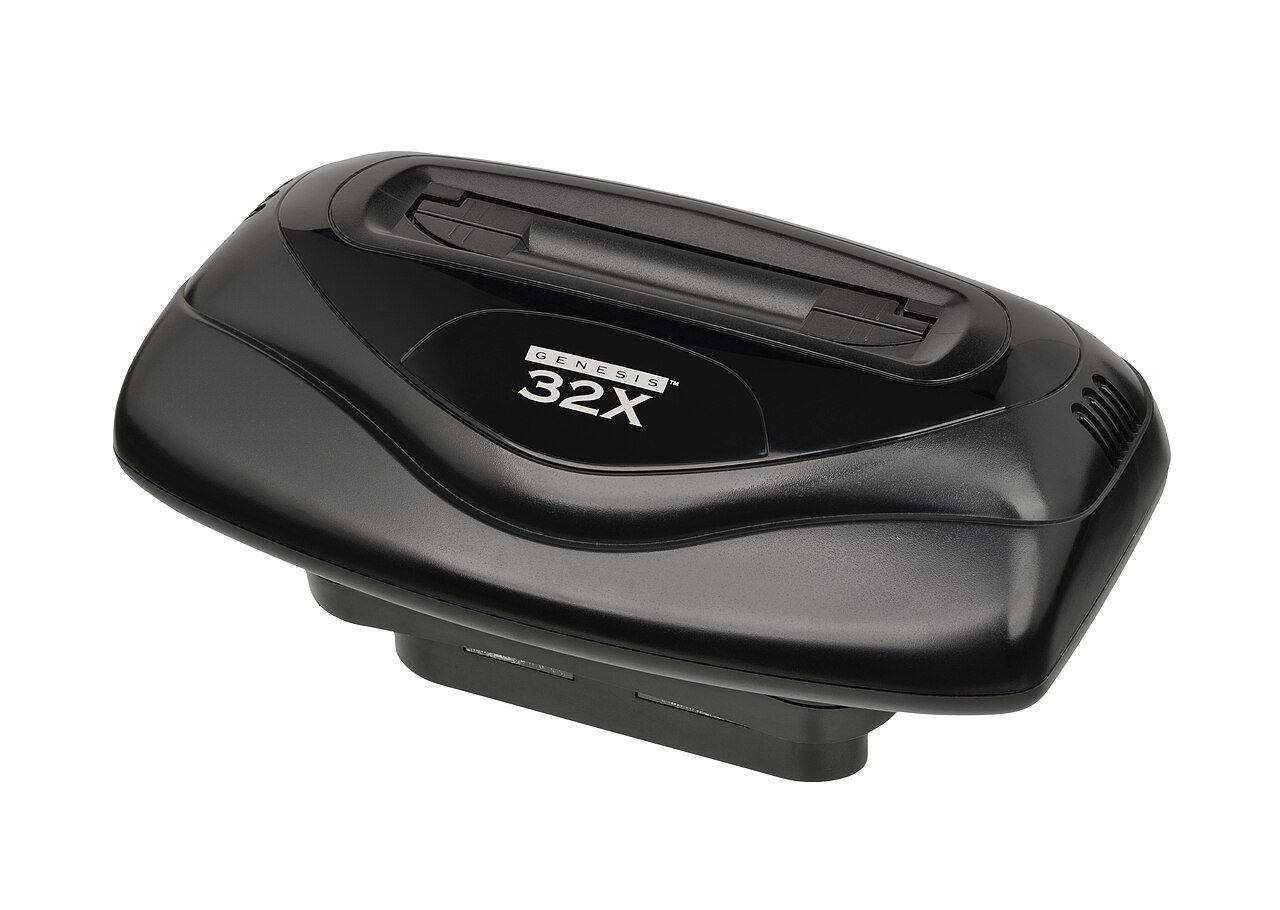
Picture this: November 1994. You are thirteen years old, standing in a Toys R Us in Northridge with a yellow plastic basket on your arm. You are looking at a black plastic mushroom sitting on a shelf next to the Genesis games. It costs $159.99. The box says it turns your Sega Genesis into a 32-bit console. The box has the word ARCADE on it in big letters. The box implies, without quite saying it, that what you are looking at is the future.
You are not looking at the future. You are looking at one of the most catastrophic hardware decisions of the 1990s. You are looking at the Sega 32X, which would launch on November 21, 1994, sell roughly 665,000 units in its first six weeks, get a final library of around 40 games, and be discontinued in less than two years. By 1996 Toys R Us would be selling the leftovers for $19.95 next to the bin of dollar VHS tapes nobody wanted.

Here's the thing about the 32X. It was not a bad piece of engineering. The processors in it could push polygons that the Genesis could not dream of. The list of people involved in its creation includes some of the smartest people Sega ever employed. The decision to build it was rational on paper. The execution, the timing, the marketing, the relationship between Sega of America and Sega of Japan, the way it shipped six months before another Sega console that did the same thing better, that is where it all falls apart. And if you were there, if you remember walking past it on the shelf and thinking what is that mushroom, you know the feeling.
This is the story of how Sega bolted a second console on top of the best console it ever made, and broke itself in the process.
The Setup: Sega in the Summer of 1993
To understand what the 32X was trying to fix, you have to remember how good things were for Sega right before this happened. The Genesis had launched in North America in August 1989 at $189.99. By 1993 it was on top. Sonic the Hedgehog had moved millions of units. The Sega CD had launched in October 1992 in North America for $299, which is roughly $660 in 2026 money. The Sega Genesis library had Streets of Rage 2, NHL 94, Mortal Kombat with the secret blood code that turned schoolyards into rumor mills, NBA Jam, and Sonic 2. Sega ads were on every channel. The catchphrase was Sega does what Nintendont. You could not be a kid in 1993 and not know it.
Behind the scenes, Sega of America was the most aggressive arm of the company. The man running it was Tom Kalinske, hired in 1990 from Mattel where he had previously run the Barbie line and the Hot Wheels line. He had no console gaming experience. He had marketing experience. He brought a price cut, a pack-in change, the Sonic launch, a deal to bundle the game with the console, and a willingness to spend like a Fortune 100 company on television. By 1993 the Genesis was outselling the Super Nintendo in North America during certain months for the first time. The press called it a console war. Sega was, in stretches, winning.
Sega of Japan was working on what came next. The internal codename was Saturn. It was going to be a true next generation 32-bit machine with custom processors, CD-ROM as standard, polygonal 3D, and a launch target for late 1994 or early 1995 in Japan. North America would follow.
And then, in late 1993, the Atari Jaguar came out.
The Jaguar Panic
The Atari Jaguar launched in November 1993 in limited markets at $249.99 with a marketing pitch that it was a 64-bit console. It was not really a 64-bit console in any meaningful sense. The math behind that number was a stretch, two 32-bit chips counted together, the kind of accounting that would not survive a five minute interview with an actual engineer. But Atari put it on the box. They ran print ads with the slogan Do The Math. They put a giant 64 in the corner of every commercial. And Sega's marketing department lost its mind.
The fear inside Sega was not that the Jaguar was good. The fear was that the press would start calling the Genesis a 16-bit console while a competitor was advertising 64.
This is where the panic move starts. Tom Kalinske and his team at Sega of America had been arguing for months that the Saturn was not going to ship in North America until at least mid-1995. They needed something on shelves for Christmas 1994 that could be sold as a 32-bit machine, that could refute the Jaguar's marketing in a single sentence, and that could keep the Genesis relevant for two more holiday seasons.
On the evening of January 8, 1994, the night before the Winter Consumer Electronics Show in Las Vegas, a group of Sega executives met in a hotel room. Hayao Nakayama, Sega's CEO from Japan. Tom Kalinske, the head of Sega of America. Joe Miller, Sega of America's Senior Vice President of Product Development. Other engineers and product leads. The meeting ran late into the night.
What came out of that meeting was a decision to greenlight a new piece of 32-bit hardware. The internal codename was Project Mars. It was originally pitched as a standalone console that would sit between the Genesis and the Saturn. But Joe Miller pushed back. He argued that another standalone console would alienate millions of Genesis owners by making their library look obsolete. He suggested a different shape: an add-on. Something that would plug into the cartridge slot, sit on top of the Genesis, and use the existing power supply and AV connections of the console you already owned. Cheaper. Faster to manufacture. A bridge.
Miller's idea won. The 32X was born in that hotel room.
The Engineering: Two Hitachi Chips and a Lot of Cables
The 32X had two Hitachi SH-2 RISC processors, the same chip family that the Saturn would later use, each running at 23 MHz. It had its own custom video chip that could output 32,768 colors on screen at once, up from the Genesis's palette of 512. It had its own dedicated memory. It could push polygonal 3D in a way the Genesis could not. On a technical sheet, this was a real upgrade.
The problem was how you actually plugged it into your Genesis.
The 32X sat on top of the Genesis in the cartridge slot. You then put your 32X games into the slot on top of the 32X. The 32X required its own power supply, a separate AC adapter that you plugged into the wall. It also required a small flat cable, called the AV cable, that ran from the 32X back into the AV out of your Genesis. So now your TV stand had a Genesis, a 32X mushroom sitting on top of it, two power bricks plugged into the wall, an AV cable hanging off the back, and the regular Genesis AV cable going to the TV. If you also owned a Sega CD, which attached to the side of the Genesis, the entire setup looked like a small black sculpture, three machines glued together, with at least four cables hanging off it. People called it the Tower of Power. Sega used that phrase in marketing.

And here's where it gets interesting. Sega marketed the 32X as a way to get Saturn quality games at Genesis prices. That was the pitch. $159.99 versus the projected $399 for the Saturn. Same generation of 3D. Same era of arcade ports. Genesis-compatible. The math, again on paper, looked good. The math, in reality, was a problem.
The Other Console: The Saturn Was Already Coming
Here is the part of the story that makes longtime Sega fans hold their head in their hands. The 32X launched in North America on November 21, 1994. Five months later, in May 1995, Sega launched the Saturn. Not in September 1995, where the public was expecting it. In May 1995, at a Sony E3 keynote that turned into one of the great corporate ambushes in gaming history, when Sony casually announced its PlayStation would launch in September at $299, and Sega responded by trying to surprise everyone by shipping the Saturn that day. Yes, that day. In a small number of stores. Without telling most of its retail partners. Kay-Bee Toys was so insulted by being left off the launch list that it stopped carrying Sega products entirely.
This means that anyone who bought a 32X for Christmas 1994 was, six months later, watching Sega put out a new console with completely different games, a completely different architecture, no 32X game compatibility, and the same target audience. The 32X library was orphaned in less time than it takes to finish high school.
This was not a secret inside Sega. Sega of America's executives, by their own later accounts, were trying to manage the Saturn launch and the 32X launch and the Sega CD launch and the Game Gear handheld and the Pico education console, all at once, all targeted at slightly different consumers, all sharing some accessories and not others. Imagine being a parent in 1994 trying to figure out which Sega box your kid actually wanted for Christmas. Imagine being the employee at the local game store trying to explain it.
The Library: Forty Games and a Lot of Empty Shelf Space
The 32X needed system selling games. It got, in its lifetime, about 40 commercial releases. To compare, the Genesis launched in 1989 and had over 900 commercial releases worldwide by the end of its life. The Super Nintendo had over 1,700. The PlayStation, which would launch in North America in September 1995, would eventually have over 7,000 games released across all regions.
The 32X library had genuinely good games in it. Virtua Fighter, the arcade fighting game that had built much of the Saturn's launch hype, got a 32X port that was technically impressive for the hardware. Doom, which had taken the PC world by storm, got a 32X port that had screen border cropping and no music but ran at a playable speed. Knuckles' Chaotix, the only Sonic-universe game that ever shipped on the 32X, was an experimental platformer that tied two characters together with a rubber band physics mechanic. NBA Jam Tournament Edition. Star Wars Arcade. Space Harrier. Some Tempo. Some Kolibri. A few others. And then the well ran dry.
The reason the well ran dry is that Sega's own internal developers were almost all working on the Saturn. Third-party developers, looking at the 32X install base versus the upcoming Saturn install base versus the PlayStation install base, made the obvious call. Why spend a year building a 32X title with a ceiling of maybe a few hundred thousand sold when you could build for the PlayStation, where the ceiling kept rising? By the spring of 1995, the 32X release schedule was already drying up. By Christmas 1995, the system was effectively dead.
Sega produced roughly 800,000 32X units. They sold about 665,000 of them. The remaining inventory got cleared at fire sale prices, finishing as low as $19.95 at retail.
The Retail Experience: Walking Through Toys R Us in 1995
If you were a kid in this era, the 32X experience was specific. You went to Toys R Us, you went to Babbage's, you went to Electronics Boutique, you went to Sears. You saw the 32X games on the shelf in their distinctive black-and-orange boxes. The boxes had a 32X logo that looked like a hot rod decal. There were never more than a handful of titles in stock. The same six or seven games kept reappearing. You read the back of Knuckles' Chaotix and you tried to figure out what the rubber band thing was. You looked at Doom and thought it cost $69.99 for a version of the game your friend already had on his dad's PC for free.
You went home. You did not buy it. Most people did not buy it. The kids whose parents had bought them a 32X for Christmas 1994 were, by mid-1995, posting on early internet bulletin boards asking if they had made a mistake. Sega did not run national television advertising for the 32X in any significant volume after the first quarter of 1995. The system effectively had no marketing presence for the second half of its life.
And here is the thing that really bothered people who loved Sega: the Sega Saturn, which launched six months later, also failed. The same internal chaos, the same surprise launch, the same lack of third-party support, the same difficulty in marketing, all of it followed the company forward. The 32X did not just fail on its own. It poisoned the well for everything that came after. Customers who got burned in 1994 did not come back in 1995. The 32X turned into a cautionary tale that retailers used to push back on Sega's next pitches.
The Aftermath: Sega's Last Console
The 32X was discontinued in 1996. The Saturn limped along until 1998 in North America and 2000 in Japan. The Dreamcast, which was a genuinely brilliant piece of hardware launched in 1999, sold over 9 million units worldwide but was discontinued in March 2001. Sega left the hardware business that year and became a third-party software publisher. They have published software for Nintendo, Sony, Microsoft, and PC for the last twenty-plus years.
Inside Sega, the 32X is remembered as the moment the company lost its discipline. Tom Kalinske, in interviews after he left Sega in 1996, has said he opposed the 32X internally and was overruled by Sega of Japan. Joe Miller, who designed the add-on concept, has been more reflective in interviews with Sega-16 and other outlets, framing the decision as a reasonable response to an impossible deadline. Both versions of the story can be true at the same time. The decision was rational. The execution was a disaster. The market did not care about the rationale.
You can still find 32X units on eBay. A working 32X with three or four good games, in box, runs around $200 in 2026 dollars, which is roughly what it cost new. Knuckles' Chaotix, complete in box, runs over $500 on a good day. The collector market has, in a way nobody predicted, decided the 32X is worth remembering.
What the 32X Actually Means
Here's what I think about when I think about the 32X. I think about every product since then that has been launched as a bridge. Every Surface RT. Every Wii U. Every PlayStation Vita. Every product that a company shipped because it had a hole in its lineup, not because it had a customer who wanted the product. The 32X is the patron saint of the bridge product. It existed because Sega had a schedule problem, not because there was a thirteen-year-old in Northridge writing letters to the company asking for a Genesis upgrade.
And the lesson, the thing that makes the 32X story actually useful and not just a piece of nostalgia, is that customers can tell. Customers in 1994 could tell that the 32X was a stopgap. The Tower of Power looked unstable on a TV stand because it was unstable as a product. The five months between the 32X launch and the Saturn launch was not an accident, it was a warning that nobody at Sega was empowered to send. The Sega 32X is a cautionary tale about what happens when a company prioritizes its own internal calendar over the needs of the people who buy its products.
The Dreamcast, when it came in 1999, was a genuinely beloved console. It had VMU memory cards with their own little screens. It had the first console internet adapter built in. It had Shenmue. It had a controller with a screen. It was, in many ways, the console Sega should have been building all along. But by the time it shipped, Sega had spent five years burning customer trust on the 32X, on the Saturn, on the Sega CD's late-stage struggles. Customers did not come back. The Dreamcast deserved better. The 32X is part of the reason it did not get better.
FAQ: The Sega 32X
When did the Sega 32X come out?
The Sega 32X launched in North America on November 21, 1994 at a retail price of $159.99. It was available in Japan as the Super 32X starting December 3, 1994 and in Europe in January 1995 under the Mega Drive 32X branding.
Why did the Sega 32X fail?
The 32X failed because Sega launched a competing console, the Saturn, just five months later in North America. Game developers shifted their attention to the Saturn and the upcoming PlayStation, leaving the 32X with a final library of around 40 commercial releases. Customers also balked at the stacking requirement, which required two power bricks and multiple cables to coexist with a Genesis and a Sega CD.
How many Sega 32X games were released?
Around 40 commercial 32X titles were released, including Virtua Fighter, Knuckles' Chaotix, Doom, Star Wars Arcade, NBA Jam Tournament Edition, Space Harrier, and Kolibri. The library was discontinued in 1996. Some unreleased prototypes have surfaced in the collector market in the years since.
How many Sega 32X units were sold?
Sega produced approximately 800,000 units and sold about 665,000 of them, with the remainder cleared at steeply discounted prices, reportedly as low as $19.95 at retail clearance.
What was the Tower of Power?
The Tower of Power was the nickname for the full Sega stack: a Genesis with a Sega CD attached to its side and a 32X plugged into its cartridge slot. The combined tower had two or three power adapters depending on configuration and required careful cable management. Sega itself used the phrase in promotional materials.
Was the Sega 32X really 32-bit?
The 32X had two Hitachi SH-2 RISC processors, each running at 23 MHz, which were 32-bit chips, plus a dedicated video processor. So yes, it was a 32-bit machine in the meaningful sense, though its performance was capped by the fact that it had to share the screen and some processing with the 16-bit Genesis underneath it.
What killed the Sega 32X?
The Saturn killed the 32X. By launching the Saturn in May 1995, five months after the 32X hit shelves, Sega effectively orphaned its own 32X library. Third party developers had no incentive to keep building for a system whose maker had already moved on. The 32X was discontinued in 1996.