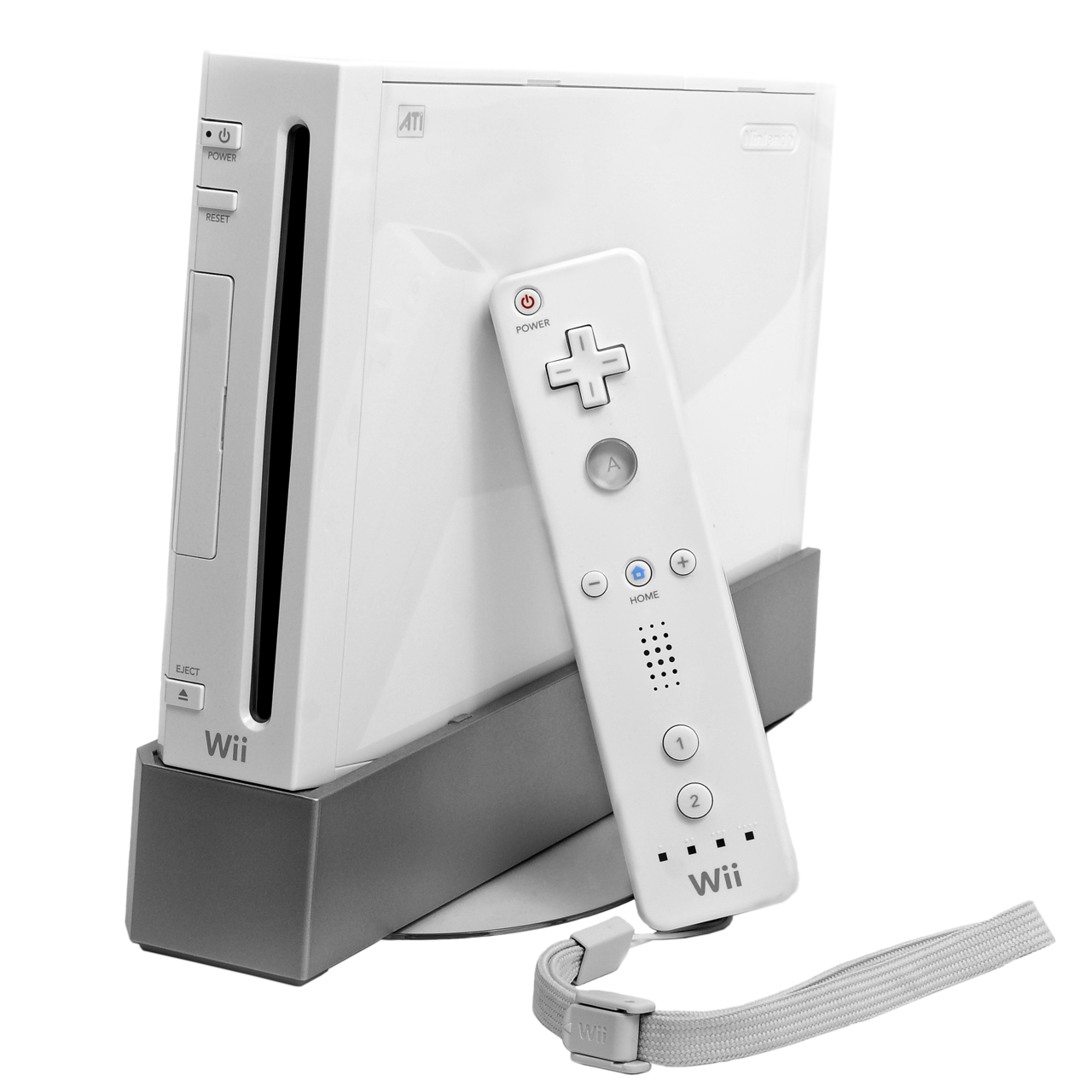
Why did Nintendo build a console with last-generation graphics?
The Nintendo Wii reached North American stores on November 19, 2006 at $249.99. Two days earlier Sony had launched the PlayStation 3 at $499 for the 20 GB model and $599 for the 60 GB one, and Microsoft's Xbox 360 had already been on sale for a year.
On paper the Wii lost every comparison. It could not output HD video, it shipped without a hard drive, and its processor was a faster relative of the chip inside the GameCube. Cheap, familiar silicon let Nintendo sell the console at a profit from day one instead of subsidizing every unit the way Sony and Microsoft did.
The strategy came from Satoru Iwata, who had run Nintendo since 2002 and worried that every console generation was shedding players rather than adding them. More buttons, longer tutorials, higher prices. His answer was to stop fighting over the same customers and go find people who had never owned a console at all. Nintendo had a patchy record with unusual hardware, from the Power Glove to the Virtual Boy and its red-on-black display, so the bet was not a safe one.
Iwata opened his 2005 Game Developers Conference keynote with a line the industry still repeats: "On my business card, I am a corporate president. In my mind, I am a game developer. But in my heart, I am a gamer." The Nintendo Wii was that sentence turned into hardware.
How did Wii Sports sell 82.9 million copies?
Nintendo bundled Wii Sports with the console in every market except Japan and South Korea. That one decision made it the best-selling game on the system, at 82.90 million copies in Nintendo's own sales data, and the best-selling game ever released on a single platform.
The game held five events: tennis, baseball, bowling, golf and boxing. None of them were deep. All of them could be explained in a sentence and played with one hand. Someone who had never held a controller could bowl a strike within two minutes, and the Wii Remote's pointer did the rest of the teaching.
The effect spread past living rooms. Retirement homes ran bowling leagues on it, physical therapists used it for range-of-motion work, and local news stations filed the same segment about grandparents playing video games through 2007 and 2008.
Nintendo kept feeding the audience it had found. Mario Kart Wii, released in April 2008, sold 37.38 million copies and is still the best-selling Wii game never bundled with hardware. Wii Fit, which shipped with the Wii Balance Board in 2008, sold 22.67 million and created the fitness-game aisle that Ring Fit Adventure later inherited.
Did the Wii really beat the PlayStation 3 and Xbox 360?
Yes, and not narrowly. Nintendo puts lifetime Nintendo Wii shipments at 101.63 million units. Sony's PlayStation 3 finished its run at 87.4 million. Microsoft has never published a lifetime figure for the Xbox 360, which is its own sort of answer.
The scale looks stranger next to what came immediately before. The GameCube sold 21.74 million units across its entire life. The Wii passed that total inside its first year on sale.
Supply was the story of 2007 and 2008. Shoppers called stores in the morning to ask what had come off the truck, and retailers ran lotteries instead of stocking shelves.
The Wii never took the all-time crown. Sony's PlayStation 2 still leads every home console ever built, and Nintendo's own Switch has since passed the Wii by more than 50 million units. But for one generation, the cheapest and technically weakest machine on the shelf outsold both expensive rivals.
Why did the Wii fade after 2009?
The audience Nintendo recruited turned out to be the audience that leaves. Households that bought a Wii for Wii Sports and Wii Fit had little reason to buy a third or fourth game, and by 2010 a lot of consoles were sitting under televisions in the off position.
Third-party publishers never solved the machine either. A studio building for the PlayStation 3 and Xbox 360 could not move that work onto a 480p console with motion controls without rebuilding it, so most shipped cheap originals instead. The library filled with party compilations and licensed filler sold on cover art alone.
Then the phone arrived. The same buyers who wanted five minutes of something simple were now carrying a device that delivered it for a dollar, with no extra hardware and no television to borrow. Nintendo had proved a huge casual market existed and then watched Apple and Google serve it more conveniently.
Nintendo discontinued the original Wii and the Wii Family Edition on October 21, 2013. The stripped-down Wii Mini, which dropped internet access entirely, stayed in production until November 13, 2017.
What happened to Wii online play and the Wii Shop Channel?
Nintendo dismantled the online side in stages. WiiConnect24, which powered the Forecast Channel, the News Channel, Everybody Votes and the Wii Message Board, went dark on June 27, 2013. Nintendo Wi-Fi Connection followed on May 20, 2014, ending official matchmaking, leaderboards and online play for every Wii game that used it.
The Wii Shop Channel stopped taking money on January 30, 2019. Nintendo gave the reason plainly in its closure Q&A: "Now that customers have shifted to Nintendo eShop on Nintendo Switch and Nintendo 3DS family systems, we plan to focus our efforts in those areas."
Redownloads survived that shutdown. A console still signed in to its original account can pull down WiiWare and Virtual Console titles it already owns, and the Wii System Transfer Tool to Wii U still runs, though Nintendo has said both will end at a date it has not announced.
Hardware support is finished. Nintendo Japan accepted its last Wii repair request on March 31, 2020, citing a shortage of parts. Anything that breaks now is a job for an independent repair shop.
What replaced the Nintendo Wii?
The Wii U arrived on November 18, 2012 and sold 13.56 million units in its entire life, less than a seventh of what the Wii managed. The name was the first problem: shoppers could not tell whether they were buying a new console or an accessory for the one they owned.
The Nintendo Switch, released in March 2017, is where the Wii's ideas actually landed. Detachable controllers with motion sensing, a machine built around people playing in the same room, and a deliberate refusal to compete on raw graphics. It has shipped 155.92 million units as of March 31, 2026, which is more than the Wii and the Wii U combined and then some.
Nintendo also kept mining the catalog: Wii Sports returned as Nintendo Switch Sports in 2022.
Can you still play a Wii in 2026, and what does one cost?
Every disc still works. The original RVL-001 model plays Wii discs and GameCube discs with no server involved, which covers Wii Sports, Mario Kart Wii, Super Mario Galaxy and the rest of the first-party library. The later Wii Family Edition and Wii Mini dropped GameCube support, so the model number matters when you buy.
Online play has a fan replacement. Wiimmfi revives matchmaking for games that used Nintendo Wi-Fi Connection, and WiiLink, which absorbed the RiiConnect24 project in December 2023, brings back the WiiConnect24 channels including the Forecast and News Channels. Both need a softmodded console and an SD card rather than anything from Nintendo.
Where to find one today
Used Wii hardware is cheap because Nintendo built more than 100 million of them. A working console with a controller and cables typically runs $40 to $75 in 2026, and a complete boxed bundle with Wii Sports reaches $80 to $120. Stone Age Gamer carries Wii accessories, replacement parts and controllers, which is usually what fails first.
Frequently Asked Questions
Does the Nintendo Wii still work in 2026?
Yes. A Nintendo Wii still boots and plays every game disc in its library in 2026, because disc-based games never needed Nintendo's servers. What no longer works is online play, which Nintendo ended on May 20, 2014, and the WiiConnect24 channels, which closed on June 27, 2013.
Can you still buy games on the Wii Shop Channel?
No. The Wii Shop Channel stopped selling WiiWare and Virtual Console games on January 30, 2019, and points cards stopped being redeemable in March 2018. Owners can still redownload titles they bought before that date, but Nintendo has warned that the redownload service will end at an unannounced future date.
How much is a used Nintendo Wii worth in 2026?
A working Nintendo Wii with a controller and cables typically sells for $40 to $75 in 2026, and a complete boxed console bundled with Wii Sports reaches $80 to $120. Prices stay low because Nintendo shipped 101.63 million Wii consoles between 2006 and 2013, making it one of the most common used consoles on the market.