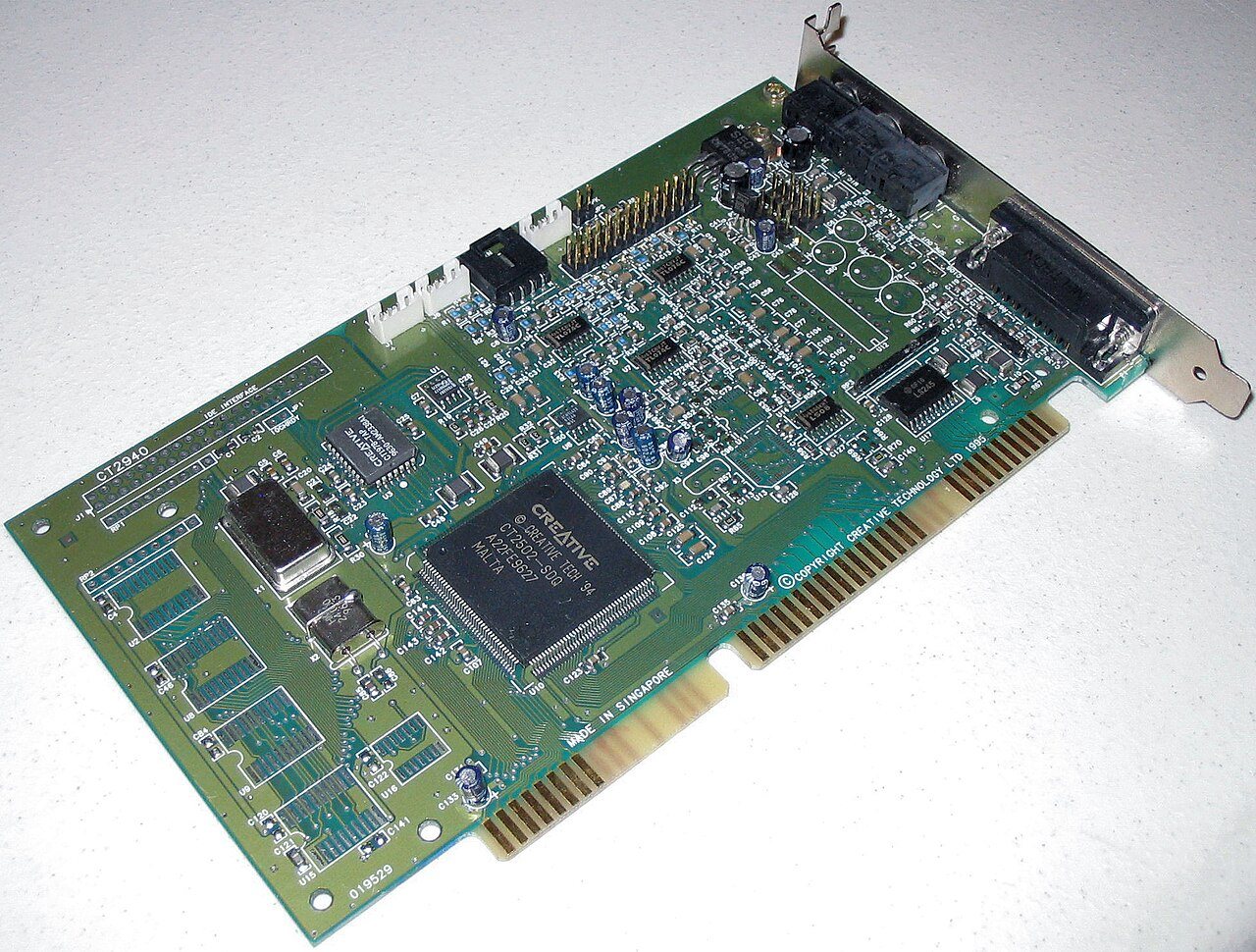
PC sound was one beeping speaker until 1987
Through the mid 1980s an IBM compatible PC had exactly one audio device: the small internal speaker soldered to the motherboard. It made square wave tones and little else. Programmers found tricks to squeeze crude music out of it, but next to a Commodore Amiga or an Atari ST, machines that shipped with real sound chips, the PC sounded broken.
The fix came from Quebec City. Ad Lib, founded in 1987 by Martin Prevel, a former music professor, sold the Ad Lib Music Synthesizer Card built around the Yamaha YM3812 FM synthesis chip, better known as the OPL2. Sierra On-Line supported it, other studios followed, and by 1990 "Ad Lib compatible" was printed on game boxes as the standard.
Ad Lib had one blind spot. The card synthesized music but could not play back recorded digital audio: no sampled voices, no recorded gunshots, no speech. That gap was the opening.
How the Sound Blaster took the market from Ad Lib
Creative Technology started in 1981 as a computer repair shop in Singapore, founded by Sim Wong Hoo and Ng Kai Wa. It had been selling audio add-ons since 1987, including the Creative Music System, without much impact outside Asia.
That changed in November 1989 at Comdex in Las Vegas, where Creative showed a card codenamed "Killer Kard" and sold as the Sound Blaster 1.0. It did everything the Ad Lib card did, using the same OPL2 chip, and added an 8-bit digital to analog converter for sampled audio, a game port that doubled as a MIDI interface, and a microphone input. One card replaced three.
The booth was small and the queue was not. "We sold one Sound Blaster every four minutes," Sim Wong Hoo told Custom PC, describing three cashiers working a 300 square foot stand.
Creative then did the unglamorous work: free cards to studios, a development kit people could actually use, real technical support. Because the Sound Blaster was Ad Lib compatible, a developer targeting it gave up nothing, and any game that used digital audio handed Sound Blaster owners speech and effects that Ad Lib owners simply could not hear. By 1991 the boxes said "Sound Blaster compatible" instead. Ad Lib answered with the Ad Lib Gold in 1992 and filed for bankruptcy the same year. When id Software shipped Doom in 1993, it shipped into a market Creative had already defined.
The peak years: Nasdaq, the AWE32 and EAX
In June 1992 Creative launched the Sound Blaster 16, the first card in the line with 16-bit sampling at 44.1 kHz, the same resolution as a compact disc. It became the card every multimedia PC advertised, and it is the model most people still picture when they hear the name.
The money followed. Creative listed on Nasdaq in 1992, the first Singapore company to do so, added a Singapore Exchange listing in 1994, and reached a market value of roughly US$1.6 billion that year.
The hardware kept getting better. The Sound Blaster AWE32 arrived in March 1994 with an E-mu EMU8000 wavetable synthesizer, so MIDI music stopped sounding like a cheap organ and started sounding like instruments. On 11 August 1998 the Sound Blaster Live! shipped with the EMU10K1 processor and hardware Environmental Audio Extensions, which let a game place a footstep behind the player and make a corridor echo differently from an open hall. For a few years the sound card mattered to a gaming PC almost as much as the 3dfx Voodoo card sitting next to it.
What killed the add-in sound card
Two decisions did it, and neither of them was Creative's.
The first came from Intel. In 1997 Intel Architecture Labs published AC'97, a codec standard that let motherboard makers put competent 16-bit audio directly on the board. Onboard sound was not as good as a Sound Blaster. It was free, it was already installed, and for anyone playing MP3s it was enough. Intel High Definition Audio replaced AC'97 in 2004 and closed the gap further.
The second came from Microsoft. Windows Vista, released in 2007, shipped a rewritten audio stack with no direct path from DirectSound to the audio driver. Hardware acceleration for DirectSound and DirectSound3D was gone, and EAX went with it, because EAX was built on DirectSound3D. Creative released ALchemy in 2007 to translate old DirectSound3D calls into OpenAL so legacy games kept their effects, and pushed developers toward OpenAL EFX instead. The patch worked. The market never came back. Needing that translation layer is part of why running 90s PC games on Windows 11 takes more setup than it should.
What Creative did after the sound card
Creative moved into portable players with the Creative Zen line and lost that market to the iPod, but it held a patent. In 2006 Apple paid Creative US$100 million for a paid up license to the Zen patent, which covered the hierarchical menu used to pick a track on a player. "This settlement resolves all of our differences with Creative, including the five lawsuits currently pending between the companies," Steve Jobs said in the announcement. Creative joined Apple's Made for iPod program the same day.
In 2007 Creative voluntarily delisted from Nasdaq, with 31 August 2007 the last day of trading, citing the cost of US reporting obligations. Its shares have traded only in Singapore since. The audio work carried on under the Sound Blaster and Super X-Fi names, moving from ISA and PCI cards to PCIe cards, USB digital to analog converters, headsets and speakers. Creative says more than 400 million Sound Blasters have been sold since 1989.
Is Creative Labs still in business in 2026?
Yes. Creative Labs is the name Creative Technology trades under in the United States, and the parent is still an independent, publicly listed company headquartered in Singapore, quoted on the Singapore Exchange as C76.
It is a far smaller business than it was. Creative reported sales of US$67.4 million for the financial year ended 30 June 2025, up about 7 percent on the year before, with a net loss of US$10.5 million. Revenue for the first half of FY2026 was US$34.2 million, down 8.6 percent year on year, with the net loss narrowed to US$1.24 million.
The top job has changed hands repeatedly since Sim Wong Hoo died on 4 January 2023. Song Siow Hui retired in February 2025, Freddy Sim was appointed in May 2025 and stepped down within three months for health reasons, executive chairman Tan Jok Tin covered as interim chief executive, and in January 2026 the board named Sim Li Ern, a nephew of the founder who has worked at Creative since 2002.
Where to find one today
Creative still sells new cards directly: the Sound Blaster AE-9, the 30th anniversary flagship, lists at $349.99, and the AE-7 at $299.99. For the original ISA hardware, working Sound Blaster 16 cards ran roughly $40 to $100 at retro parts sellers in September 2026, with the SCSI versions at the top of that range. Etsy sellers list vintage Sound Blaster cards, and condition matters more than the model number: look for a card sold as tested, with the capacitors intact.
Frequently Asked Questions
Does Creative still make Sound Blaster sound cards?
Yes. Creative Technology still sells Sound Blaster products in 2026, including internal PCIe cards such as the Sound Blaster AE-9 and AE-7, external USB digital to analog converters, speakers and gaming headsets. The line left ISA and PCI slots behind decades ago, but the Sound Blaster name has been in continuous use since the first card shipped in 1989.
Who owns Creative Labs now?
Creative Labs is the United States trading name of Creative Technology Ltd, which no larger group owns. The company has been listed on the Singapore Exchange since 1994 under the ticker C76, delisted from Nasdaq in 2007, and in January 2026 appointed Sim Li Ern, a nephew of founder Sim Wong Hoo, as chief executive.
Who was Sim Wong Hoo?
Sim Wong Hoo co-founded Creative Technology in Singapore in 1981 with Ng Kai Wa and led it as chairman and chief executive until his death on 4 January 2023 at the age of 67. He took the Sound Blaster from its November 1989 Comdex launch to a company worth roughly US$1.6 billion by 1994.