What Happened to the Atari Jaguar? The Console That Killed Atari

Picture this: late November 1993. You walk into a Toys "R" Us in Manhattan, and there it is, sitting on an endcap between a stack of SNES games and a Genesis display that's seen better days. A black console shaped like a toilet seat with the word JAGUAR across the top. There's a controller next to it that looks like someone glued a telephone to a gamepad. And above it, a sign that says: "64-BIT INTERACTIVE MULTIMEDIA SYSTEM. DO THE MATH."

That was the Atari Jaguar. The console that was supposed to save Atari. The console that was marketed as the most powerful gaming system on Earth. The console that, depending on who you ask, sold somewhere between 125,000 and 250,000 units total before being quietly discontinued. For context, the Super Nintendo sold 49 million. The original PlayStation sold over 100 million. The Jaguar sold fewer units than some individual game cartridges.

This is the story of how a legendary company staked its entire future on a piece of hardware that most people never saw in person, and lost everything.

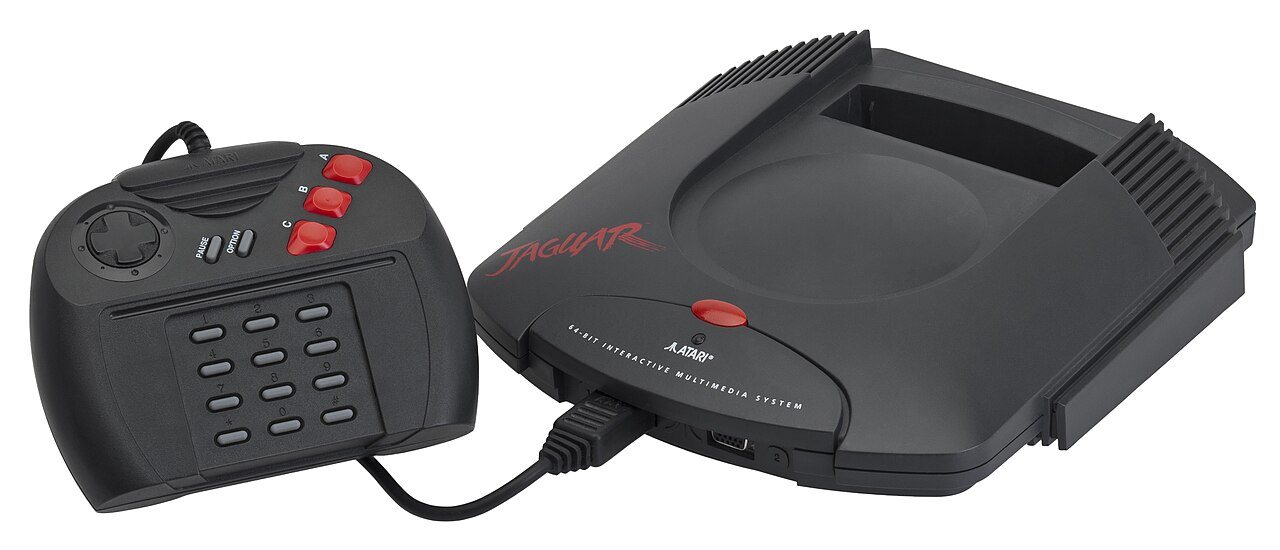
The Atari Jaguar console with its distinctive controller featuring a numeric keypad
The Atari Jaguar console and its infamous controller, released November 23, 1993, in test markets in New York and San Francisco.

The Company That Used to Be King

If you're under 30, you might only know Atari as a retro logo on t-shirts. But in the late 1970s and early 1980s, Atari practically invented the home video game industry. The Atari 2600, released in 1977, was the first console to bring arcade gaming into living rooms on a massive scale. In the first nine months of 1982 alone, Atari contributed half of Warner Communications' $2.9 billion in revenue. The fastest-growing company in America, they called it.

Then the video game crash of 1983 happened. Atari flooded the market with terrible games, most infamously the E.T. adaptation that was so bad the company literally buried unsold cartridges in a New Mexico landfill. The crash nearly killed the entire industry. Nintendo revived it with the NES in 1985, and Atari never recovered its dominance.

By 1993, Atari Corporation was a shadow of its former self. The company had been bought by Jack Tramiel, the founder of Commodore, back in 1984. Under the Tramiel family, Atari tried various things: the 7800 console, the Lynx handheld, the ST line of computers. None of them caught fire. The company was bleeding money. Sam Tramiel, Jack's son, was running things as president. And he had a plan.

That plan was the Jaguar.

The "64-Bit" Question

Here's where the Jaguar story gets both interesting and a little embarrassing. Atari's entire marketing strategy hinged on one claim: the Jaguar was the world's first 64-bit gaming console. This was the era when bit counts mattered to consumers. The SNES was 16-bit. The Genesis was 16-bit. The upcoming systems from Sony and Sega were going to be 32-bit. And here was Atari, claiming to have leapfrogged everyone with 64 bits of raw power.

The truth was more complicated. The Jaguar contained three processors. There was a Motorola 68000, the same CPU that powered the Genesis and the original Macintosh. It was a 16-bit chip. Then there were two custom co-processors designed by Flare Technology in the UK, code-named Tom and Jerry. Tom handled graphics and contained a 64-bit object processor and a 64-bit blitter. Jerry was a 32-bit digital signal processor that handled audio and some calculations.

Atari's argument was that because Tom's bus width was 64 bits, the whole system qualified as 64-bit. This is a bit like saying your car has 12 cylinders because the engine has 6 and the air conditioning compressor has 6. It's technically arguable, but it's misleading. Electronic Gaming Monthly put it best when they pointed out that if Sega used the same math for the Saturn, it would be a "112-bit monster of a machine."

But the bit count wasn't even the real problem. The real problem was that the three processors were incredibly difficult to program. Developers were supposed to use Tom and Jerry for the heavy lifting and only use the 68000 as a manager. In practice, hardware bugs made it extremely difficult to synchronize the chips. Most developers just gave up and ran their games primarily on the slow Motorola 68000, which meant the Jaguar's actual game performance was often barely better than a Super Nintendo.

Launch Day and the "Do the Math" Campaign

The Jaguar launched on November 23, 1993, in two test markets: New York and San Francisco. The retail price was $249.99. It came with one pack-in game: Cybermorph, a 3D polygon shooter developed by Attention to Detail. Cybermorph was supposed to be the Jaguar's showcase title, proof that this console could do things the SNES and Genesis couldn't dream of.

And look, Cybermorph wasn't terrible. It had fully 3D environments. You flew a ship over polygon landscapes and shot things. For 1993, that was genuinely impressive on a home console. But the color palette was muddy, the textures were basic, and the whole thing looked rough compared to what the SNES was doing with Mode 7 and what Star Fox had achieved with the Super FX chip earlier that year. Cybermorph's most memorable feature ended up being the AI companion who constantly said "Where did you learn to fly?" every time you crashed. It became a running joke.

Atari launched an advertising campaign built around the slogan "Do the Math." The idea was simple: 64 is bigger than 32, which is bigger than 16. Therefore the Jaguar is the most powerful console. The ads featured a classroom setting where a teacher explained this basic arithmetic. It was clever in theory, but it had two problems. First, as we've discussed, the math didn't actually check out. Second, Atari didn't have the advertising budget to get the message out. By 1993, Atari's marketing budget was a fraction of what Nintendo and Sega were spending.

Close-up of the Atari Jaguar controller showing the numeric keypad and buttons
The Atari Jaguar controller, widely criticized for its phone-style keypad and ergonomically awkward design. IGN later named it one of the worst controllers ever made.

That Controller, Though

We need to talk about the controller, because it might be the single most baffling design decision in console history. The Jaguar controller had a standard directional pad at the top. Below that, three action buttons labeled A, B, and C. Below those: a full 12-button numeric keypad. Like a telephone. On a game controller.

The idea was that you could insert game-specific overlays into the controller, and each keypad button would correspond to a different in-game function. In Atari's vision, this would give developers unprecedented flexibility. In reality, it meant games had absurdly complicated control schemes that required you to look down at a paper overlay mid-game to remember which button did what.

Craig Harris at IGN later rated it one of the worst game controllers ever made. And he wasn't wrong. The thing was too wide, the buttons were mushy, and the keypad was a solution to a problem that didn't exist. Every other console had figured out that six or fewer face buttons was plenty. Atari apparently didn't get that memo.

The Games That Almost Saved It

Here's the thing about the Jaguar, and this is what makes the story genuinely sad rather than just funny. It had one truly great game. Tempest 2000, designed by Jeff Minter and released in 1994, was an absolutely incredible update of the 1981 arcade classic. It was fast, psychedelic, had an amazing techno soundtrack, and used the Jaguar hardware in ways that no other game managed to replicate. Ed Semrad at Electronic Gaming Monthly gave it a perfect 10 out of 10 and called it "a great game to zone out on."

Tempest 2000 proved the Jaguar could produce remarkable experiences when the right developer understood the hardware. The problem was that Jeff Minter was one of maybe three people on Earth who could actually get the Jaguar to do what it was supposed to do. Most developers couldn't. And Atari's difficult relationship with third-party studios meant that very few were willing to try.

Computer Gaming World summed up the situation perfectly in January 1994, calling the Jaguar "a great machine in search of a developer/customer base" and noting that Atari needed to overcome the "stigma of its name" due to years of poor marketing and bad developer relations.

Over its entire commercial lifespan, the Jaguar received just 63 officially licensed games. Fifty cartridge titles and 13 CD games. For comparison, the SNES had over 1,750 games. The PlayStation launched in North America in September 1995 and had more games in its first year than the Jaguar managed in its entire life.

The Jaguar CD: Doubling Down on Disaster

As if the base console's struggles weren't enough, Atari released the Jaguar CD add-on on September 21, 1995. It cost $149.95, which meant you now needed to spend roughly $400 to own the full Jaguar setup. The CD unit sat on top of the console and gave it the appearance of a small appliance.

The Jaguar CD was plagued with hardware reliability issues from day one. The units frequently failed. The laser assemblies were unreliable. Fans who bought them often had to purchase multiple units just to get one that worked. And the game library was dismal. Fewer than 15 titles were released for the Jaguar CD, and most of them were forgettable. The add-on landed in a market that already had the PlayStation and Sega Saturn available. Nobody was buying a $150 CD attachment for a failing console when they could get a PlayStation for $299.

Zero Percent Market Share

The numbers tell the whole story. In 1993, Atari shipped roughly 17,000 Jaguar units to its two test markets. By the end of 1994, that number had crawled to about 100,000 total. And then the PlayStation arrived in September 1995, and the Sega Saturn had launched in May 1995, and whatever slim chance the Jaguar had evaporated overnight.

By the end of 1995, analysts tracking the console market reported that the Jaguar held zero percent market share in "sold through" units. Not one percent. Not half a percent. Zero. Even the struggling 3DO, which was also failing, managed to hold about one percent. The Jaguar couldn't even beat that.

In December 1995, Sam Tramiel suffered a mild heart attack and stepped down as president. His father Jack, now in his mid-sixties, had to come back to try to save the company. But there was nothing left to save.

The End of Atari Corporation

On February 13, 1996, Atari Corporation announced a reverse merger with JTS, a hard disk drive manufacturer. Think about that for a second. The company that created Pong, that built the 2600, that defined an entire industry, was merging with a company that made hard drives. The deal was finalized on July 30, 1996. All former Atari employees were dismissed or relocated. The Jaguar was discontinued. It was over.

Two years later, on March 13, 1998, JTS sold the Atari name and all its assets to Hasbro Interactive for $5 million. Five million dollars for a brand name that had once been worth billions. Hasbro later sold it to Infogrames, which eventually renamed itself Atari SA. The name lives on, but the company that made the Jaguar is long gone.

Why the Jaguar Really Failed

People love to blame the Jaguar's failure on one thing. The controller. The fake 64-bit claim. The lack of games. But the real answer is simpler and sadder than any of that. Atari Corporation in 1993 was a small company with limited resources trying to compete against giants. Nintendo and Sega had massive install bases, deep pockets, and decades of developer relationships. Sony was about to enter the market with billions in corporate backing. Atari had a clever chip design and almost nothing else.

The Jaguar needed a miracle. It needed a Mario or a Sonic, a system seller so compelling that people would overlook the weird controller and the empty game library. It got Cybermorph and a virtual pet game. Tempest 2000 was brilliant, but it was an abstract arcade game, not the kind of thing that moves consoles off shelves.

The Jaguar is a cautionary tale about what happens when ambition outpaces execution, when marketing writes checks that engineering can't cash, and when a company mistakes specs for soul. The Dreamcast deserved better. But you know what? So did the Jaguar. Somewhere inside that weird, overpromising, underdelivering box was the ghost of a company that once changed the world. It just couldn't do it one more time.

Frequently Asked Questions

How many Atari Jaguars were sold?
Estimates range from 125,000 to 250,000 total units over its entire commercial lifespan from 1993 to 1996. This made it one of the lowest-selling major consoles ever released.

Was the Atari Jaguar really 64-bit?
Technically, the Jaguar contained a custom graphics chip called Tom with a 64-bit data bus. However, the system also relied on a 16-bit Motorola 68000 processor and a 32-bit DSP chip called Jerry. Most industry analysts considered the "64-bit" marketing claim misleading.

What was the best game on the Atari Jaguar?
Tempest 2000, designed by Jeff Minter and released in 1994, is universally regarded as the Jaguar's best game. It received a perfect 10/10 from Electronic Gaming Monthly and was later ported to other platforms.

Why did Atari go out of business?
Atari Corporation merged with JTS, a hard drive manufacturer, in July 1996 after the commercial failure of the Jaguar left the company with no viable products. JTS later sold the Atari name to Hasbro Interactive in 1998 for just $5 million.

How much did the Atari Jaguar cost?
The Jaguar launched at $249.99 in November 1993. The Jaguar CD add-on, released in September 1995, cost an additional $149.95.

Is the Atari Jaguar worth collecting?
The Jaguar has become a collectible console due to its rarity and small game library. Loose consoles typically sell for $150 to $300, while complete-in-box units and specific games like Tempest 2000 command higher prices among retro gaming collectors.

๐Ÿ“– What Happened to the Atari Jaguar? The Console That Killed Atari
_ โ–ก ร—
← Back

What Happened to the Atari Jaguar? The Console That Killed Atari

2026-04-04 by 404 Memory Found

Picture this: late November 1993. You walk into a Toys "R" Us in Manhattan, and there it is, sitting on an endcap between a stack of SNES games and a Genesis display that's seen better days. A black console shaped like a toilet seat with the word JAGUAR across the top. There's a controller next to it that looks like someone glued a telephone to a gamepad. And above it, a sign that says: "64-BIT INTERACTIVE MULTIMEDIA SYSTEM. DO THE MATH."

That was the Atari Jaguar. The console that was supposed to save Atari. The console that was marketed as the most powerful gaming system on Earth. The console that, depending on who you ask, sold somewhere between 125,000 and 250,000 units total before being quietly discontinued. For context, the Super Nintendo sold 49 million. The original PlayStation sold over 100 million. The Jaguar sold fewer units than some individual game cartridges.

This is the story of how a legendary company staked its entire future on a piece of hardware that most people never saw in person, and lost everything.

The Atari Jaguar console with its distinctive controller featuring a numeric keypad
The Atari Jaguar console and its infamous controller, released November 23, 1993, in test markets in New York and San Francisco.

The Company That Used to Be King

If you're under 30, you might only know Atari as a retro logo on t-shirts. But in the late 1970s and early 1980s, Atari practically invented the home video game industry. The Atari 2600, released in 1977, was the first console to bring arcade gaming into living rooms on a massive scale. In the first nine months of 1982 alone, Atari contributed half of Warner Communications' $2.9 billion in revenue. The fastest-growing company in America, they called it.

Then the video game crash of 1983 happened. Atari flooded the market with terrible games, most infamously the E.T. adaptation that was so bad the company literally buried unsold cartridges in a New Mexico landfill. The crash nearly killed the entire industry. Nintendo revived it with the NES in 1985, and Atari never recovered its dominance.

By 1993, Atari Corporation was a shadow of its former self. The company had been bought by Jack Tramiel, the founder of Commodore, back in 1984. Under the Tramiel family, Atari tried various things: the 7800 console, the Lynx handheld, the ST line of computers. None of them caught fire. The company was bleeding money. Sam Tramiel, Jack's son, was running things as president. And he had a plan.

That plan was the Jaguar.

The "64-Bit" Question

Here's where the Jaguar story gets both interesting and a little embarrassing. Atari's entire marketing strategy hinged on one claim: the Jaguar was the world's first 64-bit gaming console. This was the era when bit counts mattered to consumers. The SNES was 16-bit. The Genesis was 16-bit. The upcoming systems from Sony and Sega were going to be 32-bit. And here was Atari, claiming to have leapfrogged everyone with 64 bits of raw power.

The truth was more complicated. The Jaguar contained three processors. There was a Motorola 68000, the same CPU that powered the Genesis and the original Macintosh. It was a 16-bit chip. Then there were two custom co-processors designed by Flare Technology in the UK, code-named Tom and Jerry. Tom handled graphics and contained a 64-bit object processor and a 64-bit blitter. Jerry was a 32-bit digital signal processor that handled audio and some calculations.

Atari's argument was that because Tom's bus width was 64 bits, the whole system qualified as 64-bit. This is a bit like saying your car has 12 cylinders because the engine has 6 and the air conditioning compressor has 6. It's technically arguable, but it's misleading. Electronic Gaming Monthly put it best when they pointed out that if Sega used the same math for the Saturn, it would be a "112-bit monster of a machine."

But the bit count wasn't even the real problem. The real problem was that the three processors were incredibly difficult to program. Developers were supposed to use Tom and Jerry for the heavy lifting and only use the 68000 as a manager. In practice, hardware bugs made it extremely difficult to synchronize the chips. Most developers just gave up and ran their games primarily on the slow Motorola 68000, which meant the Jaguar's actual game performance was often barely better than a Super Nintendo.

Launch Day and the "Do the Math" Campaign

The Jaguar launched on November 23, 1993, in two test markets: New York and San Francisco. The retail price was $249.99. It came with one pack-in game: Cybermorph, a 3D polygon shooter developed by Attention to Detail. Cybermorph was supposed to be the Jaguar's showcase title, proof that this console could do things the SNES and Genesis couldn't dream of.

And look, Cybermorph wasn't terrible. It had fully 3D environments. You flew a ship over polygon landscapes and shot things. For 1993, that was genuinely impressive on a home console. But the color palette was muddy, the textures were basic, and the whole thing looked rough compared to what the SNES was doing with Mode 7 and what Star Fox had achieved with the Super FX chip earlier that year. Cybermorph's most memorable feature ended up being the AI companion who constantly said "Where did you learn to fly?" every time you crashed. It became a running joke.

Atari launched an advertising campaign built around the slogan "Do the Math." The idea was simple: 64 is bigger than 32, which is bigger than 16. Therefore the Jaguar is the most powerful console. The ads featured a classroom setting where a teacher explained this basic arithmetic. It was clever in theory, but it had two problems. First, as we've discussed, the math didn't actually check out. Second, Atari didn't have the advertising budget to get the message out. By 1993, Atari's marketing budget was a fraction of what Nintendo and Sega were spending.

Close-up of the Atari Jaguar controller showing the numeric keypad and buttons
The Atari Jaguar controller, widely criticized for its phone-style keypad and ergonomically awkward design. IGN later named it one of the worst controllers ever made.

That Controller, Though

We need to talk about the controller, because it might be the single most baffling design decision in console history. The Jaguar controller had a standard directional pad at the top. Below that, three action buttons labeled A, B, and C. Below those: a full 12-button numeric keypad. Like a telephone. On a game controller.

The idea was that you could insert game-specific overlays into the controller, and each keypad button would correspond to a different in-game function. In Atari's vision, this would give developers unprecedented flexibility. In reality, it meant games had absurdly complicated control schemes that required you to look down at a paper overlay mid-game to remember which button did what.

Craig Harris at IGN later rated it one of the worst game controllers ever made. And he wasn't wrong. The thing was too wide, the buttons were mushy, and the keypad was a solution to a problem that didn't exist. Every other console had figured out that six or fewer face buttons was plenty. Atari apparently didn't get that memo.

The Games That Almost Saved It

Here's the thing about the Jaguar, and this is what makes the story genuinely sad rather than just funny. It had one truly great game. Tempest 2000, designed by Jeff Minter and released in 1994, was an absolutely incredible update of the 1981 arcade classic. It was fast, psychedelic, had an amazing techno soundtrack, and used the Jaguar hardware in ways that no other game managed to replicate. Ed Semrad at Electronic Gaming Monthly gave it a perfect 10 out of 10 and called it "a great game to zone out on."

Tempest 2000 proved the Jaguar could produce remarkable experiences when the right developer understood the hardware. The problem was that Jeff Minter was one of maybe three people on Earth who could actually get the Jaguar to do what it was supposed to do. Most developers couldn't. And Atari's difficult relationship with third-party studios meant that very few were willing to try.

Computer Gaming World summed up the situation perfectly in January 1994, calling the Jaguar "a great machine in search of a developer/customer base" and noting that Atari needed to overcome the "stigma of its name" due to years of poor marketing and bad developer relations.

Over its entire commercial lifespan, the Jaguar received just 63 officially licensed games. Fifty cartridge titles and 13 CD games. For comparison, the SNES had over 1,750 games. The PlayStation launched in North America in September 1995 and had more games in its first year than the Jaguar managed in its entire life.

The Jaguar CD: Doubling Down on Disaster

As if the base console's struggles weren't enough, Atari released the Jaguar CD add-on on September 21, 1995. It cost $149.95, which meant you now needed to spend roughly $400 to own the full Jaguar setup. The CD unit sat on top of the console and gave it the appearance of a small appliance.

The Jaguar CD was plagued with hardware reliability issues from day one. The units frequently failed. The laser assemblies were unreliable. Fans who bought them often had to purchase multiple units just to get one that worked. And the game library was dismal. Fewer than 15 titles were released for the Jaguar CD, and most of them were forgettable. The add-on landed in a market that already had the PlayStation and Sega Saturn available. Nobody was buying a $150 CD attachment for a failing console when they could get a PlayStation for $299.

Zero Percent Market Share

The numbers tell the whole story. In 1993, Atari shipped roughly 17,000 Jaguar units to its two test markets. By the end of 1994, that number had crawled to about 100,000 total. And then the PlayStation arrived in September 1995, and the Sega Saturn had launched in May 1995, and whatever slim chance the Jaguar had evaporated overnight.

By the end of 1995, analysts tracking the console market reported that the Jaguar held zero percent market share in "sold through" units. Not one percent. Not half a percent. Zero. Even the struggling 3DO, which was also failing, managed to hold about one percent. The Jaguar couldn't even beat that.

In December 1995, Sam Tramiel suffered a mild heart attack and stepped down as president. His father Jack, now in his mid-sixties, had to come back to try to save the company. But there was nothing left to save.

The End of Atari Corporation

On February 13, 1996, Atari Corporation announced a reverse merger with JTS, a hard disk drive manufacturer. Think about that for a second. The company that created Pong, that built the 2600, that defined an entire industry, was merging with a company that made hard drives. The deal was finalized on July 30, 1996. All former Atari employees were dismissed or relocated. The Jaguar was discontinued. It was over.

Two years later, on March 13, 1998, JTS sold the Atari name and all its assets to Hasbro Interactive for $5 million. Five million dollars for a brand name that had once been worth billions. Hasbro later sold it to Infogrames, which eventually renamed itself Atari SA. The name lives on, but the company that made the Jaguar is long gone.

Why the Jaguar Really Failed

People love to blame the Jaguar's failure on one thing. The controller. The fake 64-bit claim. The lack of games. But the real answer is simpler and sadder than any of that. Atari Corporation in 1993 was a small company with limited resources trying to compete against giants. Nintendo and Sega had massive install bases, deep pockets, and decades of developer relationships. Sony was about to enter the market with billions in corporate backing. Atari had a clever chip design and almost nothing else.

The Jaguar needed a miracle. It needed a Mario or a Sonic, a system seller so compelling that people would overlook the weird controller and the empty game library. It got Cybermorph and a virtual pet game. Tempest 2000 was brilliant, but it was an abstract arcade game, not the kind of thing that moves consoles off shelves.

The Jaguar is a cautionary tale about what happens when ambition outpaces execution, when marketing writes checks that engineering can't cash, and when a company mistakes specs for soul. The Dreamcast deserved better. But you know what? So did the Jaguar. Somewhere inside that weird, overpromising, underdelivering box was the ghost of a company that once changed the world. It just couldn't do it one more time.

Frequently Asked Questions

How many Atari Jaguars were sold?
Estimates range from 125,000 to 250,000 total units over its entire commercial lifespan from 1993 to 1996. This made it one of the lowest-selling major consoles ever released.

Was the Atari Jaguar really 64-bit?
Technically, the Jaguar contained a custom graphics chip called Tom with a 64-bit data bus. However, the system also relied on a 16-bit Motorola 68000 processor and a 32-bit DSP chip called Jerry. Most industry analysts considered the "64-bit" marketing claim misleading.

What was the best game on the Atari Jaguar?
Tempest 2000, designed by Jeff Minter and released in 1994, is universally regarded as the Jaguar's best game. It received a perfect 10/10 from Electronic Gaming Monthly and was later ported to other platforms.

Why did Atari go out of business?
Atari Corporation merged with JTS, a hard drive manufacturer, in July 1996 after the commercial failure of the Jaguar left the company with no viable products. JTS later sold the Atari name to Hasbro Interactive in 1998 for just $5 million.

How much did the Atari Jaguar cost?
The Jaguar launched at $249.99 in November 1993. The Jaguar CD add-on, released in September 1995, cost an additional $149.95.

Is the Atari Jaguar worth collecting?
The Jaguar has become a collectible console due to its rarity and small game library. Loose consoles typically sell for $150 to $300, while complete-in-box units and specific games like Tempest 2000 command higher prices among retro gaming collectors.

๐Ÿ“– What Happened to the Atari Jaguar? The Console That Killed Atari

Picture this: late November 1993. You walk into a Toys "R" Us in Manhattan, and there it is, sitting on an endcap between a stack of SNES games and a Genesis display that's seen better days. A black console shaped like a toilet seat with the word JAGUAR across the top. There's a controller next to it that looks like someone glued a telephone to a gamepad. And above it, a sign that says: "64-BIT INTERACTIVE MULTIMEDIA SYSTEM. DO THE MATH."

That was the Atari Jaguar. The console that was supposed to save Atari. The console that was marketed as the most powerful gaming system on Earth. The console that, depending on who you ask, sold somewhere between 125,000 and 250,000 units total before being quietly discontinued. For context, the Super Nintendo sold 49 million. The original PlayStation sold over 100 million. The Jaguar sold fewer units than some individual game cartridges.

This is the story of how a legendary company staked its entire future on a piece of hardware that most people never saw in person, and lost everything.

The Atari Jaguar console with its distinctive controller featuring a numeric keypad
The Atari Jaguar console and its infamous controller, released November 23, 1993, in test markets in New York and San Francisco.

The Company That Used to Be King

If you're under 30, you might only know Atari as a retro logo on t-shirts. But in the late 1970s and early 1980s, Atari practically invented the home video game industry. The Atari 2600, released in 1977, was the first console to bring arcade gaming into living rooms on a massive scale. In the first nine months of 1982 alone, Atari contributed half of Warner Communications' $2.9 billion in revenue. The fastest-growing company in America, they called it.

Then the video game crash of 1983 happened. Atari flooded the market with terrible games, most infamously the E.T. adaptation that was so bad the company literally buried unsold cartridges in a New Mexico landfill. The crash nearly killed the entire industry. Nintendo revived it with the NES in 1985, and Atari never recovered its dominance.

By 1993, Atari Corporation was a shadow of its former self. The company had been bought by Jack Tramiel, the founder of Commodore, back in 1984. Under the Tramiel family, Atari tried various things: the 7800 console, the Lynx handheld, the ST line of computers. None of them caught fire. The company was bleeding money. Sam Tramiel, Jack's son, was running things as president. And he had a plan.

That plan was the Jaguar.

The "64-Bit" Question

Here's where the Jaguar story gets both interesting and a little embarrassing. Atari's entire marketing strategy hinged on one claim: the Jaguar was the world's first 64-bit gaming console. This was the era when bit counts mattered to consumers. The SNES was 16-bit. The Genesis was 16-bit. The upcoming systems from Sony and Sega were going to be 32-bit. And here was Atari, claiming to have leapfrogged everyone with 64 bits of raw power.

The truth was more complicated. The Jaguar contained three processors. There was a Motorola 68000, the same CPU that powered the Genesis and the original Macintosh. It was a 16-bit chip. Then there were two custom co-processors designed by Flare Technology in the UK, code-named Tom and Jerry. Tom handled graphics and contained a 64-bit object processor and a 64-bit blitter. Jerry was a 32-bit digital signal processor that handled audio and some calculations.

Atari's argument was that because Tom's bus width was 64 bits, the whole system qualified as 64-bit. This is a bit like saying your car has 12 cylinders because the engine has 6 and the air conditioning compressor has 6. It's technically arguable, but it's misleading. Electronic Gaming Monthly put it best when they pointed out that if Sega used the same math for the Saturn, it would be a "112-bit monster of a machine."

But the bit count wasn't even the real problem. The real problem was that the three processors were incredibly difficult to program. Developers were supposed to use Tom and Jerry for the heavy lifting and only use the 68000 as a manager. In practice, hardware bugs made it extremely difficult to synchronize the chips. Most developers just gave up and ran their games primarily on the slow Motorola 68000, which meant the Jaguar's actual game performance was often barely better than a Super Nintendo.

Launch Day and the "Do the Math" Campaign

The Jaguar launched on November 23, 1993, in two test markets: New York and San Francisco. The retail price was $249.99. It came with one pack-in game: Cybermorph, a 3D polygon shooter developed by Attention to Detail. Cybermorph was supposed to be the Jaguar's showcase title, proof that this console could do things the SNES and Genesis couldn't dream of.

And look, Cybermorph wasn't terrible. It had fully 3D environments. You flew a ship over polygon landscapes and shot things. For 1993, that was genuinely impressive on a home console. But the color palette was muddy, the textures were basic, and the whole thing looked rough compared to what the SNES was doing with Mode 7 and what Star Fox had achieved with the Super FX chip earlier that year. Cybermorph's most memorable feature ended up being the AI companion who constantly said "Where did you learn to fly?" every time you crashed. It became a running joke.

Atari launched an advertising campaign built around the slogan "Do the Math." The idea was simple: 64 is bigger than 32, which is bigger than 16. Therefore the Jaguar is the most powerful console. The ads featured a classroom setting where a teacher explained this basic arithmetic. It was clever in theory, but it had two problems. First, as we've discussed, the math didn't actually check out. Second, Atari didn't have the advertising budget to get the message out. By 1993, Atari's marketing budget was a fraction of what Nintendo and Sega were spending.

Close-up of the Atari Jaguar controller showing the numeric keypad and buttons
The Atari Jaguar controller, widely criticized for its phone-style keypad and ergonomically awkward design. IGN later named it one of the worst controllers ever made.

That Controller, Though

We need to talk about the controller, because it might be the single most baffling design decision in console history. The Jaguar controller had a standard directional pad at the top. Below that, three action buttons labeled A, B, and C. Below those: a full 12-button numeric keypad. Like a telephone. On a game controller.

The idea was that you could insert game-specific overlays into the controller, and each keypad button would correspond to a different in-game function. In Atari's vision, this would give developers unprecedented flexibility. In reality, it meant games had absurdly complicated control schemes that required you to look down at a paper overlay mid-game to remember which button did what.

Craig Harris at IGN later rated it one of the worst game controllers ever made. And he wasn't wrong. The thing was too wide, the buttons were mushy, and the keypad was a solution to a problem that didn't exist. Every other console had figured out that six or fewer face buttons was plenty. Atari apparently didn't get that memo.

The Games That Almost Saved It

Here's the thing about the Jaguar, and this is what makes the story genuinely sad rather than just funny. It had one truly great game. Tempest 2000, designed by Jeff Minter and released in 1994, was an absolutely incredible update of the 1981 arcade classic. It was fast, psychedelic, had an amazing techno soundtrack, and used the Jaguar hardware in ways that no other game managed to replicate. Ed Semrad at Electronic Gaming Monthly gave it a perfect 10 out of 10 and called it "a great game to zone out on."

Tempest 2000 proved the Jaguar could produce remarkable experiences when the right developer understood the hardware. The problem was that Jeff Minter was one of maybe three people on Earth who could actually get the Jaguar to do what it was supposed to do. Most developers couldn't. And Atari's difficult relationship with third-party studios meant that very few were willing to try.

Computer Gaming World summed up the situation perfectly in January 1994, calling the Jaguar "a great machine in search of a developer/customer base" and noting that Atari needed to overcome the "stigma of its name" due to years of poor marketing and bad developer relations.

Over its entire commercial lifespan, the Jaguar received just 63 officially licensed games. Fifty cartridge titles and 13 CD games. For comparison, the SNES had over 1,750 games. The PlayStation launched in North America in September 1995 and had more games in its first year than the Jaguar managed in its entire life.

The Jaguar CD: Doubling Down on Disaster

As if the base console's struggles weren't enough, Atari released the Jaguar CD add-on on September 21, 1995. It cost $149.95, which meant you now needed to spend roughly $400 to own the full Jaguar setup. The CD unit sat on top of the console and gave it the appearance of a small appliance.

The Jaguar CD was plagued with hardware reliability issues from day one. The units frequently failed. The laser assemblies were unreliable. Fans who bought them often had to purchase multiple units just to get one that worked. And the game library was dismal. Fewer than 15 titles were released for the Jaguar CD, and most of them were forgettable. The add-on landed in a market that already had the PlayStation and Sega Saturn available. Nobody was buying a $150 CD attachment for a failing console when they could get a PlayStation for $299.

Zero Percent Market Share

The numbers tell the whole story. In 1993, Atari shipped roughly 17,000 Jaguar units to its two test markets. By the end of 1994, that number had crawled to about 100,000 total. And then the PlayStation arrived in September 1995, and the Sega Saturn had launched in May 1995, and whatever slim chance the Jaguar had evaporated overnight.

By the end of 1995, analysts tracking the console market reported that the Jaguar held zero percent market share in "sold through" units. Not one percent. Not half a percent. Zero. Even the struggling 3DO, which was also failing, managed to hold about one percent. The Jaguar couldn't even beat that.

In December 1995, Sam Tramiel suffered a mild heart attack and stepped down as president. His father Jack, now in his mid-sixties, had to come back to try to save the company. But there was nothing left to save.

The End of Atari Corporation

On February 13, 1996, Atari Corporation announced a reverse merger with JTS, a hard disk drive manufacturer. Think about that for a second. The company that created Pong, that built the 2600, that defined an entire industry, was merging with a company that made hard drives. The deal was finalized on July 30, 1996. All former Atari employees were dismissed or relocated. The Jaguar was discontinued. It was over.

Two years later, on March 13, 1998, JTS sold the Atari name and all its assets to Hasbro Interactive for $5 million. Five million dollars for a brand name that had once been worth billions. Hasbro later sold it to Infogrames, which eventually renamed itself Atari SA. The name lives on, but the company that made the Jaguar is long gone.

Why the Jaguar Really Failed

People love to blame the Jaguar's failure on one thing. The controller. The fake 64-bit claim. The lack of games. But the real answer is simpler and sadder than any of that. Atari Corporation in 1993 was a small company with limited resources trying to compete against giants. Nintendo and Sega had massive install bases, deep pockets, and decades of developer relationships. Sony was about to enter the market with billions in corporate backing. Atari had a clever chip design and almost nothing else.

The Jaguar needed a miracle. It needed a Mario or a Sonic, a system seller so compelling that people would overlook the weird controller and the empty game library. It got Cybermorph and a virtual pet game. Tempest 2000 was brilliant, but it was an abstract arcade game, not the kind of thing that moves consoles off shelves.

The Jaguar is a cautionary tale about what happens when ambition outpaces execution, when marketing writes checks that engineering can't cash, and when a company mistakes specs for soul. The Dreamcast deserved better. But you know what? So did the Jaguar. Somewhere inside that weird, overpromising, underdelivering box was the ghost of a company that once changed the world. It just couldn't do it one more time.

Frequently Asked Questions

How many Atari Jaguars were sold?
Estimates range from 125,000 to 250,000 total units over its entire commercial lifespan from 1993 to 1996. This made it one of the lowest-selling major consoles ever released.

Was the Atari Jaguar really 64-bit?
Technically, the Jaguar contained a custom graphics chip called Tom with a 64-bit data bus. However, the system also relied on a 16-bit Motorola 68000 processor and a 32-bit DSP chip called Jerry. Most industry analysts considered the "64-bit" marketing claim misleading.

What was the best game on the Atari Jaguar?
Tempest 2000, designed by Jeff Minter and released in 1994, is universally regarded as the Jaguar's best game. It received a perfect 10/10 from Electronic Gaming Monthly and was later ported to other platforms.

Why did Atari go out of business?
Atari Corporation merged with JTS, a hard drive manufacturer, in July 1996 after the commercial failure of the Jaguar left the company with no viable products. JTS later sold the Atari name to Hasbro Interactive in 1998 for just $5 million.

How much did the Atari Jaguar cost?
The Jaguar launched at $249.99 in November 1993. The Jaguar CD add-on, released in September 1995, cost an additional $149.95.

Is the Atari Jaguar worth collecting?
The Jaguar has become a collectible console due to its rarity and small game library. Loose consoles typically sell for $150 to $300, while complete-in-box units and specific games like Tempest 2000 command higher prices among retro gaming collectors.

00:00