Who owns Atari in 2026?
Atari is owned by Atari SA, a French holding company that spent most of its life under a different name: Infogrames Entertainment. Its shares trade on Euronext Growth in Paris under the ticker ALATA and on the OTC Pink market in the United States as PONGF.
The controlling shareholder is Wade Rosen, an American investor who became chairman of the board in April 2020 and chief executive in April 2021. His holding company, IRATA LLC, held 39.96% of the capital and 40.2% of the voting rights as of August 17, 2026. The remaining 60% or so is public float.
So nobody owns Atari outright. Rosen controls it the way a large minority holder controls a small listed company, and the Atari name is a corporate asset that has now changed hands five times.
How the Atari name changed hands five times
Nolan Bushnell and Ted Dabney founded Atari in Sunnyvale, California on June 27, 1972. Warner Communications bought the company in 1976 for $28 million.
After the video game crash of 1983, Warner broke Atari apart. In 1984 it handed the consumer division to Jack Tramiel, who had just walked out of Commodore, for $240 million in promissory notes and stock. Almost no cash changed hands. Tramiel renamed his half Atari Corporation and spent the next decade shipping computers, the Lynx handheld and finally the Jaguar.
In 1996 Atari Corporation merged with JTS Inc., a hard drive manufacturer, which left one of the most famous names in gaming parked inside a disk drive company. JTS sold that name and its assets to Hasbro Interactive in 1998 for $5 million. Infogrames acquired Hasbro Interactive in 2001, took the brand with it, and in 2009 renamed the entire French parent company Atari SA. That is the company answering to the name today.
Is Atari still in business, and is it profitable?
Yes on both counts, and it took a bankruptcy to get there. Atari's North American subsidiaries filed for Chapter 11 protection in 2013 and emerged about a year later.
For the fiscal year that ended March 31, 2026, Atari reported revenue of roughly 56 million euros, about $65 million, its highest in more than a decade. Current operating income was 0.9 million euros, against a 0.8 million euro loss the year before. Operations threw off 11.0 million euros in cash.
Those are small numbers next to any major publisher. They are also the first genuinely healthy ones Atari has posted since the Infogrames years, and they come from a company that spent most of the 2010s losing money on licensing deals and a crowdfunded console nobody bought.
What Atari actually sells today
Two things, mostly: an old catalog and modern-retro hardware. Games revenue rose 67.7% to 46.1 million euros in the year to March 2026, driven by new digital and physical releases, platform partnerships and steady management of a library that reaches back past the crash of 1983.
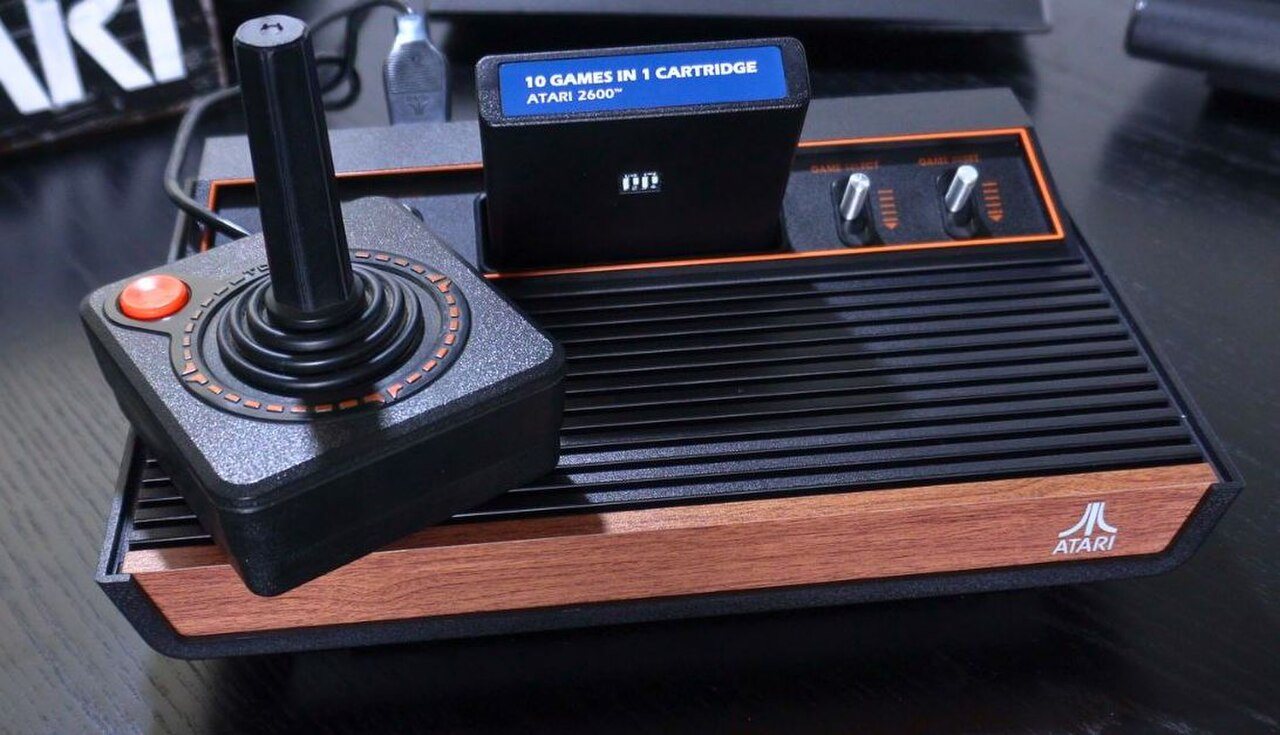
Hardware revenue grew 83% to 7.3 million euros, and that line rests on the Plus consoles. The Atari 2600+ arrived in 2023, a shrunken replica of the original machine with an HDMI output and a working cartridge slot. The Atari 7800+ followed in 2024 at $129.99, made with the German publisher Plaion, playing both 2600 and 7800 cartridges and bundled with a new game called Bentley Bear's Crystal Quest.
Where to find one today: both Plus consoles are current products rather than collectibles, so the cheapest route is a new unit at or below the $129.99 the 7800+ launched at, with used ones showing up on eBay.com for less. Original consoles from the late 1970s and early 1980s are everywhere on eBay too, where condition and a working switch matter far more than which revision you get.
The buying spree that turned Atari into a retro company
Rosen's Atari has spent the 2020s buying the people who preserve old games rather than the people who make new ones. Nightdive Studios, which rebuilds classics like System Shock and Quake for modern hardware, and Digital Eclipse, the studio behind Atari's anniversary compilations, are both Atari subsidiaries now.
On May 23, 2024 Atari bought the Intellivision brand and the rights to more than 200 games from Intellivision Entertainment, which kept its Amico console business and licensed the games back. Rosen called it "a very rare opportunity to unite former competitors." A console rivalry that started in 1979 ended with one company owning both logos.
The shopping did not stop there. Atari lifted its stake in the Swedish publisher Thunderful to 97%, and after the fiscal year closed it paid an initial $29.3 million for Hipster Whale, the Australian studio behind Crossy Road. That one is a working mobile developer, not a museum piece, which suggests where Rosen wants to take the money the catalog is finally producing.
What happened to the Atari hotels?
On January 27, 2020 Atari announced a licensing deal with GSD Group to build Atari Hotels, with the first set to break ground in Phoenix in the middle of that year. Atari was not paying to build them, it was renting out the name to a developer who would.
Nothing was built. The groundbreaking slipped, the pandemic arrived, and more than six years later there is still no Atari hotel open anywhere in the United States. A Phoenix project has since been revived on paper with a different development team and an opening date pushed years past the one originally promised.
The hotels are worth remembering because they show what the brand had been reduced to: a logo rented to whoever wanted instant 1980s shorthand. Under Rosen the company has pulled back toward products it controls end to end. That is why the 2600+ exists, why Atari owns the studios that restore its own games, and why the hotel still does not exist.
Frequently Asked Questions
Is Atari still making consoles in 2026?
Yes, in a narrow sense. The Atari 2600+ and 7800+ are cartridge-compatible reissues of 1970s and 1980s hardware, not new platforms, and they helped hardware revenue reach 7.3 million euros in the year to March 2026, up 83%. Atari is not building anything meant to compete with PlayStation or Xbox.
Who is the CEO of Atari?
Wade Rosen. He joined the board as chairman in April 2020 and took over as chief executive in April 2021. His holding company IRATA LLC held 39.96% of Atari SA's capital as of August 17, 2026, which makes him both the boss and the largest shareholder.
Is the Atari 2600+ worth buying?
It depends on whether you own cartridges. The 2600+ and the 7800+ read original 2600 and 7800 games through a real slot, and that slot is the entire reason to buy one; the 7800+ launched at $129.99. If you have no cartridges sitting in a closet, a digital compilation gives you far more games for less money.