How the Nintendo NES Saved Video Games After the 1983 Crash

Picture this. It is the fall of 1985. You are eight years old. You are walking through the toy aisle of a Sears in suburban America with your mom, and you stop in front of a display you have never seen before. There is a sleek gray plastic box that does not look like the Atari your cousin had. There is a robot called R.O.B. with glowing red eyes. There is a plastic gun shaped like a science fiction laser pistol. And there is a TV running a demo of a tiny Italian plumber jumping over a turtle to the catchiest 8-bit music you have ever heard. You stare at it for ten minutes. You drag your mom over. She squints, reads the price tag, sighs, and says, maybe for Christmas.

That is the moment Nintendo had been planning for. Because two years earlier, in the fall of 1983, the entire American video game industry had collapsed in on itself. Stores were piling unsold cartridges into landfills in New Mexico. Atari, the company that had been synonymous with the word video game, was hemorrhaging hundreds of millions of dollars and getting carved up by Warner Communications. The phrase video game had become poison at retail. And here was a Japanese playing card company that nobody in middle America had heard of, walking into that wreckage and saying, we are going to sell you a console. In a recession. After the crash. With a robot.

And the wild thing is, it worked. The Nintendo Entertainment System sold somewhere around 62 million units worldwide before it was done, with roughly 34 million of those in North America. It put Nintendo at the center of pop culture for the next decade. It minted Mario as the most recognizable character in entertainment. It built the rules every console maker still operates by. And it did all of this because of a series of decisions that, at the time, looked completely insane.

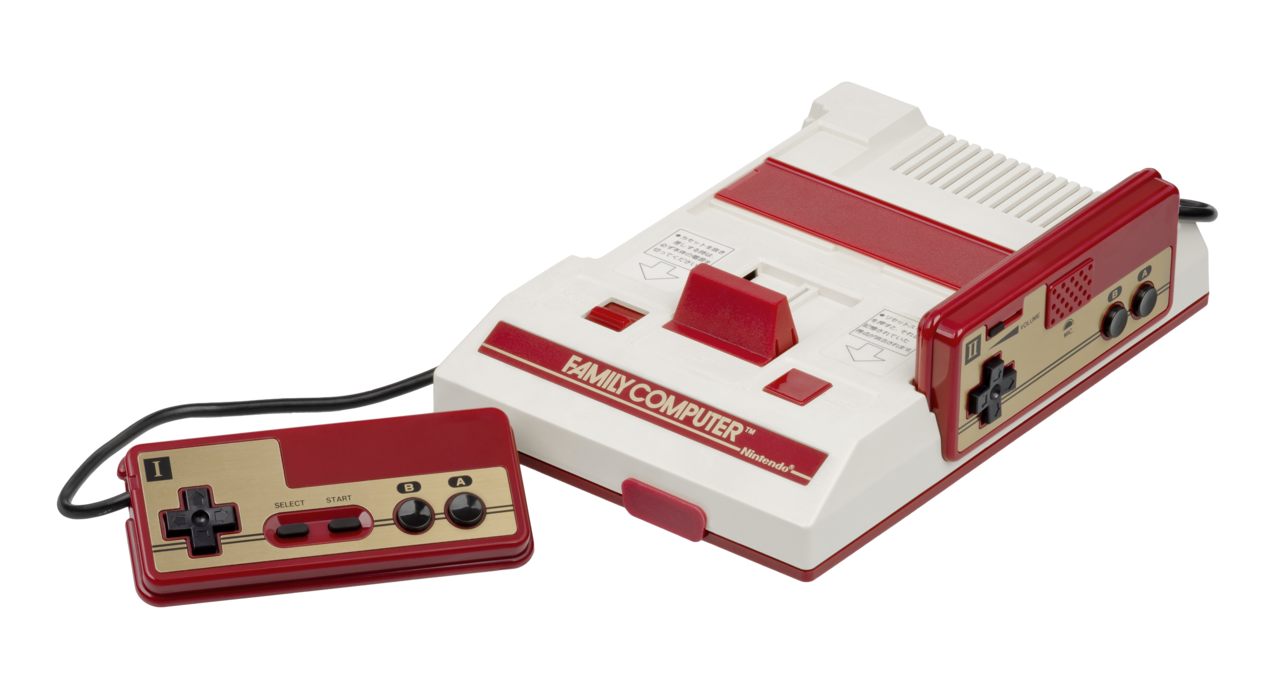
The Japanese Family Computer or Famicom console with two attached controllers and a cartridge slot, in its red and white livery
The original Japanese Family Computer, or Famicom, that launched in July 1983. Nintendo of America redesigned this hardware into the gray and black NES to escape the toxic video game label that had wrecked Atari at retail.

The Crash That Killed American Video Games

To understand why the NES was such a long shot, you have to understand how bad 1983 really was. Most people who were not there have a vague sense that there was some kind of video game crash, that E.T. on the Atari 2600 was bad, that there were buried cartridges in the desert. The reality was much worse than that.

In 1982, the American home video game market was worth about $3.2 billion. Two years later, in 1984, it was worth roughly $100 million. That is not a downturn. That is a 97 percent collapse. It is the kind of number you usually only see in stock crashes or banking panics, and it happened to an industry that had only existed for a decade.

The reasons were a perfect storm. Atari had let its 2600 platform get flooded with garbage. There were no licensing controls, no quality standards, no way for stores to know what was good. By 1982 there were dozens of third-party publishers, many of them brand new and incompetent, dumping unfinished games onto retail shelves. Pac-Man on the 2600 was a notorious mess. E.T., made in five and a half weeks to hit Christmas 1982, became the punchline. Activision was producing brilliant work, but for every Pitfall there were ten knock-offs gathering dust.

Then the price war hit. Retailers were stuck with mountains of unsold inventory and started slashing prices. Cartridges that had launched at $35 were getting dumped at $5. Once that happens, you cannot un-happen it. Buyers learn that if they wait six months, the price will collapse, so they wait. New releases die at full price. Publishers stop investing. Stores stop ordering. The whole engine seizes.

By 1984, retailers had decided the entire category was a fad that had run its course. Toys R Us slashed shelf space. Department stores moved consoles to clearance bins. The trade press was openly speculating that home video games were over for good, the same way pet rocks and CB radio had been over.

This is the room Nintendo walked into.

The Famicom: A Hit in Japan, a Risky Bet Abroad

Nintendo's Japanese console, the Family Computer or Famicom, had launched on July 15, 1983, just as the American market was starting to fall apart. The Famicom was designed by a small team led by Masayuki Uemura, an engineer Nintendo president Hiroshi Yamauchi had personally poached from Sharp years earlier. Yamauchi told Uemura two things. He wanted hardware that nobody else could clone for at least a year. And he wanted a low retail price.

Uemura's team got there by stripping the design to the studs. The Famicom used a custom Ricoh 2A03 chip based on the MOS 6502. It used a custom picture processing unit Nintendo had designed in-house. It launched at 14,800 yen with three games, two of them Donkey Kong titles and the third a port of Popeye. It sold extremely well in its first months. By 1984, the Famicom was the best-selling console in Japan and Nintendo had a logistical problem keeping up with demand.

So Yamauchi looked west. The natural move would have been to license the hardware to an American partner who already had retail relationships. Atari was the obvious choice. There was a serious negotiation with Atari in 1983 to distribute the Famicom in the United States as an Atari product. The deal fell apart, partly over Coleco showing off an unauthorized port of Donkey Kong on its Adam computer at the Consumer Electronics Show, which Yamauchi took as a sign Atari could not be trusted to protect the IP.

That left Nintendo with a brutal choice. Either give up on America entirely, or do the launch themselves through their fledgling subsidiary Nintendo of America, run by Yamauchi's son-in-law Minoru Arakawa out of a warehouse in the Seattle area. Arakawa picked the second option. He had no idea how hard it was about to be.

Selling a Dead Industry to Skeptical Retailers

This is the part that gets glossed over in most retellings, and it is the most important part of the whole story. Nintendo of America did not get to walk into a Toys R Us in 1985 and say, here is our new video game console. Nobody wanted a video game console. The category was poison. Buyers at the major chains had told their reps in plain English to stop pitching them.

Arakawa's team had to do something almost magical. They had to convince retailers that the gray plastic box on the desk in front of them was not, in fact, a video game console. So they renamed everything. The Famicom became the Nintendo Entertainment System, with the word Entertainment doing all the heavy lifting. The cartridges became Game Paks. The console did not have a console-style top-loading cartridge slot, even though the Famicom did. Nintendo of America insisted on a redesigned chassis with a front-loading slot that pushed the cartridge in like a VCR tape, because VCRs were the hot new home electronics category and nobody hated VCRs.

The R.O.B. peripheral, the Robotic Operating Buddy with the light-up sensor and the plastic arms that picked up gyros, was almost entirely a marketing prop. R.O.B. was designed to make the NES look like an interactive robot toy that happened to have games, not a video game system that happened to have a robot. There were only two real R.O.B. games released, Gyromite and Stack-Up, and they were not particularly fun. R.O.B. existed because R.O.B. could get you onto the toy aisle planogram.

The NES Zapper, the gray and orange light gun, served the same purpose. It was a toy. Toys had a category. Toys were not dead in 1985.

Nintendo of America launched the NES in a single test market first. October 18, 1985, in New York City, at a handful of select retailers. The deal Arakawa had to cut to get on those shelves is now legendary. Nintendo essentially guaranteed unsold inventory. They put their own people in stores to set up the displays. They paid for in-store demo kiosks. They handled returns. They turned a sales pitch into something closer to a consignment relationship, which retailers were willing to accept because the financial risk had moved entirely onto Nintendo's balance sheet.

The New York test sold a healthy share of the units Nintendo had committed to the launch by the end of the holiday season. That was not a triumph. It was, however, a survival. Bigger chains agreed to take the system in 1986. The national rollout began in early 1986 in Los Angeles, and continued through additional cities over the year. By the end of 1986, the NES was in stores across the country. By the end of 1987, it had sold roughly 1.8 million units in North America. By 1988, it was selling millions more in a single year. And by 1990, almost a third of American households with a television had an NES under it.

Super Mario Bros and the Pack-In That Changed Everything

None of the above happens without one specific cartridge. Super Mario Bros was developed by a small team at Nintendo R and D4 led by Shigeru Miyamoto and Takashi Tezuka, with Toshihiro Nakago as the lead programmer. It launched in Japan on September 13, 1985, and was bundled with the NES in North America from the 1985 test launch onward, often paired with Duck Hunt on a single cartridge in the so-called Action Set bundle that became the dominant SKU in 1988. The bundle deal was unprecedented in the American market. Most consoles before the NES had not shipped with software at all. You bought the hardware and then you bought a separate cartridge. Nintendo's pack-in strategy meant that the second you got the system home, you had a transcendent piece of software waiting for you.

Super Mario Bros was so far beyond what anyone had seen on home hardware that it was almost difficult to process. The screen scrolled smoothly to the right. The sprites were enormous and recognizable. The music, written by Koji Kondo, lodged itself in your head on the first playthrough. The level design rewarded experimentation in a way that felt new. There were secret pipes that took you to underground bonus rooms. There was a hidden warp zone. There was a final boss who was not actually the final boss, because the kingdom was always in another castle.

The cartridge sold roughly 40 million copies as a pack-in over the lifetime of the NES, which made it the best-selling video game in history for two decades. It was finally surpassed by Wii Sports in 2009, which was also a pack-in. The pattern is not a coincidence. If you give people the most charming software possible the moment they unbox the hardware, they tell their friends. Word of mouth in 1986 was kids in elementary school cafeterias trading rumors about the warp zone in 1-2.

A Nintendo Entertainment System console with a Super Mario Bros sticker, with a controller and Game Pak in front
Super Mario Bros became the killer app of the NES era. The pack-in deal meant that every American kid who unwrapped a Nintendo on Christmas morning had Mario waiting for them, which made the system feel essential the moment the box was open.

The Lockout Chip and the Iron Grip on Quality

Nintendo had watched what happened to Atari and decided, in detail, never to let it happen to them. The 1983 crash had been driven in large part by an avalanche of bad third-party games that Atari had no power to stop. Nintendo's response was a piece of silicon called the 10NES, a small lockout chip that lived inside every NES console and inside every licensed Game Pak. The chip in the cartridge had to handshake with the chip in the console for the game to boot. No handshake, no game.

That single design decision rewrote the rules of the console business. To get the lockout chip, you had to be a Nintendo licensee. To be a Nintendo licensee, you had to agree to terms that, at the time, sounded outrageous. You had to manufacture your cartridges through Nintendo, paying the company a per-cartridge fee on top of the underlying production cost. You had to commit to minimum order quantities that put the inventory risk back on you, not Nintendo. You had to limit the number of titles you released per year, capped at five or so for most publishers. You could not release the same title on a competing platform within a window of two years. And every game had to pass through Nintendo of America's quality assurance process, which is where the famous gold Nintendo Seal of Quality came from.

This is where it all gets interesting, because Nintendo's licensing terms were genuinely heavy-handed. They got Nintendo sued by Atari Games, which set up a subsidiary called Tengen specifically to crack the 10NES chip and ship unlicensed cartridges. Tengen reverse-engineered the lockout chip, lost a lengthy legal battle, and eventually had to stop manufacturing NES cartridges. Nintendo also drew the attention of regulators, settling a price-fixing investigation in 1991 that resulted in rebate coupons sent to NES owners.

And here is the thing. The licensing terms were anti-competitive. They were also, in retrospect, exactly what the industry needed. Nintendo's quality bar kept retailers convinced that the NES library was worth shelf space. Stores knew that whatever Nintendo Seal cartridge they put on the rack had passed through a real review process. The seal of approval was, functionally, a brand promise to retailers as much as to consumers. That promise is what kept Toys R Us from pulling the rug out from under video games again.

Nintendo Power and the Cool Patrol

Nintendo of America was not just selling a console. It was building a media empire around it. Nintendo Power magazine launched in July 1988 as a free issue, then converted to a paid subscription. Within a couple of years it had over a million subscribers, making it one of the largest paid magazines in the United States, period. Not just gaming. The whole magazine industry. A children's product magazine was outselling adult-targeted lifestyle publications.

Before Nintendo Power, there was the Nintendo Fun Club newsletter, which had been free since 1987. And before that, there was the Nintendo Game Counselor hotline, a phone line you could call to get tips on stuck games. Kids ran up phone bills calling that hotline. Parents got the bills, and you would hear stories about hundreds of dollars of phone charges from a single weekend of trying to beat Battletoads.

Then came the Nintendo World Championships in 1990, a multi-city tournament that Nintendo turned into the gaming equivalent of a Coca-Cola commercial. There was The Wizard, a 1989 film starring Fred Savage that was essentially a 100-minute advertisement for Super Mario Bros 3 and the Power Glove. The Power Glove itself was a colossal flop as a product, but a marketing win because it was so weird that it became iconic.

Nintendo even ran a kids' show on Saturday mornings, The Super Mario Bros Super Show, which ran from 1989 to 1990 with live-action segments featuring Captain Lou Albano as Mario. The show was widely considered terrible. It also reinforced, in the brain of every American child watching cartoons in the bowl-of-cereal hour, that the Nintendo characters were celebrities.

By 1990, almost a third of American households with a television also had an NES under it. Nintendo had captured kids in a way no electronics company had managed since the introduction of the transistor radio.

The Library and the Killer Apps

The NES library ended up at roughly 715 licensed games in North America by the time the system was officially discontinued. The hits during the system's run kept compounding on each other. The Legend of Zelda launched in North America in August 1987 and shipped with a battery-backed gold cartridge, the first console game in the United States to let you save your progress. Metroid arrived a few months later. Mike Tyson's Punch-Out came out in 1987, with the actual world heavyweight champion's name on the box. Tetris, in its NES form, launched in late 1989 after a famously messy licensing dispute. Final Fantasy and Dragon Quest opened the door for Japanese role-playing games on American shelves, even if Final Fantasy 1 sold only modestly its first year. Castlevania, Mega Man, Contra, Duck Tales, Battletoads, the licensed Disney games from Capcom, the Sega-poaching of Capcom and Konami onto the platform. The list is long because the system kept producing them.

Super Mario Bros 3 is the one most people remember as the peak. It launched in North America in February 1990 and went on to sell well over 17 million copies, making it one of the highest-grossing pieces of entertainment of any kind from that period.

By 1991, Sega had launched the Genesis in the United States with the explicit intention of breaking Nintendo's grip. The console wars that followed are their own story, but the important point is that the Genesis only got to fight Nintendo because Nintendo had already rebuilt the entire industry from scratch. Sega did not have to convince Toys R Us that video games were a real category anymore. The NES had already done that work.

The Slow Goodbye: 1993 to 2003

The Super Nintendo launched in North America in August 1991. From that point on, the NES was technically a legacy product, but Nintendo did not pull the plug. There was a redesigned NES-101 model released in 1993 at $49.99, a cute top-loading version that looked like a pillow with a controller port. The NES kept selling new games into 1994. Kirby's Adventure, Tetris 2, the U.S. release of Mega Man 6, the cartridge port of Wario's Woods. Nintendo of America formally discontinued sales of the NES in 1995. In Japan, Nintendo continued repairing and servicing Famicom units until 2007, when the company officially ended hardware servicing for the system.

That tail is a hint of what made the NES different. Most consoles get cut off the second the next generation launches. Nintendo kept supporting a system at retail for years after a successor existed because, in many American households, the NES was still the only console. Sega had a more aggressive customer churn strategy. Nintendo had, in effect, a customer base. There were elementary school kids in 1992 who got an NES instead of a Super Nintendo because their older sibling already had one and the cartridges were cheaper.

What the NES Actually Built

The NES did not just save video games. It rewrote what a video game console even meant. Almost every rule in modern console business comes from decisions Nintendo made between 1985 and 1990.

The pack-in game as a launch tool. The console as a media platform with magazines, hotlines, TV shows, and licensed merchandise. The licensing program with mandatory royalties and quality control. The seal of approval as a brand promise to retailers. The first-party flagship character used to anchor every generation. The exclusivity windows that locked publishers into platform commitments. The peripheral as a marketing device, even if the peripheral itself was a flop. The tournament as a customer engagement event. The deliberate cultivation of a kid-first audience as the long-term economic base.

Sony's PlayStation, Microsoft's Xbox, even Nintendo's own Switch, all of them are still operating inside the framework Nintendo built in the wreckage of the 1983 crash. When Sony decided in 1994 that PlayStation games would be manufactured by Sony, with publishers paying a per-disc royalty and quality control going through Sony, that was an NES idea. When Microsoft decided in 2002 that Xbox Live would centralize multiplayer infrastructure rather than let publishers run their own servers, that was an NES idea about controlling the platform. When the Switch launches with a Mario or Zelda title every time, that is the pack-in lesson with three more decades of polish on it.

The NES was the moment video games stopped being a fad and became infrastructure. The gray plastic box, the gold-sealed cartridges, the laser gun, the robot. All of it was a Trojan horse for a 40-year industry that has not had a serious crash since.

Frequently Asked Questions

How many NES units were sold in total?

Nintendo's official lifetime figure for the Famicom and NES combined is approximately 61.91 million units worldwide. North America accounts for the largest share at around 34 million sales, Japan accounts for about 19 million, and the rest were sold in Europe, Australia, and other regions where the system launched in the late 1980s.

Was the NES really styled to look like a VCR?

Yes. Nintendo of America explicitly redesigned the Japanese Famicom into a front-loading, gray and black chassis to dodge the toxic video game label. Buyers at chains like Toys R Us were refusing to consider new game consoles after the 1983 crash, so Nintendo positioned the NES as a piece of consumer electronics in the same general category as VCRs, which were a hot new product. The Robotic Operating Buddy and the Zapper light gun were extensions of the same strategy, designed to push the system into the toy aisle while the entertainment system framing kept it eligible for electronics shelves too.

What was the role of the 10NES lockout chip?

The 10NES was a security chip Nintendo embedded in every NES console and licensed Game Pak. It performed a handshake at boot to verify that the cartridge was officially licensed. Without that handshake, the console would refuse to play the game. The chip enforced Nintendo's strict licensing program, which required publishers to pay royalties, manufacture cartridges through Nintendo, and pass quality reviews before getting the gold Nintendo Seal of Quality. The system was challenged in court by Atari Games through its Tengen subsidiary, which reverse-engineered the chip and ultimately lost the resulting copyright lawsuit in the early 1990s.

What were the best-selling NES games?

Super Mario Bros sits at the top with around 40 million copies sold, the vast majority bundled in as a pack-in. Super Mario Bros 3 sold roughly 17 million. Other major sellers include Super Mario Bros 2, Duck Hunt, Tetris, The Legend of Zelda, Zelda II, and Mike Tyson's Punch-Out. The library overall reached approximately 715 licensed games released in North America by the end of the system's commercial life.

When was the NES officially discontinued?

Nintendo of America stopped distributing new NES hardware in 1995. The system was kept alive much longer in Japan, where Nintendo continued repairing and servicing Famicom units into the late 2000s. By that point, the NES had been on the market in some form for two decades, an extremely rare lifespan for any piece of consumer electronics.

Did the NES really save the video game industry?

The American home console market collapsed from roughly $3.2 billion in 1982 to about $100 million in 1985, a 97 percent drop driven by oversaturation, low-quality software, and the resulting retail panic. Nintendo's launch strategy and licensing controls rebuilt the category from scratch over the second half of the 1980s. By 1990, the home console business was again worth several billion dollars in the United States alone, and almost every successful console business since has used a version of the playbook Nintendo wrote during the NES era. By any reasonable read, yes, the NES saved video games as a mainstream consumer product.

๐Ÿ“– How the Nintendo NES Saved Video Games After the 1983 Crash
_ โ–ก ร—
← Back

How the Nintendo NES Saved Video Games After the 1983 Crash

2026-05-10 by 404 Memory Found

Picture this. It is the fall of 1985. You are eight years old. You are walking through the toy aisle of a Sears in suburban America with your mom, and you stop in front of a display you have never seen before. There is a sleek gray plastic box that does not look like the Atari your cousin had. There is a robot called R.O.B. with glowing red eyes. There is a plastic gun shaped like a science fiction laser pistol. And there is a TV running a demo of a tiny Italian plumber jumping over a turtle to the catchiest 8-bit music you have ever heard. You stare at it for ten minutes. You drag your mom over. She squints, reads the price tag, sighs, and says, maybe for Christmas.

That is the moment Nintendo had been planning for. Because two years earlier, in the fall of 1983, the entire American video game industry had collapsed in on itself. Stores were piling unsold cartridges into landfills in New Mexico. Atari, the company that had been synonymous with the word video game, was hemorrhaging hundreds of millions of dollars and getting carved up by Warner Communications. The phrase video game had become poison at retail. And here was a Japanese playing card company that nobody in middle America had heard of, walking into that wreckage and saying, we are going to sell you a console. In a recession. After the crash. With a robot.

And the wild thing is, it worked. The Nintendo Entertainment System sold somewhere around 62 million units worldwide before it was done, with roughly 34 million of those in North America. It put Nintendo at the center of pop culture for the next decade. It minted Mario as the most recognizable character in entertainment. It built the rules every console maker still operates by. And it did all of this because of a series of decisions that, at the time, looked completely insane.

The Japanese Family Computer or Famicom console with two attached controllers and a cartridge slot, in its red and white livery
The original Japanese Family Computer, or Famicom, that launched in July 1983. Nintendo of America redesigned this hardware into the gray and black NES to escape the toxic video game label that had wrecked Atari at retail.

The Crash That Killed American Video Games

To understand why the NES was such a long shot, you have to understand how bad 1983 really was. Most people who were not there have a vague sense that there was some kind of video game crash, that E.T. on the Atari 2600 was bad, that there were buried cartridges in the desert. The reality was much worse than that.

In 1982, the American home video game market was worth about $3.2 billion. Two years later, in 1984, it was worth roughly $100 million. That is not a downturn. That is a 97 percent collapse. It is the kind of number you usually only see in stock crashes or banking panics, and it happened to an industry that had only existed for a decade.

The reasons were a perfect storm. Atari had let its 2600 platform get flooded with garbage. There were no licensing controls, no quality standards, no way for stores to know what was good. By 1982 there were dozens of third-party publishers, many of them brand new and incompetent, dumping unfinished games onto retail shelves. Pac-Man on the 2600 was a notorious mess. E.T., made in five and a half weeks to hit Christmas 1982, became the punchline. Activision was producing brilliant work, but for every Pitfall there were ten knock-offs gathering dust.

Then the price war hit. Retailers were stuck with mountains of unsold inventory and started slashing prices. Cartridges that had launched at $35 were getting dumped at $5. Once that happens, you cannot un-happen it. Buyers learn that if they wait six months, the price will collapse, so they wait. New releases die at full price. Publishers stop investing. Stores stop ordering. The whole engine seizes.

By 1984, retailers had decided the entire category was a fad that had run its course. Toys R Us slashed shelf space. Department stores moved consoles to clearance bins. The trade press was openly speculating that home video games were over for good, the same way pet rocks and CB radio had been over.

This is the room Nintendo walked into.

The Famicom: A Hit in Japan, a Risky Bet Abroad

Nintendo's Japanese console, the Family Computer or Famicom, had launched on July 15, 1983, just as the American market was starting to fall apart. The Famicom was designed by a small team led by Masayuki Uemura, an engineer Nintendo president Hiroshi Yamauchi had personally poached from Sharp years earlier. Yamauchi told Uemura two things. He wanted hardware that nobody else could clone for at least a year. And he wanted a low retail price.

Uemura's team got there by stripping the design to the studs. The Famicom used a custom Ricoh 2A03 chip based on the MOS 6502. It used a custom picture processing unit Nintendo had designed in-house. It launched at 14,800 yen with three games, two of them Donkey Kong titles and the third a port of Popeye. It sold extremely well in its first months. By 1984, the Famicom was the best-selling console in Japan and Nintendo had a logistical problem keeping up with demand.

So Yamauchi looked west. The natural move would have been to license the hardware to an American partner who already had retail relationships. Atari was the obvious choice. There was a serious negotiation with Atari in 1983 to distribute the Famicom in the United States as an Atari product. The deal fell apart, partly over Coleco showing off an unauthorized port of Donkey Kong on its Adam computer at the Consumer Electronics Show, which Yamauchi took as a sign Atari could not be trusted to protect the IP.

That left Nintendo with a brutal choice. Either give up on America entirely, or do the launch themselves through their fledgling subsidiary Nintendo of America, run by Yamauchi's son-in-law Minoru Arakawa out of a warehouse in the Seattle area. Arakawa picked the second option. He had no idea how hard it was about to be.

Selling a Dead Industry to Skeptical Retailers

This is the part that gets glossed over in most retellings, and it is the most important part of the whole story. Nintendo of America did not get to walk into a Toys R Us in 1985 and say, here is our new video game console. Nobody wanted a video game console. The category was poison. Buyers at the major chains had told their reps in plain English to stop pitching them.

Arakawa's team had to do something almost magical. They had to convince retailers that the gray plastic box on the desk in front of them was not, in fact, a video game console. So they renamed everything. The Famicom became the Nintendo Entertainment System, with the word Entertainment doing all the heavy lifting. The cartridges became Game Paks. The console did not have a console-style top-loading cartridge slot, even though the Famicom did. Nintendo of America insisted on a redesigned chassis with a front-loading slot that pushed the cartridge in like a VCR tape, because VCRs were the hot new home electronics category and nobody hated VCRs.

The R.O.B. peripheral, the Robotic Operating Buddy with the light-up sensor and the plastic arms that picked up gyros, was almost entirely a marketing prop. R.O.B. was designed to make the NES look like an interactive robot toy that happened to have games, not a video game system that happened to have a robot. There were only two real R.O.B. games released, Gyromite and Stack-Up, and they were not particularly fun. R.O.B. existed because R.O.B. could get you onto the toy aisle planogram.

The NES Zapper, the gray and orange light gun, served the same purpose. It was a toy. Toys had a category. Toys were not dead in 1985.

Nintendo of America launched the NES in a single test market first. October 18, 1985, in New York City, at a handful of select retailers. The deal Arakawa had to cut to get on those shelves is now legendary. Nintendo essentially guaranteed unsold inventory. They put their own people in stores to set up the displays. They paid for in-store demo kiosks. They handled returns. They turned a sales pitch into something closer to a consignment relationship, which retailers were willing to accept because the financial risk had moved entirely onto Nintendo's balance sheet.

The New York test sold a healthy share of the units Nintendo had committed to the launch by the end of the holiday season. That was not a triumph. It was, however, a survival. Bigger chains agreed to take the system in 1986. The national rollout began in early 1986 in Los Angeles, and continued through additional cities over the year. By the end of 1986, the NES was in stores across the country. By the end of 1987, it had sold roughly 1.8 million units in North America. By 1988, it was selling millions more in a single year. And by 1990, almost a third of American households with a television had an NES under it.

Super Mario Bros and the Pack-In That Changed Everything

None of the above happens without one specific cartridge. Super Mario Bros was developed by a small team at Nintendo R and D4 led by Shigeru Miyamoto and Takashi Tezuka, with Toshihiro Nakago as the lead programmer. It launched in Japan on September 13, 1985, and was bundled with the NES in North America from the 1985 test launch onward, often paired with Duck Hunt on a single cartridge in the so-called Action Set bundle that became the dominant SKU in 1988. The bundle deal was unprecedented in the American market. Most consoles before the NES had not shipped with software at all. You bought the hardware and then you bought a separate cartridge. Nintendo's pack-in strategy meant that the second you got the system home, you had a transcendent piece of software waiting for you.

Super Mario Bros was so far beyond what anyone had seen on home hardware that it was almost difficult to process. The screen scrolled smoothly to the right. The sprites were enormous and recognizable. The music, written by Koji Kondo, lodged itself in your head on the first playthrough. The level design rewarded experimentation in a way that felt new. There were secret pipes that took you to underground bonus rooms. There was a hidden warp zone. There was a final boss who was not actually the final boss, because the kingdom was always in another castle.

The cartridge sold roughly 40 million copies as a pack-in over the lifetime of the NES, which made it the best-selling video game in history for two decades. It was finally surpassed by Wii Sports in 2009, which was also a pack-in. The pattern is not a coincidence. If you give people the most charming software possible the moment they unbox the hardware, they tell their friends. Word of mouth in 1986 was kids in elementary school cafeterias trading rumors about the warp zone in 1-2.

A Nintendo Entertainment System console with a Super Mario Bros sticker, with a controller and Game Pak in front
Super Mario Bros became the killer app of the NES era. The pack-in deal meant that every American kid who unwrapped a Nintendo on Christmas morning had Mario waiting for them, which made the system feel essential the moment the box was open.

The Lockout Chip and the Iron Grip on Quality

Nintendo had watched what happened to Atari and decided, in detail, never to let it happen to them. The 1983 crash had been driven in large part by an avalanche of bad third-party games that Atari had no power to stop. Nintendo's response was a piece of silicon called the 10NES, a small lockout chip that lived inside every NES console and inside every licensed Game Pak. The chip in the cartridge had to handshake with the chip in the console for the game to boot. No handshake, no game.

That single design decision rewrote the rules of the console business. To get the lockout chip, you had to be a Nintendo licensee. To be a Nintendo licensee, you had to agree to terms that, at the time, sounded outrageous. You had to manufacture your cartridges through Nintendo, paying the company a per-cartridge fee on top of the underlying production cost. You had to commit to minimum order quantities that put the inventory risk back on you, not Nintendo. You had to limit the number of titles you released per year, capped at five or so for most publishers. You could not release the same title on a competing platform within a window of two years. And every game had to pass through Nintendo of America's quality assurance process, which is where the famous gold Nintendo Seal of Quality came from.

This is where it all gets interesting, because Nintendo's licensing terms were genuinely heavy-handed. They got Nintendo sued by Atari Games, which set up a subsidiary called Tengen specifically to crack the 10NES chip and ship unlicensed cartridges. Tengen reverse-engineered the lockout chip, lost a lengthy legal battle, and eventually had to stop manufacturing NES cartridges. Nintendo also drew the attention of regulators, settling a price-fixing investigation in 1991 that resulted in rebate coupons sent to NES owners.

And here is the thing. The licensing terms were anti-competitive. They were also, in retrospect, exactly what the industry needed. Nintendo's quality bar kept retailers convinced that the NES library was worth shelf space. Stores knew that whatever Nintendo Seal cartridge they put on the rack had passed through a real review process. The seal of approval was, functionally, a brand promise to retailers as much as to consumers. That promise is what kept Toys R Us from pulling the rug out from under video games again.

Nintendo Power and the Cool Patrol

Nintendo of America was not just selling a console. It was building a media empire around it. Nintendo Power magazine launched in July 1988 as a free issue, then converted to a paid subscription. Within a couple of years it had over a million subscribers, making it one of the largest paid magazines in the United States, period. Not just gaming. The whole magazine industry. A children's product magazine was outselling adult-targeted lifestyle publications.

Before Nintendo Power, there was the Nintendo Fun Club newsletter, which had been free since 1987. And before that, there was the Nintendo Game Counselor hotline, a phone line you could call to get tips on stuck games. Kids ran up phone bills calling that hotline. Parents got the bills, and you would hear stories about hundreds of dollars of phone charges from a single weekend of trying to beat Battletoads.

Then came the Nintendo World Championships in 1990, a multi-city tournament that Nintendo turned into the gaming equivalent of a Coca-Cola commercial. There was The Wizard, a 1989 film starring Fred Savage that was essentially a 100-minute advertisement for Super Mario Bros 3 and the Power Glove. The Power Glove itself was a colossal flop as a product, but a marketing win because it was so weird that it became iconic.

Nintendo even ran a kids' show on Saturday mornings, The Super Mario Bros Super Show, which ran from 1989 to 1990 with live-action segments featuring Captain Lou Albano as Mario. The show was widely considered terrible. It also reinforced, in the brain of every American child watching cartoons in the bowl-of-cereal hour, that the Nintendo characters were celebrities.

By 1990, almost a third of American households with a television also had an NES under it. Nintendo had captured kids in a way no electronics company had managed since the introduction of the transistor radio.

The Library and the Killer Apps

The NES library ended up at roughly 715 licensed games in North America by the time the system was officially discontinued. The hits during the system's run kept compounding on each other. The Legend of Zelda launched in North America in August 1987 and shipped with a battery-backed gold cartridge, the first console game in the United States to let you save your progress. Metroid arrived a few months later. Mike Tyson's Punch-Out came out in 1987, with the actual world heavyweight champion's name on the box. Tetris, in its NES form, launched in late 1989 after a famously messy licensing dispute. Final Fantasy and Dragon Quest opened the door for Japanese role-playing games on American shelves, even if Final Fantasy 1 sold only modestly its first year. Castlevania, Mega Man, Contra, Duck Tales, Battletoads, the licensed Disney games from Capcom, the Sega-poaching of Capcom and Konami onto the platform. The list is long because the system kept producing them.

Super Mario Bros 3 is the one most people remember as the peak. It launched in North America in February 1990 and went on to sell well over 17 million copies, making it one of the highest-grossing pieces of entertainment of any kind from that period.

By 1991, Sega had launched the Genesis in the United States with the explicit intention of breaking Nintendo's grip. The console wars that followed are their own story, but the important point is that the Genesis only got to fight Nintendo because Nintendo had already rebuilt the entire industry from scratch. Sega did not have to convince Toys R Us that video games were a real category anymore. The NES had already done that work.

The Slow Goodbye: 1993 to 2003

The Super Nintendo launched in North America in August 1991. From that point on, the NES was technically a legacy product, but Nintendo did not pull the plug. There was a redesigned NES-101 model released in 1993 at $49.99, a cute top-loading version that looked like a pillow with a controller port. The NES kept selling new games into 1994. Kirby's Adventure, Tetris 2, the U.S. release of Mega Man 6, the cartridge port of Wario's Woods. Nintendo of America formally discontinued sales of the NES in 1995. In Japan, Nintendo continued repairing and servicing Famicom units until 2007, when the company officially ended hardware servicing for the system.

That tail is a hint of what made the NES different. Most consoles get cut off the second the next generation launches. Nintendo kept supporting a system at retail for years after a successor existed because, in many American households, the NES was still the only console. Sega had a more aggressive customer churn strategy. Nintendo had, in effect, a customer base. There were elementary school kids in 1992 who got an NES instead of a Super Nintendo because their older sibling already had one and the cartridges were cheaper.

What the NES Actually Built

The NES did not just save video games. It rewrote what a video game console even meant. Almost every rule in modern console business comes from decisions Nintendo made between 1985 and 1990.

The pack-in game as a launch tool. The console as a media platform with magazines, hotlines, TV shows, and licensed merchandise. The licensing program with mandatory royalties and quality control. The seal of approval as a brand promise to retailers. The first-party flagship character used to anchor every generation. The exclusivity windows that locked publishers into platform commitments. The peripheral as a marketing device, even if the peripheral itself was a flop. The tournament as a customer engagement event. The deliberate cultivation of a kid-first audience as the long-term economic base.

Sony's PlayStation, Microsoft's Xbox, even Nintendo's own Switch, all of them are still operating inside the framework Nintendo built in the wreckage of the 1983 crash. When Sony decided in 1994 that PlayStation games would be manufactured by Sony, with publishers paying a per-disc royalty and quality control going through Sony, that was an NES idea. When Microsoft decided in 2002 that Xbox Live would centralize multiplayer infrastructure rather than let publishers run their own servers, that was an NES idea about controlling the platform. When the Switch launches with a Mario or Zelda title every time, that is the pack-in lesson with three more decades of polish on it.

The NES was the moment video games stopped being a fad and became infrastructure. The gray plastic box, the gold-sealed cartridges, the laser gun, the robot. All of it was a Trojan horse for a 40-year industry that has not had a serious crash since.

Frequently Asked Questions

How many NES units were sold in total?

Nintendo's official lifetime figure for the Famicom and NES combined is approximately 61.91 million units worldwide. North America accounts for the largest share at around 34 million sales, Japan accounts for about 19 million, and the rest were sold in Europe, Australia, and other regions where the system launched in the late 1980s.

Was the NES really styled to look like a VCR?

Yes. Nintendo of America explicitly redesigned the Japanese Famicom into a front-loading, gray and black chassis to dodge the toxic video game label. Buyers at chains like Toys R Us were refusing to consider new game consoles after the 1983 crash, so Nintendo positioned the NES as a piece of consumer electronics in the same general category as VCRs, which were a hot new product. The Robotic Operating Buddy and the Zapper light gun were extensions of the same strategy, designed to push the system into the toy aisle while the entertainment system framing kept it eligible for electronics shelves too.

What was the role of the 10NES lockout chip?

The 10NES was a security chip Nintendo embedded in every NES console and licensed Game Pak. It performed a handshake at boot to verify that the cartridge was officially licensed. Without that handshake, the console would refuse to play the game. The chip enforced Nintendo's strict licensing program, which required publishers to pay royalties, manufacture cartridges through Nintendo, and pass quality reviews before getting the gold Nintendo Seal of Quality. The system was challenged in court by Atari Games through its Tengen subsidiary, which reverse-engineered the chip and ultimately lost the resulting copyright lawsuit in the early 1990s.

What were the best-selling NES games?

Super Mario Bros sits at the top with around 40 million copies sold, the vast majority bundled in as a pack-in. Super Mario Bros 3 sold roughly 17 million. Other major sellers include Super Mario Bros 2, Duck Hunt, Tetris, The Legend of Zelda, Zelda II, and Mike Tyson's Punch-Out. The library overall reached approximately 715 licensed games released in North America by the end of the system's commercial life.

When was the NES officially discontinued?

Nintendo of America stopped distributing new NES hardware in 1995. The system was kept alive much longer in Japan, where Nintendo continued repairing and servicing Famicom units into the late 2000s. By that point, the NES had been on the market in some form for two decades, an extremely rare lifespan for any piece of consumer electronics.

Did the NES really save the video game industry?

The American home console market collapsed from roughly $3.2 billion in 1982 to about $100 million in 1985, a 97 percent drop driven by oversaturation, low-quality software, and the resulting retail panic. Nintendo's launch strategy and licensing controls rebuilt the category from scratch over the second half of the 1980s. By 1990, the home console business was again worth several billion dollars in the United States alone, and almost every successful console business since has used a version of the playbook Nintendo wrote during the NES era. By any reasonable read, yes, the NES saved video games as a mainstream consumer product.

๐Ÿ“– How the Nintendo NES Saved Video Games After the 1983 Crash

Picture this. It is the fall of 1985. You are eight years old. You are walking through the toy aisle of a Sears in suburban America with your mom, and you stop in front of a display you have never seen before. There is a sleek gray plastic box that does not look like the Atari your cousin had. There is a robot called R.O.B. with glowing red eyes. There is a plastic gun shaped like a science fiction laser pistol. And there is a TV running a demo of a tiny Italian plumber jumping over a turtle to the catchiest 8-bit music you have ever heard. You stare at it for ten minutes. You drag your mom over. She squints, reads the price tag, sighs, and says, maybe for Christmas.

That is the moment Nintendo had been planning for. Because two years earlier, in the fall of 1983, the entire American video game industry had collapsed in on itself. Stores were piling unsold cartridges into landfills in New Mexico. Atari, the company that had been synonymous with the word video game, was hemorrhaging hundreds of millions of dollars and getting carved up by Warner Communications. The phrase video game had become poison at retail. And here was a Japanese playing card company that nobody in middle America had heard of, walking into that wreckage and saying, we are going to sell you a console. In a recession. After the crash. With a robot.

And the wild thing is, it worked. The Nintendo Entertainment System sold somewhere around 62 million units worldwide before it was done, with roughly 34 million of those in North America. It put Nintendo at the center of pop culture for the next decade. It minted Mario as the most recognizable character in entertainment. It built the rules every console maker still operates by. And it did all of this because of a series of decisions that, at the time, looked completely insane.

The Japanese Family Computer or Famicom console with two attached controllers and a cartridge slot, in its red and white livery
The original Japanese Family Computer, or Famicom, that launched in July 1983. Nintendo of America redesigned this hardware into the gray and black NES to escape the toxic video game label that had wrecked Atari at retail.

The Crash That Killed American Video Games

To understand why the NES was such a long shot, you have to understand how bad 1983 really was. Most people who were not there have a vague sense that there was some kind of video game crash, that E.T. on the Atari 2600 was bad, that there were buried cartridges in the desert. The reality was much worse than that.

In 1982, the American home video game market was worth about $3.2 billion. Two years later, in 1984, it was worth roughly $100 million. That is not a downturn. That is a 97 percent collapse. It is the kind of number you usually only see in stock crashes or banking panics, and it happened to an industry that had only existed for a decade.

The reasons were a perfect storm. Atari had let its 2600 platform get flooded with garbage. There were no licensing controls, no quality standards, no way for stores to know what was good. By 1982 there were dozens of third-party publishers, many of them brand new and incompetent, dumping unfinished games onto retail shelves. Pac-Man on the 2600 was a notorious mess. E.T., made in five and a half weeks to hit Christmas 1982, became the punchline. Activision was producing brilliant work, but for every Pitfall there were ten knock-offs gathering dust.

Then the price war hit. Retailers were stuck with mountains of unsold inventory and started slashing prices. Cartridges that had launched at $35 were getting dumped at $5. Once that happens, you cannot un-happen it. Buyers learn that if they wait six months, the price will collapse, so they wait. New releases die at full price. Publishers stop investing. Stores stop ordering. The whole engine seizes.

By 1984, retailers had decided the entire category was a fad that had run its course. Toys R Us slashed shelf space. Department stores moved consoles to clearance bins. The trade press was openly speculating that home video games were over for good, the same way pet rocks and CB radio had been over.

This is the room Nintendo walked into.

The Famicom: A Hit in Japan, a Risky Bet Abroad

Nintendo's Japanese console, the Family Computer or Famicom, had launched on July 15, 1983, just as the American market was starting to fall apart. The Famicom was designed by a small team led by Masayuki Uemura, an engineer Nintendo president Hiroshi Yamauchi had personally poached from Sharp years earlier. Yamauchi told Uemura two things. He wanted hardware that nobody else could clone for at least a year. And he wanted a low retail price.

Uemura's team got there by stripping the design to the studs. The Famicom used a custom Ricoh 2A03 chip based on the MOS 6502. It used a custom picture processing unit Nintendo had designed in-house. It launched at 14,800 yen with three games, two of them Donkey Kong titles and the third a port of Popeye. It sold extremely well in its first months. By 1984, the Famicom was the best-selling console in Japan and Nintendo had a logistical problem keeping up with demand.

So Yamauchi looked west. The natural move would have been to license the hardware to an American partner who already had retail relationships. Atari was the obvious choice. There was a serious negotiation with Atari in 1983 to distribute the Famicom in the United States as an Atari product. The deal fell apart, partly over Coleco showing off an unauthorized port of Donkey Kong on its Adam computer at the Consumer Electronics Show, which Yamauchi took as a sign Atari could not be trusted to protect the IP.

That left Nintendo with a brutal choice. Either give up on America entirely, or do the launch themselves through their fledgling subsidiary Nintendo of America, run by Yamauchi's son-in-law Minoru Arakawa out of a warehouse in the Seattle area. Arakawa picked the second option. He had no idea how hard it was about to be.

Selling a Dead Industry to Skeptical Retailers

This is the part that gets glossed over in most retellings, and it is the most important part of the whole story. Nintendo of America did not get to walk into a Toys R Us in 1985 and say, here is our new video game console. Nobody wanted a video game console. The category was poison. Buyers at the major chains had told their reps in plain English to stop pitching them.

Arakawa's team had to do something almost magical. They had to convince retailers that the gray plastic box on the desk in front of them was not, in fact, a video game console. So they renamed everything. The Famicom became the Nintendo Entertainment System, with the word Entertainment doing all the heavy lifting. The cartridges became Game Paks. The console did not have a console-style top-loading cartridge slot, even though the Famicom did. Nintendo of America insisted on a redesigned chassis with a front-loading slot that pushed the cartridge in like a VCR tape, because VCRs were the hot new home electronics category and nobody hated VCRs.

The R.O.B. peripheral, the Robotic Operating Buddy with the light-up sensor and the plastic arms that picked up gyros, was almost entirely a marketing prop. R.O.B. was designed to make the NES look like an interactive robot toy that happened to have games, not a video game system that happened to have a robot. There were only two real R.O.B. games released, Gyromite and Stack-Up, and they were not particularly fun. R.O.B. existed because R.O.B. could get you onto the toy aisle planogram.

The NES Zapper, the gray and orange light gun, served the same purpose. It was a toy. Toys had a category. Toys were not dead in 1985.

Nintendo of America launched the NES in a single test market first. October 18, 1985, in New York City, at a handful of select retailers. The deal Arakawa had to cut to get on those shelves is now legendary. Nintendo essentially guaranteed unsold inventory. They put their own people in stores to set up the displays. They paid for in-store demo kiosks. They handled returns. They turned a sales pitch into something closer to a consignment relationship, which retailers were willing to accept because the financial risk had moved entirely onto Nintendo's balance sheet.

The New York test sold a healthy share of the units Nintendo had committed to the launch by the end of the holiday season. That was not a triumph. It was, however, a survival. Bigger chains agreed to take the system in 1986. The national rollout began in early 1986 in Los Angeles, and continued through additional cities over the year. By the end of 1986, the NES was in stores across the country. By the end of 1987, it had sold roughly 1.8 million units in North America. By 1988, it was selling millions more in a single year. And by 1990, almost a third of American households with a television had an NES under it.

Super Mario Bros and the Pack-In That Changed Everything

None of the above happens without one specific cartridge. Super Mario Bros was developed by a small team at Nintendo R and D4 led by Shigeru Miyamoto and Takashi Tezuka, with Toshihiro Nakago as the lead programmer. It launched in Japan on September 13, 1985, and was bundled with the NES in North America from the 1985 test launch onward, often paired with Duck Hunt on a single cartridge in the so-called Action Set bundle that became the dominant SKU in 1988. The bundle deal was unprecedented in the American market. Most consoles before the NES had not shipped with software at all. You bought the hardware and then you bought a separate cartridge. Nintendo's pack-in strategy meant that the second you got the system home, you had a transcendent piece of software waiting for you.

Super Mario Bros was so far beyond what anyone had seen on home hardware that it was almost difficult to process. The screen scrolled smoothly to the right. The sprites were enormous and recognizable. The music, written by Koji Kondo, lodged itself in your head on the first playthrough. The level design rewarded experimentation in a way that felt new. There were secret pipes that took you to underground bonus rooms. There was a hidden warp zone. There was a final boss who was not actually the final boss, because the kingdom was always in another castle.

The cartridge sold roughly 40 million copies as a pack-in over the lifetime of the NES, which made it the best-selling video game in history for two decades. It was finally surpassed by Wii Sports in 2009, which was also a pack-in. The pattern is not a coincidence. If you give people the most charming software possible the moment they unbox the hardware, they tell their friends. Word of mouth in 1986 was kids in elementary school cafeterias trading rumors about the warp zone in 1-2.

A Nintendo Entertainment System console with a Super Mario Bros sticker, with a controller and Game Pak in front
Super Mario Bros became the killer app of the NES era. The pack-in deal meant that every American kid who unwrapped a Nintendo on Christmas morning had Mario waiting for them, which made the system feel essential the moment the box was open.

The Lockout Chip and the Iron Grip on Quality

Nintendo had watched what happened to Atari and decided, in detail, never to let it happen to them. The 1983 crash had been driven in large part by an avalanche of bad third-party games that Atari had no power to stop. Nintendo's response was a piece of silicon called the 10NES, a small lockout chip that lived inside every NES console and inside every licensed Game Pak. The chip in the cartridge had to handshake with the chip in the console for the game to boot. No handshake, no game.

That single design decision rewrote the rules of the console business. To get the lockout chip, you had to be a Nintendo licensee. To be a Nintendo licensee, you had to agree to terms that, at the time, sounded outrageous. You had to manufacture your cartridges through Nintendo, paying the company a per-cartridge fee on top of the underlying production cost. You had to commit to minimum order quantities that put the inventory risk back on you, not Nintendo. You had to limit the number of titles you released per year, capped at five or so for most publishers. You could not release the same title on a competing platform within a window of two years. And every game had to pass through Nintendo of America's quality assurance process, which is where the famous gold Nintendo Seal of Quality came from.

This is where it all gets interesting, because Nintendo's licensing terms were genuinely heavy-handed. They got Nintendo sued by Atari Games, which set up a subsidiary called Tengen specifically to crack the 10NES chip and ship unlicensed cartridges. Tengen reverse-engineered the lockout chip, lost a lengthy legal battle, and eventually had to stop manufacturing NES cartridges. Nintendo also drew the attention of regulators, settling a price-fixing investigation in 1991 that resulted in rebate coupons sent to NES owners.

And here is the thing. The licensing terms were anti-competitive. They were also, in retrospect, exactly what the industry needed. Nintendo's quality bar kept retailers convinced that the NES library was worth shelf space. Stores knew that whatever Nintendo Seal cartridge they put on the rack had passed through a real review process. The seal of approval was, functionally, a brand promise to retailers as much as to consumers. That promise is what kept Toys R Us from pulling the rug out from under video games again.

Nintendo Power and the Cool Patrol

Nintendo of America was not just selling a console. It was building a media empire around it. Nintendo Power magazine launched in July 1988 as a free issue, then converted to a paid subscription. Within a couple of years it had over a million subscribers, making it one of the largest paid magazines in the United States, period. Not just gaming. The whole magazine industry. A children's product magazine was outselling adult-targeted lifestyle publications.

Before Nintendo Power, there was the Nintendo Fun Club newsletter, which had been free since 1987. And before that, there was the Nintendo Game Counselor hotline, a phone line you could call to get tips on stuck games. Kids ran up phone bills calling that hotline. Parents got the bills, and you would hear stories about hundreds of dollars of phone charges from a single weekend of trying to beat Battletoads.

Then came the Nintendo World Championships in 1990, a multi-city tournament that Nintendo turned into the gaming equivalent of a Coca-Cola commercial. There was The Wizard, a 1989 film starring Fred Savage that was essentially a 100-minute advertisement for Super Mario Bros 3 and the Power Glove. The Power Glove itself was a colossal flop as a product, but a marketing win because it was so weird that it became iconic.

Nintendo even ran a kids' show on Saturday mornings, The Super Mario Bros Super Show, which ran from 1989 to 1990 with live-action segments featuring Captain Lou Albano as Mario. The show was widely considered terrible. It also reinforced, in the brain of every American child watching cartoons in the bowl-of-cereal hour, that the Nintendo characters were celebrities.

By 1990, almost a third of American households with a television also had an NES under it. Nintendo had captured kids in a way no electronics company had managed since the introduction of the transistor radio.

The Library and the Killer Apps

The NES library ended up at roughly 715 licensed games in North America by the time the system was officially discontinued. The hits during the system's run kept compounding on each other. The Legend of Zelda launched in North America in August 1987 and shipped with a battery-backed gold cartridge, the first console game in the United States to let you save your progress. Metroid arrived a few months later. Mike Tyson's Punch-Out came out in 1987, with the actual world heavyweight champion's name on the box. Tetris, in its NES form, launched in late 1989 after a famously messy licensing dispute. Final Fantasy and Dragon Quest opened the door for Japanese role-playing games on American shelves, even if Final Fantasy 1 sold only modestly its first year. Castlevania, Mega Man, Contra, Duck Tales, Battletoads, the licensed Disney games from Capcom, the Sega-poaching of Capcom and Konami onto the platform. The list is long because the system kept producing them.

Super Mario Bros 3 is the one most people remember as the peak. It launched in North America in February 1990 and went on to sell well over 17 million copies, making it one of the highest-grossing pieces of entertainment of any kind from that period.

By 1991, Sega had launched the Genesis in the United States with the explicit intention of breaking Nintendo's grip. The console wars that followed are their own story, but the important point is that the Genesis only got to fight Nintendo because Nintendo had already rebuilt the entire industry from scratch. Sega did not have to convince Toys R Us that video games were a real category anymore. The NES had already done that work.

The Slow Goodbye: 1993 to 2003

The Super Nintendo launched in North America in August 1991. From that point on, the NES was technically a legacy product, but Nintendo did not pull the plug. There was a redesigned NES-101 model released in 1993 at $49.99, a cute top-loading version that looked like a pillow with a controller port. The NES kept selling new games into 1994. Kirby's Adventure, Tetris 2, the U.S. release of Mega Man 6, the cartridge port of Wario's Woods. Nintendo of America formally discontinued sales of the NES in 1995. In Japan, Nintendo continued repairing and servicing Famicom units until 2007, when the company officially ended hardware servicing for the system.

That tail is a hint of what made the NES different. Most consoles get cut off the second the next generation launches. Nintendo kept supporting a system at retail for years after a successor existed because, in many American households, the NES was still the only console. Sega had a more aggressive customer churn strategy. Nintendo had, in effect, a customer base. There were elementary school kids in 1992 who got an NES instead of a Super Nintendo because their older sibling already had one and the cartridges were cheaper.

What the NES Actually Built

The NES did not just save video games. It rewrote what a video game console even meant. Almost every rule in modern console business comes from decisions Nintendo made between 1985 and 1990.

The pack-in game as a launch tool. The console as a media platform with magazines, hotlines, TV shows, and licensed merchandise. The licensing program with mandatory royalties and quality control. The seal of approval as a brand promise to retailers. The first-party flagship character used to anchor every generation. The exclusivity windows that locked publishers into platform commitments. The peripheral as a marketing device, even if the peripheral itself was a flop. The tournament as a customer engagement event. The deliberate cultivation of a kid-first audience as the long-term economic base.

Sony's PlayStation, Microsoft's Xbox, even Nintendo's own Switch, all of them are still operating inside the framework Nintendo built in the wreckage of the 1983 crash. When Sony decided in 1994 that PlayStation games would be manufactured by Sony, with publishers paying a per-disc royalty and quality control going through Sony, that was an NES idea. When Microsoft decided in 2002 that Xbox Live would centralize multiplayer infrastructure rather than let publishers run their own servers, that was an NES idea about controlling the platform. When the Switch launches with a Mario or Zelda title every time, that is the pack-in lesson with three more decades of polish on it.

The NES was the moment video games stopped being a fad and became infrastructure. The gray plastic box, the gold-sealed cartridges, the laser gun, the robot. All of it was a Trojan horse for a 40-year industry that has not had a serious crash since.

Frequently Asked Questions

How many NES units were sold in total?

Nintendo's official lifetime figure for the Famicom and NES combined is approximately 61.91 million units worldwide. North America accounts for the largest share at around 34 million sales, Japan accounts for about 19 million, and the rest were sold in Europe, Australia, and other regions where the system launched in the late 1980s.

Was the NES really styled to look like a VCR?

Yes. Nintendo of America explicitly redesigned the Japanese Famicom into a front-loading, gray and black chassis to dodge the toxic video game label. Buyers at chains like Toys R Us were refusing to consider new game consoles after the 1983 crash, so Nintendo positioned the NES as a piece of consumer electronics in the same general category as VCRs, which were a hot new product. The Robotic Operating Buddy and the Zapper light gun were extensions of the same strategy, designed to push the system into the toy aisle while the entertainment system framing kept it eligible for electronics shelves too.

What was the role of the 10NES lockout chip?

The 10NES was a security chip Nintendo embedded in every NES console and licensed Game Pak. It performed a handshake at boot to verify that the cartridge was officially licensed. Without that handshake, the console would refuse to play the game. The chip enforced Nintendo's strict licensing program, which required publishers to pay royalties, manufacture cartridges through Nintendo, and pass quality reviews before getting the gold Nintendo Seal of Quality. The system was challenged in court by Atari Games through its Tengen subsidiary, which reverse-engineered the chip and ultimately lost the resulting copyright lawsuit in the early 1990s.

What were the best-selling NES games?

Super Mario Bros sits at the top with around 40 million copies sold, the vast majority bundled in as a pack-in. Super Mario Bros 3 sold roughly 17 million. Other major sellers include Super Mario Bros 2, Duck Hunt, Tetris, The Legend of Zelda, Zelda II, and Mike Tyson's Punch-Out. The library overall reached approximately 715 licensed games released in North America by the end of the system's commercial life.

When was the NES officially discontinued?

Nintendo of America stopped distributing new NES hardware in 1995. The system was kept alive much longer in Japan, where Nintendo continued repairing and servicing Famicom units into the late 2000s. By that point, the NES had been on the market in some form for two decades, an extremely rare lifespan for any piece of consumer electronics.

Did the NES really save the video game industry?

The American home console market collapsed from roughly $3.2 billion in 1982 to about $100 million in 1985, a 97 percent drop driven by oversaturation, low-quality software, and the resulting retail panic. Nintendo's launch strategy and licensing controls rebuilt the category from scratch over the second half of the 1980s. By 1990, the home console business was again worth several billion dollars in the United States alone, and almost every successful console business since has used a version of the playbook Nintendo wrote during the NES era. By any reasonable read, yes, the NES saved video games as a mainstream consumer product.

00:00