What Happened to the Sega Channel, the Cable Service That Streamed Games in 1994

Picture this. It's a Saturday afternoon in 1995. You're 11 years old, sprawled on the carpet in front of a tube TV that weighs more than your bicycle, and you've just plugged a thick black cartridge into the top of your Sega Genesis. The cartridge isn't a game. It's an adapter, and a coaxial cable runs from the back of it across your living room floor into the same wall jack that feeds your family's basic cable. You hit the power button. The Genesis whirs. And instead of a startup screen, your TV fills with a glowing menu of around fifty games you can play, right now, for as long as you want, with no trip to Blockbuster, no $50 receipt at Toys R Us, no waiting.

This was the Sega Channel. And if you were lucky enough to live in one of the right ZIP codes, it felt like science fiction.

A Sega Genesis console connected to a TV in a 1990s living room setup
The Sega Genesis was the host hardware for the Sega Channel adapter, which slotted into the top cartridge port.

The Sega Channel launched on December 12, 1994, the same week most American kids were begging Santa for a Super Nintendo or a Sega Saturn that wouldn't actually show up in stores until the following spring. It was a partnership between Sega of America, Time Warner Cable, and TCI (Tele Communications Inc., the biggest cable company in the country at the time), with the broadcasting hardware built by Scientific Atlanta and General Instrument. If those names sound like the kind of companies that put set-top boxes in your grandma's living room, that's because they were. The Sega Channel rode on the exact same infrastructure that was already piping in CNN and HBO, except instead of broadcasting Larry King, it broadcast Sonic the Hedgehog 2 and Streets of Rage and Mortal Kombat, beamed through your coax cable straight into a 4 MB chunk of memory inside the adapter.

This was insane, by the way. We have to stop and acknowledge how insane this was. In 1994, your dial-up modem (if you even had one) ran at 14.4 kbps. Downloading a single 4 MB game from a BBS would take you the better part of an evening, assuming the line didn't drop. The cable infrastructure, by contrast, had bandwidth nobody was using. So Sega looked at all that empty pipe and said, what if we just shoved video games down it?

How the Sega Channel Actually Worked

The setup was elegant in a way that '90s tech rarely was. You paid roughly $14.95 a month, depending on your local cable operator, plus a $25 one-time activation fee. The cable company sent a technician to your house with the adapter cart (model number D-9593 if it came from Scientific Atlanta), an external power brick, and a coaxial splitter. They plugged the splitter into your cable line, ran one feed to the TV and one to the back of the adapter, dropped the adapter into the top of your Genesis, plugged the power brick into the wall, and you were done. Took maybe twenty minutes. Less if your dad shooed the guy out so he could try it himself.

When you turned on the Genesis with the adapter installed, the cable signal hit a tuner inside the cartridge and pulled down a continuously broadcast carousel of game data. The carousel cycled through games on a schedule, and the adapter grabbed the bytes corresponding to whatever you'd selected from the menu, dumped them into 4 MB of DRAM, and then ran the game off that DRAM exactly like the Genesis would run a regular cartridge. To the console, it was indistinguishable from a normal game pak. There was no streaming in the modern sense, no internet connection, no account login. The game lived in volatile memory until you turned the power off, at which point it vanished. Want to play it again tomorrow? Cool, just download it again. It took maybe a minute or two per game.

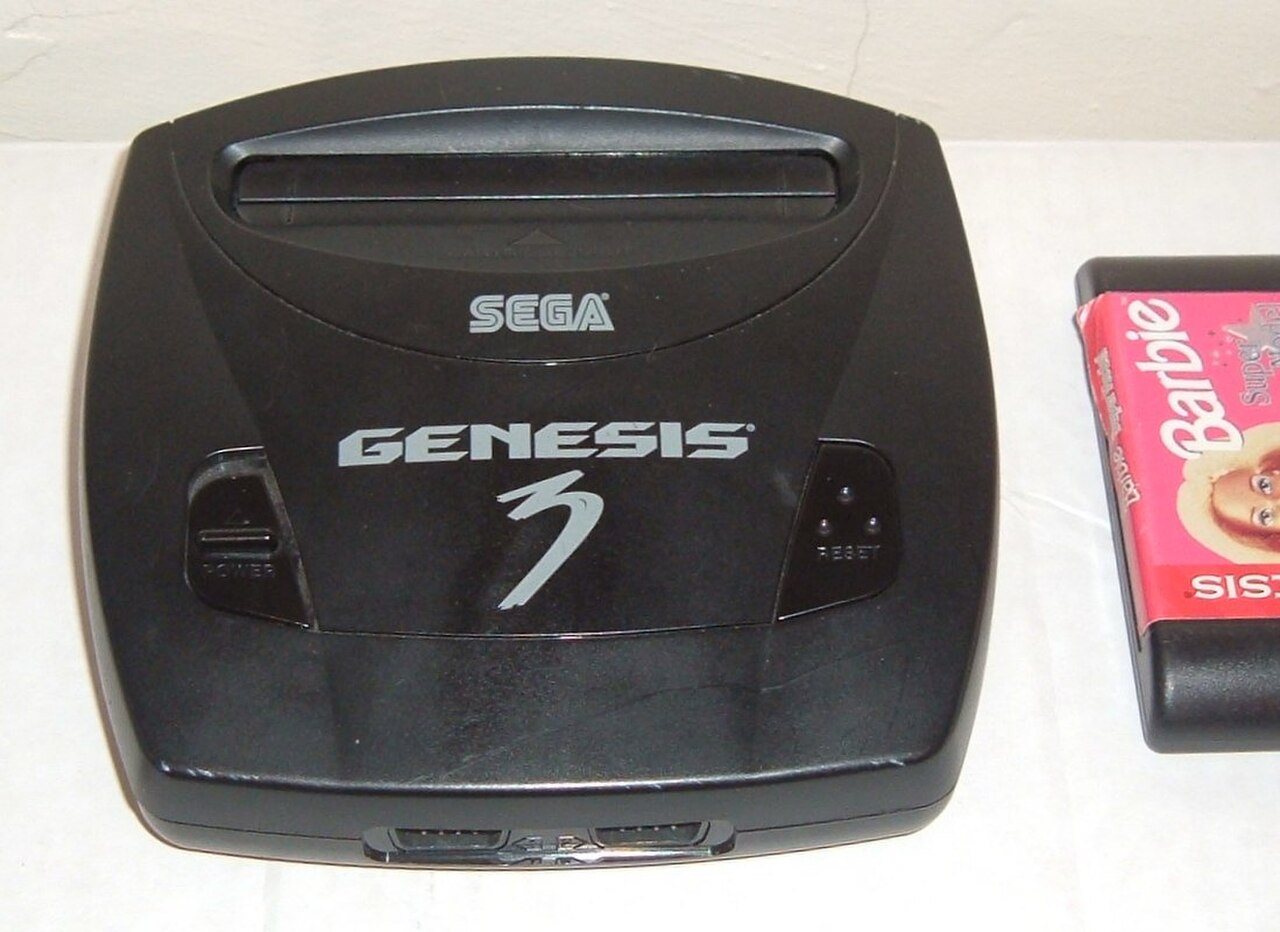
The original model Sega Genesis console with controller
The Sega Channel adapter sat on top of the Genesis like a cartridge, but its coax tail connected to your house's cable line.

The technical specs are wild to look back on. The uplink from Sega's broadcast center ran at 1.435 GHz over 8 MHz of bandwidth using QPSK modulation. The downlink to your house came in at 1.1 GHz over 6 MHz. None of that mattered to you as a kid, of course. What mattered was that the menu reset every month with a fresh rotation of about fifty games. New month, new lineup. Sometimes the lineup included games that hadn't even hit retail yet. Sometimes it included games that never would hit American retail at all (Pulseman, Alien Soldier, and Mega Man: The Wily Wars are the ones every Sega Channel kid remembers, because for years that was the only legal way to play them in North America). The service ran exclusive demos of upcoming games. It ran cheat codes and tips. There was a section called Test Drives where you could play time-limited slices of brand-new releases.

The hardware itself, the adapter, came in two variants because Scientific Atlanta and General Instrument both made their own. They looked slightly different but did the same job. The cartridge was tall, almost cube-shaped, and it stuck up out of the Genesis like a little black tower. If you pushed your Genesis flush against the wall behind your TV, the cable tail bent at an angle that always seemed about three weeks away from snapping. Mine survived, somehow. A lot of them didn't.

The Pitch That Made This Happen

To understand how something this ambitious got greenlit, you have to remember what 1993 looked like from Sega's chair. The Genesis was at its peak. Sonic was Mickey Mouse in sneakers. Sega was outselling Nintendo in the United States for the first time ever, and they were taking shots at Nintendo in TV commercials the way the Pepsi guy used to take shots at Coke. Tom Kalinske, the CEO of Sega of America at the time, was running one of the most aggressive marketing campaigns in the history of consumer electronics, and his team was looking for the next leap.

The cable industry, meanwhile, was sitting on a different problem. By 1993 most American households with cable were already wired up. The growth math was getting harder. Operators wanted new value-add services to justify rate increases. Interactive television was the buzzword every executive was throwing around at every industry conference. Some companies were trying to do video on demand. Some were trying interactive shopping. None of it worked yet because the technology was clumsy and expensive and consumers didn't really want any of it.

And here's where it gets interesting. Sega looked at this stalemate and realized something nobody else had figured out. The cable companies didn't need to invent interactive entertainment. Sega had already invented interactive entertainment. It was called video games. The cable companies just needed to be the pipe.

The original demonstration of the technology happened at the National Cable Television Association show in May 1994, where Scientific Atlanta and Sega ran a live demo of game delivery over working cable infrastructure. Cable operators saw it and got fired up. By June, Time Warner and TCI had signed on. By December, the service was live in test markets. Within a year, it was available to roughly one-third of American homes, which meant something like 20 million households technically had the option to subscribe.

The Catalog Was the Magic

The thing nobody tells you about the Sega Channel, because most of the people writing about it now are basing their memory on technical specs and screenshots, is that the actual experience of using it was magical in a specific way that's hard to recreate now. It wasn't just that you could play games. It was that you could play games you would never have rented and never have bought.

Think about how you actually consumed games in 1995 if you were a kid. You had whatever cartridges your parents had bought you, which was maybe four or five if you were lucky, plus whatever you could rent from Blockbuster on a Friday night for $3.50 for two days. The rentals at Blockbuster were heavily skewed toward whatever was new and heavily marketed. If you wanted to try Toejam and Earl in Panic on Funkotron, you had to either find it at Blockbuster, which probably had two copies, or save up your allowance and buy it sight unseen for $59.95 plus tax. There was no demo. There was no review on YouTube. There was no Reddit thread. You bought blind and prayed.

The Sega Channel blew that wide open. Suddenly you were trying weird Japanese RPGs you'd never heard of. You were playing Streets of Rage 3 and Comix Zone and World Series Baseball and Vectorman in the same afternoon. The library rotated monthly, so there was always something new to mess around with. Sega had access to its full back catalog, and it could put obscure stuff in front of kids who would otherwise never have touched it. Some of those games became cult favorites entirely because of Sega Channel exposure. Pulseman in particular has a borderline religious following among Sega Channel veterans because it never got an American cartridge release, only digital distribution. If you played it as a kid, you played it on Sega Channel. Full stop.

Why It Couldn't Last

This is where it all falls apart. By any rational measure, the Sega Channel should have been the biggest thing in video games. The technology worked. The catalog was deep. The pricing was reasonable. So why are we writing about it as ancient history?

A few reasons, and they stack up in a way that makes the whole thing tragic in retrospect.

First, the rollout was painfully uneven. The service required your local cable operator to install the broadcast headend equipment, sign a deal with Sega, and train technicians. Not every cable company did that, and not every system within a given cable company did it either. So you'd have a kid in suburban Atlanta with full Sega Channel access while his cousin in suburban Phoenix had Time Warner but no Sega Channel because the local headend hadn't been upgraded. Demand was throttled by geography in a way that had nothing to do with consumer interest. Sega Channel marketing was happening on national TV during Saturday morning cartoons, kids would beg their parents to call the cable company, and the cable company would say, sorry, we don't offer that here.

Second, peak subscribers topped out at around 250,000. That number sounds modest, and it was, but it was within striking distance of profitability for a service that operated as a joint venture with minimal direct cost to Sega itself. The problem wasn't the absolute number. The problem was that the Genesis itself was already entering its sunset years. The Sega Saturn launched in North America in May 1995, six months after the Sega Channel went live. The Sony PlayStation launched in September 1995. The 32-bit era was here, and parents who'd just been pitched a brand-new $399 console were not going to pay an additional monthly fee to keep playing 16-bit games on the console their kids were supposedly outgrowing.

Third, and this is the one that really stings, Sega itself was a mess by 1996. The Saturn was tanking in America. Internal conflict between Sega of America and Sega of Japan was reaching legendary levels. Tom Kalinske left in mid-1996. The company that should have been the Sega Channel's biggest champion was fighting for its own survival, and a profitable side venture on aging hardware wasn't anyone's top priority.

By 1997 the subscriber count was sliding. The service stopped accepting new subscribers in mid-1998, and the Sega Channel formally shut down on July 31, 1998. The last broadcast went out, the last carousel cycled through, and millions of dollars of broadcast headend equipment in cable facilities across America was unplugged and warehoused and eventually scrapped.

The Adapters Are Bricks Now

If you find a Sega Channel adapter at a swap meet today, and they show up more often than you'd think, you can hold it in your hand and feel the weight of it and even hook it up to a working Genesis, and absolutely nothing will happen. The broadcast that fed it does not exist. The headend equipment was decommissioned a quarter century ago. The cable companies that ran the service either don't exist anymore or have been so completely absorbed into Comcast and Spectrum that nobody who works there has ever heard of the Sega Channel.

A small dedicated community of preservationists has tried, with mixed results, to extract game data from old Sega Channel adapters and reconstruct what the catalog looked like at various points in its run. There are emulator projects that simulate the menu experience using ROMs of games that were known to have been on the service. None of it brings the actual thing back. It's archeology at this point.

The Sega Channel Was Right About Everything

Here's the thing that twists the knife. The Sega Channel was right. About everything.

It was right that gamers would pay a monthly fee for a rotating library of titles. That's Xbox Game Pass. That's PlayStation Plus Extra. That's Apple Arcade. Microsoft has been on record saying Game Pass is the future of the company's gaming business, and the model they're describing is, structurally, the Sega Channel.

It was right that you didn't need to own a physical copy of a game to enjoy it. That's how everyone under 25 plays games now. The cartridge in your hand was a temporary inconvenience, a bottleneck of distribution. Once you could get rid of the cartridge, you would. And we did.

It was right that bundling discovery into the service was more valuable than the games themselves. The Sega Channel's killer feature wasn't any single title, it was the buffet. You came for Sonic and stayed for Vectorman. Game Pass works the same way. Netflix works the same way. The platform is the product.

It was even right about hardware. The Sega Channel adapter was, in a real technical sense, an early form of the set-top streaming box. Roku, Apple TV, Fire Stick, they're all doing the same job the Sega Channel adapter did, just for video instead of games. The lineage is so direct it's almost embarrassing how little credit Sega gets for it.

The Dreamcast deserved better, sure. But honestly, the Sega Channel deserved better too. It was just twelve years too early to win.

What killed it wasn't the idea. The idea was perfect. What killed it was that the infrastructure to deliver the idea at scale, which is to say two-way broadband internet to every American home, didn't exist yet. The Sega Channel was trying to be Netflix in a world that still had to mail you DVDs because the pipes weren't big enough. By the time the pipes got big enough, Sega wasn't around to take advantage. They quit hardware after the Dreamcast, and the company that emerged from that retreat was a software publisher, not the kind of platform builder that could ever try this again.

So we got Xbox Live and PlayStation Network and Steam and Game Pass instead, all of them descended from the same idea Tom Kalinske and his team launched in December 1994, none of them giving credit. That's how it goes sometimes. The first guy to do something correctly doesn't get the trophy. The fifth guy to do it, with better hardware and better timing, takes the whole pot.

Frequently Asked Questions

When did the Sega Channel launch and when did it shut down?

The Sega Channel launched on December 12, 1994, and shut down on July 31, 1998. It ran for just over three and a half years.

How much did the Sega Channel cost?

The standard subscription was roughly $14.95 per month, depending on your local cable operator, with a one-time activation fee of $25 that included the adapter cartridge and installation.

How many subscribers did the Sega Channel have at its peak?

At its peak the service had approximately 250,000 subscribers. It was technically available to about one-third of American households via participating cable operators.

What games could you play on the Sega Channel?

The catalog rotated monthly with around fifty Genesis games at a time. Highlights included exclusive titles never released on cartridge in North America, like Pulseman, Alien Soldier, and Mega Man: The Wily Wars, plus the full Sonic series, Streets of Rage, Vectorman, Comix Zone, and a deep back catalog of Sega first-party and licensed games.

Who made the Sega Channel adapter?

The adapter cartridges were manufactured by Scientific Atlanta (model D-9593) and General Instrument, in partnership with Sega. The service itself was a joint venture between Sega of America, Time Warner Cable, and TCI.

Can you still use a Sega Channel adapter today?

No. The broadcast headend equipment was decommissioned when the service shut down in 1998. An adapter today is a collector's curiosity but cannot receive any signal. Preservationists have attempted to reverse engineer the file format and emulate the menu experience, with limited success.

Why did the Sega Channel fail?

A combination of factors: uneven cable operator rollout limited geographic availability, the Genesis hardware was aging out as the 32-bit era arrived, Sega itself was struggling with the Saturn launch and internal conflicts, and the broader market wasn't ready to pay monthly fees for game access on a console generation that was being phased out.

Was the Sega Channel actually streaming?

Not in the modern sense. Games were broadcast continuously on a carousel and downloaded into the adapter's 4 MB of DRAM when selected. The game then ran locally off that memory, and was deleted when the console was turned off. There was no two-way communication, no account, no save state synchronization. It was, in effect, a download service riding on broadcast infrastructure.

๐Ÿ“– What Happened to the Sega Channel, the Cable Service That Streamed Games in 1994
_ โ–ก ร—
← Back

What Happened to the Sega Channel, the Cable Service That Streamed Games in 1994

2026-05-18 by 404 Memory Found

Picture this. It's a Saturday afternoon in 1995. You're 11 years old, sprawled on the carpet in front of a tube TV that weighs more than your bicycle, and you've just plugged a thick black cartridge into the top of your Sega Genesis. The cartridge isn't a game. It's an adapter, and a coaxial cable runs from the back of it across your living room floor into the same wall jack that feeds your family's basic cable. You hit the power button. The Genesis whirs. And instead of a startup screen, your TV fills with a glowing menu of around fifty games you can play, right now, for as long as you want, with no trip to Blockbuster, no $50 receipt at Toys R Us, no waiting.

This was the Sega Channel. And if you were lucky enough to live in one of the right ZIP codes, it felt like science fiction.

A Sega Genesis console connected to a TV in a 1990s living room setup
The Sega Genesis was the host hardware for the Sega Channel adapter, which slotted into the top cartridge port.

The Sega Channel launched on December 12, 1994, the same week most American kids were begging Santa for a Super Nintendo or a Sega Saturn that wouldn't actually show up in stores until the following spring. It was a partnership between Sega of America, Time Warner Cable, and TCI (Tele Communications Inc., the biggest cable company in the country at the time), with the broadcasting hardware built by Scientific Atlanta and General Instrument. If those names sound like the kind of companies that put set-top boxes in your grandma's living room, that's because they were. The Sega Channel rode on the exact same infrastructure that was already piping in CNN and HBO, except instead of broadcasting Larry King, it broadcast Sonic the Hedgehog 2 and Streets of Rage and Mortal Kombat, beamed through your coax cable straight into a 4 MB chunk of memory inside the adapter.

This was insane, by the way. We have to stop and acknowledge how insane this was. In 1994, your dial-up modem (if you even had one) ran at 14.4 kbps. Downloading a single 4 MB game from a BBS would take you the better part of an evening, assuming the line didn't drop. The cable infrastructure, by contrast, had bandwidth nobody was using. So Sega looked at all that empty pipe and said, what if we just shoved video games down it?

How the Sega Channel Actually Worked

The setup was elegant in a way that '90s tech rarely was. You paid roughly $14.95 a month, depending on your local cable operator, plus a $25 one-time activation fee. The cable company sent a technician to your house with the adapter cart (model number D-9593 if it came from Scientific Atlanta), an external power brick, and a coaxial splitter. They plugged the splitter into your cable line, ran one feed to the TV and one to the back of the adapter, dropped the adapter into the top of your Genesis, plugged the power brick into the wall, and you were done. Took maybe twenty minutes. Less if your dad shooed the guy out so he could try it himself.

When you turned on the Genesis with the adapter installed, the cable signal hit a tuner inside the cartridge and pulled down a continuously broadcast carousel of game data. The carousel cycled through games on a schedule, and the adapter grabbed the bytes corresponding to whatever you'd selected from the menu, dumped them into 4 MB of DRAM, and then ran the game off that DRAM exactly like the Genesis would run a regular cartridge. To the console, it was indistinguishable from a normal game pak. There was no streaming in the modern sense, no internet connection, no account login. The game lived in volatile memory until you turned the power off, at which point it vanished. Want to play it again tomorrow? Cool, just download it again. It took maybe a minute or two per game.

The original model Sega Genesis console with controller
The Sega Channel adapter sat on top of the Genesis like a cartridge, but its coax tail connected to your house's cable line.

The technical specs are wild to look back on. The uplink from Sega's broadcast center ran at 1.435 GHz over 8 MHz of bandwidth using QPSK modulation. The downlink to your house came in at 1.1 GHz over 6 MHz. None of that mattered to you as a kid, of course. What mattered was that the menu reset every month with a fresh rotation of about fifty games. New month, new lineup. Sometimes the lineup included games that hadn't even hit retail yet. Sometimes it included games that never would hit American retail at all (Pulseman, Alien Soldier, and Mega Man: The Wily Wars are the ones every Sega Channel kid remembers, because for years that was the only legal way to play them in North America). The service ran exclusive demos of upcoming games. It ran cheat codes and tips. There was a section called Test Drives where you could play time-limited slices of brand-new releases.

The hardware itself, the adapter, came in two variants because Scientific Atlanta and General Instrument both made their own. They looked slightly different but did the same job. The cartridge was tall, almost cube-shaped, and it stuck up out of the Genesis like a little black tower. If you pushed your Genesis flush against the wall behind your TV, the cable tail bent at an angle that always seemed about three weeks away from snapping. Mine survived, somehow. A lot of them didn't.

The Pitch That Made This Happen

To understand how something this ambitious got greenlit, you have to remember what 1993 looked like from Sega's chair. The Genesis was at its peak. Sonic was Mickey Mouse in sneakers. Sega was outselling Nintendo in the United States for the first time ever, and they were taking shots at Nintendo in TV commercials the way the Pepsi guy used to take shots at Coke. Tom Kalinske, the CEO of Sega of America at the time, was running one of the most aggressive marketing campaigns in the history of consumer electronics, and his team was looking for the next leap.

The cable industry, meanwhile, was sitting on a different problem. By 1993 most American households with cable were already wired up. The growth math was getting harder. Operators wanted new value-add services to justify rate increases. Interactive television was the buzzword every executive was throwing around at every industry conference. Some companies were trying to do video on demand. Some were trying interactive shopping. None of it worked yet because the technology was clumsy and expensive and consumers didn't really want any of it.

And here's where it gets interesting. Sega looked at this stalemate and realized something nobody else had figured out. The cable companies didn't need to invent interactive entertainment. Sega had already invented interactive entertainment. It was called video games. The cable companies just needed to be the pipe.

The original demonstration of the technology happened at the National Cable Television Association show in May 1994, where Scientific Atlanta and Sega ran a live demo of game delivery over working cable infrastructure. Cable operators saw it and got fired up. By June, Time Warner and TCI had signed on. By December, the service was live in test markets. Within a year, it was available to roughly one-third of American homes, which meant something like 20 million households technically had the option to subscribe.

The Catalog Was the Magic

The thing nobody tells you about the Sega Channel, because most of the people writing about it now are basing their memory on technical specs and screenshots, is that the actual experience of using it was magical in a specific way that's hard to recreate now. It wasn't just that you could play games. It was that you could play games you would never have rented and never have bought.

Think about how you actually consumed games in 1995 if you were a kid. You had whatever cartridges your parents had bought you, which was maybe four or five if you were lucky, plus whatever you could rent from Blockbuster on a Friday night for $3.50 for two days. The rentals at Blockbuster were heavily skewed toward whatever was new and heavily marketed. If you wanted to try Toejam and Earl in Panic on Funkotron, you had to either find it at Blockbuster, which probably had two copies, or save up your allowance and buy it sight unseen for $59.95 plus tax. There was no demo. There was no review on YouTube. There was no Reddit thread. You bought blind and prayed.

The Sega Channel blew that wide open. Suddenly you were trying weird Japanese RPGs you'd never heard of. You were playing Streets of Rage 3 and Comix Zone and World Series Baseball and Vectorman in the same afternoon. The library rotated monthly, so there was always something new to mess around with. Sega had access to its full back catalog, and it could put obscure stuff in front of kids who would otherwise never have touched it. Some of those games became cult favorites entirely because of Sega Channel exposure. Pulseman in particular has a borderline religious following among Sega Channel veterans because it never got an American cartridge release, only digital distribution. If you played it as a kid, you played it on Sega Channel. Full stop.

Why It Couldn't Last

This is where it all falls apart. By any rational measure, the Sega Channel should have been the biggest thing in video games. The technology worked. The catalog was deep. The pricing was reasonable. So why are we writing about it as ancient history?

A few reasons, and they stack up in a way that makes the whole thing tragic in retrospect.

First, the rollout was painfully uneven. The service required your local cable operator to install the broadcast headend equipment, sign a deal with Sega, and train technicians. Not every cable company did that, and not every system within a given cable company did it either. So you'd have a kid in suburban Atlanta with full Sega Channel access while his cousin in suburban Phoenix had Time Warner but no Sega Channel because the local headend hadn't been upgraded. Demand was throttled by geography in a way that had nothing to do with consumer interest. Sega Channel marketing was happening on national TV during Saturday morning cartoons, kids would beg their parents to call the cable company, and the cable company would say, sorry, we don't offer that here.

Second, peak subscribers topped out at around 250,000. That number sounds modest, and it was, but it was within striking distance of profitability for a service that operated as a joint venture with minimal direct cost to Sega itself. The problem wasn't the absolute number. The problem was that the Genesis itself was already entering its sunset years. The Sega Saturn launched in North America in May 1995, six months after the Sega Channel went live. The Sony PlayStation launched in September 1995. The 32-bit era was here, and parents who'd just been pitched a brand-new $399 console were not going to pay an additional monthly fee to keep playing 16-bit games on the console their kids were supposedly outgrowing.

Third, and this is the one that really stings, Sega itself was a mess by 1996. The Saturn was tanking in America. Internal conflict between Sega of America and Sega of Japan was reaching legendary levels. Tom Kalinske left in mid-1996. The company that should have been the Sega Channel's biggest champion was fighting for its own survival, and a profitable side venture on aging hardware wasn't anyone's top priority.

By 1997 the subscriber count was sliding. The service stopped accepting new subscribers in mid-1998, and the Sega Channel formally shut down on July 31, 1998. The last broadcast went out, the last carousel cycled through, and millions of dollars of broadcast headend equipment in cable facilities across America was unplugged and warehoused and eventually scrapped.

The Adapters Are Bricks Now

If you find a Sega Channel adapter at a swap meet today, and they show up more often than you'd think, you can hold it in your hand and feel the weight of it and even hook it up to a working Genesis, and absolutely nothing will happen. The broadcast that fed it does not exist. The headend equipment was decommissioned a quarter century ago. The cable companies that ran the service either don't exist anymore or have been so completely absorbed into Comcast and Spectrum that nobody who works there has ever heard of the Sega Channel.

A small dedicated community of preservationists has tried, with mixed results, to extract game data from old Sega Channel adapters and reconstruct what the catalog looked like at various points in its run. There are emulator projects that simulate the menu experience using ROMs of games that were known to have been on the service. None of it brings the actual thing back. It's archeology at this point.

The Sega Channel Was Right About Everything

Here's the thing that twists the knife. The Sega Channel was right. About everything.

It was right that gamers would pay a monthly fee for a rotating library of titles. That's Xbox Game Pass. That's PlayStation Plus Extra. That's Apple Arcade. Microsoft has been on record saying Game Pass is the future of the company's gaming business, and the model they're describing is, structurally, the Sega Channel.

It was right that you didn't need to own a physical copy of a game to enjoy it. That's how everyone under 25 plays games now. The cartridge in your hand was a temporary inconvenience, a bottleneck of distribution. Once you could get rid of the cartridge, you would. And we did.

It was right that bundling discovery into the service was more valuable than the games themselves. The Sega Channel's killer feature wasn't any single title, it was the buffet. You came for Sonic and stayed for Vectorman. Game Pass works the same way. Netflix works the same way. The platform is the product.

It was even right about hardware. The Sega Channel adapter was, in a real technical sense, an early form of the set-top streaming box. Roku, Apple TV, Fire Stick, they're all doing the same job the Sega Channel adapter did, just for video instead of games. The lineage is so direct it's almost embarrassing how little credit Sega gets for it.

The Dreamcast deserved better, sure. But honestly, the Sega Channel deserved better too. It was just twelve years too early to win.

What killed it wasn't the idea. The idea was perfect. What killed it was that the infrastructure to deliver the idea at scale, which is to say two-way broadband internet to every American home, didn't exist yet. The Sega Channel was trying to be Netflix in a world that still had to mail you DVDs because the pipes weren't big enough. By the time the pipes got big enough, Sega wasn't around to take advantage. They quit hardware after the Dreamcast, and the company that emerged from that retreat was a software publisher, not the kind of platform builder that could ever try this again.

So we got Xbox Live and PlayStation Network and Steam and Game Pass instead, all of them descended from the same idea Tom Kalinske and his team launched in December 1994, none of them giving credit. That's how it goes sometimes. The first guy to do something correctly doesn't get the trophy. The fifth guy to do it, with better hardware and better timing, takes the whole pot.

Frequently Asked Questions

When did the Sega Channel launch and when did it shut down?

The Sega Channel launched on December 12, 1994, and shut down on July 31, 1998. It ran for just over three and a half years.

How much did the Sega Channel cost?

The standard subscription was roughly $14.95 per month, depending on your local cable operator, with a one-time activation fee of $25 that included the adapter cartridge and installation.

How many subscribers did the Sega Channel have at its peak?

At its peak the service had approximately 250,000 subscribers. It was technically available to about one-third of American households via participating cable operators.

What games could you play on the Sega Channel?

The catalog rotated monthly with around fifty Genesis games at a time. Highlights included exclusive titles never released on cartridge in North America, like Pulseman, Alien Soldier, and Mega Man: The Wily Wars, plus the full Sonic series, Streets of Rage, Vectorman, Comix Zone, and a deep back catalog of Sega first-party and licensed games.

Who made the Sega Channel adapter?

The adapter cartridges were manufactured by Scientific Atlanta (model D-9593) and General Instrument, in partnership with Sega. The service itself was a joint venture between Sega of America, Time Warner Cable, and TCI.

Can you still use a Sega Channel adapter today?

No. The broadcast headend equipment was decommissioned when the service shut down in 1998. An adapter today is a collector's curiosity but cannot receive any signal. Preservationists have attempted to reverse engineer the file format and emulate the menu experience, with limited success.

Why did the Sega Channel fail?

A combination of factors: uneven cable operator rollout limited geographic availability, the Genesis hardware was aging out as the 32-bit era arrived, Sega itself was struggling with the Saturn launch and internal conflicts, and the broader market wasn't ready to pay monthly fees for game access on a console generation that was being phased out.

Was the Sega Channel actually streaming?

Not in the modern sense. Games were broadcast continuously on a carousel and downloaded into the adapter's 4 MB of DRAM when selected. The game then ran locally off that memory, and was deleted when the console was turned off. There was no two-way communication, no account, no save state synchronization. It was, in effect, a download service riding on broadcast infrastructure.

๐Ÿ“– What Happened to the Sega Channel, the Cable Service That Streamed Games in 1994

Picture this. It's a Saturday afternoon in 1995. You're 11 years old, sprawled on the carpet in front of a tube TV that weighs more than your bicycle, and you've just plugged a thick black cartridge into the top of your Sega Genesis. The cartridge isn't a game. It's an adapter, and a coaxial cable runs from the back of it across your living room floor into the same wall jack that feeds your family's basic cable. You hit the power button. The Genesis whirs. And instead of a startup screen, your TV fills with a glowing menu of around fifty games you can play, right now, for as long as you want, with no trip to Blockbuster, no $50 receipt at Toys R Us, no waiting.

This was the Sega Channel. And if you were lucky enough to live in one of the right ZIP codes, it felt like science fiction.

A Sega Genesis console connected to a TV in a 1990s living room setup
The Sega Genesis was the host hardware for the Sega Channel adapter, which slotted into the top cartridge port.

The Sega Channel launched on December 12, 1994, the same week most American kids were begging Santa for a Super Nintendo or a Sega Saturn that wouldn't actually show up in stores until the following spring. It was a partnership between Sega of America, Time Warner Cable, and TCI (Tele Communications Inc., the biggest cable company in the country at the time), with the broadcasting hardware built by Scientific Atlanta and General Instrument. If those names sound like the kind of companies that put set-top boxes in your grandma's living room, that's because they were. The Sega Channel rode on the exact same infrastructure that was already piping in CNN and HBO, except instead of broadcasting Larry King, it broadcast Sonic the Hedgehog 2 and Streets of Rage and Mortal Kombat, beamed through your coax cable straight into a 4 MB chunk of memory inside the adapter.

This was insane, by the way. We have to stop and acknowledge how insane this was. In 1994, your dial-up modem (if you even had one) ran at 14.4 kbps. Downloading a single 4 MB game from a BBS would take you the better part of an evening, assuming the line didn't drop. The cable infrastructure, by contrast, had bandwidth nobody was using. So Sega looked at all that empty pipe and said, what if we just shoved video games down it?

How the Sega Channel Actually Worked

The setup was elegant in a way that '90s tech rarely was. You paid roughly $14.95 a month, depending on your local cable operator, plus a $25 one-time activation fee. The cable company sent a technician to your house with the adapter cart (model number D-9593 if it came from Scientific Atlanta), an external power brick, and a coaxial splitter. They plugged the splitter into your cable line, ran one feed to the TV and one to the back of the adapter, dropped the adapter into the top of your Genesis, plugged the power brick into the wall, and you were done. Took maybe twenty minutes. Less if your dad shooed the guy out so he could try it himself.

When you turned on the Genesis with the adapter installed, the cable signal hit a tuner inside the cartridge and pulled down a continuously broadcast carousel of game data. The carousel cycled through games on a schedule, and the adapter grabbed the bytes corresponding to whatever you'd selected from the menu, dumped them into 4 MB of DRAM, and then ran the game off that DRAM exactly like the Genesis would run a regular cartridge. To the console, it was indistinguishable from a normal game pak. There was no streaming in the modern sense, no internet connection, no account login. The game lived in volatile memory until you turned the power off, at which point it vanished. Want to play it again tomorrow? Cool, just download it again. It took maybe a minute or two per game.

The original model Sega Genesis console with controller
The Sega Channel adapter sat on top of the Genesis like a cartridge, but its coax tail connected to your house's cable line.

The technical specs are wild to look back on. The uplink from Sega's broadcast center ran at 1.435 GHz over 8 MHz of bandwidth using QPSK modulation. The downlink to your house came in at 1.1 GHz over 6 MHz. None of that mattered to you as a kid, of course. What mattered was that the menu reset every month with a fresh rotation of about fifty games. New month, new lineup. Sometimes the lineup included games that hadn't even hit retail yet. Sometimes it included games that never would hit American retail at all (Pulseman, Alien Soldier, and Mega Man: The Wily Wars are the ones every Sega Channel kid remembers, because for years that was the only legal way to play them in North America). The service ran exclusive demos of upcoming games. It ran cheat codes and tips. There was a section called Test Drives where you could play time-limited slices of brand-new releases.

The hardware itself, the adapter, came in two variants because Scientific Atlanta and General Instrument both made their own. They looked slightly different but did the same job. The cartridge was tall, almost cube-shaped, and it stuck up out of the Genesis like a little black tower. If you pushed your Genesis flush against the wall behind your TV, the cable tail bent at an angle that always seemed about three weeks away from snapping. Mine survived, somehow. A lot of them didn't.

The Pitch That Made This Happen

To understand how something this ambitious got greenlit, you have to remember what 1993 looked like from Sega's chair. The Genesis was at its peak. Sonic was Mickey Mouse in sneakers. Sega was outselling Nintendo in the United States for the first time ever, and they were taking shots at Nintendo in TV commercials the way the Pepsi guy used to take shots at Coke. Tom Kalinske, the CEO of Sega of America at the time, was running one of the most aggressive marketing campaigns in the history of consumer electronics, and his team was looking for the next leap.

The cable industry, meanwhile, was sitting on a different problem. By 1993 most American households with cable were already wired up. The growth math was getting harder. Operators wanted new value-add services to justify rate increases. Interactive television was the buzzword every executive was throwing around at every industry conference. Some companies were trying to do video on demand. Some were trying interactive shopping. None of it worked yet because the technology was clumsy and expensive and consumers didn't really want any of it.

And here's where it gets interesting. Sega looked at this stalemate and realized something nobody else had figured out. The cable companies didn't need to invent interactive entertainment. Sega had already invented interactive entertainment. It was called video games. The cable companies just needed to be the pipe.

The original demonstration of the technology happened at the National Cable Television Association show in May 1994, where Scientific Atlanta and Sega ran a live demo of game delivery over working cable infrastructure. Cable operators saw it and got fired up. By June, Time Warner and TCI had signed on. By December, the service was live in test markets. Within a year, it was available to roughly one-third of American homes, which meant something like 20 million households technically had the option to subscribe.

The Catalog Was the Magic

The thing nobody tells you about the Sega Channel, because most of the people writing about it now are basing their memory on technical specs and screenshots, is that the actual experience of using it was magical in a specific way that's hard to recreate now. It wasn't just that you could play games. It was that you could play games you would never have rented and never have bought.

Think about how you actually consumed games in 1995 if you were a kid. You had whatever cartridges your parents had bought you, which was maybe four or five if you were lucky, plus whatever you could rent from Blockbuster on a Friday night for $3.50 for two days. The rentals at Blockbuster were heavily skewed toward whatever was new and heavily marketed. If you wanted to try Toejam and Earl in Panic on Funkotron, you had to either find it at Blockbuster, which probably had two copies, or save up your allowance and buy it sight unseen for $59.95 plus tax. There was no demo. There was no review on YouTube. There was no Reddit thread. You bought blind and prayed.

The Sega Channel blew that wide open. Suddenly you were trying weird Japanese RPGs you'd never heard of. You were playing Streets of Rage 3 and Comix Zone and World Series Baseball and Vectorman in the same afternoon. The library rotated monthly, so there was always something new to mess around with. Sega had access to its full back catalog, and it could put obscure stuff in front of kids who would otherwise never have touched it. Some of those games became cult favorites entirely because of Sega Channel exposure. Pulseman in particular has a borderline religious following among Sega Channel veterans because it never got an American cartridge release, only digital distribution. If you played it as a kid, you played it on Sega Channel. Full stop.

Why It Couldn't Last

This is where it all falls apart. By any rational measure, the Sega Channel should have been the biggest thing in video games. The technology worked. The catalog was deep. The pricing was reasonable. So why are we writing about it as ancient history?

A few reasons, and they stack up in a way that makes the whole thing tragic in retrospect.

First, the rollout was painfully uneven. The service required your local cable operator to install the broadcast headend equipment, sign a deal with Sega, and train technicians. Not every cable company did that, and not every system within a given cable company did it either. So you'd have a kid in suburban Atlanta with full Sega Channel access while his cousin in suburban Phoenix had Time Warner but no Sega Channel because the local headend hadn't been upgraded. Demand was throttled by geography in a way that had nothing to do with consumer interest. Sega Channel marketing was happening on national TV during Saturday morning cartoons, kids would beg their parents to call the cable company, and the cable company would say, sorry, we don't offer that here.

Second, peak subscribers topped out at around 250,000. That number sounds modest, and it was, but it was within striking distance of profitability for a service that operated as a joint venture with minimal direct cost to Sega itself. The problem wasn't the absolute number. The problem was that the Genesis itself was already entering its sunset years. The Sega Saturn launched in North America in May 1995, six months after the Sega Channel went live. The Sony PlayStation launched in September 1995. The 32-bit era was here, and parents who'd just been pitched a brand-new $399 console were not going to pay an additional monthly fee to keep playing 16-bit games on the console their kids were supposedly outgrowing.

Third, and this is the one that really stings, Sega itself was a mess by 1996. The Saturn was tanking in America. Internal conflict between Sega of America and Sega of Japan was reaching legendary levels. Tom Kalinske left in mid-1996. The company that should have been the Sega Channel's biggest champion was fighting for its own survival, and a profitable side venture on aging hardware wasn't anyone's top priority.

By 1997 the subscriber count was sliding. The service stopped accepting new subscribers in mid-1998, and the Sega Channel formally shut down on July 31, 1998. The last broadcast went out, the last carousel cycled through, and millions of dollars of broadcast headend equipment in cable facilities across America was unplugged and warehoused and eventually scrapped.

The Adapters Are Bricks Now

If you find a Sega Channel adapter at a swap meet today, and they show up more often than you'd think, you can hold it in your hand and feel the weight of it and even hook it up to a working Genesis, and absolutely nothing will happen. The broadcast that fed it does not exist. The headend equipment was decommissioned a quarter century ago. The cable companies that ran the service either don't exist anymore or have been so completely absorbed into Comcast and Spectrum that nobody who works there has ever heard of the Sega Channel.

A small dedicated community of preservationists has tried, with mixed results, to extract game data from old Sega Channel adapters and reconstruct what the catalog looked like at various points in its run. There are emulator projects that simulate the menu experience using ROMs of games that were known to have been on the service. None of it brings the actual thing back. It's archeology at this point.

The Sega Channel Was Right About Everything

Here's the thing that twists the knife. The Sega Channel was right. About everything.

It was right that gamers would pay a monthly fee for a rotating library of titles. That's Xbox Game Pass. That's PlayStation Plus Extra. That's Apple Arcade. Microsoft has been on record saying Game Pass is the future of the company's gaming business, and the model they're describing is, structurally, the Sega Channel.

It was right that you didn't need to own a physical copy of a game to enjoy it. That's how everyone under 25 plays games now. The cartridge in your hand was a temporary inconvenience, a bottleneck of distribution. Once you could get rid of the cartridge, you would. And we did.

It was right that bundling discovery into the service was more valuable than the games themselves. The Sega Channel's killer feature wasn't any single title, it was the buffet. You came for Sonic and stayed for Vectorman. Game Pass works the same way. Netflix works the same way. The platform is the product.

It was even right about hardware. The Sega Channel adapter was, in a real technical sense, an early form of the set-top streaming box. Roku, Apple TV, Fire Stick, they're all doing the same job the Sega Channel adapter did, just for video instead of games. The lineage is so direct it's almost embarrassing how little credit Sega gets for it.

The Dreamcast deserved better, sure. But honestly, the Sega Channel deserved better too. It was just twelve years too early to win.

What killed it wasn't the idea. The idea was perfect. What killed it was that the infrastructure to deliver the idea at scale, which is to say two-way broadband internet to every American home, didn't exist yet. The Sega Channel was trying to be Netflix in a world that still had to mail you DVDs because the pipes weren't big enough. By the time the pipes got big enough, Sega wasn't around to take advantage. They quit hardware after the Dreamcast, and the company that emerged from that retreat was a software publisher, not the kind of platform builder that could ever try this again.

So we got Xbox Live and PlayStation Network and Steam and Game Pass instead, all of them descended from the same idea Tom Kalinske and his team launched in December 1994, none of them giving credit. That's how it goes sometimes. The first guy to do something correctly doesn't get the trophy. The fifth guy to do it, with better hardware and better timing, takes the whole pot.

Frequently Asked Questions

When did the Sega Channel launch and when did it shut down?

The Sega Channel launched on December 12, 1994, and shut down on July 31, 1998. It ran for just over three and a half years.

How much did the Sega Channel cost?

The standard subscription was roughly $14.95 per month, depending on your local cable operator, with a one-time activation fee of $25 that included the adapter cartridge and installation.

How many subscribers did the Sega Channel have at its peak?

At its peak the service had approximately 250,000 subscribers. It was technically available to about one-third of American households via participating cable operators.

What games could you play on the Sega Channel?

The catalog rotated monthly with around fifty Genesis games at a time. Highlights included exclusive titles never released on cartridge in North America, like Pulseman, Alien Soldier, and Mega Man: The Wily Wars, plus the full Sonic series, Streets of Rage, Vectorman, Comix Zone, and a deep back catalog of Sega first-party and licensed games.

Who made the Sega Channel adapter?

The adapter cartridges were manufactured by Scientific Atlanta (model D-9593) and General Instrument, in partnership with Sega. The service itself was a joint venture between Sega of America, Time Warner Cable, and TCI.

Can you still use a Sega Channel adapter today?

No. The broadcast headend equipment was decommissioned when the service shut down in 1998. An adapter today is a collector's curiosity but cannot receive any signal. Preservationists have attempted to reverse engineer the file format and emulate the menu experience, with limited success.

Why did the Sega Channel fail?

A combination of factors: uneven cable operator rollout limited geographic availability, the Genesis hardware was aging out as the 32-bit era arrived, Sega itself was struggling with the Saturn launch and internal conflicts, and the broader market wasn't ready to pay monthly fees for game access on a console generation that was being phased out.

Was the Sega Channel actually streaming?

Not in the modern sense. Games were broadcast continuously on a carousel and downloaded into the adapter's 4 MB of DRAM when selected. The game then ran locally off that memory, and was deleted when the console was turned off. There was no two-way communication, no account, no save state synchronization. It was, in effect, a download service riding on broadcast infrastructure.

00:00