What Happened to RadioShack? The Store That Was on Every Corner in America
There's a specific smell I remember from RadioShack, though I can't quite name it anymore. It was something between soldered circuit boards, plastic packaging, and that vaguely sterile electronics-store air that hasn't changed in thirty years. I walked into one on a Tuesday afternoon in 1998, maybe ten years old, with forty dollars burning a hole in my pocket and the kind of determination only a kid obsessed with building things can muster. The store was maybe 2,000 square feet, packed so densely with merchandise that you had to turn sideways in some aisles. There was a bin of resistors. Another of capacitors. Switches, wire, breadboards, power supplies, LED displays in every color, components I didn't understand but desperately wanted to learn. Behind the counter was a guy who actually knew what all of it did. He could look at what you were building and suggest the right transistor. He could wire you up with exactly the cable you needed. This was what RadioShack was, at least in my neighborhood: a temple of possibility, a place where the barrier between wanting to understand electronics and actually building something was just wide enough that you could jump it with a little help.
RadioShack died in 2015, officially, though it had been dying much longer than that. The bankruptcy filing in February 2015 was just the paperwork acknowledging what every nostalgic Gen X and older millennial already knew: the store that was within five minutes of 94 percent of Americans at its absolute peak had somehow become invisible. Where I grew up, there were three RadioShacks within a twenty-minute drive. Now there are none. But the real story of RadioShack isn't about collapse or obsolescence or the simple march of Amazon killing yet another brick-and-mortar business. The story is much weirder and more frustrating than that. It's about a company that owned the future and then systematically abandoned it, that made catastrophic strategic decisions from the highest levels, that treated its core customers like they didn't matter, and that ultimately got exactly what it deserved while somehow managing to break something irreplaceable in the process.
When RadioShack Was the Only Game in Town
The story starts in 1921, which is older than you probably thought. Theodore and Milton Deutschmann opened the first Radio Shack in Boston as a one-room shop to serve amateur radio operators, the "ham radio" enthusiasts who built their own equipment and needed specialized parts. This is crucial to understanding RadioShack's original DNA: it was built by and for people who wanted to tinker, to understand, to build things with their hands. The name "Radio Shack" referred to the small wooden enclosures on the decks of ships where early radio equipment was housed. For more than forty years, that was what RadioShack was. You went there if you were serious about radio, about electronics, about understanding the technology itself.
But RadioShack was a specialty store in a specialty market. They were fine, profitable, but not explosive. Then in 1963, a guy named Charles Tandy showed up and changed everything. Tandy owned Tandy Leather, which is not what you'd expect to be a springboard for electronics retail domination. But Tandy was a ruthless businessman with an almost prescient understanding of where retail was heading. He acquired RadioShack for around $300,000, which adjusted for inflation is about $3 million today. It seemed like an odd move at the time. Tandy, a leather goods guy, buying a niche electronics supplier? But Tandy saw something that other executives missed: amateur radio hobbyists weren't just a stable market, they were the early adopters of a much larger wave. They were the people who would want home computers when they existed. They were the people who would build stereo systems and alarm systems and all the electronics that would eventually fill American homes.
Tandy systematized RadioShack in a way that transformed it from a collection of specialty shops into a retail empire. He standardized inventory. He trained staff. He expanded beyond just ham radio enthusiasts to serve anyone who wanted electronics components. And then he did something brilliant: he recognized that the real money wasn't in serving experts. The real money was in democratizing electronics, in making the parts accessible to people who had no idea what a capacitor was but wanted to learn. He built RadioShack into something like a library of possibility for the electronics age.
The Computer Revolution That RadioShack Actually Started
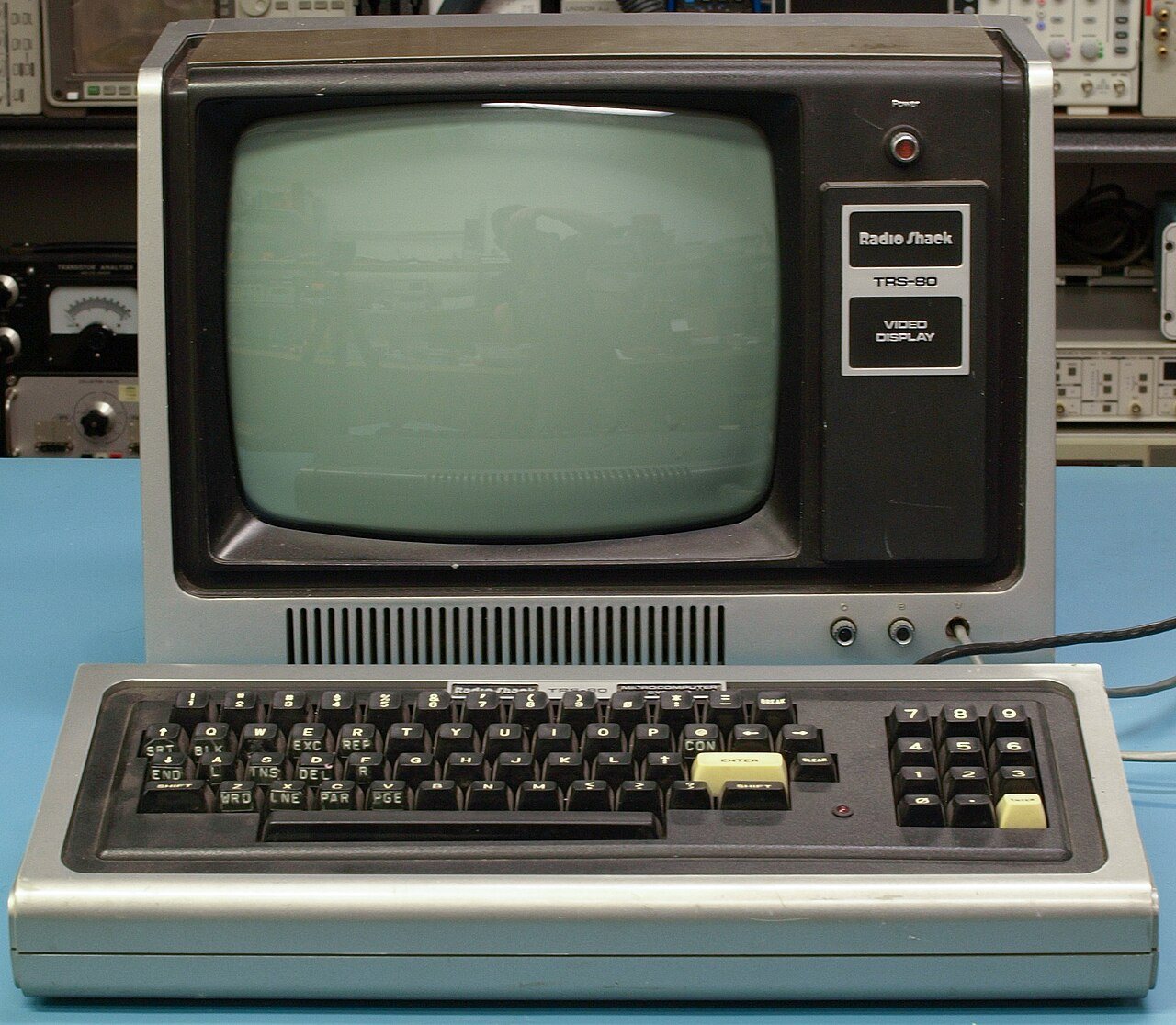
In August 1977, RadioShack released the TRS-80, and this is where the company stepped into immortality. The TRS-80 was named for Tandy Radio Shack and its Zilog Z80 processor, and it cost $599. In 1977 dollars, that was not cheap, but it was absolutely accessible compared to the alternatives. The Apple II, released the same year, started at $1,298. The Commodore PET launched at $795. RadioShack undercut both of them and sold 10,000 units in the first month. In the first year, they moved over 100,000. By some estimates, the TRS-80 held roughly half of the entire personal computer market in 1978. Half. One company. One store. That's kind of insane when you think about it.
For a few years there, RadioShack owned the future. Not completely, obviously. IBM would disrupt everything in 1981 with the PC. But RadioShack was in every mall and strip mall in America. When you wanted a computer, you didn't have to special order it or mail order it from some distant company. You went to RadioShack. You could touch it. You could talk to someone who could explain it. The TRS-80 became legendary among the people who programmed the early games and business software that made personal computers relevant.
And the stores themselves became destinations. On a Saturday afternoon in the early 1980s, the RadioShack in any decent-sized town would be packed with kids staring at the demo units, looking at the walls of cables and connectors, thumbing through programming manuals. There was something about the physicality of it. The weight of the computer. The smell of the cardboard. The actual conversation with an actual human being who could tell you why you needed a certain cable or what a particular programming book was actually about. This wasn't just retail. This was part of the texture of growing up in America during the computer age.
RadioShack even ran something called the Battery of the Month Club, which is exactly as absurd as it sounds and somehow also exactly perfect. You signed up. You got a free battery every month. You were a member of a club dedicated to batteries. And somehow this worked because people actually did need batteries constantly, and RadioShack was the place where you thought to buy them, and there was something in American culture during the 1980s that made joining a battery club seem charming rather than ridiculous.
The Peak: 7,000 Stores and Counting
By the mid-1990s, RadioShack had metastasized across America in the most aggressive retail expansion you could imagine. At the absolute peak, RadioShack operated over 7,000 stores in the United States, with some estimates pushing that number closer to 8,000 when you counted international locations. The company's annual revenue topped $4 billion. For over a decade, from 2000 to 2011, RadioShack posted net sales and operating revenue above $4 billion every single year. At one point the revenue hit $5 billion, though profits were razor thin.
This is worth sitting with for a moment because it's so utterly gone now. RadioShack was a ubiquitous part of American retail for nearly fifty years. It was in every town that had fifty thousand people or more. If you lived in America and wanted to buy a battery, a cable, a computer, computer peripherals, a cordless phone, a burglar alarm kit, a soldering iron, solder, wire, components, a radio, a walkie-talkie, or literally a thousand other things, you went to RadioShack. There were no serious competitors for this niche. Best Buy was growing but focused on big-ticket items. Amazon was selling books. If RadioShack didn't have what you needed, you basically had to order it by mail, which took weeks.
And here's where it gets interesting. Because somewhere in the late 1990s and early 2000s, RadioShack made the decision that still baffles people who remember it. The company decided that it didn't want to serve hobbyists and serious electronics users anymore. It wanted to be a mainstream consumer electronics retailer, competing with Best Buy and Circuit City on their terms. This meant replacing those beautiful bins of components with displays of cell phones and consumer gadgets. It meant replacing the knowledgeable electronics enthusiasts at the counter with sales associates trained to push wireless plans and extended warranties.
The Moment RadioShack Became a Cell Phone Store
The shift didn't happen overnight, but by the early 2000s it was undeniable. RadioShack was becoming something different. The bins of resistors and capacitors were still there, but increasingly relegated to the back of the store, gathering dust. The front space was dedicated to the same products Best Buy sold, except Best Buy was bigger, had better inventory, and had a better reputation. RadioShack was trying to compete on ground where it had no advantage at all.
The company had made a catastrophic strategic decision: it assumed that the core hobbyist market would be replaced by mainstream consumer electronics revenue. The people who built things with components, the people who actually understood electronics, were seen as a dying breed. Maybe they were. But RadioShack abandoned them without building anything credible to replace them. The company that had been the place to go for amateur radio operators and early computer enthusiasts gradually became just another place to buy a phone, except with worse selection and less knowledgeable staff than the bigger chains.
There's a specific cruelty to this strategy. RadioShack had spent fifty years building a brand identity around serving people who cared about technology. That brand meant something. When you walked into RadioShack, you knew what it represented. And then the company systematically destroyed that identity in pursuit of market share with customers who didn't actually care about RadioShack and would much rather go to Best Buy or Walmart anyway. It's like a beloved local bookstore deciding to compete with Barnes and Noble by removing all the interesting titles and stocking nothing but bestsellers. You've destroyed your actual value proposition in pursuit of a market segment that has no reason to prefer you.
But the decision to abandon the enthusiast market wasn't even the most damaging thing RadioShack did. That honor goes to a customer service policy that might be the single most self-destructive decision I've ever seen a retailer make.
RadioShack decided that it would require you to provide your name and address to purchase almost anything. Including batteries. Just batteries. RadioShack, the company that had built its entire existence around convenience, now required that convenience to come with a mini interrogation. The ostensible reason was marketing and customer database building. The actual effect was that you would choose not to shop there. I have a specific memory of wanting to buy a 9-volt battery at RadioShack and just leaving when the cashier asked for my information. I went to Walmart instead. And I wasn't alone. Thousands of people made the same choice every day. RadioShack was actively discouraging people from buying things, which is the exact opposite of what a retail store is supposed to do.
Corporate Dysfunction and the Long Decline
By the mid-2000s, RadioShack was in visible decline. The company had expanded to roughly 8,000 locations, which is a staggering number, but the stores themselves were becoming less relevant. Best Buy had conquered the mainstream consumer electronics market. Amazon was starting to cut into everything. Walmart was selling electronics. Target was selling electronics. RadioShack's entire reason for existing, which was convenience and specialist knowledge, was being erased by the internet and by bigger retailers with better buying power.
Rather than adapting back to what had made the company valuable, RadioShack doubled down on mainstream retail and added layers of corporate dysfunction. The company went through multiple CEOs, each with a different vision, none of which involved actually fixing the fundamental problems.
In 2006, RadioShack made headlines by laying off 400 employees via email. They received a message telling them they were fired. No meeting, no phone call, just an email. It was emblematic of how disconnected the corporate leadership had become from the actual DNA of the business. You were laying off employees from a store built on personal relationships and human interaction by treating them like they were spam. The tone deafness was breathtaking.
By 2013, the company announced a net trading loss of $400.2 million, well above the 2012 loss of $139.4 million. At the end of October 2014, quarterly figures indicated RadioShack was losing $1.1 million per day. Per day. Let that number sink in for a second. Every single day, RadioShack was bleeding over a million dollars, and nobody could figure out how to stop it.
The Super Bowl Ad and the End
In February 2014, RadioShack aired a Super Bowl ad that might be the most tragically self-aware piece of advertising in history. The premise: the 1980s called and they want their store back. Characters from 1980s pop culture storm through a RadioShack, reclaiming everything. It was funny. It was clever. And it was basically RadioShack telling the entire country, "Yeah, we know. We know we're a relic."
The ad was supposed to signal a rebrand, a new direction. Less than a year later, in February 2015, RadioShack filed for Chapter 11 bankruptcy. The company was delisted from the New York Stock Exchange. General Wireless, a subsidiary of Standard General, bought RadioShack's assets for $26.2 million in May 2015. That's it. The entire company, every store, every piece of inventory, every trademark, for roughly the price of a couple of nice houses in Manhattan.
Theoretically, this should have been the end. But RadioShack persisted in zombie form. General Wireless continued to operate stores, continued to decline, and in March 2017, filed for bankruptcy again. This time the brand was essentially left floating, passing through various hands until Unicomer Group, based in El Salvador, acquired control of the worldwide RadioShack business in 2023.
Today, a handful of RadioShack franchise locations still exist. The number changes constantly. The brand persists online as something that has almost nothing to do with what RadioShack actually was. The store where you could buy a TRS-80 and talk to someone who understood electronics is gone, replaced by a name attached to a memory.
What Was Actually Lost
The death of RadioShack is usually attributed to the internet, to Amazon, to the simple fact that you don't need to go to a physical store to buy electronics anymore. There's truth in that. But it's not the real story. The real story is that RadioShack was a company that forgot what made it valuable and tried to compete on the terms of companies that would always beat it.
RadioShack's value was never that it had the biggest inventory or the lowest prices. Its value was that it was there. It was accessible. It had staff that actually cared about electronics. It served a genuine community of people who wanted to understand technology, not just consume it. When RadioShack decided to become a cell phone store, it didn't adapt. It surrendered. It said, "We can't win at what we're actually good at, so let's try to win at something we're terrible at."
The internet didn't kill RadioShack. RadioShack killed RadioShack. The company had an opportunity to become the online component supplier, the digital marketplace for hobbyists and enthusiasts. Companies like Digi-Key and Mouser Electronics eventually filled this niche and did incredibly well. But RadioShack could have owned it. Instead, the company tried to compete with Best Buy online, which is an insane strategy when Best Buy already existed and was bigger and better capitalized and actually good at it.
What's genuinely lost is something harder to quantify. It's the physical space where you could go and browse and discover. It's the human expertise available to you in person, on a Saturday, without an appointment. It's the culture of hobbyist electronics, of building things, of understanding how technology worked at a component level. RadioShack was that place. When it became a cell phone store, it abandoned everyone who actually needed it. And the people who needed cell phones never needed RadioShack.
Frequently Asked Questions
When was RadioShack founded? RadioShack was founded in 1921 by Theodore and Milton Deutschmann in Boston, originally to serve amateur radio operators and electronics hobbyists.
What was the TRS-80? The TRS-80, released in August 1977, was one of the earliest mass-market personal computers. Priced at $599, it sold over 100,000 units in its first year and briefly captured roughly half of the entire personal computer market.
Why did RadioShack ask for your name and address? RadioShack's policy was ostensibly for marketing purposes and customer database building, but it became infamous and actively drove customers to competitors. The inconvenience of providing personal information for simple purchases like batteries outweighed whatever convenience RadioShack offered.
How many stores did RadioShack have at its peak? RadioShack operated over 7,000 stores in the United States at its peak during the 1990s, with some estimates reaching as high as 8,000 locations including international stores.
When did RadioShack file for bankruptcy? RadioShack filed for Chapter 11 bankruptcy in February 2015. Its assets were purchased by General Wireless for $26.2 million. The company filed for bankruptcy again in March 2017.
Does RadioShack still exist? The RadioShack brand is now owned by Unicomer Group, based in El Salvador, which acquired the worldwide business in 2023. A handful of franchise locations remain, but the company bears little resemblance to the RadioShack of the 20th century.
What killed RadioShack? Rather than external market forces alone, RadioShack was undermined by internal strategic decisions: abandoning the hobbyist electronics market, competing poorly against Best Buy in mainstream consumer goods, implementing the unpopular name-and-address policy, executive turnover, and failing to build an online presence that leveraged its specialist expertise.