What Happened to Netbooks? The $200 Laptops That Terrified Microsoft

2026-04-03 by 404 Memory Found

In October 2007, a Taiwanese computer manufacturer called ASUS released a laptop that weighed two pounds, had a seven-inch screen, ran Linux, and cost $299. It was called the Eee PC, and within weeks, the initial production run of 350,000 units had completely sold out.

That laptop launched an entire product category. By 2009, netbooks accounted for 10% of all personal computers shipped worldwide, roughly 33 million units in a single year. By 2013, the category was dead. Not declining. Dead. Acer and ASUS, the two biggest netbook makers, both announced they would stop producing them entirely.

The netbook's rise and fall is one of the most compressed boom-and-bust cycles in consumer technology history. And the story of how it happened involves Microsoft scrambling to keep a dead operating system alive, Intel creating a processor specifically designed to be "good enough," and Apple releasing a product that made the entire category irrelevant overnight.

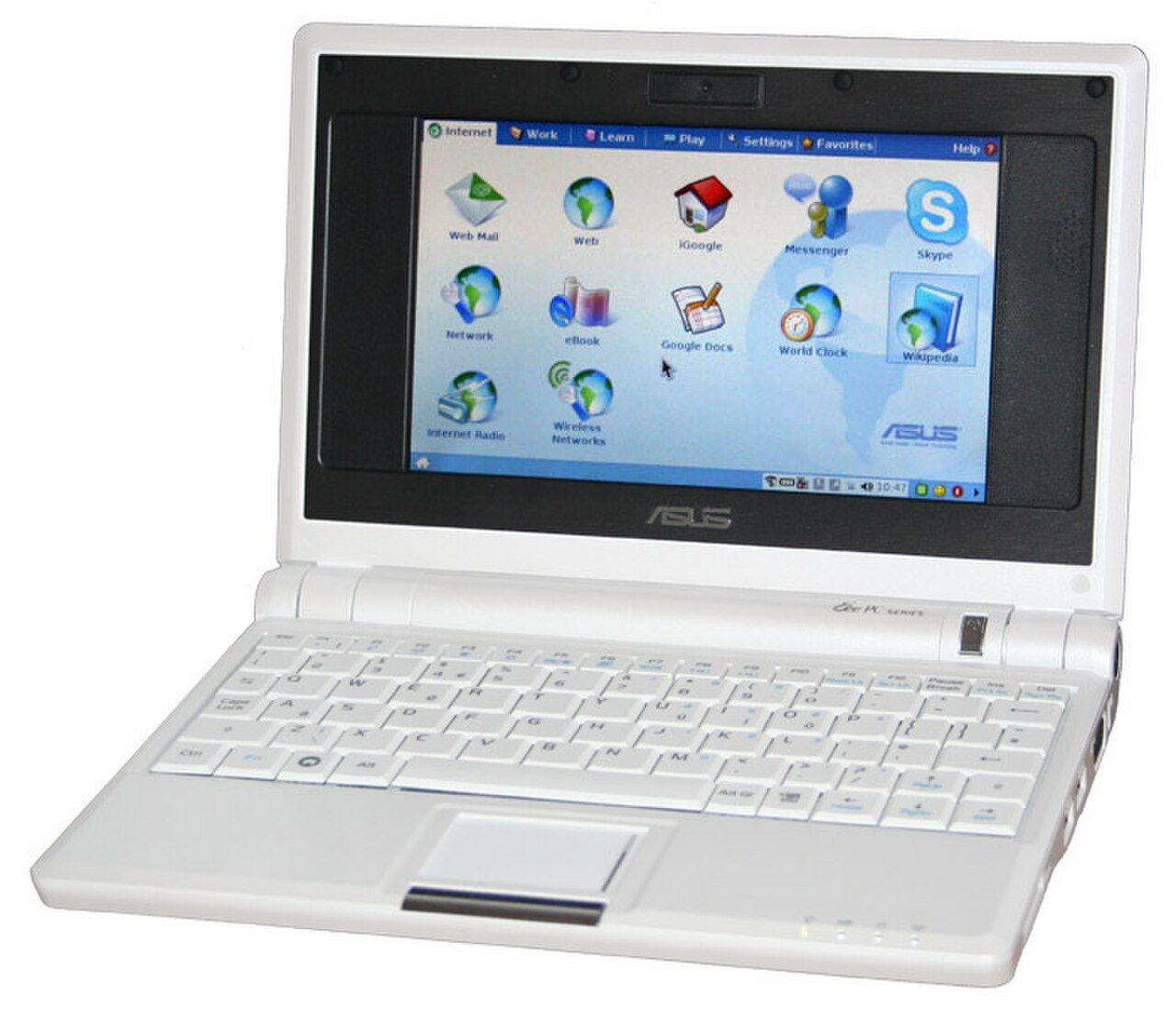
ASUS Eee PC 701 laptop in white
The ASUS Eee PC 701, released in late 2007, launched the netbook revolution with its tiny frame and $299 price tag.

The Problem Netbooks Were Solving

To understand why netbooks exploded, you have to understand the laptop market in 2007. The average laptop cost somewhere between $700 and $1,200. They were heavy, they had terrible battery life, and they ran Windows Vista, which was, to put it diplomatically, not well-loved. If you wanted a portable computer for basic tasks like email, web browsing, and word processing, you were paying a premium for hardware capabilities you would never use.

The Eee PC's pitch was radical in its simplicity: what if a laptop only did the basics, but did them at a price point that made it almost an impulse purchase? ASUS stripped out everything unnecessary. The original Eee PC 701 had a 7-inch, 800x480 display, a 900 MHz Intel Celeron processor, 512 MB of RAM, and a 4 GB solid-state drive. It ran a customized version of Xandros Linux with a simplified interface. It booted in about 15 seconds.

The "Eee" name stood for "Easy to learn, Easy to work, Easy to play." That triple-easy branding captured exactly what the product was about. This wasn't a computer for people who cared about computers. It was a computer for people who needed a computer.

The Industry Scramble

What happened next was something the PC industry rarely experiences: genuine panic followed by a gold rush. Every major manufacturer saw ASUS's sales numbers and wanted in. Within 18 months of the original Eee PC, you could buy netbooks from Acer, Dell, HP, Lenovo, Samsung, MSI, and a dozen smaller brands. The Acer Aspire One, launched in mid-2008, became a massive hit. By 2010, Acer had captured 37% of the global netbook market.

Two companies played particularly crucial roles in the netbook explosion: Intel and Microsoft. And their responses reveal a lot about how incumbents react when disruption threatens their business model.

Intel's Calculated Move

Intel saw netbooks coming and made a strategic decision that was, in retrospect, brilliant. Rather than let low-cost ARM processors or AMD chips power the netbook revolution, Intel designed a processor specifically for the category. The Intel Atom N270, launched in April 2008 at a wholesale price of $44, was a masterstroke of strategic positioning.

The Atom was a single-core, 1.6 GHz chip built on Intel's 45-nanometer process. It consumed just 2.5 watts. It was, by any modern standard, extremely slow. But that was the point. Intel didn't want the Atom to be good. It wanted the Atom to be good enough. Good enough for email. Good enough for web browsing. Good enough for basic document editing. Not good enough to cannibalize sales of its higher-margin Core processors that went into real laptops.

This is a textbook case of what Clayton Christensen described as "the innovator's dilemma," except Intel managed to disrupt itself on its own terms. By creating a cheap chip for the low end, Intel ensured that netbook manufacturers stayed in the Intel ecosystem rather than looking elsewhere. The Atom became the de facto standard for netbooks almost overnight.

Microsoft's Panic Response

Microsoft's reaction was less elegant. The company had a serious problem: Windows Vista, its current operating system, was too resource-hungry to run on netbook hardware. The original Eee PC ran Linux, and early netbook buyers seemed perfectly fine with that. If the netbook market grew large enough on Linux, Microsoft risked losing an entire generation of low-end computer users.

So Microsoft did something extraordinary. It extended the life of Windows XP, which had been released in 2001 and was already scheduled for end-of-life, specifically to keep netbooks running Windows. Microsoft offered OEMs deeply discounted Windows XP licenses for netbooks, reportedly as low as $15 per unit compared to the standard $50 or more for a full Windows license. But there was a catch: Microsoft imposed strict hardware limitations on what qualified as a "netbook." Screens couldn't exceed 10.2 inches. RAM was capped at 1 GB. Hard drive or SSD storage was limited.

These restrictions were designed to protect Microsoft's higher-margin Windows licenses for regular laptops. But they also had the effect of permanently stunting the netbook as a product category. Manufacturers couldn't make netbooks meaningfully better without losing their discounted Windows license. The ceiling was baked in.

ASUS Eee PC next to a MacBook showing the dramatic size difference
The Eee PC next to a MacBook, showing the dramatic size difference that defined the netbook category.

Peak Netbook: 2009

The netbook market peaked in 2009 and early 2010. The numbers were genuinely impressive. In 2009 alone, approximately 33 million netbooks shipped worldwide, representing 103% growth over 2008's 16.4 million units. Revenue hit $11.4 billion. Netbooks accounted for roughly 10% of all PC shipments globally.

For a product category that hadn't existed two years earlier, those numbers were remarkable. Analysts were projecting continued growth. DisplaySearch forecast 41.8 million netbook shipments in 2010. Some analysts predicted netbooks would eventually make up 20% of the total PC market.

But beneath the impressive sales numbers, there was a fundamental problem that almost nobody was talking about: the economics were terrible. After paying Intel for an Atom processor and Microsoft for a Windows license, the margins on a $250 to $350 netbook were razor-thin. Some manufacturers were reportedly making less than $10 profit per unit. PC makers had effectively created a race to the bottom, cannibalizing their own higher-margin laptop sales in the process.

The iPad Landed

On January 27, 2010, Steve Jobs walked onto a stage at the Yerba Buena Center for the Arts in San Francisco and introduced the iPad. He sat in a leather chair, held the device, and browsed the web. He read email. He looked at photos. He watched a video. Everything a netbook could do, except the experience looked nothing like a netbook.

Jobs had actually addressed netbooks directly during the presentation. "The problem is, netbooks aren't better at anything," he said. And he was right. The iPad, starting at $499, was more expensive than most netbooks. But it was better at every single task that netbook buyers actually cared about. Web browsing on a netbook's cramped 10-inch screen with a trackpad was functional. Web browsing on a 9.7-inch touchscreen that you held in your hands was pleasant. Watching video on a netbook meant squinting at a low-resolution panel. On the iPad, it was genuinely enjoyable.

The iPad sold 300,000 units on its first day. It sold 3 million units in its first 80 days. And almost immediately, netbook sales began to decline.

The Speed of the Collapse

The netbook's death was remarkably fast. In 2010, netbooks still shipped around 39 million units. But growth had stalled, and the trajectory had clearly reversed. By 2011, netbook shipments dropped significantly as tablet sales exploded. By 2012, the category was in free fall.

The final blow came in January 2013. Both ASUS and Acer, the category's two largest manufacturers (and the company that had started it all), confirmed they would no longer produce netbooks. The product category that had gone from zero to 10% of the global PC market in just two years had been effectively eliminated in three.

Multiple factors converged to kill the netbook, and it's worth understanding each one because the pattern repeats across tech history.

First, tablets offered a better experience for the use cases that drove netbook adoption. If you're mostly browsing the web and checking email, a touchscreen is more intuitive than a tiny keyboard and trackpad. The iPad proved that conclusively. Second, smartphones got bigger and more capable. The iPhone 4, released in June 2010, had a higher-resolution display than most netbooks. Why carry a second device for web browsing when your phone could do it? Third, regular laptops got cheaper. The same competitive pressure that created netbooks eventually pushed mainstream laptop prices down. By 2012, you could buy a decent 14-inch laptop for $400 to $450, which made a cramped 10-inch netbook with a slow Atom processor a much harder sell.

The Linux Question

There's an alternate history worth considering. The original Eee PC ran Linux, and it worked well. Boot times were fast. The interface was simple. For the basic tasks that netbook buyers needed, Linux was arguably a better fit than Windows XP, which was designed for a different era of computing.

Early data suggested that consumers were surprisingly open to Linux on netbooks. Some reports indicated that return rates for Linux netbooks were higher than Windows models, which Microsoft used as evidence that consumers wanted Windows. But other analyses suggested the returns had more to do with poor Linux implementations by manufacturers who didn't invest in making the experience polished.

If netbook makers had committed to Linux and used the savings on Windows licenses (even the discounted ones) to improve hardware or lower prices further, would the category have survived longer? Probably not, given the iPad's impact. But the netbook era remains one of the biggest "what if" moments for desktop Linux adoption.

What Netbooks Got Right

For all their limitations, netbooks identified a real and lasting market insight: most people don't need a powerful computer. They need a screen, a keyboard, a web browser, and enough battery life to get through a few hours. The netbook's failure wasn't a failure of the idea. It was a failure of execution, constrained by the limitations of the hardware, the economics of the software licensing model, and the arrival of a form factor that delivered on the promise more effectively.

That insight survived. Chromebooks, which Google launched in 2011, are essentially netbooks with better software economics. Instead of paying Microsoft for a Windows license, manufacturers use Chrome OS for free. Instead of running local applications on underpowered hardware, everything runs in the browser, backed by cloud computing. Chromebooks now dominate the education market and have carved out a significant share of the consumer laptop space. In 2023, Chromebooks accounted for roughly 10% of global laptop shipments, which is, notably, about the same market share that netbooks held at their peak.

The line from the ASUS Eee PC to the modern Chromebook is almost perfectly straight. Same audience. Same price point. Same basic proposition: a computer that does the basics well, at a price that doesn't require serious deliberation. The netbook got the idea right and the execution wrong. The Chromebook fixed the execution.

The Lesson Nobody Learned in Time

The netbook boom and bust taught the tech industry something it keeps having to relearn: you cannot build a sustainable business on a product that is defined by how cheap it is. The race to the bottom destroys margins. It attracts customers who have no brand loyalty. And it creates an opening for anyone who offers a genuinely better experience at a slightly higher price.

Apple understood this intuitively. While the entire PC industry was chasing the netbook dollar, Apple refused to make one. Steve Jobs called netbooks "just cheap laptops" and said Apple didn't know how to make a $500 computer that wasn't "a piece of junk." Instead, Apple made the MacBook Air thinner and more desirable, and then made the iPad to capture the audience that netbooks were serving. One company competed on price. The other competed on experience. The outcome was predictable.

Frequently Asked Questions

What exactly was a netbook?

A netbook was a small, lightweight, inexpensive laptop designed primarily for web browsing and basic computing tasks. They typically had screens between 7 and 10 inches, Intel Atom processors, limited storage, and cost between $200 and $400. The category existed roughly from 2007 to 2013.

What was the first netbook?

The ASUS Eee PC 701, released in October 2007 in Taiwan and November 2007 in the United States, is widely considered the first modern netbook. It had a 7-inch screen, ran Linux, and cost $299. It sold out its initial production run of 350,000 units within weeks.

Why did netbooks fail?

Netbooks declined due to several converging factors: the iPad and tablets offered a better experience for casual computing, smartphones became more capable, traditional laptops got cheaper, the economics of netbook manufacturing offered razor-thin margins, and Microsoft's licensing restrictions prevented meaningful hardware improvements.

What killed the netbook market?

The iPad, launched in April 2010, is widely credited as the primary netbook killer. The tablet offered a superior experience for the tasks that drove netbook adoption (web browsing, email, media consumption) while being more portable and intuitive. Netbook sales declined sharply after the iPad's launch and the category was effectively dead by 2013.

Are Chromebooks the successors to netbooks?

In many ways, yes. Chromebooks serve the same market (affordable, basic computing), target the same price point ($200 to $400), and operate on the same insight (most users only need a web browser). The key difference is the software model: Chrome OS is free and cloud-based, which solves the margin problem that plagued netbook manufacturers paying for Windows licenses.

Did Steve Jobs ever comment on netbooks?

Yes. Jobs was famously dismissive of netbooks. At an Apple earnings call in 2008, he said, "We don't know how to make a $500 computer that's not a piece of junk." Apple never made a netbook, instead releasing the iPad in 2010 as its answer to the low-cost computing market.

Related Posts:
← Back to Blog

What Happened to Netbooks? The $200 Laptops That Terrified Microsoft | 404 Memory Found

📖 What Happened to Netbooks? The $200 Laptops That Terrified Microsoft

In October 2007, a Taiwanese computer manufacturer called ASUS released a laptop that weighed two pounds, had a seven-inch screen, ran Linux, and cost $299. It was called the Eee PC, and within weeks, the initial production run of 350,000 units had completely sold out.

That laptop launched an entire product category. By 2009, netbooks accounted for 10% of all personal computers shipped worldwide, roughly 33 million units in a single year. By 2013, the category was dead. Not declining. Dead. Acer and ASUS, the two biggest netbook makers, both announced they would stop producing them entirely.

The netbook's rise and fall is one of the most compressed boom-and-bust cycles in consumer technology history. And the story of how it happened involves Microsoft scrambling to keep a dead operating system alive, Intel creating a processor specifically designed to be "good enough," and Apple releasing a product that made the entire category irrelevant overnight.

ASUS Eee PC 701 laptop in white
The ASUS Eee PC 701, released in late 2007, launched the netbook revolution with its tiny frame and $299 price tag.

The Problem Netbooks Were Solving

To understand why netbooks exploded, you have to understand the laptop market in 2007. The average laptop cost somewhere between $700 and $1,200. They were heavy, they had terrible battery life, and they ran Windows Vista, which was, to put it diplomatically, not well-loved. If you wanted a portable computer for basic tasks like email, web browsing, and word processing, you were paying a premium for hardware capabilities you would never use.

The Eee PC's pitch was radical in its simplicity: what if a laptop only did the basics, but did them at a price point that made it almost an impulse purchase? ASUS stripped out everything unnecessary. The original Eee PC 701 had a 7-inch, 800x480 display, a 900 MHz Intel Celeron processor, 512 MB of RAM, and a 4 GB solid-state drive. It ran a customized version of Xandros Linux with a simplified interface. It booted in about 15 seconds.

The "Eee" name stood for "Easy to learn, Easy to work, Easy to play." That triple-easy branding captured exactly what the product was about. This wasn't a computer for people who cared about computers. It was a computer for people who needed a computer.

The Industry Scramble

What happened next was something the PC industry rarely experiences: genuine panic followed by a gold rush. Every major manufacturer saw ASUS's sales numbers and wanted in. Within 18 months of the original Eee PC, you could buy netbooks from Acer, Dell, HP, Lenovo, Samsung, MSI, and a dozen smaller brands. The Acer Aspire One, launched in mid-2008, became a massive hit. By 2010, Acer had captured 37% of the global netbook market.

Two companies played particularly crucial roles in the netbook explosion: Intel and Microsoft. And their responses reveal a lot about how incumbents react when disruption threatens their business model.

Intel's Calculated Move

Intel saw netbooks coming and made a strategic decision that was, in retrospect, brilliant. Rather than let low-cost ARM processors or AMD chips power the netbook revolution, Intel designed a processor specifically for the category. The Intel Atom N270, launched in April 2008 at a wholesale price of $44, was a masterstroke of strategic positioning.

The Atom was a single-core, 1.6 GHz chip built on Intel's 45-nanometer process. It consumed just 2.5 watts. It was, by any modern standard, extremely slow. But that was the point. Intel didn't want the Atom to be good. It wanted the Atom to be good enough. Good enough for email. Good enough for web browsing. Good enough for basic document editing. Not good enough to cannibalize sales of its higher-margin Core processors that went into real laptops.

This is a textbook case of what Clayton Christensen described as "the innovator's dilemma," except Intel managed to disrupt itself on its own terms. By creating a cheap chip for the low end, Intel ensured that netbook manufacturers stayed in the Intel ecosystem rather than looking elsewhere. The Atom became the de facto standard for netbooks almost overnight.

Microsoft's Panic Response

Microsoft's reaction was less elegant. The company had a serious problem: Windows Vista, its current operating system, was too resource-hungry to run on netbook hardware. The original Eee PC ran Linux, and early netbook buyers seemed perfectly fine with that. If the netbook market grew large enough on Linux, Microsoft risked losing an entire generation of low-end computer users.

So Microsoft did something extraordinary. It extended the life of Windows XP, which had been released in 2001 and was already scheduled for end-of-life, specifically to keep netbooks running Windows. Microsoft offered OEMs deeply discounted Windows XP licenses for netbooks, reportedly as low as $15 per unit compared to the standard $50 or more for a full Windows license. But there was a catch: Microsoft imposed strict hardware limitations on what qualified as a "netbook." Screens couldn't exceed 10.2 inches. RAM was capped at 1 GB. Hard drive or SSD storage was limited.

These restrictions were designed to protect Microsoft's higher-margin Windows licenses for regular laptops. But they also had the effect of permanently stunting the netbook as a product category. Manufacturers couldn't make netbooks meaningfully better without losing their discounted Windows license. The ceiling was baked in.

ASUS Eee PC next to a MacBook showing the dramatic size difference
The Eee PC next to a MacBook, showing the dramatic size difference that defined the netbook category.

Peak Netbook: 2009

The netbook market peaked in 2009 and early 2010. The numbers were genuinely impressive. In 2009 alone, approximately 33 million netbooks shipped worldwide, representing 103% growth over 2008's 16.4 million units. Revenue hit $11.4 billion. Netbooks accounted for roughly 10% of all PC shipments globally.

For a product category that hadn't existed two years earlier, those numbers were remarkable. Analysts were projecting continued growth. DisplaySearch forecast 41.8 million netbook shipments in 2010. Some analysts predicted netbooks would eventually make up 20% of the total PC market.

But beneath the impressive sales numbers, there was a fundamental problem that almost nobody was talking about: the economics were terrible. After paying Intel for an Atom processor and Microsoft for a Windows license, the margins on a $250 to $350 netbook were razor-thin. Some manufacturers were reportedly making less than $10 profit per unit. PC makers had effectively created a race to the bottom, cannibalizing their own higher-margin laptop sales in the process.

The iPad Landed

On January 27, 2010, Steve Jobs walked onto a stage at the Yerba Buena Center for the Arts in San Francisco and introduced the iPad. He sat in a leather chair, held the device, and browsed the web. He read email. He looked at photos. He watched a video. Everything a netbook could do, except the experience looked nothing like a netbook.

Jobs had actually addressed netbooks directly during the presentation. "The problem is, netbooks aren't better at anything," he said. And he was right. The iPad, starting at $499, was more expensive than most netbooks. But it was better at every single task that netbook buyers actually cared about. Web browsing on a netbook's cramped 10-inch screen with a trackpad was functional. Web browsing on a 9.7-inch touchscreen that you held in your hands was pleasant. Watching video on a netbook meant squinting at a low-resolution panel. On the iPad, it was genuinely enjoyable.

The iPad sold 300,000 units on its first day. It sold 3 million units in its first 80 days. And almost immediately, netbook sales began to decline.

The Speed of the Collapse

The netbook's death was remarkably fast. In 2010, netbooks still shipped around 39 million units. But growth had stalled, and the trajectory had clearly reversed. By 2011, netbook shipments dropped significantly as tablet sales exploded. By 2012, the category was in free fall.

The final blow came in January 2013. Both ASUS and Acer, the category's two largest manufacturers (and the company that had started it all), confirmed they would no longer produce netbooks. The product category that had gone from zero to 10% of the global PC market in just two years had been effectively eliminated in three.

Multiple factors converged to kill the netbook, and it's worth understanding each one because the pattern repeats across tech history.

First, tablets offered a better experience for the use cases that drove netbook adoption. If you're mostly browsing the web and checking email, a touchscreen is more intuitive than a tiny keyboard and trackpad. The iPad proved that conclusively. Second, smartphones got bigger and more capable. The iPhone 4, released in June 2010, had a higher-resolution display than most netbooks. Why carry a second device for web browsing when your phone could do it? Third, regular laptops got cheaper. The same competitive pressure that created netbooks eventually pushed mainstream laptop prices down. By 2012, you could buy a decent 14-inch laptop for $400 to $450, which made a cramped 10-inch netbook with a slow Atom processor a much harder sell.

The Linux Question

There's an alternate history worth considering. The original Eee PC ran Linux, and it worked well. Boot times were fast. The interface was simple. For the basic tasks that netbook buyers needed, Linux was arguably a better fit than Windows XP, which was designed for a different era of computing.

Early data suggested that consumers were surprisingly open to Linux on netbooks. Some reports indicated that return rates for Linux netbooks were higher than Windows models, which Microsoft used as evidence that consumers wanted Windows. But other analyses suggested the returns had more to do with poor Linux implementations by manufacturers who didn't invest in making the experience polished.

If netbook makers had committed to Linux and used the savings on Windows licenses (even the discounted ones) to improve hardware or lower prices further, would the category have survived longer? Probably not, given the iPad's impact. But the netbook era remains one of the biggest "what if" moments for desktop Linux adoption.

What Netbooks Got Right

For all their limitations, netbooks identified a real and lasting market insight: most people don't need a powerful computer. They need a screen, a keyboard, a web browser, and enough battery life to get through a few hours. The netbook's failure wasn't a failure of the idea. It was a failure of execution, constrained by the limitations of the hardware, the economics of the software licensing model, and the arrival of a form factor that delivered on the promise more effectively.

That insight survived. Chromebooks, which Google launched in 2011, are essentially netbooks with better software economics. Instead of paying Microsoft for a Windows license, manufacturers use Chrome OS for free. Instead of running local applications on underpowered hardware, everything runs in the browser, backed by cloud computing. Chromebooks now dominate the education market and have carved out a significant share of the consumer laptop space. In 2023, Chromebooks accounted for roughly 10% of global laptop shipments, which is, notably, about the same market share that netbooks held at their peak.

The line from the ASUS Eee PC to the modern Chromebook is almost perfectly straight. Same audience. Same price point. Same basic proposition: a computer that does the basics well, at a price that doesn't require serious deliberation. The netbook got the idea right and the execution wrong. The Chromebook fixed the execution.

The Lesson Nobody Learned in Time

The netbook boom and bust taught the tech industry something it keeps having to relearn: you cannot build a sustainable business on a product that is defined by how cheap it is. The race to the bottom destroys margins. It attracts customers who have no brand loyalty. And it creates an opening for anyone who offers a genuinely better experience at a slightly higher price.

Apple understood this intuitively. While the entire PC industry was chasing the netbook dollar, Apple refused to make one. Steve Jobs called netbooks "just cheap laptops" and said Apple didn't know how to make a $500 computer that wasn't "a piece of junk." Instead, Apple made the MacBook Air thinner and more desirable, and then made the iPad to capture the audience that netbooks were serving. One company competed on price. The other competed on experience. The outcome was predictable.

Frequently Asked Questions

What exactly was a netbook?

A netbook was a small, lightweight, inexpensive laptop designed primarily for web browsing and basic computing tasks. They typically had screens between 7 and 10 inches, Intel Atom processors, limited storage, and cost between $200 and $400. The category existed roughly from 2007 to 2013.

What was the first netbook?

The ASUS Eee PC 701, released in October 2007 in Taiwan and November 2007 in the United States, is widely considered the first modern netbook. It had a 7-inch screen, ran Linux, and cost $299. It sold out its initial production run of 350,000 units within weeks.

Why did netbooks fail?

Netbooks declined due to several converging factors: the iPad and tablets offered a better experience for casual computing, smartphones became more capable, traditional laptops got cheaper, the economics of netbook manufacturing offered razor-thin margins, and Microsoft's licensing restrictions prevented meaningful hardware improvements.

What killed the netbook market?

The iPad, launched in April 2010, is widely credited as the primary netbook killer. The tablet offered a superior experience for the tasks that drove netbook adoption (web browsing, email, media consumption) while being more portable and intuitive. Netbook sales declined sharply after the iPad's launch and the category was effectively dead by 2013.

Are Chromebooks the successors to netbooks?

In many ways, yes. Chromebooks serve the same market (affordable, basic computing), target the same price point ($200 to $400), and operate on the same insight (most users only need a web browser). The key difference is the software model: Chrome OS is free and cloud-based, which solves the margin problem that plagued netbook manufacturers paying for Windows licenses.

Did Steve Jobs ever comment on netbooks?

Yes. Jobs was famously dismissive of netbooks. At an Apple earnings call in 2008, he said, "We don't know how to make a $500 computer that's not a piece of junk." Apple never made a netbook, instead releasing the iPad in 2010 as its answer to the low-cost computing market.

← Back to Blog
00:00