What Happened to Kodak, the Company That Invented the Digital Camera Then Chose to Ignore It

In 1975, a 24-year-old Kodak engineer named Steve Sasson built the world's first digital camera. It was the size of a toaster, weighed about eight pounds, recorded black-and-white images at a resolution of 0.01 megapixels, and stored them on a cassette tape. The process of capturing a single photograph took 23 seconds.

Sasson brought his invention to Kodak's management. Their response, as he later recalled, was a version of: "That's cute, but don't tell anyone about it." The company that had built its empire on the phrase "Kodak moment" had just been handed the future of photography. And it decided the future could wait.

Twenty-seven years later, Kodak filed for bankruptcy.

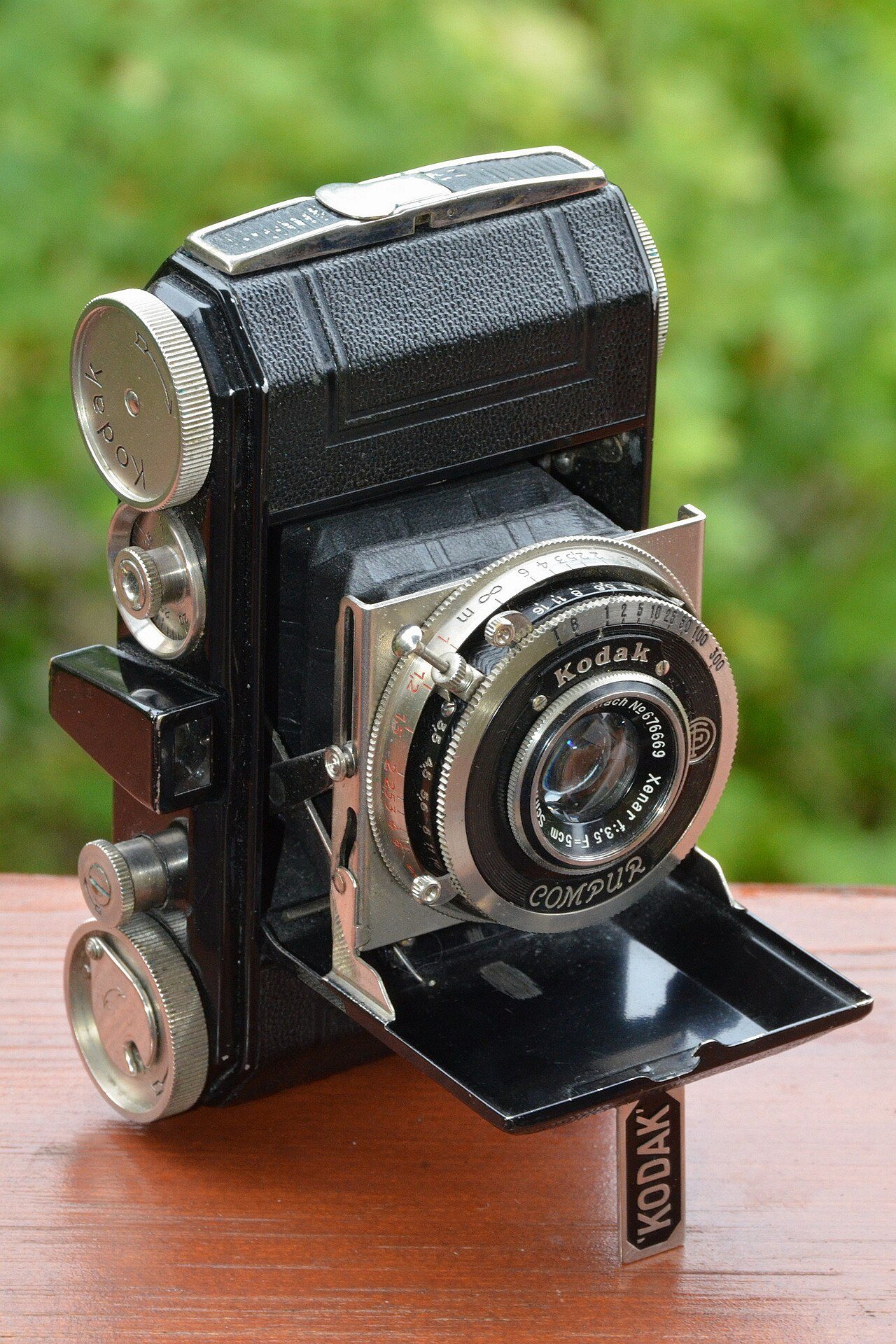
A Kodak Retina camera from 1934
A Kodak Retina camera from 1934. For most of the 20th century, Kodak didn't just sell cameras. It defined how the world captured and preserved memories.

The Company That Made Photography Democratic

George Eastman didn't invent photography. But he made it accessible to everyone, which mattered more. In 1888, Eastman launched the original Kodak camera with a slogan that captured its entire value proposition in seven words: "You press the button, we do the rest." Before Eastman, photography required specialized knowledge, bulky equipment, and a darkroom. After Eastman, it required $25 and a functioning index finger.

The business model was elegant in a way that would later be compared to razor-and-blades economics. The camera was the entry point. The real money came from film, processing, and printing. Every photograph taken was a consumable transaction. Every birthday party, every vacation, every first day of school generated revenue for Kodak. And because film needed to be developed, Kodak controlled both ends of the value chain: the capture and the output.

By the mid-20th century, Kodak was one of the most recognizable brands on the planet. The company's yellow-and-red logo was ubiquitous, appearing in camera shops, drugstores, and tourist destinations worldwide. "Kodak moment" entered the English language as shorthand for a memory worth preserving. The company wasn't just selling film. It was selling the idea that your life's important moments deserved to be captured, and that Kodak was the way to do it.

The Numbers at the Peak

Look at the numbers and you start to understand why Kodak's leadership had a hard time imagining the end. In 1976, Kodak controlled approximately 90% of film sales and 85% of camera sales in the United States. Global employment peaked at 145,300 workers in 1988. Annual revenue hit $16 billion in 1996. The company's market capitalization reached $31 billion in 1997.

These weren't the numbers of a company in trouble. These were the numbers of a company that had won. Kodak's dominance in film photography was so complete that it functioned almost like a utility. If you took pictures, you almost certainly used Kodak products somewhere in the process. The company's Rochester, New York headquarters was the economic engine of the entire region, and Kodak was routinely listed among the most valuable brands in America.

The problem, of course, is that dominance in a declining market is still decline. And by the time Kodak's leadership fully acknowledged what was happening, the market had already moved.

1975: The Camera That Should Have Changed Everything

Steve Sasson's digital camera prototype was, by any reasonable definition, a breakthrough. He had proven that you could capture an image electronically, without film, without chemicals, without a darkroom. The resolution was terrible. The process was slow. The storage was primitive. But the concept was sound, and concepts are what matter when you're looking at a 15-to-20-year technology horizon.

Sasson and his colleague Robert Hills even built a more advanced prototype in 1989 that produced images closer to what consumers would eventually expect from digital photography. They showed it internally. The response from Kodak's film division was predictable. As Sasson later told The New York Times, management's reaction could be summarized as: "Why would anyone ever want to look at their pictures on a television set?"

Here's the thing. The people asking that question weren't stupid. They were rational actors protecting a phenomenally profitable business. Kodak's film and processing operations had profit margins estimated between 60% and 70%. Digital photography, by contrast, eliminated the consumable. No film to sell. No processing fees. No prints unless the customer chose to make them. From a pure business perspective, digital photography was a threat to the most profitable part of Kodak's business model.

This is the innovator's dilemma in its purest form. Clayton Christensen would later use Kodak as one of his defining case studies. The company that had the most to gain from leading the digital transition was also the company that had the most to lose from it. And Kodak chose to protect what it had rather than build what was coming.

The Slow Decline Nobody Wanted to See

The strange thing about Kodak's decline is that it wasn't sudden. It was a slow, visible erosion that took roughly 15 years to reach the point of no return. And during that entire period, Kodak made moves that suggested awareness of the digital threat, just never with the conviction required to actually pivot the business.

In 1991, Kodak developed the Kodak DCS 100, one of the first commercially available digital cameras, in partnership with Nikon. It cost between $20,000 and $25,000 depending on configuration, targeting professional photojournalists rather than consumers. In 1995, Kodak released the DC40, one of the first consumer-oriented digital cameras, at a price point accessible to early-adopter consumers. The company invested heavily in digital imaging research throughout the 1990s and held thousands of patents related to digital photography technology.

So Kodak wasn't ignoring digital. It was hedging. The strategy seemed to be: participate in digital just enough to stay relevant, but never commit so aggressively that it cannibalized the film business. On paper, this looked like prudent corporate strategy. In practice, it meant that Kodak was always two steps behind the companies that had nothing to lose.

The original iMac G3 in Bondi Blue
The late 1990s digital revolution, exemplified by products like the iMac, was transforming how consumers interacted with technology. Kodak saw it coming and still couldn't adapt.

Canon, Nikon, Sony, and eventually Samsung and the smartphone manufacturers had no legacy film business to protect. They could go all-in on digital without worrying about destroying an existing revenue stream. Kodak could not. Or rather, Kodak chose not to, which amounts to the same thing.

Consider the timeline. In 1997, when Kodak's market cap hit $31 billion, digital cameras were still expensive toys that produced mediocre images. A reasonable executive could look at the numbers and conclude that digital was years, maybe decades, away from threatening the core business. But technology doesn't move in straight lines. It moves in S-curves. By 2003, digital camera sales surpassed film camera sales globally. By 2006, Nikon had stopped producing film cameras entirely. The transition that seemed distant in 1997 was effectively complete by 2008.

Kodak's annual reports from this period make for fascinating reading. The company acknowledged the digital transition explicitly. It discussed its digital strategy at length. It reported digital revenue alongside film revenue. And yet, year after year, the investment balance tilted toward protecting the existing film business rather than accelerating the digital one. The words said "digital transformation." The capital allocation said "maybe next year."

The Final Decade

By the early 2000s, the numbers were turning ugly. Digital camera sales surpassed film camera sales in 2003. Kodak's revenue began declining. The company started cutting jobs, closing factories, and restructuring repeatedly. In 2004, Kodak announced it would stop selling traditional film cameras in North America and Europe. In 2005, the company reported its first annual loss in over a decade.

CEO after CEO cycled through, each with a new strategy. Antonio Perez, who took over in 2005, tried to transform Kodak into a digital printing company, leveraging the company's expertise in imaging science for commercial and consumer inkjet printing. The logic was defensible. The execution was too late and too underfunded.

Meanwhile, the technology that would truly kill Kodak's remaining digital camera business was already in people's pockets. When Apple launched the iPhone in 2007, it didn't just disrupt the phone industry. It began the process of making standalone digital cameras unnecessary for most consumers. Why carry a separate camera when your phone took pictures that were good enough to share instantly on social media?

Kodak's digital camera business, which had never been its strongest division anyway, collapsed alongside the rest of the consumer camera market. By 2010, Kodak was bleeding money. The company tried to monetize its vast patent portfolio, which included foundational digital imaging patents. It filed licensing lawsuits against Apple, Samsung, and others, essentially trying to extract revenue from the technology it had helped pioneer but failed to commercialize effectively.

Bankruptcy and After

On January 19, 2012, the Eastman Kodak Company filed for Chapter 11 bankruptcy protection. The filing listed assets of $5.1 billion and debts of $6.8 billion. A company that had once employed 145,300 people and generated $16 billion in annual revenue was now insolvent.

Kodak emerged from bankruptcy in September 2013 as a much smaller company focused on commercial printing and imaging for business customers. The consumer photography business that had defined the brand for over a century was gone. The workforce had been reduced to a fraction of its former size. Rochester, which had depended on Kodak for generations, was left to reinvent itself.

The Kodak brand still exists today. The company produces commercial printing solutions, advanced materials, and chemicals. In 2020, Kodak briefly made headlines when the Trump administration announced a $765 million loan to help the company produce pharmaceutical ingredients, though the deal was later put on hold amid insider trading allegations. The company's stock briefly surged from around $2 to over $60 before crashing back down.

But the Kodak that most people remember, the one that was synonymous with photography itself, is gone. And the tragedy of it is that the company literally held the technology that would replace its core business 37 years before that replacement actually happened.

The Fuji Problem and the Antitrust Distraction

While Kodak was wrestling with the digital question internally, it was also fighting a very public battle against Fujifilm on the analog front. Throughout the 1990s, Kodak accused Fuji of unfair trade practices in Japan, where Fuji allegedly blocked Kodak from accessing distribution channels. In 1995, Kodak filed a petition with the U.S. Trade Representative under Section 301 of the Trade Act, escalating the dispute to the World Trade Organization.

The WTO ruled against Kodak in 1998, finding insufficient evidence that Japan's market was systematically closed to foreign competition. The ruling was a blow to Kodak's management, which had invested significant time, money, and executive attention into the trade dispute. But the larger problem wasn't the ruling itself. It was the distraction.

During the years that Kodak was focused on beating Fuji in the film market, the film market itself was shrinking. Fuji, notably, managed the digital transition somewhat better than Kodak, diversifying into healthcare imaging, optical films for LCD screens, and cosmetics (leveraging its expertise in collagen chemistry from film manufacturing). By 2012, while Kodak was filing for bankruptcy, Fujifilm had revenue exceeding $21 billion and remained profitable. Same industry, same disruption, very different outcomes.

The comparison is instructive. Fujifilm's leadership made the painful decision to invest aggressively in non-film businesses even while film was still profitable. They accepted that the core business was dying and looked for adjacent markets where their chemical and optical expertise could be applied. Kodak's leadership, by contrast, kept trying to slow the decline of film while half-heartedly investing in digital. The difference wasn't intelligence or foresight. It was willingness to act on what both companies could clearly see coming.

The Patent Portfolio: Kodak's Final Card

One of the more poignant chapters in Kodak's decline was its attempt to monetize its intellectual property. Over decades of research and development, Kodak had accumulated a massive portfolio of patents related to digital imaging. More than 1,000 digital imaging patents covered technologies that were fundamental to how digital cameras, smartphones, and image processing systems worked.

Starting in the mid-2000s, Kodak began filing patent infringement lawsuits against major technology companies, including Apple, Samsung, and LG. The company also tried to license its patents directly. In some cases, Kodak won settlements. Samsung paid $550 million to settle patent disputes with Kodak in 2010. LG settled for $414 million in 2009.

But these were one-time windfalls, not a sustainable business model. And the irony was thick: Kodak was now making money from the very technology it had refused to fully embrace when it had the chance. The company that had invented core digital imaging technology decades earlier was reduced to suing the companies that had actually turned that technology into products people wanted to buy.

During the bankruptcy proceedings, Kodak sold a portfolio of 1,100 digital imaging patents to a consortium of buyers including Apple, Google, Microsoft, Samsung, and others for approximately $525 million. The patents that might have been the foundation of a digital imaging empire were instead liquidated to fund the restructuring.

Rochester: The City Kodak Left Behind

You can't tell the Kodak story without talking about Rochester, New York. For most of the 20th century, Kodak was Rochester, and Rochester was Kodak. The company was the largest employer in the region. It funded hospitals, parks, universities, and cultural institutions. George Eastman himself had donated over $100 million (in early 1900s dollars) to institutions including the University of Rochester, MIT, and what became the Eastman School of Music.

When Kodak began its decline, Rochester felt it in layers. First came the layoffs, wave after wave through the 2000s. Then came the real estate impact as former Kodak employees left the region. Then the secondary effects: restaurants that served Kodak workers closed, small businesses that depended on Kodak supply contracts folded, and the tax base that funded public services eroded.

Rochester has worked hard to reinvent itself in the years since, investing in healthcare, education, optics research, and technology startups. The University of Rochester's optics program, partly Kodak's legacy, has become a hub for photonics research. But the city is still smaller and poorer than it was during the Kodak years, and the memory of what the company's decline cost the community remains vivid.

The story of Kodak's bankruptcy also has an important footnote about timing. When Kodak filed in January 2012, the smartphone camera revolution was still accelerating. Instagram had launched in October 2010 and had already reached 15 million users by the end of 2011. The idea that every person would carry a high-quality camera in their pocket at all times, that photographs would be shared instantly with hundreds or thousands of people, that the "Kodak moment" would be replaced by the Instagram post: all of this was becoming reality while Kodak was negotiating with creditors.

George Eastman's original insight, that photography should be simple and accessible, had been realized more completely than he ever imagined. The camera was now built into the device people already carried everywhere. The "you press the button, we do the rest" promise had evolved into tap the screen and share with the world. Eastman would have understood the appeal immediately. His company just couldn't find a way to be part of it.

The Real Lesson

It's tempting to frame Kodak's story as simple corporate stupidity. The company that invented the digital camera and then refused to use it. But that framing is too clean. Kodak's leadership understood the digital threat. They invested in digital technology. They held the patents. They released digital products. The problem wasn't ignorance. It was incentive structure.

Every quarter that Kodak sold film and processing services, it generated enormous profits. Every quarter that it invested aggressively in digital, it accelerated the destruction of those profits. The stock market, the board, and the shareholders all rewarded short-term profitability. No CEO wanted to be the one who voluntarily cratered Kodak's earnings by cannibalizing the film business, even if doing so was the only viable long-term survival strategy.

This is essentially what Netflix did when it abandoned its profitable DVD-by-mail business to go all-in on streaming. Reed Hastings took the short-term hit, the stock cratered, customers revolted, and the company was mocked. But it survived. Kodak's leadership never made that leap. Not because they couldn't see the cliff. Because jumping off it voluntarily felt worse than being pushed.

The Kodak story is, at its core, a story about how rational, intelligent people can collectively make decisions that lead to disaster when the incentive structures reward preservation over transformation. Every incumbent industry facing technological disruption should study it. Most of them probably won't act on the lessons, for exactly the same reasons Kodak didn't.

Frequently Asked Questions

Did Kodak really invent the digital camera?

Yes. In 1975, Kodak engineer Steve Sasson built the first working digital camera prototype. It was the size of a toaster, captured images at 0.01 megapixels, and stored them on a cassette tape. Kodak held numerous foundational patents in digital imaging technology.

When did Kodak file for bankruptcy?

Kodak filed for Chapter 11 bankruptcy protection on January 19, 2012. The company emerged from bankruptcy in September 2013 as a significantly smaller company focused on commercial printing and imaging.

Does Kodak still exist?

Yes, but as a very different company. Today's Kodak focuses on commercial printing, advanced materials, and chemicals. The consumer photography business that defined the brand for over a century no longer exists in any meaningful form.

How many people did Kodak employ at its peak?

Kodak's global employment peaked at approximately 145,300 workers in 1988. By the time of its bankruptcy in 2012, the workforce had been reduced dramatically through years of layoffs and restructuring.

What was Kodak's peak revenue?

Kodak's annual revenue peaked at approximately $16 billion in 1996. Its market capitalization reached $31 billion in 1997. By the time of its bankruptcy filing in 2012, the company listed assets of $5.1 billion against debts of $6.8 billion.

Could Kodak have survived if it had embraced digital earlier?

Possibly, though it would have required a fundamentally different business model. The core challenge was that digital photography eliminated the consumable (film and processing) that generated most of Kodak's profits. Successfully transitioning would have meant accepting years of lower margins while building a competitive digital business, something Kodak's corporate structure and shareholder expectations made extremely difficult.

๐Ÿ“– What Happened to Kodak, the Company That Invented the Digital Camera Then Chose to Ignore It
_ โ–ก ร—
← Back

What Happened to Kodak, the Company That Invented the Digital Camera Then Chose to Ignore It

2026-04-15 by 404 Memory Found

In 1975, a 24-year-old Kodak engineer named Steve Sasson built the world's first digital camera. It was the size of a toaster, weighed about eight pounds, recorded black-and-white images at a resolution of 0.01 megapixels, and stored them on a cassette tape. The process of capturing a single photograph took 23 seconds.

Sasson brought his invention to Kodak's management. Their response, as he later recalled, was a version of: "That's cute, but don't tell anyone about it." The company that had built its empire on the phrase "Kodak moment" had just been handed the future of photography. And it decided the future could wait.

Twenty-seven years later, Kodak filed for bankruptcy.

A Kodak Retina camera from 1934
A Kodak Retina camera from 1934. For most of the 20th century, Kodak didn't just sell cameras. It defined how the world captured and preserved memories.

The Company That Made Photography Democratic

George Eastman didn't invent photography. But he made it accessible to everyone, which mattered more. In 1888, Eastman launched the original Kodak camera with a slogan that captured its entire value proposition in seven words: "You press the button, we do the rest." Before Eastman, photography required specialized knowledge, bulky equipment, and a darkroom. After Eastman, it required $25 and a functioning index finger.

The business model was elegant in a way that would later be compared to razor-and-blades economics. The camera was the entry point. The real money came from film, processing, and printing. Every photograph taken was a consumable transaction. Every birthday party, every vacation, every first day of school generated revenue for Kodak. And because film needed to be developed, Kodak controlled both ends of the value chain: the capture and the output.

By the mid-20th century, Kodak was one of the most recognizable brands on the planet. The company's yellow-and-red logo was ubiquitous, appearing in camera shops, drugstores, and tourist destinations worldwide. "Kodak moment" entered the English language as shorthand for a memory worth preserving. The company wasn't just selling film. It was selling the idea that your life's important moments deserved to be captured, and that Kodak was the way to do it.

The Numbers at the Peak

Look at the numbers and you start to understand why Kodak's leadership had a hard time imagining the end. In 1976, Kodak controlled approximately 90% of film sales and 85% of camera sales in the United States. Global employment peaked at 145,300 workers in 1988. Annual revenue hit $16 billion in 1996. The company's market capitalization reached $31 billion in 1997.

These weren't the numbers of a company in trouble. These were the numbers of a company that had won. Kodak's dominance in film photography was so complete that it functioned almost like a utility. If you took pictures, you almost certainly used Kodak products somewhere in the process. The company's Rochester, New York headquarters was the economic engine of the entire region, and Kodak was routinely listed among the most valuable brands in America.

The problem, of course, is that dominance in a declining market is still decline. And by the time Kodak's leadership fully acknowledged what was happening, the market had already moved.

1975: The Camera That Should Have Changed Everything

Steve Sasson's digital camera prototype was, by any reasonable definition, a breakthrough. He had proven that you could capture an image electronically, without film, without chemicals, without a darkroom. The resolution was terrible. The process was slow. The storage was primitive. But the concept was sound, and concepts are what matter when you're looking at a 15-to-20-year technology horizon.

Sasson and his colleague Robert Hills even built a more advanced prototype in 1989 that produced images closer to what consumers would eventually expect from digital photography. They showed it internally. The response from Kodak's film division was predictable. As Sasson later told The New York Times, management's reaction could be summarized as: "Why would anyone ever want to look at their pictures on a television set?"

Here's the thing. The people asking that question weren't stupid. They were rational actors protecting a phenomenally profitable business. Kodak's film and processing operations had profit margins estimated between 60% and 70%. Digital photography, by contrast, eliminated the consumable. No film to sell. No processing fees. No prints unless the customer chose to make them. From a pure business perspective, digital photography was a threat to the most profitable part of Kodak's business model.

This is the innovator's dilemma in its purest form. Clayton Christensen would later use Kodak as one of his defining case studies. The company that had the most to gain from leading the digital transition was also the company that had the most to lose from it. And Kodak chose to protect what it had rather than build what was coming.

The Slow Decline Nobody Wanted to See

The strange thing about Kodak's decline is that it wasn't sudden. It was a slow, visible erosion that took roughly 15 years to reach the point of no return. And during that entire period, Kodak made moves that suggested awareness of the digital threat, just never with the conviction required to actually pivot the business.

In 1991, Kodak developed the Kodak DCS 100, one of the first commercially available digital cameras, in partnership with Nikon. It cost between $20,000 and $25,000 depending on configuration, targeting professional photojournalists rather than consumers. In 1995, Kodak released the DC40, one of the first consumer-oriented digital cameras, at a price point accessible to early-adopter consumers. The company invested heavily in digital imaging research throughout the 1990s and held thousands of patents related to digital photography technology.

So Kodak wasn't ignoring digital. It was hedging. The strategy seemed to be: participate in digital just enough to stay relevant, but never commit so aggressively that it cannibalized the film business. On paper, this looked like prudent corporate strategy. In practice, it meant that Kodak was always two steps behind the companies that had nothing to lose.

The original iMac G3 in Bondi Blue
The late 1990s digital revolution, exemplified by products like the iMac, was transforming how consumers interacted with technology. Kodak saw it coming and still couldn't adapt.

Canon, Nikon, Sony, and eventually Samsung and the smartphone manufacturers had no legacy film business to protect. They could go all-in on digital without worrying about destroying an existing revenue stream. Kodak could not. Or rather, Kodak chose not to, which amounts to the same thing.

Consider the timeline. In 1997, when Kodak's market cap hit $31 billion, digital cameras were still expensive toys that produced mediocre images. A reasonable executive could look at the numbers and conclude that digital was years, maybe decades, away from threatening the core business. But technology doesn't move in straight lines. It moves in S-curves. By 2003, digital camera sales surpassed film camera sales globally. By 2006, Nikon had stopped producing film cameras entirely. The transition that seemed distant in 1997 was effectively complete by 2008.

Kodak's annual reports from this period make for fascinating reading. The company acknowledged the digital transition explicitly. It discussed its digital strategy at length. It reported digital revenue alongside film revenue. And yet, year after year, the investment balance tilted toward protecting the existing film business rather than accelerating the digital one. The words said "digital transformation." The capital allocation said "maybe next year."

The Final Decade

By the early 2000s, the numbers were turning ugly. Digital camera sales surpassed film camera sales in 2003. Kodak's revenue began declining. The company started cutting jobs, closing factories, and restructuring repeatedly. In 2004, Kodak announced it would stop selling traditional film cameras in North America and Europe. In 2005, the company reported its first annual loss in over a decade.

CEO after CEO cycled through, each with a new strategy. Antonio Perez, who took over in 2005, tried to transform Kodak into a digital printing company, leveraging the company's expertise in imaging science for commercial and consumer inkjet printing. The logic was defensible. The execution was too late and too underfunded.

Meanwhile, the technology that would truly kill Kodak's remaining digital camera business was already in people's pockets. When Apple launched the iPhone in 2007, it didn't just disrupt the phone industry. It began the process of making standalone digital cameras unnecessary for most consumers. Why carry a separate camera when your phone took pictures that were good enough to share instantly on social media?

Kodak's digital camera business, which had never been its strongest division anyway, collapsed alongside the rest of the consumer camera market. By 2010, Kodak was bleeding money. The company tried to monetize its vast patent portfolio, which included foundational digital imaging patents. It filed licensing lawsuits against Apple, Samsung, and others, essentially trying to extract revenue from the technology it had helped pioneer but failed to commercialize effectively.

Bankruptcy and After

On January 19, 2012, the Eastman Kodak Company filed for Chapter 11 bankruptcy protection. The filing listed assets of $5.1 billion and debts of $6.8 billion. A company that had once employed 145,300 people and generated $16 billion in annual revenue was now insolvent.

Kodak emerged from bankruptcy in September 2013 as a much smaller company focused on commercial printing and imaging for business customers. The consumer photography business that had defined the brand for over a century was gone. The workforce had been reduced to a fraction of its former size. Rochester, which had depended on Kodak for generations, was left to reinvent itself.

The Kodak brand still exists today. The company produces commercial printing solutions, advanced materials, and chemicals. In 2020, Kodak briefly made headlines when the Trump administration announced a $765 million loan to help the company produce pharmaceutical ingredients, though the deal was later put on hold amid insider trading allegations. The company's stock briefly surged from around $2 to over $60 before crashing back down.

But the Kodak that most people remember, the one that was synonymous with photography itself, is gone. And the tragedy of it is that the company literally held the technology that would replace its core business 37 years before that replacement actually happened.

The Fuji Problem and the Antitrust Distraction

While Kodak was wrestling with the digital question internally, it was also fighting a very public battle against Fujifilm on the analog front. Throughout the 1990s, Kodak accused Fuji of unfair trade practices in Japan, where Fuji allegedly blocked Kodak from accessing distribution channels. In 1995, Kodak filed a petition with the U.S. Trade Representative under Section 301 of the Trade Act, escalating the dispute to the World Trade Organization.

The WTO ruled against Kodak in 1998, finding insufficient evidence that Japan's market was systematically closed to foreign competition. The ruling was a blow to Kodak's management, which had invested significant time, money, and executive attention into the trade dispute. But the larger problem wasn't the ruling itself. It was the distraction.

During the years that Kodak was focused on beating Fuji in the film market, the film market itself was shrinking. Fuji, notably, managed the digital transition somewhat better than Kodak, diversifying into healthcare imaging, optical films for LCD screens, and cosmetics (leveraging its expertise in collagen chemistry from film manufacturing). By 2012, while Kodak was filing for bankruptcy, Fujifilm had revenue exceeding $21 billion and remained profitable. Same industry, same disruption, very different outcomes.

The comparison is instructive. Fujifilm's leadership made the painful decision to invest aggressively in non-film businesses even while film was still profitable. They accepted that the core business was dying and looked for adjacent markets where their chemical and optical expertise could be applied. Kodak's leadership, by contrast, kept trying to slow the decline of film while half-heartedly investing in digital. The difference wasn't intelligence or foresight. It was willingness to act on what both companies could clearly see coming.

The Patent Portfolio: Kodak's Final Card

One of the more poignant chapters in Kodak's decline was its attempt to monetize its intellectual property. Over decades of research and development, Kodak had accumulated a massive portfolio of patents related to digital imaging. More than 1,000 digital imaging patents covered technologies that were fundamental to how digital cameras, smartphones, and image processing systems worked.

Starting in the mid-2000s, Kodak began filing patent infringement lawsuits against major technology companies, including Apple, Samsung, and LG. The company also tried to license its patents directly. In some cases, Kodak won settlements. Samsung paid $550 million to settle patent disputes with Kodak in 2010. LG settled for $414 million in 2009.

But these were one-time windfalls, not a sustainable business model. And the irony was thick: Kodak was now making money from the very technology it had refused to fully embrace when it had the chance. The company that had invented core digital imaging technology decades earlier was reduced to suing the companies that had actually turned that technology into products people wanted to buy.

During the bankruptcy proceedings, Kodak sold a portfolio of 1,100 digital imaging patents to a consortium of buyers including Apple, Google, Microsoft, Samsung, and others for approximately $525 million. The patents that might have been the foundation of a digital imaging empire were instead liquidated to fund the restructuring.

Rochester: The City Kodak Left Behind

You can't tell the Kodak story without talking about Rochester, New York. For most of the 20th century, Kodak was Rochester, and Rochester was Kodak. The company was the largest employer in the region. It funded hospitals, parks, universities, and cultural institutions. George Eastman himself had donated over $100 million (in early 1900s dollars) to institutions including the University of Rochester, MIT, and what became the Eastman School of Music.

When Kodak began its decline, Rochester felt it in layers. First came the layoffs, wave after wave through the 2000s. Then came the real estate impact as former Kodak employees left the region. Then the secondary effects: restaurants that served Kodak workers closed, small businesses that depended on Kodak supply contracts folded, and the tax base that funded public services eroded.

Rochester has worked hard to reinvent itself in the years since, investing in healthcare, education, optics research, and technology startups. The University of Rochester's optics program, partly Kodak's legacy, has become a hub for photonics research. But the city is still smaller and poorer than it was during the Kodak years, and the memory of what the company's decline cost the community remains vivid.

The story of Kodak's bankruptcy also has an important footnote about timing. When Kodak filed in January 2012, the smartphone camera revolution was still accelerating. Instagram had launched in October 2010 and had already reached 15 million users by the end of 2011. The idea that every person would carry a high-quality camera in their pocket at all times, that photographs would be shared instantly with hundreds or thousands of people, that the "Kodak moment" would be replaced by the Instagram post: all of this was becoming reality while Kodak was negotiating with creditors.

George Eastman's original insight, that photography should be simple and accessible, had been realized more completely than he ever imagined. The camera was now built into the device people already carried everywhere. The "you press the button, we do the rest" promise had evolved into tap the screen and share with the world. Eastman would have understood the appeal immediately. His company just couldn't find a way to be part of it.

The Real Lesson

It's tempting to frame Kodak's story as simple corporate stupidity. The company that invented the digital camera and then refused to use it. But that framing is too clean. Kodak's leadership understood the digital threat. They invested in digital technology. They held the patents. They released digital products. The problem wasn't ignorance. It was incentive structure.

Every quarter that Kodak sold film and processing services, it generated enormous profits. Every quarter that it invested aggressively in digital, it accelerated the destruction of those profits. The stock market, the board, and the shareholders all rewarded short-term profitability. No CEO wanted to be the one who voluntarily cratered Kodak's earnings by cannibalizing the film business, even if doing so was the only viable long-term survival strategy.

This is essentially what Netflix did when it abandoned its profitable DVD-by-mail business to go all-in on streaming. Reed Hastings took the short-term hit, the stock cratered, customers revolted, and the company was mocked. But it survived. Kodak's leadership never made that leap. Not because they couldn't see the cliff. Because jumping off it voluntarily felt worse than being pushed.

The Kodak story is, at its core, a story about how rational, intelligent people can collectively make decisions that lead to disaster when the incentive structures reward preservation over transformation. Every incumbent industry facing technological disruption should study it. Most of them probably won't act on the lessons, for exactly the same reasons Kodak didn't.

Frequently Asked Questions

Did Kodak really invent the digital camera?

Yes. In 1975, Kodak engineer Steve Sasson built the first working digital camera prototype. It was the size of a toaster, captured images at 0.01 megapixels, and stored them on a cassette tape. Kodak held numerous foundational patents in digital imaging technology.

When did Kodak file for bankruptcy?

Kodak filed for Chapter 11 bankruptcy protection on January 19, 2012. The company emerged from bankruptcy in September 2013 as a significantly smaller company focused on commercial printing and imaging.

Does Kodak still exist?

Yes, but as a very different company. Today's Kodak focuses on commercial printing, advanced materials, and chemicals. The consumer photography business that defined the brand for over a century no longer exists in any meaningful form.

How many people did Kodak employ at its peak?

Kodak's global employment peaked at approximately 145,300 workers in 1988. By the time of its bankruptcy in 2012, the workforce had been reduced dramatically through years of layoffs and restructuring.

What was Kodak's peak revenue?

Kodak's annual revenue peaked at approximately $16 billion in 1996. Its market capitalization reached $31 billion in 1997. By the time of its bankruptcy filing in 2012, the company listed assets of $5.1 billion against debts of $6.8 billion.

Could Kodak have survived if it had embraced digital earlier?

Possibly, though it would have required a fundamentally different business model. The core challenge was that digital photography eliminated the consumable (film and processing) that generated most of Kodak's profits. Successfully transitioning would have meant accepting years of lower margins while building a competitive digital business, something Kodak's corporate structure and shareholder expectations made extremely difficult.

๐Ÿ“– What Happened to Kodak, the Company That Invented the Digital Camera Then Chose to Ignore It

In 1975, a 24-year-old Kodak engineer named Steve Sasson built the world's first digital camera. It was the size of a toaster, weighed about eight pounds, recorded black-and-white images at a resolution of 0.01 megapixels, and stored them on a cassette tape. The process of capturing a single photograph took 23 seconds.

Sasson brought his invention to Kodak's management. Their response, as he later recalled, was a version of: "That's cute, but don't tell anyone about it." The company that had built its empire on the phrase "Kodak moment" had just been handed the future of photography. And it decided the future could wait.

Twenty-seven years later, Kodak filed for bankruptcy.

A Kodak Retina camera from 1934
A Kodak Retina camera from 1934. For most of the 20th century, Kodak didn't just sell cameras. It defined how the world captured and preserved memories.

The Company That Made Photography Democratic

George Eastman didn't invent photography. But he made it accessible to everyone, which mattered more. In 1888, Eastman launched the original Kodak camera with a slogan that captured its entire value proposition in seven words: "You press the button, we do the rest." Before Eastman, photography required specialized knowledge, bulky equipment, and a darkroom. After Eastman, it required $25 and a functioning index finger.

The business model was elegant in a way that would later be compared to razor-and-blades economics. The camera was the entry point. The real money came from film, processing, and printing. Every photograph taken was a consumable transaction. Every birthday party, every vacation, every first day of school generated revenue for Kodak. And because film needed to be developed, Kodak controlled both ends of the value chain: the capture and the output.

By the mid-20th century, Kodak was one of the most recognizable brands on the planet. The company's yellow-and-red logo was ubiquitous, appearing in camera shops, drugstores, and tourist destinations worldwide. "Kodak moment" entered the English language as shorthand for a memory worth preserving. The company wasn't just selling film. It was selling the idea that your life's important moments deserved to be captured, and that Kodak was the way to do it.

The Numbers at the Peak

Look at the numbers and you start to understand why Kodak's leadership had a hard time imagining the end. In 1976, Kodak controlled approximately 90% of film sales and 85% of camera sales in the United States. Global employment peaked at 145,300 workers in 1988. Annual revenue hit $16 billion in 1996. The company's market capitalization reached $31 billion in 1997.

These weren't the numbers of a company in trouble. These were the numbers of a company that had won. Kodak's dominance in film photography was so complete that it functioned almost like a utility. If you took pictures, you almost certainly used Kodak products somewhere in the process. The company's Rochester, New York headquarters was the economic engine of the entire region, and Kodak was routinely listed among the most valuable brands in America.

The problem, of course, is that dominance in a declining market is still decline. And by the time Kodak's leadership fully acknowledged what was happening, the market had already moved.

1975: The Camera That Should Have Changed Everything

Steve Sasson's digital camera prototype was, by any reasonable definition, a breakthrough. He had proven that you could capture an image electronically, without film, without chemicals, without a darkroom. The resolution was terrible. The process was slow. The storage was primitive. But the concept was sound, and concepts are what matter when you're looking at a 15-to-20-year technology horizon.

Sasson and his colleague Robert Hills even built a more advanced prototype in 1989 that produced images closer to what consumers would eventually expect from digital photography. They showed it internally. The response from Kodak's film division was predictable. As Sasson later told The New York Times, management's reaction could be summarized as: "Why would anyone ever want to look at their pictures on a television set?"

Here's the thing. The people asking that question weren't stupid. They were rational actors protecting a phenomenally profitable business. Kodak's film and processing operations had profit margins estimated between 60% and 70%. Digital photography, by contrast, eliminated the consumable. No film to sell. No processing fees. No prints unless the customer chose to make them. From a pure business perspective, digital photography was a threat to the most profitable part of Kodak's business model.

This is the innovator's dilemma in its purest form. Clayton Christensen would later use Kodak as one of his defining case studies. The company that had the most to gain from leading the digital transition was also the company that had the most to lose from it. And Kodak chose to protect what it had rather than build what was coming.

The Slow Decline Nobody Wanted to See

The strange thing about Kodak's decline is that it wasn't sudden. It was a slow, visible erosion that took roughly 15 years to reach the point of no return. And during that entire period, Kodak made moves that suggested awareness of the digital threat, just never with the conviction required to actually pivot the business.

In 1991, Kodak developed the Kodak DCS 100, one of the first commercially available digital cameras, in partnership with Nikon. It cost between $20,000 and $25,000 depending on configuration, targeting professional photojournalists rather than consumers. In 1995, Kodak released the DC40, one of the first consumer-oriented digital cameras, at a price point accessible to early-adopter consumers. The company invested heavily in digital imaging research throughout the 1990s and held thousands of patents related to digital photography technology.

So Kodak wasn't ignoring digital. It was hedging. The strategy seemed to be: participate in digital just enough to stay relevant, but never commit so aggressively that it cannibalized the film business. On paper, this looked like prudent corporate strategy. In practice, it meant that Kodak was always two steps behind the companies that had nothing to lose.

The original iMac G3 in Bondi Blue
The late 1990s digital revolution, exemplified by products like the iMac, was transforming how consumers interacted with technology. Kodak saw it coming and still couldn't adapt.

Canon, Nikon, Sony, and eventually Samsung and the smartphone manufacturers had no legacy film business to protect. They could go all-in on digital without worrying about destroying an existing revenue stream. Kodak could not. Or rather, Kodak chose not to, which amounts to the same thing.

Consider the timeline. In 1997, when Kodak's market cap hit $31 billion, digital cameras were still expensive toys that produced mediocre images. A reasonable executive could look at the numbers and conclude that digital was years, maybe decades, away from threatening the core business. But technology doesn't move in straight lines. It moves in S-curves. By 2003, digital camera sales surpassed film camera sales globally. By 2006, Nikon had stopped producing film cameras entirely. The transition that seemed distant in 1997 was effectively complete by 2008.

Kodak's annual reports from this period make for fascinating reading. The company acknowledged the digital transition explicitly. It discussed its digital strategy at length. It reported digital revenue alongside film revenue. And yet, year after year, the investment balance tilted toward protecting the existing film business rather than accelerating the digital one. The words said "digital transformation." The capital allocation said "maybe next year."

The Final Decade

By the early 2000s, the numbers were turning ugly. Digital camera sales surpassed film camera sales in 2003. Kodak's revenue began declining. The company started cutting jobs, closing factories, and restructuring repeatedly. In 2004, Kodak announced it would stop selling traditional film cameras in North America and Europe. In 2005, the company reported its first annual loss in over a decade.

CEO after CEO cycled through, each with a new strategy. Antonio Perez, who took over in 2005, tried to transform Kodak into a digital printing company, leveraging the company's expertise in imaging science for commercial and consumer inkjet printing. The logic was defensible. The execution was too late and too underfunded.

Meanwhile, the technology that would truly kill Kodak's remaining digital camera business was already in people's pockets. When Apple launched the iPhone in 2007, it didn't just disrupt the phone industry. It began the process of making standalone digital cameras unnecessary for most consumers. Why carry a separate camera when your phone took pictures that were good enough to share instantly on social media?

Kodak's digital camera business, which had never been its strongest division anyway, collapsed alongside the rest of the consumer camera market. By 2010, Kodak was bleeding money. The company tried to monetize its vast patent portfolio, which included foundational digital imaging patents. It filed licensing lawsuits against Apple, Samsung, and others, essentially trying to extract revenue from the technology it had helped pioneer but failed to commercialize effectively.

Bankruptcy and After

On January 19, 2012, the Eastman Kodak Company filed for Chapter 11 bankruptcy protection. The filing listed assets of $5.1 billion and debts of $6.8 billion. A company that had once employed 145,300 people and generated $16 billion in annual revenue was now insolvent.

Kodak emerged from bankruptcy in September 2013 as a much smaller company focused on commercial printing and imaging for business customers. The consumer photography business that had defined the brand for over a century was gone. The workforce had been reduced to a fraction of its former size. Rochester, which had depended on Kodak for generations, was left to reinvent itself.

The Kodak brand still exists today. The company produces commercial printing solutions, advanced materials, and chemicals. In 2020, Kodak briefly made headlines when the Trump administration announced a $765 million loan to help the company produce pharmaceutical ingredients, though the deal was later put on hold amid insider trading allegations. The company's stock briefly surged from around $2 to over $60 before crashing back down.

But the Kodak that most people remember, the one that was synonymous with photography itself, is gone. And the tragedy of it is that the company literally held the technology that would replace its core business 37 years before that replacement actually happened.

The Fuji Problem and the Antitrust Distraction

While Kodak was wrestling with the digital question internally, it was also fighting a very public battle against Fujifilm on the analog front. Throughout the 1990s, Kodak accused Fuji of unfair trade practices in Japan, where Fuji allegedly blocked Kodak from accessing distribution channels. In 1995, Kodak filed a petition with the U.S. Trade Representative under Section 301 of the Trade Act, escalating the dispute to the World Trade Organization.

The WTO ruled against Kodak in 1998, finding insufficient evidence that Japan's market was systematically closed to foreign competition. The ruling was a blow to Kodak's management, which had invested significant time, money, and executive attention into the trade dispute. But the larger problem wasn't the ruling itself. It was the distraction.

During the years that Kodak was focused on beating Fuji in the film market, the film market itself was shrinking. Fuji, notably, managed the digital transition somewhat better than Kodak, diversifying into healthcare imaging, optical films for LCD screens, and cosmetics (leveraging its expertise in collagen chemistry from film manufacturing). By 2012, while Kodak was filing for bankruptcy, Fujifilm had revenue exceeding $21 billion and remained profitable. Same industry, same disruption, very different outcomes.

The comparison is instructive. Fujifilm's leadership made the painful decision to invest aggressively in non-film businesses even while film was still profitable. They accepted that the core business was dying and looked for adjacent markets where their chemical and optical expertise could be applied. Kodak's leadership, by contrast, kept trying to slow the decline of film while half-heartedly investing in digital. The difference wasn't intelligence or foresight. It was willingness to act on what both companies could clearly see coming.

The Patent Portfolio: Kodak's Final Card

One of the more poignant chapters in Kodak's decline was its attempt to monetize its intellectual property. Over decades of research and development, Kodak had accumulated a massive portfolio of patents related to digital imaging. More than 1,000 digital imaging patents covered technologies that were fundamental to how digital cameras, smartphones, and image processing systems worked.

Starting in the mid-2000s, Kodak began filing patent infringement lawsuits against major technology companies, including Apple, Samsung, and LG. The company also tried to license its patents directly. In some cases, Kodak won settlements. Samsung paid $550 million to settle patent disputes with Kodak in 2010. LG settled for $414 million in 2009.

But these were one-time windfalls, not a sustainable business model. And the irony was thick: Kodak was now making money from the very technology it had refused to fully embrace when it had the chance. The company that had invented core digital imaging technology decades earlier was reduced to suing the companies that had actually turned that technology into products people wanted to buy.

During the bankruptcy proceedings, Kodak sold a portfolio of 1,100 digital imaging patents to a consortium of buyers including Apple, Google, Microsoft, Samsung, and others for approximately $525 million. The patents that might have been the foundation of a digital imaging empire were instead liquidated to fund the restructuring.

Rochester: The City Kodak Left Behind

You can't tell the Kodak story without talking about Rochester, New York. For most of the 20th century, Kodak was Rochester, and Rochester was Kodak. The company was the largest employer in the region. It funded hospitals, parks, universities, and cultural institutions. George Eastman himself had donated over $100 million (in early 1900s dollars) to institutions including the University of Rochester, MIT, and what became the Eastman School of Music.

When Kodak began its decline, Rochester felt it in layers. First came the layoffs, wave after wave through the 2000s. Then came the real estate impact as former Kodak employees left the region. Then the secondary effects: restaurants that served Kodak workers closed, small businesses that depended on Kodak supply contracts folded, and the tax base that funded public services eroded.

Rochester has worked hard to reinvent itself in the years since, investing in healthcare, education, optics research, and technology startups. The University of Rochester's optics program, partly Kodak's legacy, has become a hub for photonics research. But the city is still smaller and poorer than it was during the Kodak years, and the memory of what the company's decline cost the community remains vivid.

The story of Kodak's bankruptcy also has an important footnote about timing. When Kodak filed in January 2012, the smartphone camera revolution was still accelerating. Instagram had launched in October 2010 and had already reached 15 million users by the end of 2011. The idea that every person would carry a high-quality camera in their pocket at all times, that photographs would be shared instantly with hundreds or thousands of people, that the "Kodak moment" would be replaced by the Instagram post: all of this was becoming reality while Kodak was negotiating with creditors.

George Eastman's original insight, that photography should be simple and accessible, had been realized more completely than he ever imagined. The camera was now built into the device people already carried everywhere. The "you press the button, we do the rest" promise had evolved into tap the screen and share with the world. Eastman would have understood the appeal immediately. His company just couldn't find a way to be part of it.

The Real Lesson

It's tempting to frame Kodak's story as simple corporate stupidity. The company that invented the digital camera and then refused to use it. But that framing is too clean. Kodak's leadership understood the digital threat. They invested in digital technology. They held the patents. They released digital products. The problem wasn't ignorance. It was incentive structure.

Every quarter that Kodak sold film and processing services, it generated enormous profits. Every quarter that it invested aggressively in digital, it accelerated the destruction of those profits. The stock market, the board, and the shareholders all rewarded short-term profitability. No CEO wanted to be the one who voluntarily cratered Kodak's earnings by cannibalizing the film business, even if doing so was the only viable long-term survival strategy.

This is essentially what Netflix did when it abandoned its profitable DVD-by-mail business to go all-in on streaming. Reed Hastings took the short-term hit, the stock cratered, customers revolted, and the company was mocked. But it survived. Kodak's leadership never made that leap. Not because they couldn't see the cliff. Because jumping off it voluntarily felt worse than being pushed.

The Kodak story is, at its core, a story about how rational, intelligent people can collectively make decisions that lead to disaster when the incentive structures reward preservation over transformation. Every incumbent industry facing technological disruption should study it. Most of them probably won't act on the lessons, for exactly the same reasons Kodak didn't.

Frequently Asked Questions

Did Kodak really invent the digital camera?

Yes. In 1975, Kodak engineer Steve Sasson built the first working digital camera prototype. It was the size of a toaster, captured images at 0.01 megapixels, and stored them on a cassette tape. Kodak held numerous foundational patents in digital imaging technology.

When did Kodak file for bankruptcy?

Kodak filed for Chapter 11 bankruptcy protection on January 19, 2012. The company emerged from bankruptcy in September 2013 as a significantly smaller company focused on commercial printing and imaging.

Does Kodak still exist?

Yes, but as a very different company. Today's Kodak focuses on commercial printing, advanced materials, and chemicals. The consumer photography business that defined the brand for over a century no longer exists in any meaningful form.

How many people did Kodak employ at its peak?

Kodak's global employment peaked at approximately 145,300 workers in 1988. By the time of its bankruptcy in 2012, the workforce had been reduced dramatically through years of layoffs and restructuring.

What was Kodak's peak revenue?

Kodak's annual revenue peaked at approximately $16 billion in 1996. Its market capitalization reached $31 billion in 1997. By the time of its bankruptcy filing in 2012, the company listed assets of $5.1 billion against debts of $6.8 billion.

Could Kodak have survived if it had embraced digital earlier?

Possibly, though it would have required a fundamentally different business model. The core challenge was that digital photography eliminated the consumable (film and processing) that generated most of Kodak's profits. Successfully transitioning would have meant accepting years of lower margins while building a competitive digital business, something Kodak's corporate structure and shareholder expectations made extremely difficult.

00:00