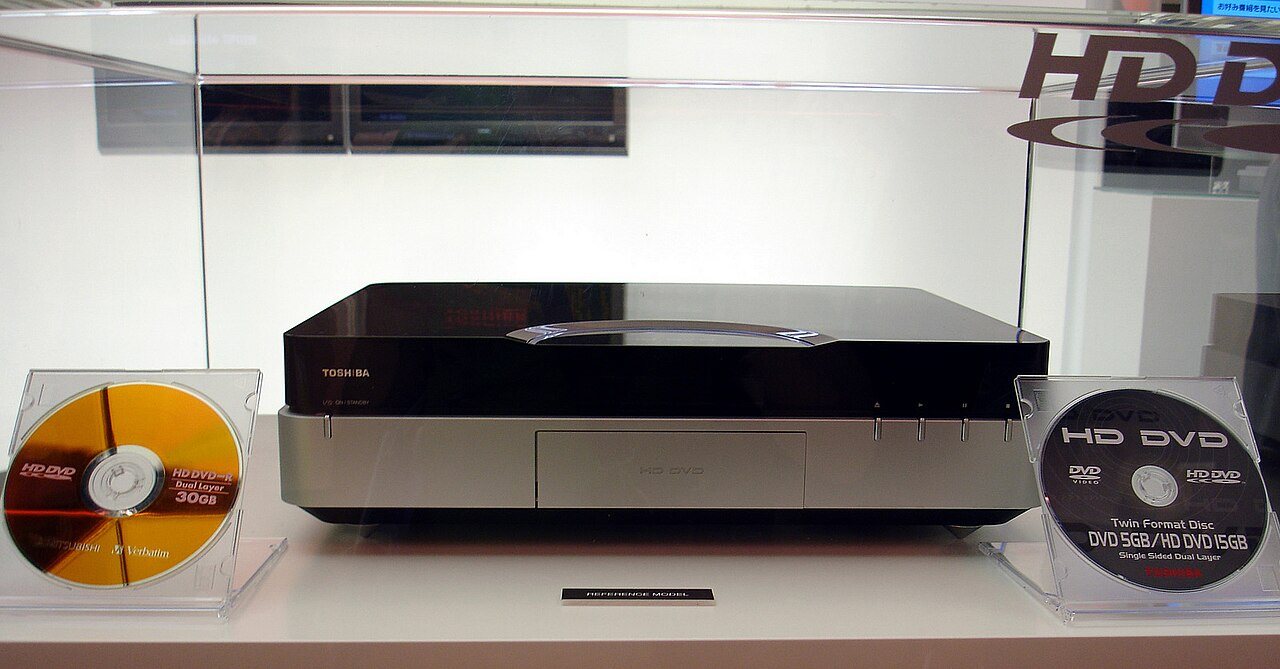
Picture this: April 18, 2006. You walk into a Best Buy, and there it is. The Toshiba HD-A1. The first HD DVD player ever sold in the United States. It costs $499. It weighs about twelve pounds. It takes roughly a full minute to load a disc. And it is, according to Toshiba, the future of home entertainment.
There were only a handful of movies available on launch day. Warner released The Last Samurai, Million Dollar Baby, and The Phantom of the Opera, while Universal contributed Serenity. Four titles. That is your launch lineup. That is what you are spending five hundred bucks to watch. And here's the thing that really gets me: Toshiba was reportedly losing about $200 on every single player sold. They were subsidizing the future, betting that once people saw high-definition movies on their TVs, they would never go back to regular DVD.
They were right about that part. They were wrong about almost everything else.
Two Formats Walk Into a Bar
To understand how we got here, you need to go back to about 2002. DVD had become the fastest-adopted consumer electronics format in history. Everyone had a DVD player. Movie studios were printing money. And two separate groups of engineers were independently working on the next generation of optical disc, one that would use a blue-violet laser instead of the red laser in DVD players, allowing data to be packed much more densely onto a disc.
On one side, you had Toshiba and NEC, working on what they initially called the Advanced Optical Disc. The DVD Forum, the industry group that had overseen the original DVD standard, officially adopted it as HD DVD in November 2003. On the other side, you had a consortium called the Blu-ray Disc Association, led by Sony and backed by Panasonic, Philips, Samsung, LG, and a handful of other electronics giants. Their format was called Blu-ray, and it had been formally announced back in February 2002.
Both formats used the same blue laser technology. Both could display gorgeous 1080p video. But they were fundamentally different in ways that would matter enormously. Blu-ray discs could hold 25 gigabytes per layer, compared to HD DVD's 15 gigabytes. That extra space gave Blu-ray room for higher bitrate video, more audio tracks, and more special features. HD DVD's advantage was simpler: it was cheaper to manufacture. Existing DVD production lines could be retooled to press HD DVD discs with minimal investment. Blu-ray required entirely new manufacturing equipment.
In a sane world, these two groups would have sat down, hammered out a compromise, and given consumers a single format. And they actually tried. In early 2005, the two camps held serious negotiations about merging the formats. But by August 2005, those talks collapsed. Nobody could agree on whose technology would form the base layer. So instead of one format, we got a war.
Inside the Technology: Why Blue Lasers Mattered
If you are wondering why anyone needed a new disc format in the first place, the answer comes down to physics. Standard DVDs used a red laser with a wavelength of 650 nanometers. Both HD DVD and Blu-ray used a blue-violet laser at 405 nanometers. The shorter wavelength meant the laser could focus on a smaller spot, which meant data pits on the disc could be packed more closely together. More pits per square inch meant more data per disc.
A single-layer DVD held 4.7 gigabytes. That was enough for a standard-definition movie with some extras. But high-definition video takes up dramatically more space. A two-hour movie in 1080p, compressed with modern codecs, needs somewhere between 15 and 30 gigabytes depending on the bitrate. DVD simply could not hold enough data for a proper HD movie.
HD DVD addressed this by putting 15 gigabytes on a single layer (30GB dual-layer). Blu-ray went further with 25 gigabytes per layer (50GB dual-layer). Both were more than enough for a single movie, but Blu-ray's extra space gave studios more room for uncompressed audio tracks, alternate versions, and extensive bonus features. For the average consumer renting a movie on a Friday night, the difference was negligible. For home theater enthusiasts who cared about reference-quality audio and the highest possible video bitrate, Blu-ray had a clear technical edge.
The manufacturing difference was real, though. HD DVD discs were structurally similar to regular DVDs, with the data layer sitting 0.6 millimeters from the surface. Existing DVD pressing plants could be upgraded to produce HD DVDs relatively cheaply. Blu-ray discs placed the data layer just 0.1 millimeters from the surface, which required completely different manufacturing equipment and much tighter quality tolerances. This made Blu-ray discs more expensive to produce, an advantage Toshiba emphasized constantly in its marketing to studios. But consumers never saw that cost difference reflected in retail prices in any meaningful way, which neutralized Toshiba's strongest business argument.
The Battle Lines
Both sides started signing up movie studios like rival generals recruiting armies. Toshiba secured exclusive support from Universal Studios and, initially, Paramount Pictures. Sony had its own movie studio, obviously, plus Disney, Fox, and Lionsgate. Warner Bros., the single biggest studio in terms of home video revenue, decided to release movies on both formats. So did Paramount, at first.
On the hardware side, Toshiba had a significant first-mover advantage. The HD-A1 shipped in April 2006, a full two months before the first Blu-ray player hit shelves. Samsung's BD-P1000, the first standalone Blu-ray player, did not arrive until June 2006, and it cost $999. Almost twice the price of the Toshiba. And by most accounts, the Samsung was a buggy mess that took even longer to load discs.
But Sony had a secret weapon. Actually, it was not a secret at all. It was the PlayStation 3.
The Trojan Horse That Was Not a Horse
The PS3 launched on November 17, 2006, at $499 for the 20GB model and $599 for the 60GB model. Those were staggering prices for a game console. People lost their minds over how expensive it was. Sony took enormous criticism. But every single PS3 came with a Blu-ray drive built in. Every one.
This was a massive gamble. Sony was losing hundreds of dollars on each PS3 sold, partly because of the expensive Blu-ray hardware inside. But the strategy was brutally effective. Within its first year, the PS3 had put millions of Blu-ray players into living rooms. Even people who bought a PS3 purely for gaming now had a Blu-ray player sitting under their TV. And when they walked past the movie section at Target and saw that Casino Royale was available on Blu-ray, some of them picked it up.
Toshiba tried to counter this with the Xbox 360 HD DVD Drive, an external add-on that Microsoft sold for $199 starting in November 2006. It was a reasonable product. But there was a critical difference: the Xbox 360 HD DVD Drive was an accessory. It was optional. No Xbox 360 game ever shipped on HD DVD. Microsoft never fully committed the way Sony did. They were hedging their bets, and everyone in the industry knew it.
The Price War Gets Desperate
By mid-2007, Toshiba was getting aggressive on price. They started slashing the cost of their players dramatically. In November 2007, you could buy a Toshiba HD-A2 for $99 during a Walmart sale. Under a hundred bucks for a high-definition disc player. That was unheard of. The cheapest standalone Blu-ray player at the time still cost around $300 to $400.
And it was working, at least on the hardware side. HD DVD players were outselling standalone Blu-ray players. But "standalone" was the key word. When you factored in the PS3, Blu-ray had a massive installed base advantage. By the end of 2007, there were roughly 2.7 million PS3 consoles in the US alone, each one capable of playing Blu-ray discs. Toshiba had moved only about a million HD DVD players worldwide, including the Xbox 360 add-on.
Then, in August 2007, Paramount and DreamWorks Animation suddenly went HD DVD exclusive. This was widely reported as a deal worth around $150 million in incentives from Toshiba. For a brief moment, HD DVD supporters celebrated. It looked like the tide might be turning. Paramount had some huge titles coming, including the Transformers franchise and the entire Shrek library from DreamWorks.
But it was a temporary victory, and the celebration lasted less than five months.
The Killing Blow
On January 4, 2008, Warner Bros. announced that it would drop HD DVD support and go Blu-ray exclusive, effective June 2008. This was the single most important moment of the entire format war. Warner was the biggest home video distributor in the world. They had been the one major studio releasing titles on both formats, and their defection to Blu-ray was devastating.
The announcement was reportedly supposed to come during CES 2008 in Las Vegas, but it leaked early. The HD DVD Promotion Group had already booked a massive press conference at CES. They canceled it. The Toshiba booth at CES was described by attendees as funereal. People were wandering around in a daze.
After the Warner announcement, everything collapsed in fast succession. Best Buy announced it would recommend Blu-ray to customers. Walmart said it would only stock Blu-ray going forward. Netflix dropped HD DVD from its rental lineup. In Europe, Woolworths and Carrefour followed suit. Within six weeks of the Warner decision, the war was effectively over.
The Surrender
On February 19, 2008, Toshiba officially announced that it would cease development, manufacturing, and marketing of HD DVD players and recorders. The format had been on the market for less than two years.
The financial damage was severe. Initial reports from Japan's Nikkei business newspaper estimated Toshiba's total losses at 100 billion yen, roughly $986 million. When Toshiba reported its actual figures, the HD DVD-related loss came in at about $653 million. Still enormous. And that number did not account for the billions of dollars that studios, retailers, and consumers had poured into a dead format.
Only about 1.03 million HD DVD players were ever sold worldwide, including the Xbox 360 add-on. For comparison, the PS3 alone had shipped over 10 million units by that point. The math was never going to work.
Why Did HD DVD Lose?
The easy answer is the PS3. And the PS3 was certainly the biggest single factor. Having a Blu-ray drive in every console was a masterstroke that Toshiba simply could not match. But it was more complicated than that.
HD DVD's lower disc capacity was a real limitation. Studios wanting to pack a movie with extras, multiple audio tracks, and the highest possible video bitrate kept running into space constraints on HD DVD. Blu-ray's 25GB-per-layer advantage (and 50GB for dual-layer discs versus HD DVD's 30GB) gave studios more room to breathe.
Toshiba also made the mistake of treating HD DVD as a natural evolution of DVD rather than a distinct new platform. Their "it's cheaper to manufacture" pitch was aimed at studios and hardware makers, not consumers. Consumers did not care about manufacturing costs. They cared about picture quality, selection, and which format had the movies they wanted to watch.
And then there was the simple fact that more of the major consumer electronics companies backed Blu-ray. Sony, Samsung, LG, Panasonic, Philips, Sharp. Toshiba was essentially alone on the HD DVD side, with only partial support from Microsoft (who never put an HD DVD drive inside the Xbox 360) and a rotating cast of studio alliances.
The Irony of It All
Here is the part that still gets me. Blu-ray won the format war. It decisively beat HD DVD. And then streaming happened. By 2010, Netflix was pushing hard into streaming. By 2012, most people were watching movies online. Blu-ray never reached the kind of mainstream adoption that DVD had enjoyed. The format war that Toshiba lost, that cost them over $650 million, that consumed years of corporate energy and destroyed consumer confidence in physical media. It was a war over a prize that was already shrinking.
Toshiba fought and lost a battle for a throne that nobody would sit on for very long. They bet everything on being the next DVD, and by the time the dust settled, DVD itself was becoming obsolete. The real winner of the HD DVD vs. Blu-ray war was not Sony. It was Netflix.
Which, honestly, is kind of hilarious. And kind of heartbreaking.
The Xbox 360 Question That Still Haunts Microsoft
One of the biggest what-ifs of the format war is what would have happened if Microsoft had put an HD DVD drive inside the Xbox 360 from day one. The console launched in November 2005, over a year before the PS3. If every Xbox 360 had shipped with an HD DVD drive, the installed base math would have been completely different.
But Microsoft had good reasons not to do it. Adding an HD DVD drive would have increased the console's cost significantly. The Xbox 360 was already price-competitive against the PS3 specifically because it used a standard DVD drive. Microsoft was playing a different game: they wanted to win the console war by being cheaper and having better games, not by pushing an optical disc format.
Peter Moore, who was running the Xbox division at the time, later said that Microsoft viewed digital distribution as the real future of content delivery. They saw HD DVD and Blu-ray as transitional technologies, speed bumps on the road to a fully digital world. In a way, they were right. But in the short term, their refusal to commit to HD DVD was one of the biggest factors in the format's defeat. Toshiba needed Microsoft's full commitment. They got a $199 accessory instead.
The Consumers Who Got Burned
The human cost of the format war does not get talked about enough. Regular people, not tech enthusiasts, but everyday consumers who walked into a store and chose HD DVD because it was cheaper, got stuck with a dead format. They had players that would never get new movies. They had disc collections that became frozen in time.
Toshiba tried to soften the blow. In the months after discontinuing HD DVD, they offered rebates and trade-in programs. Some retailers let people swap their HD DVD players for Blu-ray models. But most consumers just ate the loss. The HD DVD section at Best Buy quietly shrank, then disappeared entirely. The discs migrated to clearance bins, then to Goodwill shelves.
If you go to a thrift store today, you can still find HD DVD discs. They look almost identical to regular DVDs. The cases are the same size. The only difference is a small red HD DVD logo in the corner. People donate them constantly because they have no way to play them. The players themselves show up at garage sales for five or ten bucks. A piece of consumer electronics that cost $499 in 2006, selling for less than a sandwich twenty years later. That is what losing a format war looks like on the ground level.
The Last Format War
The HD DVD vs. Blu-ray conflict is almost certainly the last physical media format war we will ever see. The entire concept of competing disc formats feels like an artifact of a different era. Nobody is going to fight over physical media standards again because physical media itself is in permanent decline.
Blu-ray still exists, and it still has its fans. Collectors appreciate the superior audio and video quality compared to streaming. 4K Ultra HD Blu-ray discs offer the best home video presentation available. But the mass market has moved on. Netflix, Disney+, Amazon Prime, and their competitors have made physical media a niche product for enthusiasts rather than the default way people consume content.
Toshiba, for its part, recovered. They joined the Blu-ray Disc Association in 2009, barely a year after surrendering, and started making Blu-ray players themselves. The company that fought the hardest against Blu-ray ended up manufacturing devices that played Blu-ray discs. Business is business.
But if you were there during those two years, from early 2006 to early 2008, you remember the anxiety. Standing in a store, staring at two different disc players, two different movie sections, two different futures. Not knowing which one to bet on. And the sinking feeling when you realized you had bet wrong. That was the HD DVD experience. A lesson in corporate warfare fought on the shelves of your local electronics store, with your wallet caught in the crossfire.
Frequently Asked Questions
Can you still buy HD DVD discs?
You can find them secondhand on eBay and at thrift stores, usually for a few dollars each. They are not being manufactured anymore. Collectors still pick them up, especially for titles that had unique transfers or special features not replicated on Blu-ray.
Did the Xbox 360 HD DVD Drive hurt HD DVD's chances?
Arguably, yes. Having it as an optional accessory sent the message that Microsoft was not fully committed to HD DVD. If Microsoft had built an HD DVD drive into every Xbox 360 (the way Sony built Blu-ray into the PS3), the war might have played out very differently.
Was HD DVD technically inferior to Blu-ray?
In terms of disc capacity, yes. Blu-ray held 25GB per layer versus HD DVD's 15GB. In terms of actual picture and sound quality for movies, the difference was often negligible since both formats supported the same video and audio codecs. The capacity gap mattered more for bonus features and future-proofing than for the main movie itself.
How many HD DVD players were sold total?
Toshiba reported that approximately 1.03 million HD DVD players were sold worldwide, including the Xbox 360 HD DVD add-on. That number is vanishingly small compared to the tens of millions of Blu-ray-capable devices (especially PS3 consoles) sold during the same period.
Did anyone try to make a player that could handle both formats?
Yes. LG released the BH100, a "Super Multi Blue" player in early 2007 that could play both HD DVD and Blu-ray discs. Samsung also made a dual-format player. But they were expensive (the LG was around $1,199 at launch) and never gained traction. By the time they existed, the war was nearly over.