What Happened to Gateway? The Cow Box Computer Company

2026-04-02 by 404 Memory Found

Picture this: 1985, Sioux City, Iowa. Not exactly Silicon Valley. Not even close. A 22-year-old named Ted Waitt is working on his father's cattle ranch, and he's got this idea that's going to sound completely ridiculous to anyone who knows anything about how computers were actually sold back then. He's going to start a computer company. From a ranch. In Iowa. With his friend Mike Hammond and a $10,000 loan secured by his grandmother's certificate of deposit.

Most people would have laughed him out of the room. The personal computer industry in 1985 was dominated by massive corporations with massive retail networks. IBM had their way of doing things. Apple had theirs. You wanted a computer, you went to a computer store. You didn't order one over the phone like you were buying a pizza. You certainly didn't order one from some kids running operations out of farm country.

But here's the thing: Ted Waitt and Mike Hammond weren't trying to play the game everyone else was playing. They were going to do something that seemed genuinely insane at the time, and it was going to change how people bought computers forever. Gateway 2000 wasn't just a computer company. It was a direct-to-consumer revolution wrapped up in one of the most iconic packaging decisions in tech history: black and white spotted boxes that looked like Holstein cow hides.

The Ranch, The Idea, The Cow Box

On September 5, 1985, Gateway 2000 officially opened for business. The operation started on Ted Waitt's father's cattle ranch in Sioux City, which is about as far from the tech industry epicenter as you can possibly get. But that geographic distance was actually part of the genius. Lower costs. No Silicon Valley overhead. No pretension. Just a couple of guys who understood computers and understood that people didn't need to pay retail markups if they were willing to wait a few days for their machine to be built and shipped.

The early numbers were modest but promising. In that first partial year, from September through December 1985, Gateway pulled in about $400,000 in revenue. Not bad for a startup operating out of a cattle ranch with borrowed money. By the end of 1986, they'd crossed the $1 million mark. They were onto something.

But the real genius, the thing that made Gateway instantly recognizable and utterly unforgettable, was the packaging. Those black and white spotted boxes became the visual identity of the entire company. And here's where it gets interesting: the cow box wasn't just a clever marketing gimmick, though it absolutely was that. It was also just practical. You know what's expensive? Full-color printing on cardboard. You know what's cheap? Black and white. The Holstein cow pattern killed two birds with one stone. It made the boxes instantly iconic and memorable, and it saved the company money on printing costs. Which is kind of insane when you think about how perfectly it worked out.

When one of those boxes showed up at your front door, you knew exactly what it was. You knew you were about to unpack a personal computer that you'd configured yourself over the phone, that you'd paid less for than you would have at any retail store, and that had been built specifically for you. There was something magical about that. There was anticipation in it. There was ownership before you'd even opened the box.

The Direct-to-Consumer Model: Stealing Dell's Playbook

The business model Gateway employed wasn't entirely new. Michael Dell had already figured out that selling computers directly to customers, without the middleman of retail stores, could work. But Gateway took that model and ran with it in their own way, and they executed it brilliantly.

Customers would call Gateway, talk to a sales rep, configure their computer based on their needs and budget, and place an order. The computer would be built to order and shipped directly to their door. No inventory sitting in warehouses. No middleman markup. No retail stores with their own margins stacked on top. Just manufacturer to customer, with competitive pricing that made retail-bought computers look ridiculous by comparison.

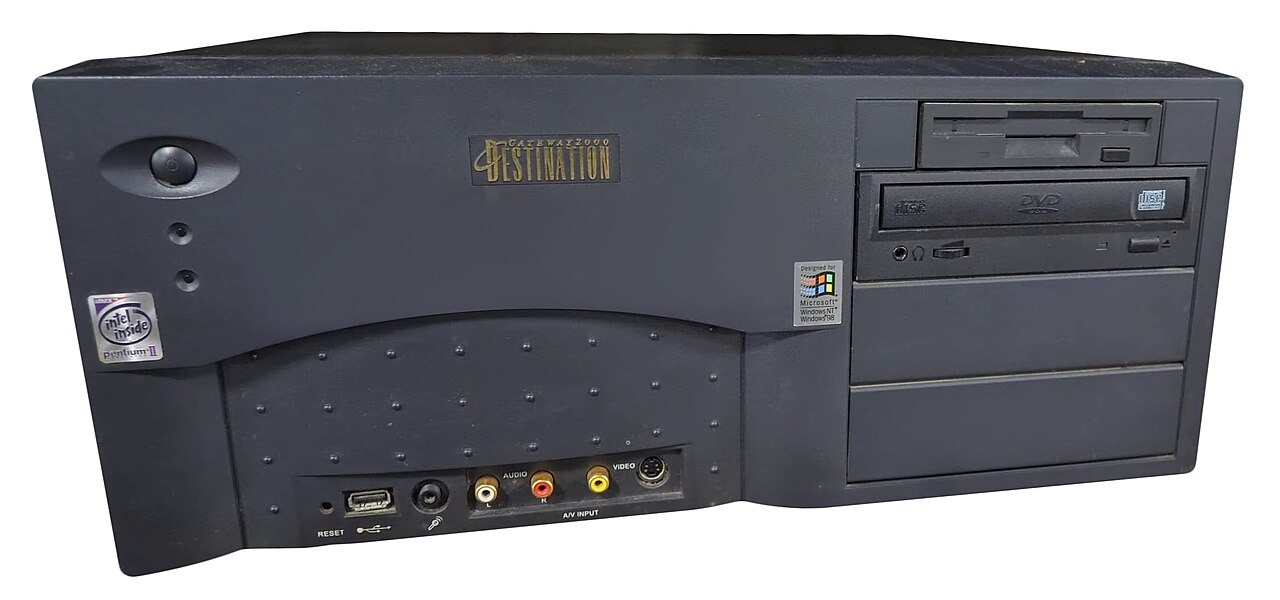
A Gateway 2000 Destination PC, the all-in-one big-screen computer
The Gateway 2000 Destination, Gateway's ambitious big-screen PC that tried to merge your computer and television into one device.

This was revolutionary in the early 1990s. Most people weren't comfortable buying computers this way yet. You wanted to see it, touch it, make sure it was real. But Gateway built trust through consistent quality and stellar customer service. The company grew explosively. By 1992, just seven years after that first year pulling in $400,000, Gateway's annual sales had reached $1.1 billion. They were identified as the fastest-growing company in the United States. That kind of growth trajectory is the stuff of business school case studies.

And the financial markets were paying attention. In December 1993, Gateway went public. The IPO raised $150 million through the sale of 10.9 million shares, and the Waitt family still owned 85 percent of the company at that point. They'd built something real, something valuable, something that people actually wanted and trusted. That's not an easy thing to do, and it's even harder to do from a cattle ranch in Iowa while everyone else in your industry is telling you you're crazy.

The Explosive Growth Years

The 1990s were when Gateway really started to dominate. By 1996, the company was doing more than $1 billion in revenue per quarter. Per quarter. Think about that. Four years earlier they'd crossed the $1 billion annual mark and everyone thought that was incredible. Now they were hitting that number four times a year. The direct-to-consumer model was clearly working, and working spectacularly.

But Gateway wasn't content just to sell computers over the phone and ship them in cow boxes. They were going to do something that no other computer manufacturer had really tried at scale: they were going to open stores. Not traditional computer retail stores. Something different. Something that only Gateway could pull off.

Late in the 1990s, Gateway started opening Gateway Country Stores. These weren't like Best Buy or CompUSA. You couldn't walk in and buy a computer off the shelf. That wasn't the point. The stores served a completely different function. They were showrooms and ordering centers. You'd walk in, you'd see the machines, you'd talk to someone who actually knew computers, you'd get your questions answered, and then you'd place your order. The computer would be built at the factory and shipped to your house.

It was a brilliant hybrid approach. It addressed the concern a lot of people still had about buying computers unseen. You could touch them, see them, understand what you were getting. But you still got the benefits of the direct model: lower prices, customization, no inventory bloat. And here's the thing: by 1999, Gateway had over 140 Country Stores across the United States. Within six years, that number topped 300. These weren't tiny kiosks in malls. These were dedicated retail locations run by Gateway, staffed with Gateway employees.

The energy around Gateway Country Stores was real. For a lot of families in the 1990s and early 2000s, going to a Gateway Country Store and configuring your own computer felt like stepping into the future. You were building your machine. You were making choices. You were getting something that was specifically yours, not something that came off a shelf that someone else had configured six months earlier.

Big Ambitions and the Cow-Spotted Peak

By the late 1990s, Gateway was riding high. The company had moved its headquarters from South Dakota to Poway, California in 1998, closer to the tech industry but still holding on to that Midwestern authenticity in its brand. By 2000, at the peak of the dot-com boom, Gateway had nearly 25,000 employees. They were a massive company, a real player in the industry.

And they started swinging for the fences. The Gateway Destination was one of those big ambitious bets. It was an all-in-one computer and television hybrid, a big-screen experience that was supposed to be the future of the home computer. The Destination was meant to sit in your living room like a piece of furniture, to be your entertainment center and your computer at the same time.

The problem, of course, was that it was way ahead of its time. Most people weren't ready for a computer to be their primary television experience. They wanted a computer at a desk, a place to work and check email. They wanted their television to be a television. The market wasn't there yet. The Destination looked cool and felt aspirational, but it didn't sell in the numbers Gateway needed it to.

Close-up of a Gateway 2000 P5-75 desktop computer
A Gateway 2000 P5-75 desktop. For millions of American families in the 1990s, this was the first real computer in the house.

Still, that kind of innovation was part of what Gateway did. They weren't just taking orders and shipping boxes. They were trying to imagine what the next thing could be. They were taking risks. Some of them paid off. Some didn't. But the company was still incredibly successful, still growing at a rate that most companies could only dream about.

The Cracks Begin to Show

The 2000s brought a different energy. The dot-com bubble burst. The economy softened. The PC market, which had been a wild growth story in the 1990s, started to mature. Everyone who wanted a computer had one, or at least had access to one. The growth couldn't continue forever. It never does.

Gateway's business model, which had been so revolutionary and so successful, started to look less revolutionary. The direct-to-consumer market that Gateway had pioneered became crowded. Dell, their chief competitor, was executing the same playbook even more aggressively. The Country Stores, which had been such a differentiator, started to feel like a liability. They required real estate investments and staffing in an era when people were increasingly comfortable buying computers online.

The company tried to adapt. In 2004, Gateway acquired eMachines, a budget computer maker that had gained market share with low-cost PCs. It seemed like a smart move on paper. Expand the product line, reach a different customer segment, gain market share. But the acquisition never really worked the way Gateway hoped. eMachines had its own brand identity, its own customer base, and integrating the two companies proved more complicated than expected.

The End of the Line

By the mid-2000s, Gateway was in decline. The company that had been at nearly 25,000 employees at its peak was hemorrhaging market share and struggling financially. The PC market itself was becoming commoditized. The excitement had gone out of it. A computer was a computer. The brand loyalty that Gateway had built in the 1990s wasn't translating into sustained growth in the 2000s.

In October 2007, it was over. Taiwan-based Acer acquired Gateway for $710 million, which worked out to $1.90 per share. That was it. Gateway, the company that had started with a $10,000 loan secured by Ted Waitt's grandmother, that had built a direct-to-consumer empire from a cattle ranch in Iowa, that had defined what it meant to buy a computer in the 1990s, was now just a subsidiary of a larger company.

It's not that Acer made a bad acquisition. Gateway still had brand recognition. It still had customer loyalty. But the golden era was over. The thing that made Gateway special was no longer special. Direct-to-consumer was now standard. The big boxy computers of the 1990s were being phased out by laptops and eventually tablets. The world had moved on, and Gateway hadn't quite managed to move on with it.

What Made Gateway Legendary

But here's the thing: Gateway's legacy isn't determined by what happened in 2007. It's determined by what happened in the 1990s and what that meant for the computer industry and for regular people who wanted to buy computers.

Gateway democratized computer buying. Before Gateway really hit its stride, computers were these expensive, intimidating things that you bought at a retail store run by people who had a financial incentive to upsell you. Gateway said: no. You can call us. You can talk to someone who'll help you figure out what you actually need. You can configure your own machine. You can get it for less money. And it'll show up at your door in a box that looks like a cow.

That wasn't a small thing. That was genuinely revolutionary, even if it doesn't sound revolutionary now. Now it's normal. You can build your own computer online, customize it exactly how you want it, and have it shipped to you. That's standard. That's how things work. But in 1985, in 1990, in 1995, that was not how things worked. Gateway made it work.

And the cow box. God, the cow box. It's easy to underestimate how important that was. In a world of beige boxes and corporate aesthetics, the Gateway cow box stood out. It was memorable. It was friendly. It was weird in a way that felt intentional, playful. When that box showed up at your door, you knew what it was immediately. You knew it was from Gateway. You knew you'd made a smart choice buying from these people.

For millions of Americans, especially in the 1990s and early 2000s, the Gateway box arriving at the house was a genuine event. You'd been saving up. You'd made this decision. You'd configured your machine exactly how you wanted it. And then here it was, this big cow-spotted box, sitting on your porch. Inside was the thing that was going to connect you to the internet, that was going to let you email and browse and learn and work. That was the first real computer for a lot of families. And it came in a cow box from Iowa.

The Bigger Picture

Gateway's rise and fall tells us something important about the technology industry and about how quickly things change. A company can be absolutely dominant, can be doing everything right, can be innovating and growing and profitable, and then the market can shift underneath it and suddenly the advantage disappears. Dell figured out the same techniques Gateway pioneered and executed them at greater scale. The direct-to-consumer model became commoditized. The retail stores that had been such a brilliant differentiator became just another overhead cost.

But that doesn't erase what Gateway did. The company proved that you could build something massive and meaningful from a cattle ranch in Iowa. You could take on the biggest computer companies in the world with better customer service, lower prices, and a direct relationship with your customers. You could create a brand that meant something, that made people excited to buy your product, that had cultural resonance beyond just being a list of specs and prices.

Gateway did all of that. And for a golden stretch in the 1990s, they were the coolest computer company on earth. Not because they had the fastest processors. Not because their machines were the most beautiful. They were cool because of who they were: a bunch of Midwesterners who understood that computers shouldn't be intimidating, that technology should be accessible, that you could run a major tech company without being in Silicon Valley, and that a box that looks like a cow is way more memorable than a box that looks like every other box.

Frequently Asked Questions

Why did Gateway use the cow-spotted boxes?

The Holstein cow pattern served two purposes. First, it was an incredibly distinctive visual identity that made Gateway boxes instantly recognizable. Second, black and white printing was significantly cheaper than full-color printing on cardboard. Gateway saved money on packaging costs while creating one of the most iconic brand images in tech history. The design was inspired by the company's roots on a cattle ranch in Sioux City, Iowa, where Holstein dairy cows were part of daily life.

Did Gateway invent the direct-to-consumer computer model?

No, Dell beat them to it. Michael Dell pioneered the direct-to-consumer model for computers before Gateway really hit their stride. However, Gateway took that model and executed it brilliantly, especially through their Country Stores, which added a unique hybrid retail-direct approach that Dell didn't replicate at the same scale.

What were Gateway Country Stores?

Gateway Country Stores were showrooms where customers could see and touch computers, but they didn't keep significant inventory on hand. Customers would come in, look at demo machines, talk to sales staff, and place a custom order. The computer would then be built at the factory and shipped to the customer's home. At its peak, Gateway had over 300 Country Stores across the United States.

What happened to Gateway after Acer bought it?

Acer acquired Gateway in October 2007 for $710 million. The Gateway brand continued to be used on certain products for a while, but it gradually faded as Acer integrated Gateway's operations into its own. The cow-spotted branding was eventually retired. Today, the Gateway name occasionally appears on budget electronics, but the company that built a billion-dollar empire from Iowa no longer exists as an independent entity.

Why did Gateway fail to adapt in the 2000s?

By the early 2000s, the direct-to-consumer model had become standard rather than revolutionary. Competitors like Dell executed it at greater scale. The Country Stores became overhead in an era when customers increasingly preferred buying online. The PC market itself matured and became commoditized, meaning price competition intensified and brand differentiation mattered less. Gateway's biggest advantage in the 1990s simply became less relevant in the 2000s.

Related Posts:
← Back to Blog

What Happened to Gateway? The Cow Box Computer Company | 404 Memory Found

📖 What Happened to Gateway? The Cow Box Computer Company

Picture this: 1985, Sioux City, Iowa. Not exactly Silicon Valley. Not even close. A 22-year-old named Ted Waitt is working on his father's cattle ranch, and he's got this idea that's going to sound completely ridiculous to anyone who knows anything about how computers were actually sold back then. He's going to start a computer company. From a ranch. In Iowa. With his friend Mike Hammond and a $10,000 loan secured by his grandmother's certificate of deposit.

Most people would have laughed him out of the room. The personal computer industry in 1985 was dominated by massive corporations with massive retail networks. IBM had their way of doing things. Apple had theirs. You wanted a computer, you went to a computer store. You didn't order one over the phone like you were buying a pizza. You certainly didn't order one from some kids running operations out of farm country.

But here's the thing: Ted Waitt and Mike Hammond weren't trying to play the game everyone else was playing. They were going to do something that seemed genuinely insane at the time, and it was going to change how people bought computers forever. Gateway 2000 wasn't just a computer company. It was a direct-to-consumer revolution wrapped up in one of the most iconic packaging decisions in tech history: black and white spotted boxes that looked like Holstein cow hides.

The Ranch, The Idea, The Cow Box

On September 5, 1985, Gateway 2000 officially opened for business. The operation started on Ted Waitt's father's cattle ranch in Sioux City, which is about as far from the tech industry epicenter as you can possibly get. But that geographic distance was actually part of the genius. Lower costs. No Silicon Valley overhead. No pretension. Just a couple of guys who understood computers and understood that people didn't need to pay retail markups if they were willing to wait a few days for their machine to be built and shipped.

The early numbers were modest but promising. In that first partial year, from September through December 1985, Gateway pulled in about $400,000 in revenue. Not bad for a startup operating out of a cattle ranch with borrowed money. By the end of 1986, they'd crossed the $1 million mark. They were onto something.

But the real genius, the thing that made Gateway instantly recognizable and utterly unforgettable, was the packaging. Those black and white spotted boxes became the visual identity of the entire company. And here's where it gets interesting: the cow box wasn't just a clever marketing gimmick, though it absolutely was that. It was also just practical. You know what's expensive? Full-color printing on cardboard. You know what's cheap? Black and white. The Holstein cow pattern killed two birds with one stone. It made the boxes instantly iconic and memorable, and it saved the company money on printing costs. Which is kind of insane when you think about how perfectly it worked out.

When one of those boxes showed up at your front door, you knew exactly what it was. You knew you were about to unpack a personal computer that you'd configured yourself over the phone, that you'd paid less for than you would have at any retail store, and that had been built specifically for you. There was something magical about that. There was anticipation in it. There was ownership before you'd even opened the box.

The Direct-to-Consumer Model: Stealing Dell's Playbook

The business model Gateway employed wasn't entirely new. Michael Dell had already figured out that selling computers directly to customers, without the middleman of retail stores, could work. But Gateway took that model and ran with it in their own way, and they executed it brilliantly.

Customers would call Gateway, talk to a sales rep, configure their computer based on their needs and budget, and place an order. The computer would be built to order and shipped directly to their door. No inventory sitting in warehouses. No middleman markup. No retail stores with their own margins stacked on top. Just manufacturer to customer, with competitive pricing that made retail-bought computers look ridiculous by comparison.

A Gateway 2000 Destination PC, the all-in-one big-screen computer
The Gateway 2000 Destination, Gateway's ambitious big-screen PC that tried to merge your computer and television into one device.

This was revolutionary in the early 1990s. Most people weren't comfortable buying computers this way yet. You wanted to see it, touch it, make sure it was real. But Gateway built trust through consistent quality and stellar customer service. The company grew explosively. By 1992, just seven years after that first year pulling in $400,000, Gateway's annual sales had reached $1.1 billion. They were identified as the fastest-growing company in the United States. That kind of growth trajectory is the stuff of business school case studies.

And the financial markets were paying attention. In December 1993, Gateway went public. The IPO raised $150 million through the sale of 10.9 million shares, and the Waitt family still owned 85 percent of the company at that point. They'd built something real, something valuable, something that people actually wanted and trusted. That's not an easy thing to do, and it's even harder to do from a cattle ranch in Iowa while everyone else in your industry is telling you you're crazy.

The Explosive Growth Years

The 1990s were when Gateway really started to dominate. By 1996, the company was doing more than $1 billion in revenue per quarter. Per quarter. Think about that. Four years earlier they'd crossed the $1 billion annual mark and everyone thought that was incredible. Now they were hitting that number four times a year. The direct-to-consumer model was clearly working, and working spectacularly.

But Gateway wasn't content just to sell computers over the phone and ship them in cow boxes. They were going to do something that no other computer manufacturer had really tried at scale: they were going to open stores. Not traditional computer retail stores. Something different. Something that only Gateway could pull off.

Late in the 1990s, Gateway started opening Gateway Country Stores. These weren't like Best Buy or CompUSA. You couldn't walk in and buy a computer off the shelf. That wasn't the point. The stores served a completely different function. They were showrooms and ordering centers. You'd walk in, you'd see the machines, you'd talk to someone who actually knew computers, you'd get your questions answered, and then you'd place your order. The computer would be built at the factory and shipped to your house.

It was a brilliant hybrid approach. It addressed the concern a lot of people still had about buying computers unseen. You could touch them, see them, understand what you were getting. But you still got the benefits of the direct model: lower prices, customization, no inventory bloat. And here's the thing: by 1999, Gateway had over 140 Country Stores across the United States. Within six years, that number topped 300. These weren't tiny kiosks in malls. These were dedicated retail locations run by Gateway, staffed with Gateway employees.

The energy around Gateway Country Stores was real. For a lot of families in the 1990s and early 2000s, going to a Gateway Country Store and configuring your own computer felt like stepping into the future. You were building your machine. You were making choices. You were getting something that was specifically yours, not something that came off a shelf that someone else had configured six months earlier.

Big Ambitions and the Cow-Spotted Peak

By the late 1990s, Gateway was riding high. The company had moved its headquarters from South Dakota to Poway, California in 1998, closer to the tech industry but still holding on to that Midwestern authenticity in its brand. By 2000, at the peak of the dot-com boom, Gateway had nearly 25,000 employees. They were a massive company, a real player in the industry.

And they started swinging for the fences. The Gateway Destination was one of those big ambitious bets. It was an all-in-one computer and television hybrid, a big-screen experience that was supposed to be the future of the home computer. The Destination was meant to sit in your living room like a piece of furniture, to be your entertainment center and your computer at the same time.

The problem, of course, was that it was way ahead of its time. Most people weren't ready for a computer to be their primary television experience. They wanted a computer at a desk, a place to work and check email. They wanted their television to be a television. The market wasn't there yet. The Destination looked cool and felt aspirational, but it didn't sell in the numbers Gateway needed it to.

Close-up of a Gateway 2000 P5-75 desktop computer
A Gateway 2000 P5-75 desktop. For millions of American families in the 1990s, this was the first real computer in the house.

Still, that kind of innovation was part of what Gateway did. They weren't just taking orders and shipping boxes. They were trying to imagine what the next thing could be. They were taking risks. Some of them paid off. Some didn't. But the company was still incredibly successful, still growing at a rate that most companies could only dream about.

The Cracks Begin to Show

The 2000s brought a different energy. The dot-com bubble burst. The economy softened. The PC market, which had been a wild growth story in the 1990s, started to mature. Everyone who wanted a computer had one, or at least had access to one. The growth couldn't continue forever. It never does.

Gateway's business model, which had been so revolutionary and so successful, started to look less revolutionary. The direct-to-consumer market that Gateway had pioneered became crowded. Dell, their chief competitor, was executing the same playbook even more aggressively. The Country Stores, which had been such a differentiator, started to feel like a liability. They required real estate investments and staffing in an era when people were increasingly comfortable buying computers online.

The company tried to adapt. In 2004, Gateway acquired eMachines, a budget computer maker that had gained market share with low-cost PCs. It seemed like a smart move on paper. Expand the product line, reach a different customer segment, gain market share. But the acquisition never really worked the way Gateway hoped. eMachines had its own brand identity, its own customer base, and integrating the two companies proved more complicated than expected.

The End of the Line

By the mid-2000s, Gateway was in decline. The company that had been at nearly 25,000 employees at its peak was hemorrhaging market share and struggling financially. The PC market itself was becoming commoditized. The excitement had gone out of it. A computer was a computer. The brand loyalty that Gateway had built in the 1990s wasn't translating into sustained growth in the 2000s.

In October 2007, it was over. Taiwan-based Acer acquired Gateway for $710 million, which worked out to $1.90 per share. That was it. Gateway, the company that had started with a $10,000 loan secured by Ted Waitt's grandmother, that had built a direct-to-consumer empire from a cattle ranch in Iowa, that had defined what it meant to buy a computer in the 1990s, was now just a subsidiary of a larger company.

It's not that Acer made a bad acquisition. Gateway still had brand recognition. It still had customer loyalty. But the golden era was over. The thing that made Gateway special was no longer special. Direct-to-consumer was now standard. The big boxy computers of the 1990s were being phased out by laptops and eventually tablets. The world had moved on, and Gateway hadn't quite managed to move on with it.

What Made Gateway Legendary

But here's the thing: Gateway's legacy isn't determined by what happened in 2007. It's determined by what happened in the 1990s and what that meant for the computer industry and for regular people who wanted to buy computers.

Gateway democratized computer buying. Before Gateway really hit its stride, computers were these expensive, intimidating things that you bought at a retail store run by people who had a financial incentive to upsell you. Gateway said: no. You can call us. You can talk to someone who'll help you figure out what you actually need. You can configure your own machine. You can get it for less money. And it'll show up at your door in a box that looks like a cow.

That wasn't a small thing. That was genuinely revolutionary, even if it doesn't sound revolutionary now. Now it's normal. You can build your own computer online, customize it exactly how you want it, and have it shipped to you. That's standard. That's how things work. But in 1985, in 1990, in 1995, that was not how things worked. Gateway made it work.

And the cow box. God, the cow box. It's easy to underestimate how important that was. In a world of beige boxes and corporate aesthetics, the Gateway cow box stood out. It was memorable. It was friendly. It was weird in a way that felt intentional, playful. When that box showed up at your door, you knew what it was immediately. You knew it was from Gateway. You knew you'd made a smart choice buying from these people.

For millions of Americans, especially in the 1990s and early 2000s, the Gateway box arriving at the house was a genuine event. You'd been saving up. You'd made this decision. You'd configured your machine exactly how you wanted it. And then here it was, this big cow-spotted box, sitting on your porch. Inside was the thing that was going to connect you to the internet, that was going to let you email and browse and learn and work. That was the first real computer for a lot of families. And it came in a cow box from Iowa.

The Bigger Picture

Gateway's rise and fall tells us something important about the technology industry and about how quickly things change. A company can be absolutely dominant, can be doing everything right, can be innovating and growing and profitable, and then the market can shift underneath it and suddenly the advantage disappears. Dell figured out the same techniques Gateway pioneered and executed them at greater scale. The direct-to-consumer model became commoditized. The retail stores that had been such a brilliant differentiator became just another overhead cost.

But that doesn't erase what Gateway did. The company proved that you could build something massive and meaningful from a cattle ranch in Iowa. You could take on the biggest computer companies in the world with better customer service, lower prices, and a direct relationship with your customers. You could create a brand that meant something, that made people excited to buy your product, that had cultural resonance beyond just being a list of specs and prices.

Gateway did all of that. And for a golden stretch in the 1990s, they were the coolest computer company on earth. Not because they had the fastest processors. Not because their machines were the most beautiful. They were cool because of who they were: a bunch of Midwesterners who understood that computers shouldn't be intimidating, that technology should be accessible, that you could run a major tech company without being in Silicon Valley, and that a box that looks like a cow is way more memorable than a box that looks like every other box.

Frequently Asked Questions

Why did Gateway use the cow-spotted boxes?

The Holstein cow pattern served two purposes. First, it was an incredibly distinctive visual identity that made Gateway boxes instantly recognizable. Second, black and white printing was significantly cheaper than full-color printing on cardboard. Gateway saved money on packaging costs while creating one of the most iconic brand images in tech history. The design was inspired by the company's roots on a cattle ranch in Sioux City, Iowa, where Holstein dairy cows were part of daily life.

Did Gateway invent the direct-to-consumer computer model?

No, Dell beat them to it. Michael Dell pioneered the direct-to-consumer model for computers before Gateway really hit their stride. However, Gateway took that model and executed it brilliantly, especially through their Country Stores, which added a unique hybrid retail-direct approach that Dell didn't replicate at the same scale.

What were Gateway Country Stores?

Gateway Country Stores were showrooms where customers could see and touch computers, but they didn't keep significant inventory on hand. Customers would come in, look at demo machines, talk to sales staff, and place a custom order. The computer would then be built at the factory and shipped to the customer's home. At its peak, Gateway had over 300 Country Stores across the United States.

What happened to Gateway after Acer bought it?

Acer acquired Gateway in October 2007 for $710 million. The Gateway brand continued to be used on certain products for a while, but it gradually faded as Acer integrated Gateway's operations into its own. The cow-spotted branding was eventually retired. Today, the Gateway name occasionally appears on budget electronics, but the company that built a billion-dollar empire from Iowa no longer exists as an independent entity.

Why did Gateway fail to adapt in the 2000s?

By the early 2000s, the direct-to-consumer model had become standard rather than revolutionary. Competitors like Dell executed it at greater scale. The Country Stores became overhead in an era when customers increasingly preferred buying online. The PC market itself matured and became commoditized, meaning price competition intensified and brand differentiation mattered less. Gateway's biggest advantage in the 1990s simply became less relevant in the 2000s.

← Back to Blog
00:00