What Happened to Fry's Electronics? The Store That Died Overnight

2026-03-29 by 404 Memory Found

Walking Into a Spaceship to Buy a Hard Drive

Picture this: 2003. You're twelve years old. Your dad pulls into a parking lot somewhere in the San Fernando Valley, and the building in front of you looks like a crashed alien spaceship. Not metaphorically. There is a literal spaceship crashing through the facade of a building. Smoke effects. Metal panels. Rivets. The whole thing. And your dad just casually goes, "Let's grab some RAM," like this is a normal Saturday.

That was Fry's Electronics. That was the experience. And if you grew up anywhere near Silicon Valley, Southern California, or Texas in the '90s and 2000s, you know exactly what I'm talking about. Fry's wasn't just a store. It was an event. It was a pilgrimage. It was the kind of place where you'd go in for a USB cable and walk out three hours later with a motherboard, a bag of beef jerky, a magazine about Linux, and somehow a lava lamp. The place was chaos, and it was beautiful.

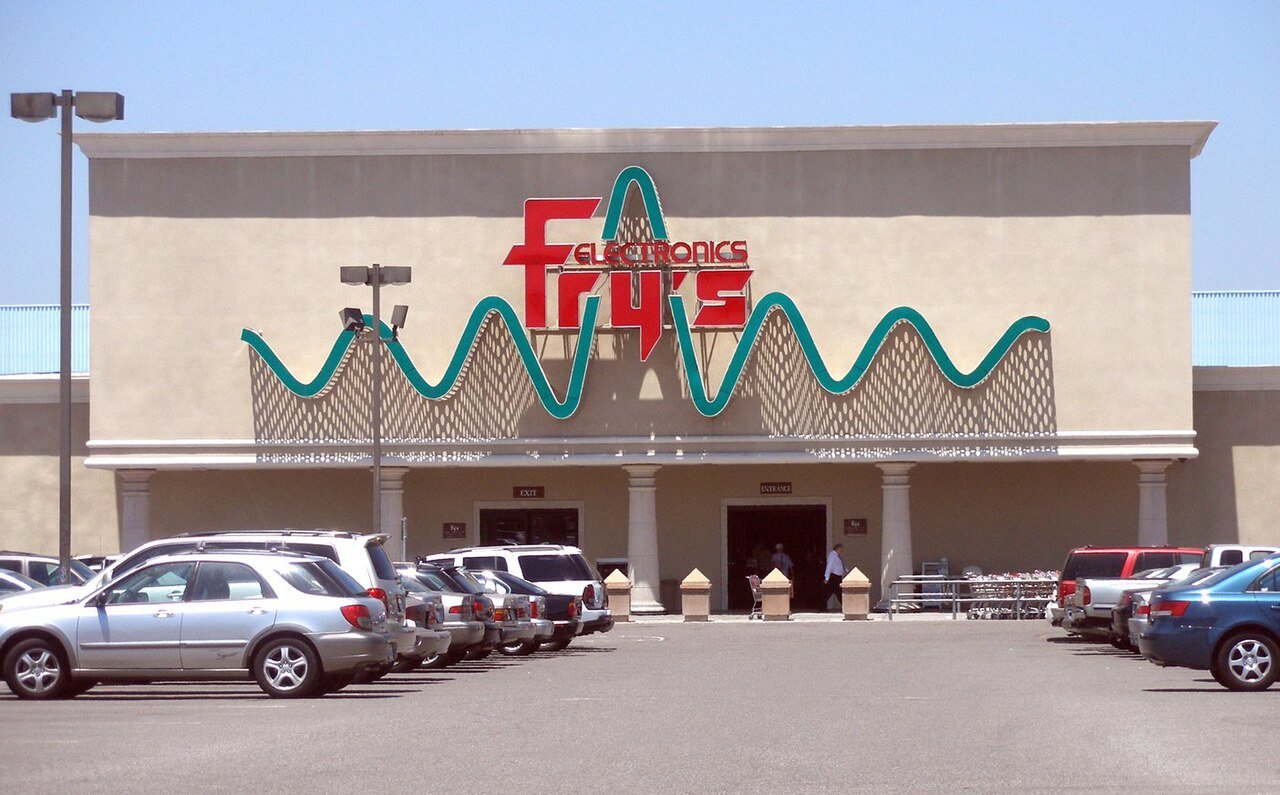
Former Fry's Electronics store building in Fountain Valley, California
A former Fry's Electronics location in Fountain Valley, California, photographed after the chain's permanent closure in 2021

And now it's gone. All of it. Every single store, closed overnight in February 2021. No warning. No farewell sale. No "everything must go" signs. Just a website that said, essentially, "We're done." Thirty-six years of retail history, wiped out in a single press release. If that doesn't make you a little angry, you probably never walked through those doors.

The Grocery Store Kids Who Built a Tech Empire

Here's the origin story, and it's one of the most Silicon Valley things you'll ever hear. Fry's Electronics was founded in 1985 by three brothers: John, Randy, and David Fry, along with their partner Kathy Kolder. But here's the twist. The Fry family wasn't in tech. They were in groceries. Their father, Charles Fry, had built a chain of 41 Fry's Food Stores across California and Arizona. He sold the whole operation to Dillons in 1972 for $14 million, which was serious money back then.

Charles gave each of his sons roughly a million dollars from the sale. And John Fry, who had been managing the computer systems for his dad's supermarket chain after graduating from Santa Clara University with a math degree, had an idea. He looked around Silicon Valley in the early '80s and saw engineers and hobbyists who had nowhere decent to buy components. The options were either mail-order catalogs or tiny specialty shops that never had what you needed. So John convinced his brothers to pool their money and open a store that would stock everything a tech person could want, all under one roof.

The first Fry's opened in Sunnyvale, California, in 1985. And from day one, it was different. The store stocked integrated circuits, oscilloscopes, test equipment, and computer components right alongside consumer electronics, software, and snacks. Yes, snacks. One of the signature Fry's touches was having a full snack aisle, complete with candy bars, chips, and sodas. It came directly from John's supermarket background. He understood something fundamental about retail: if you keep people in the store longer, they buy more. So he gave them reasons to stay. Chips and a Coke while you browse motherboards? Absolutely.

When Every Store Was a Theme Park

But the thing that really set Fry's apart, the thing that made it legendary, was the themed stores. This is where John Fry's personality really showed through. Every single Fry's location had a completely different, elaborate, over-the-top theme built into the architecture and decor. And I'm not talking about some posters on the wall. I'm talking millions of dollars in custom design work.

The Burbank location had a crashed UFO bursting through the exterior of the building. The movie prop designer who created it, Eric Christensen, had worked with George Lucas. That store cost $15 million to build. The San Jose location was designed as a Mayan temple, complete with fake stone walls and displays about ancient Mayan astronomy. Woodland Hills got an Alice in Wonderland theme. The Fountain Valley store had Roman gladiators stationed throughout the aisles. The store in Campbell, California, had an Egyptian pyramid theme with pharaoh statues and hieroglyphics everywhere.

And here's the thing: none of this had anything to do with electronics. A Mayan temple selling graphics cards. A Roman colosseum selling printer ink. An alien invasion backdrop for buying Ethernet cables. It made absolutely no sense, and that was the entire point. Shopping at Fry's was supposed to feel like an adventure. It was supposed to feel weird and exciting and unlike anything else. And it worked. People drove hours to visit specific Fry's locations just to see the themes.

"You didn't go to Fry's because you needed something. You went to Fry's because it was Fry's."

I remember walking into the Burbank store with my dad on a Saturday afternoon, and the place was packed. Not Black Friday packed. Just regular Saturday packed. Families. Engineers with shopping carts full of components. Kids staring at the video game section. Old guys in the ham radio aisle. It was this incredible cross-section of humanity, all united by the fact that they thought technology was cool and they wanted to be surrounded by it. You don't get that at Best Buy. You definitely don't get that ordering from Amazon.

The Golden Age: 34 Stores and $2.4 Billion

Through the late '90s and 2000s, Fry's expanded aggressively. They went from that single Sunnyvale location to 34 stores across nine states at their peak. California, Texas, Arizona, Georgia, Illinois, Indiana, Nevada, Oregon, and Washington. At their height, the company was pulling in roughly $2.4 billion in annual revenue. They were consistently ranked among the top consumer electronics retailers in the country.

The stores were massive, too. We're talking 50,000 to over 100,000 square feet per location. Warehouse-scale buildings packed floor to ceiling with everything from resistors and capacitors to big-screen TVs and refrigerators. They had a computer components section that would make your head spin. Rows and rows of graphics cards, CPUs, RAM sticks, cases, power supplies, cooling fans. If you were building a PC, Fry's was the only place you needed to go.

And the return policy was famously generous. Too generous, honestly. People would buy a laptop, use it for two weeks, and return it. Fry's would take it back, slap a "previously opened" sticker on it, and sell it at a slight discount. This created a whole secondary market of deal-hunters who would specifically look for opened-box items. It was a feature, not a bug. At least for a while.

Fry's Electronics store in Sunnyvale, California
The Sunnyvale, California Fry's Electronics location, near where the very first store opened in 1985

The Slow Collapse: Empty Shelves and a Terrible Idea

Here's where the story turns from nostalgia to tragedy. Because Fry's didn't die in a sudden explosion. It rotted from the inside out, slowly, over years. And the worst part is that you could see it happening in real time if you visited any store after about 2017.

The shelves started getting empty. Not "we're running low on a few items" empty. I mean entire aisles with nothing on them. You'd walk into a Fry's expecting the usual sensory overload, and instead you'd find barren metal shelving stretching into the distance, like a post-apocalyptic Costco. The lighting felt harsher when there was nothing to look at. The themed decorations, which had always been charming, suddenly looked sad and out of place. A Mayan temple with no merchandise is just a weird empty building.

So what happened? In September 2019, The Mercury News reported what customers had been seeing for months: the shelves were bare across most locations. Fry's responded with what might be the worst strategic pivot in retail history. They announced they were transitioning to a "consignment model" with their vendors. Instead of buying inventory upfront and stocking their shelves, Fry's would only pay suppliers after items sold. The idea was to reduce their financial risk.

But here's the thing about consignment: it only works if vendors trust you enough to hand over their products for free until they sell. And by 2019, vendors did not trust Fry's. The company was reportedly having trouble paying its bills. Suppliers pulled back. Inventory dried up. The consignment model didn't fill the shelves. It emptied them further. It was a death spiral disguised as a business strategy.

Fry's ended 2019 with about $900 million in consumer electronics revenue, which sounds like a lot until you realize that's a massive decline from their $2.4 billion peak. They were bleeding money and losing customers to Amazon, Best Buy, Micro Center, and Newegg. The themed buildings that once attracted crowds now felt like museums for a dying era.

February 24, 2021: Lights Out

And then it was over. On February 24, 2021, Fry's posted a brief announcement on their website stating that the company was permanently closing all remaining locations, effective immediately. They cited "changes in the retail industry and the challenges posed by the COVID-19 pandemic." That was it. No bankruptcy filing. No going-out-of-business sale. No chance for customers to walk through the doors one last time and say goodbye.

Of the 34 stores that had existed at peak, 30 were still operating when the announcement came. All 30 closed that day. Employees showed up to work and were told the company was done. Years of memories, thousands of jobs, decades of community presence, all gone in a single morning.

The closures hit different depending on where you lived. In Silicon Valley, losing Fry's felt like losing a piece of the region's identity. This was a store that had been part of the tech ecosystem since 1985. Engineers who built the internet had shopped there. Startup founders had bought their first servers there. Kids who grew up to work at Google and Apple had wandered those aisles with their parents on weekends. It wasn't just a store. It was cultural infrastructure.

Why Fry's Actually Failed

COVID gets blamed in the official statement, but that's a convenient excuse. The truth is more complicated and more painful. Fry's failed for a combination of reasons that all trace back to one core problem: they never adapted.

First, Amazon. The rise of online shopping fundamentally destroyed the value proposition of driving to a massive store to buy electronics. Why fight traffic and parking when you can have a graphics card delivered to your door in two days? Fry's never built a competitive online presence. Their website was always an afterthought, clunky and poorly stocked compared to Newegg or Amazon.

Second, Best Buy figured out how to survive. Best Buy went through its own near-death experience in the early 2010s but made smart moves: price matching, store-within-a-store partnerships with Samsung and Apple, a focus on services like Geek Squad, and a streamlined shopping experience. Fry's did none of this. They kept the same sprawling, chaotic format that had worked in 1995 and expected it to work in 2019.

Third, the component market changed. Enthusiasts who once needed Fry's for PC parts could now order from Newegg, Amazon, or directly from manufacturers. The niche that Fry's had originally filled, being the one-stop shop for tech components, was now served by a dozen online retailers with better prices and better selection.

And fourth, there were the internal problems. Reports of mismanagement, financial difficulties, and the disastrous consignment pivot all pointed to a company that had lost its way. The Fry family kept the business private, so there's limited public information about the finances, but the empty shelves told the story more clearly than any balance sheet could.

What Fry's Meant (And Why It Still Hurts)

Here's what I keep coming back to. Fry's wasn't just a place to buy things. It was a place to discover things. You'd go in looking for a specific cable and end up spending an hour in the robotics section you didn't know existed. You'd find a book about Unix sitting next to a soldering iron sitting next to a bag of gummy bears. The chaos was the point. The serendipity of stumbling onto something you didn't know you wanted was the entire experience.

That kind of physical discovery doesn't exist online. Amazon's recommendation algorithm is efficient, but it's not the same as wandering an aisle and finding something unexpected. Best Buy is clean and organized, but it's sterile. Micro Center comes closest to the old Fry's energy, but there are only about 25 of them in the entire country.

When Fry's closed, we didn't just lose a retailer. We lost one of the last places where technology felt physical, tangible, and exciting. Where you could hold a processor in your hand before buying it. Where the smell of new electronics mixed with the faint scent of popcorn from the snack aisle. Where a crashed spaceship greeted you at the door and nobody thought that was weird.

"The stores are gone. The themed buildings are being demolished or converted into other businesses. But if you were there, you remember the feeling of walking through those doors for the first time, and nothing has ever quite replaced it."

Then vs Now: The Retail Landscape

In 2000, Fry's was one of the top consumer electronics retailers in the United States, with billions in revenue and stores that people treated like tourist attractions. Shopping for tech was an experience you planned around. You made a day of it. You brought the family.

In 2026, the consumer electronics retail landscape is dominated by Amazon, Best Buy, and Costco. Physical stores still exist, but they're primarily showrooms for online purchases. Micro Center carries the torch for the enthusiast market, but with a fraction of Fry's footprint. The themed megastore concept that Fry's pioneered died with them. Nobody is building a Roman colosseum to sell printer cartridges anymore.

What's interesting is that the things Fry's did best, the browsing experience, the discovery, the community gathering space, those are exactly the things that online retail still can't replicate. Every few years, some tech company announces a new retail concept that promises to bring back the magic of in-person shopping. None of them have. The magic of Fry's wasn't in the technology or the business model. It was in the culture. And you can't download culture.

Frequently Asked Questions

When did Fry's Electronics close?

Fry's Electronics permanently closed all remaining stores on February 24, 2021. The closure was announced without prior warning, and all 30 remaining locations shut down that same day. The company cited changes in the retail industry and COVID-19 challenges.

Who founded Fry's Electronics?

Fry's was founded in 1985 by three brothers, John, Randy, and David Fry, along with partner Kathy Kolder. Their father Charles Fry had built and sold a chain of 41 grocery stores, and John used his share of the proceeds to launch the electronics business in Sunnyvale, California.

How many Fry's Electronics stores existed at peak?

At its peak around 2019, Fry's operated 34 stores across nine states: California, Texas, Arizona, Georgia, Illinois, Indiana, Nevada, Oregon, and Washington. The company generated approximately $2.4 billion in annual revenue during its strongest years.

Why did Fry's Electronics fail?

Fry's failed due to a combination of factors: competition from Amazon and online retailers, failure to build a competitive e-commerce presence, a disastrous 2019 pivot to a consignment inventory model that emptied shelves, internal financial difficulties, and an inability to adapt the sprawling megastore format to changing consumer habits.

What were the themed Fry's stores?

Every Fry's location featured a unique elaborate theme built into its architecture. Notable examples include the Burbank store with a crashed alien spaceship (designed by a George Lucas collaborator), the San Jose Mayan temple, the Woodland Hills Alice in Wonderland theme, and the Fountain Valley Roman gladiator motif. These themed environments cost millions to create and were a major part of the Fry's experience.

Related Posts:
← Back to Blog

What Happened to Fry's Electronics? The Store That Died Overnight | 404 Memory Found

📖 What Happened to Fry's Electronics? The Store That Died Overnight

Walking Into a Spaceship to Buy a Hard Drive

Picture this: 2003. You're twelve years old. Your dad pulls into a parking lot somewhere in the San Fernando Valley, and the building in front of you looks like a crashed alien spaceship. Not metaphorically. There is a literal spaceship crashing through the facade of a building. Smoke effects. Metal panels. Rivets. The whole thing. And your dad just casually goes, "Let's grab some RAM," like this is a normal Saturday.

That was Fry's Electronics. That was the experience. And if you grew up anywhere near Silicon Valley, Southern California, or Texas in the '90s and 2000s, you know exactly what I'm talking about. Fry's wasn't just a store. It was an event. It was a pilgrimage. It was the kind of place where you'd go in for a USB cable and walk out three hours later with a motherboard, a bag of beef jerky, a magazine about Linux, and somehow a lava lamp. The place was chaos, and it was beautiful.

Former Fry's Electronics store building in Fountain Valley, California
A former Fry's Electronics location in Fountain Valley, California, photographed after the chain's permanent closure in 2021

And now it's gone. All of it. Every single store, closed overnight in February 2021. No warning. No farewell sale. No "everything must go" signs. Just a website that said, essentially, "We're done." Thirty-six years of retail history, wiped out in a single press release. If that doesn't make you a little angry, you probably never walked through those doors.

The Grocery Store Kids Who Built a Tech Empire

Here's the origin story, and it's one of the most Silicon Valley things you'll ever hear. Fry's Electronics was founded in 1985 by three brothers: John, Randy, and David Fry, along with their partner Kathy Kolder. But here's the twist. The Fry family wasn't in tech. They were in groceries. Their father, Charles Fry, had built a chain of 41 Fry's Food Stores across California and Arizona. He sold the whole operation to Dillons in 1972 for $14 million, which was serious money back then.

Charles gave each of his sons roughly a million dollars from the sale. And John Fry, who had been managing the computer systems for his dad's supermarket chain after graduating from Santa Clara University with a math degree, had an idea. He looked around Silicon Valley in the early '80s and saw engineers and hobbyists who had nowhere decent to buy components. The options were either mail-order catalogs or tiny specialty shops that never had what you needed. So John convinced his brothers to pool their money and open a store that would stock everything a tech person could want, all under one roof.

The first Fry's opened in Sunnyvale, California, in 1985. And from day one, it was different. The store stocked integrated circuits, oscilloscopes, test equipment, and computer components right alongside consumer electronics, software, and snacks. Yes, snacks. One of the signature Fry's touches was having a full snack aisle, complete with candy bars, chips, and sodas. It came directly from John's supermarket background. He understood something fundamental about retail: if you keep people in the store longer, they buy more. So he gave them reasons to stay. Chips and a Coke while you browse motherboards? Absolutely.

When Every Store Was a Theme Park

But the thing that really set Fry's apart, the thing that made it legendary, was the themed stores. This is where John Fry's personality really showed through. Every single Fry's location had a completely different, elaborate, over-the-top theme built into the architecture and decor. And I'm not talking about some posters on the wall. I'm talking millions of dollars in custom design work.

The Burbank location had a crashed UFO bursting through the exterior of the building. The movie prop designer who created it, Eric Christensen, had worked with George Lucas. That store cost $15 million to build. The San Jose location was designed as a Mayan temple, complete with fake stone walls and displays about ancient Mayan astronomy. Woodland Hills got an Alice in Wonderland theme. The Fountain Valley store had Roman gladiators stationed throughout the aisles. The store in Campbell, California, had an Egyptian pyramid theme with pharaoh statues and hieroglyphics everywhere.

And here's the thing: none of this had anything to do with electronics. A Mayan temple selling graphics cards. A Roman colosseum selling printer ink. An alien invasion backdrop for buying Ethernet cables. It made absolutely no sense, and that was the entire point. Shopping at Fry's was supposed to feel like an adventure. It was supposed to feel weird and exciting and unlike anything else. And it worked. People drove hours to visit specific Fry's locations just to see the themes.

"You didn't go to Fry's because you needed something. You went to Fry's because it was Fry's."

I remember walking into the Burbank store with my dad on a Saturday afternoon, and the place was packed. Not Black Friday packed. Just regular Saturday packed. Families. Engineers with shopping carts full of components. Kids staring at the video game section. Old guys in the ham radio aisle. It was this incredible cross-section of humanity, all united by the fact that they thought technology was cool and they wanted to be surrounded by it. You don't get that at Best Buy. You definitely don't get that ordering from Amazon.

The Golden Age: 34 Stores and $2.4 Billion

Through the late '90s and 2000s, Fry's expanded aggressively. They went from that single Sunnyvale location to 34 stores across nine states at their peak. California, Texas, Arizona, Georgia, Illinois, Indiana, Nevada, Oregon, and Washington. At their height, the company was pulling in roughly $2.4 billion in annual revenue. They were consistently ranked among the top consumer electronics retailers in the country.

The stores were massive, too. We're talking 50,000 to over 100,000 square feet per location. Warehouse-scale buildings packed floor to ceiling with everything from resistors and capacitors to big-screen TVs and refrigerators. They had a computer components section that would make your head spin. Rows and rows of graphics cards, CPUs, RAM sticks, cases, power supplies, cooling fans. If you were building a PC, Fry's was the only place you needed to go.

And the return policy was famously generous. Too generous, honestly. People would buy a laptop, use it for two weeks, and return it. Fry's would take it back, slap a "previously opened" sticker on it, and sell it at a slight discount. This created a whole secondary market of deal-hunters who would specifically look for opened-box items. It was a feature, not a bug. At least for a while.

Fry's Electronics store in Sunnyvale, California
The Sunnyvale, California Fry's Electronics location, near where the very first store opened in 1985

The Slow Collapse: Empty Shelves and a Terrible Idea

Here's where the story turns from nostalgia to tragedy. Because Fry's didn't die in a sudden explosion. It rotted from the inside out, slowly, over years. And the worst part is that you could see it happening in real time if you visited any store after about 2017.

The shelves started getting empty. Not "we're running low on a few items" empty. I mean entire aisles with nothing on them. You'd walk into a Fry's expecting the usual sensory overload, and instead you'd find barren metal shelving stretching into the distance, like a post-apocalyptic Costco. The lighting felt harsher when there was nothing to look at. The themed decorations, which had always been charming, suddenly looked sad and out of place. A Mayan temple with no merchandise is just a weird empty building.

So what happened? In September 2019, The Mercury News reported what customers had been seeing for months: the shelves were bare across most locations. Fry's responded with what might be the worst strategic pivot in retail history. They announced they were transitioning to a "consignment model" with their vendors. Instead of buying inventory upfront and stocking their shelves, Fry's would only pay suppliers after items sold. The idea was to reduce their financial risk.

But here's the thing about consignment: it only works if vendors trust you enough to hand over their products for free until they sell. And by 2019, vendors did not trust Fry's. The company was reportedly having trouble paying its bills. Suppliers pulled back. Inventory dried up. The consignment model didn't fill the shelves. It emptied them further. It was a death spiral disguised as a business strategy.

Fry's ended 2019 with about $900 million in consumer electronics revenue, which sounds like a lot until you realize that's a massive decline from their $2.4 billion peak. They were bleeding money and losing customers to Amazon, Best Buy, Micro Center, and Newegg. The themed buildings that once attracted crowds now felt like museums for a dying era.

February 24, 2021: Lights Out

And then it was over. On February 24, 2021, Fry's posted a brief announcement on their website stating that the company was permanently closing all remaining locations, effective immediately. They cited "changes in the retail industry and the challenges posed by the COVID-19 pandemic." That was it. No bankruptcy filing. No going-out-of-business sale. No chance for customers to walk through the doors one last time and say goodbye.

Of the 34 stores that had existed at peak, 30 were still operating when the announcement came. All 30 closed that day. Employees showed up to work and were told the company was done. Years of memories, thousands of jobs, decades of community presence, all gone in a single morning.

The closures hit different depending on where you lived. In Silicon Valley, losing Fry's felt like losing a piece of the region's identity. This was a store that had been part of the tech ecosystem since 1985. Engineers who built the internet had shopped there. Startup founders had bought their first servers there. Kids who grew up to work at Google and Apple had wandered those aisles with their parents on weekends. It wasn't just a store. It was cultural infrastructure.

Why Fry's Actually Failed

COVID gets blamed in the official statement, but that's a convenient excuse. The truth is more complicated and more painful. Fry's failed for a combination of reasons that all trace back to one core problem: they never adapted.

First, Amazon. The rise of online shopping fundamentally destroyed the value proposition of driving to a massive store to buy electronics. Why fight traffic and parking when you can have a graphics card delivered to your door in two days? Fry's never built a competitive online presence. Their website was always an afterthought, clunky and poorly stocked compared to Newegg or Amazon.

Second, Best Buy figured out how to survive. Best Buy went through its own near-death experience in the early 2010s but made smart moves: price matching, store-within-a-store partnerships with Samsung and Apple, a focus on services like Geek Squad, and a streamlined shopping experience. Fry's did none of this. They kept the same sprawling, chaotic format that had worked in 1995 and expected it to work in 2019.

Third, the component market changed. Enthusiasts who once needed Fry's for PC parts could now order from Newegg, Amazon, or directly from manufacturers. The niche that Fry's had originally filled, being the one-stop shop for tech components, was now served by a dozen online retailers with better prices and better selection.

And fourth, there were the internal problems. Reports of mismanagement, financial difficulties, and the disastrous consignment pivot all pointed to a company that had lost its way. The Fry family kept the business private, so there's limited public information about the finances, but the empty shelves told the story more clearly than any balance sheet could.

What Fry's Meant (And Why It Still Hurts)

Here's what I keep coming back to. Fry's wasn't just a place to buy things. It was a place to discover things. You'd go in looking for a specific cable and end up spending an hour in the robotics section you didn't know existed. You'd find a book about Unix sitting next to a soldering iron sitting next to a bag of gummy bears. The chaos was the point. The serendipity of stumbling onto something you didn't know you wanted was the entire experience.

That kind of physical discovery doesn't exist online. Amazon's recommendation algorithm is efficient, but it's not the same as wandering an aisle and finding something unexpected. Best Buy is clean and organized, but it's sterile. Micro Center comes closest to the old Fry's energy, but there are only about 25 of them in the entire country.

When Fry's closed, we didn't just lose a retailer. We lost one of the last places where technology felt physical, tangible, and exciting. Where you could hold a processor in your hand before buying it. Where the smell of new electronics mixed with the faint scent of popcorn from the snack aisle. Where a crashed spaceship greeted you at the door and nobody thought that was weird.

"The stores are gone. The themed buildings are being demolished or converted into other businesses. But if you were there, you remember the feeling of walking through those doors for the first time, and nothing has ever quite replaced it."

Then vs Now: The Retail Landscape

In 2000, Fry's was one of the top consumer electronics retailers in the United States, with billions in revenue and stores that people treated like tourist attractions. Shopping for tech was an experience you planned around. You made a day of it. You brought the family.

In 2026, the consumer electronics retail landscape is dominated by Amazon, Best Buy, and Costco. Physical stores still exist, but they're primarily showrooms for online purchases. Micro Center carries the torch for the enthusiast market, but with a fraction of Fry's footprint. The themed megastore concept that Fry's pioneered died with them. Nobody is building a Roman colosseum to sell printer cartridges anymore.

What's interesting is that the things Fry's did best, the browsing experience, the discovery, the community gathering space, those are exactly the things that online retail still can't replicate. Every few years, some tech company announces a new retail concept that promises to bring back the magic of in-person shopping. None of them have. The magic of Fry's wasn't in the technology or the business model. It was in the culture. And you can't download culture.

Frequently Asked Questions

When did Fry's Electronics close?

Fry's Electronics permanently closed all remaining stores on February 24, 2021. The closure was announced without prior warning, and all 30 remaining locations shut down that same day. The company cited changes in the retail industry and COVID-19 challenges.

Who founded Fry's Electronics?

Fry's was founded in 1985 by three brothers, John, Randy, and David Fry, along with partner Kathy Kolder. Their father Charles Fry had built and sold a chain of 41 grocery stores, and John used his share of the proceeds to launch the electronics business in Sunnyvale, California.

How many Fry's Electronics stores existed at peak?

At its peak around 2019, Fry's operated 34 stores across nine states: California, Texas, Arizona, Georgia, Illinois, Indiana, Nevada, Oregon, and Washington. The company generated approximately $2.4 billion in annual revenue during its strongest years.

Why did Fry's Electronics fail?

Fry's failed due to a combination of factors: competition from Amazon and online retailers, failure to build a competitive e-commerce presence, a disastrous 2019 pivot to a consignment inventory model that emptied shelves, internal financial difficulties, and an inability to adapt the sprawling megastore format to changing consumer habits.

What were the themed Fry's stores?

Every Fry's location featured a unique elaborate theme built into its architecture. Notable examples include the Burbank store with a crashed alien spaceship (designed by a George Lucas collaborator), the San Jose Mayan temple, the Woodland Hills Alice in Wonderland theme, and the Fountain Valley Roman gladiator motif. These themed environments cost millions to create and were a major part of the Fry's experience.

← Back to Blog
00:00