What Happened to Circuit City? The Store That Fired Its Way to Death

2026-03-31 by 404 Memory Found

Picture this: it's a Saturday morning in 1998. You're twelve years old. Your dad just got paid, and he's got that look on his face, the one that means you're about to go somewhere good. He grabs his keys, you grab your jacket, and twenty minutes later you're standing in front of a Circuit City. The red-and-white logo glowing above you. The automatic doors sliding open. And inside, rows and rows of televisions, all tuned to the same channel, playing the same football game in slightly different shades of color.

That was the magic of Circuit City. It wasn't just a store. It was an event. A destination. You went there the way some families went to church: on a schedule, with reverence, and usually with the intention of spending money you probably shouldn't have been spending.

And for decades, it worked. Circuit City was the king of American electronics retail. Before Best Buy was Best Buy, before Amazon was anything more than a bookstore run out of a garage, Circuit City was where America bought its TVs, its stereos, its VCRs, and eventually its computers. At its peak, the company operated over 700 stores across the country, employed nearly 60,000 people, and pulled in $12.6 billion in annual revenue.

Then it all collapsed. Not slowly. Not gracefully. Circuit City went from dominant to dead in less than two years. And the story of how that happened is one of the most baffling, frustrating, and entirely preventable corporate disasters of the 2000s.

A Circuit City Superstore location in its original format
A Circuit City Superstore in its heyday, the kind of massive electronics destination that defined Saturday shopping trips for millions of Americans.

The Beginning: A Haircut That Changed Everything

The Circuit City story starts, of all places, in a barber's chair. In 1949, a New York importer-exporter named Samuel Wurtzel was on vacation in Richmond, Virginia. He went in for a haircut, and his barber mentioned that the first commercial television station in the South was about to launch in the city. Wurtzel saw an opportunity. If people in Richmond were about to get local TV broadcasts, they'd need television sets to watch them on.

So he moved his entire family to Virginia and opened a store called Wards. The name wasn't random. It was an acronym built from his family: W for Wurtzel, A for his son Alan, R for his wife Ruth, D for his son David, and S for Samuel himself. It was a family business from day one.

By 1959, Wards had four stores around Richmond, selling televisions and home appliances. Samuel ran the company until 1972, when his son Alan took over as CEO. And that's when things started to get really interesting.

The Rise: Inventing the Electronics Superstore

Alan Wurtzel didn't just want to run a chain of appliance shops. He wanted to build something bigger. In the mid-1970s, he pioneered a concept that would reshape American retail: the electronics superstore. The idea was simple but radical. Instead of small stores with limited inventory, why not build massive showrooms packed with every electronic device a consumer could want? Staff them with knowledgeable salespeople who worked on commission. Let customers touch everything, compare everything, and walk out with something they didn't even know they wanted when they walked in.

It was a hit. The stores were renamed Circuit City in 1984, and the company went on a tear. Through the late '80s and all through the '90s, Circuit City was the place. If you were buying a new TV, a new stereo system, a camcorder, a car stereo, or eventually a desktop computer, you went to Circuit City. The company was so successful that it was one of only eleven companies featured in Jim Collins' famous business book "Good to Great," published in 2001, as an example of a company that had made the leap from mediocre to exceptional performance.

Think about that for a second. A business professor studied thousands of companies and held Circuit City up as a model of excellence. In 2001.

The Competition Heats Up

But the landscape was shifting. Best Buy, which had been a regional player based in Minnesota, was growing fast. And Best Buy made a critical decision that would end up being the difference between survival and extinction: in 1989, they ditched the commission-based sales model in favor of a no-pressure, self-service shopping experience. Customers could browse without being followed around by a salesperson trying to upsell them on extended warranties.

Circuit City, meanwhile, stuck with its commissioned salespeople. For a while, this was actually an advantage. Circuit City's sales staff were knowledgeable, experienced, and genuinely helpful. They could explain the difference between a $400 TV and a $900 TV in a way that made you feel like you were making an informed decision, not being hustled. Customers trusted them.

But Best Buy's approach was cheaper to operate, and it turned out a lot of customers preferred being left alone. By the early 2000s, Best Buy had overtaken Circuit City as the largest electronics retailer in the United States. That should have been a wake-up call. Instead, it was the beginning of a series of decisions that would make things much, much worse.

The Decision That Killed Circuit City

On March 28, 2007, Circuit City's leadership made a decision that still makes people in the retail industry shake their heads. The company announced that it was immediately terminating 3,400 of its highest-paid in-store employees. Not the worst performers. Not redundant positions. The highest-paid, which in a commission-based environment meant the most experienced, most knowledgeable, and most effective salespeople on the floor.

The company called it "wage management." CEO Philip Schoonover said the move would make Circuit City "stronger for the long term." The plan was to replace these veteran employees with new hires who would accept lower wages. On paper, the math made sense. In practice, it was corporate suicide.

Here's what made it especially infuriating. These 3,400 employees were walked out of their stores that same morning. No transition period. No knowledge transfer. Just: you make too much money, here's the door. Meanwhile, Schoonover himself had received $4.5 million in compensation and another $5.4 million in stock options the year before. The combined salaries of those 3,400 fired workers probably didn't add up to what the executive team spent on golf.

The Washington Post reported within weeks that the layoffs appeared to be "backfiring." Sales slowed. Customer satisfaction plummeted. The institutional knowledge that had been Circuit City's greatest differentiator, the thing that made it better than Best Buy, was gone. Replaced by minimum-wage workers who couldn't tell you the difference between HDMI and component cables.

A closed Circuit City storefront
A closed Circuit City location, a sight that became all too common across America in early 2009.

The Spiral

After the layoffs, everything accelerated. The housing crisis hit in 2007 and 2008, and consumer spending on big-ticket electronics cratered. Circuit City, already weakened by its self-inflicted wounds, had no cushion. Best Buy weathered the storm. Circuit City couldn't.

On November 3, 2008, Circuit City announced it would close 155 stores and cut 17% of its workforce. One week later, on November 10, the company filed for Chapter 11 bankruptcy protection. They tried to find a buyer. Two unnamed parties expressed interest, but neither deal materialized.

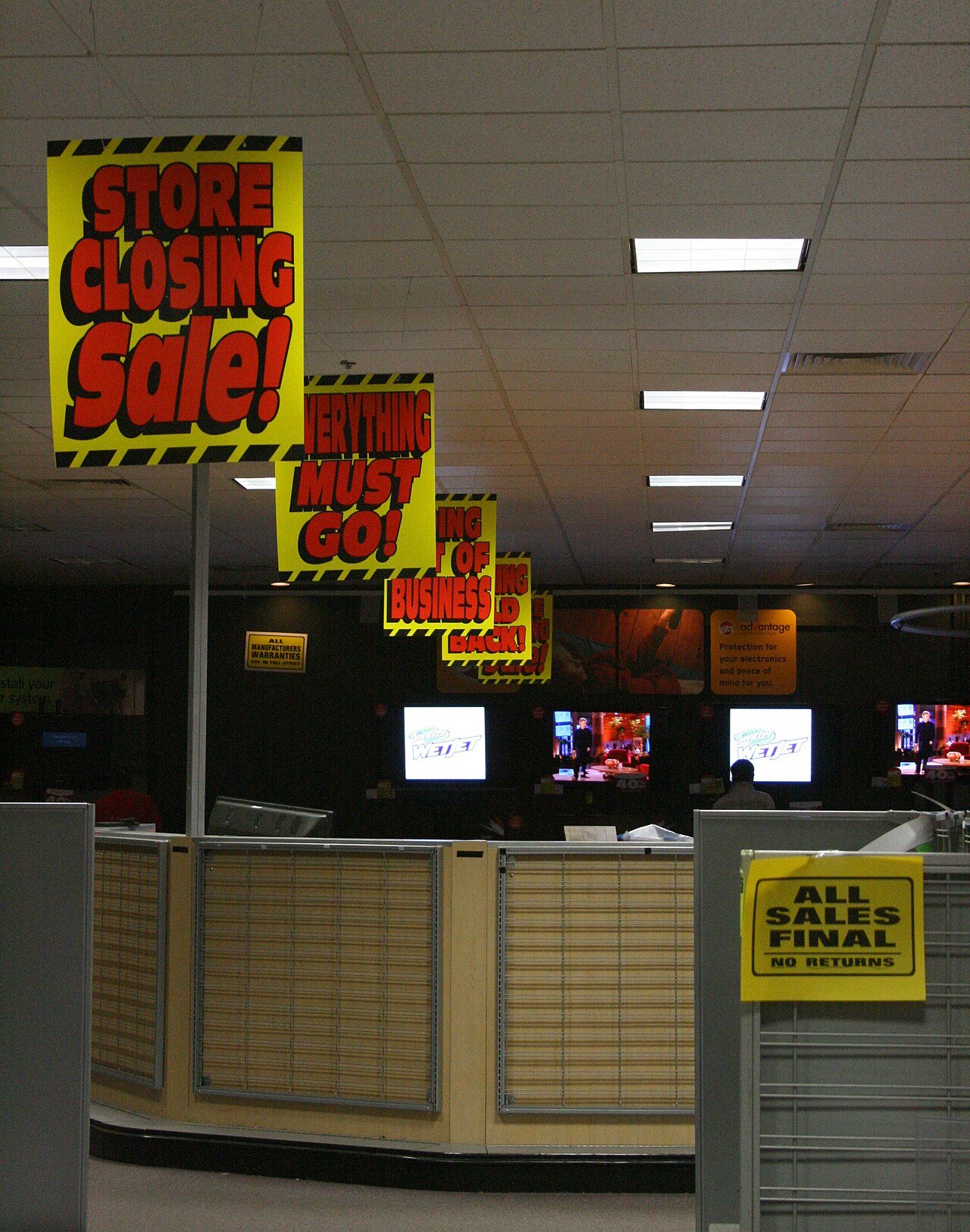
On January 16, 2009, Circuit City announced it would liquidate all remaining stores. The "going out of business" signs went up. Shoppers flooded in looking for deals on marked-down TVs and laptops. And on March 8, 2009, the last Circuit City store turned off its lights. Over 30,000 people lost their jobs.

The whole thing, from the layoffs to the liquidation, took less than two years.

What Went Wrong (Besides the Obvious)

The 3,400-employee massacre gets most of the blame, and it deserves it. But Circuit City had been making smaller mistakes for years that added up to a death sentence.

First, they stopped selling appliances in 2000. This was baffling. Appliances were high-margin products with consistent demand. Best Buy eventually moved into appliances. Circuit City voluntarily gave up the category.

Second, their stores were aging. By the mid-2000s, many Circuit City locations looked tired compared to Best Buy's cleaner, more modern layouts. The company underinvested in renovations and store design at exactly the wrong time.

Third, they were late to e-commerce. Amazon was eating the electronics market alive by the mid-2000s, and Circuit City's online presence was an afterthought. Their website was clunky, their inventory system wasn't properly integrated, and they never figured out how to compete on price with an online retailer that didn't have to pay for 700 storefronts.

And fourth, they had a leadership problem. The company cycled through strategies without committing to any of them. They couldn't decide if they were a high-service retailer or a discount chain, and in trying to be both, they ended up being neither.

The Legacy

There's a sad irony to Circuit City's story. The company that pioneered the electronics superstore, that literally invented the way Americans shopped for technology, couldn't figure out how to evolve when the game changed. The salespeople who made Circuit City special were treated as expenses to be cut rather than assets to be protected. And the executives who made those decisions walked away with golden parachutes while 30,000 regular people lost their livelihoods.

The brand has technically come back. An online-only version of Circuit City launched in 2016, and there have been various attempts to revive the name. None of them have captured anything close to the original. Because Circuit City was never really about the name on the building. It was about the guy on the floor who knew exactly which receiver would work with your speakers, and who was genuinely excited to help you set it up.

You can't fire that and hire it back at a lower wage.

Frequently Asked Questions

When did Circuit City go out of business?

Circuit City filed for Chapter 11 bankruptcy on November 10, 2008, and began liquidating all stores on January 16, 2009. The last store closed on March 8, 2009.

How many stores did Circuit City have at its peak?

At its peak, Circuit City operated over 700 stores across the United States and employed nearly 60,000 people.

Why did Circuit City fire 3,400 employees in 2007?

In a move the company called "wage management," Circuit City terminated its 3,400 highest-paid in-store employees and planned to replace them with lower-wage workers. The decision backfired, leading to decreased sales and customer satisfaction.

Who founded Circuit City?

Samuel Wurtzel founded the company in 1949 as Wards in Richmond, Virginia. The name was an acronym of his family members' names. The company was renamed Circuit City in 1984.

Is Circuit City still in business?

The original Circuit City closed all physical stores in 2009. An online-only version of the brand relaunched in 2016, but it bears little resemblance to the original chain.

Was Circuit City bigger than Best Buy?

Yes. Through the 1990s, Circuit City was the largest specialty electronics retailer in the United States. Best Buy overtook Circuit City in market share in the early 2000s.

Related Posts:
← Back to Blog

What Happened to Circuit City? The Store That Fired Its Way to Death | 404 Memory Found

📖 What Happened to Circuit City? The Store That Fired Its Way to Death

Picture this: it's a Saturday morning in 1998. You're twelve years old. Your dad just got paid, and he's got that look on his face, the one that means you're about to go somewhere good. He grabs his keys, you grab your jacket, and twenty minutes later you're standing in front of a Circuit City. The red-and-white logo glowing above you. The automatic doors sliding open. And inside, rows and rows of televisions, all tuned to the same channel, playing the same football game in slightly different shades of color.

That was the magic of Circuit City. It wasn't just a store. It was an event. A destination. You went there the way some families went to church: on a schedule, with reverence, and usually with the intention of spending money you probably shouldn't have been spending.

And for decades, it worked. Circuit City was the king of American electronics retail. Before Best Buy was Best Buy, before Amazon was anything more than a bookstore run out of a garage, Circuit City was where America bought its TVs, its stereos, its VCRs, and eventually its computers. At its peak, the company operated over 700 stores across the country, employed nearly 60,000 people, and pulled in $12.6 billion in annual revenue.

Then it all collapsed. Not slowly. Not gracefully. Circuit City went from dominant to dead in less than two years. And the story of how that happened is one of the most baffling, frustrating, and entirely preventable corporate disasters of the 2000s.

A Circuit City Superstore location in its original format
A Circuit City Superstore in its heyday, the kind of massive electronics destination that defined Saturday shopping trips for millions of Americans.

The Beginning: A Haircut That Changed Everything

The Circuit City story starts, of all places, in a barber's chair. In 1949, a New York importer-exporter named Samuel Wurtzel was on vacation in Richmond, Virginia. He went in for a haircut, and his barber mentioned that the first commercial television station in the South was about to launch in the city. Wurtzel saw an opportunity. If people in Richmond were about to get local TV broadcasts, they'd need television sets to watch them on.

So he moved his entire family to Virginia and opened a store called Wards. The name wasn't random. It was an acronym built from his family: W for Wurtzel, A for his son Alan, R for his wife Ruth, D for his son David, and S for Samuel himself. It was a family business from day one.

By 1959, Wards had four stores around Richmond, selling televisions and home appliances. Samuel ran the company until 1972, when his son Alan took over as CEO. And that's when things started to get really interesting.

The Rise: Inventing the Electronics Superstore

Alan Wurtzel didn't just want to run a chain of appliance shops. He wanted to build something bigger. In the mid-1970s, he pioneered a concept that would reshape American retail: the electronics superstore. The idea was simple but radical. Instead of small stores with limited inventory, why not build massive showrooms packed with every electronic device a consumer could want? Staff them with knowledgeable salespeople who worked on commission. Let customers touch everything, compare everything, and walk out with something they didn't even know they wanted when they walked in.

It was a hit. The stores were renamed Circuit City in 1984, and the company went on a tear. Through the late '80s and all through the '90s, Circuit City was the place. If you were buying a new TV, a new stereo system, a camcorder, a car stereo, or eventually a desktop computer, you went to Circuit City. The company was so successful that it was one of only eleven companies featured in Jim Collins' famous business book "Good to Great," published in 2001, as an example of a company that had made the leap from mediocre to exceptional performance.

Think about that for a second. A business professor studied thousands of companies and held Circuit City up as a model of excellence. In 2001.

The Competition Heats Up

But the landscape was shifting. Best Buy, which had been a regional player based in Minnesota, was growing fast. And Best Buy made a critical decision that would end up being the difference between survival and extinction: in 1989, they ditched the commission-based sales model in favor of a no-pressure, self-service shopping experience. Customers could browse without being followed around by a salesperson trying to upsell them on extended warranties.

Circuit City, meanwhile, stuck with its commissioned salespeople. For a while, this was actually an advantage. Circuit City's sales staff were knowledgeable, experienced, and genuinely helpful. They could explain the difference between a $400 TV and a $900 TV in a way that made you feel like you were making an informed decision, not being hustled. Customers trusted them.

But Best Buy's approach was cheaper to operate, and it turned out a lot of customers preferred being left alone. By the early 2000s, Best Buy had overtaken Circuit City as the largest electronics retailer in the United States. That should have been a wake-up call. Instead, it was the beginning of a series of decisions that would make things much, much worse.

The Decision That Killed Circuit City

On March 28, 2007, Circuit City's leadership made a decision that still makes people in the retail industry shake their heads. The company announced that it was immediately terminating 3,400 of its highest-paid in-store employees. Not the worst performers. Not redundant positions. The highest-paid, which in a commission-based environment meant the most experienced, most knowledgeable, and most effective salespeople on the floor.

The company called it "wage management." CEO Philip Schoonover said the move would make Circuit City "stronger for the long term." The plan was to replace these veteran employees with new hires who would accept lower wages. On paper, the math made sense. In practice, it was corporate suicide.

Here's what made it especially infuriating. These 3,400 employees were walked out of their stores that same morning. No transition period. No knowledge transfer. Just: you make too much money, here's the door. Meanwhile, Schoonover himself had received $4.5 million in compensation and another $5.4 million in stock options the year before. The combined salaries of those 3,400 fired workers probably didn't add up to what the executive team spent on golf.

The Washington Post reported within weeks that the layoffs appeared to be "backfiring." Sales slowed. Customer satisfaction plummeted. The institutional knowledge that had been Circuit City's greatest differentiator, the thing that made it better than Best Buy, was gone. Replaced by minimum-wage workers who couldn't tell you the difference between HDMI and component cables.

A closed Circuit City storefront
A closed Circuit City location, a sight that became all too common across America in early 2009.

The Spiral

After the layoffs, everything accelerated. The housing crisis hit in 2007 and 2008, and consumer spending on big-ticket electronics cratered. Circuit City, already weakened by its self-inflicted wounds, had no cushion. Best Buy weathered the storm. Circuit City couldn't.

On November 3, 2008, Circuit City announced it would close 155 stores and cut 17% of its workforce. One week later, on November 10, the company filed for Chapter 11 bankruptcy protection. They tried to find a buyer. Two unnamed parties expressed interest, but neither deal materialized.

On January 16, 2009, Circuit City announced it would liquidate all remaining stores. The "going out of business" signs went up. Shoppers flooded in looking for deals on marked-down TVs and laptops. And on March 8, 2009, the last Circuit City store turned off its lights. Over 30,000 people lost their jobs.

The whole thing, from the layoffs to the liquidation, took less than two years.

What Went Wrong (Besides the Obvious)

The 3,400-employee massacre gets most of the blame, and it deserves it. But Circuit City had been making smaller mistakes for years that added up to a death sentence.

First, they stopped selling appliances in 2000. This was baffling. Appliances were high-margin products with consistent demand. Best Buy eventually moved into appliances. Circuit City voluntarily gave up the category.

Second, their stores were aging. By the mid-2000s, many Circuit City locations looked tired compared to Best Buy's cleaner, more modern layouts. The company underinvested in renovations and store design at exactly the wrong time.

Third, they were late to e-commerce. Amazon was eating the electronics market alive by the mid-2000s, and Circuit City's online presence was an afterthought. Their website was clunky, their inventory system wasn't properly integrated, and they never figured out how to compete on price with an online retailer that didn't have to pay for 700 storefronts.

And fourth, they had a leadership problem. The company cycled through strategies without committing to any of them. They couldn't decide if they were a high-service retailer or a discount chain, and in trying to be both, they ended up being neither.

The Legacy

There's a sad irony to Circuit City's story. The company that pioneered the electronics superstore, that literally invented the way Americans shopped for technology, couldn't figure out how to evolve when the game changed. The salespeople who made Circuit City special were treated as expenses to be cut rather than assets to be protected. And the executives who made those decisions walked away with golden parachutes while 30,000 regular people lost their livelihoods.

The brand has technically come back. An online-only version of Circuit City launched in 2016, and there have been various attempts to revive the name. None of them have captured anything close to the original. Because Circuit City was never really about the name on the building. It was about the guy on the floor who knew exactly which receiver would work with your speakers, and who was genuinely excited to help you set it up.

You can't fire that and hire it back at a lower wage.

Frequently Asked Questions

When did Circuit City go out of business?

Circuit City filed for Chapter 11 bankruptcy on November 10, 2008, and began liquidating all stores on January 16, 2009. The last store closed on March 8, 2009.

How many stores did Circuit City have at its peak?

At its peak, Circuit City operated over 700 stores across the United States and employed nearly 60,000 people.

Why did Circuit City fire 3,400 employees in 2007?

In a move the company called "wage management," Circuit City terminated its 3,400 highest-paid in-store employees and planned to replace them with lower-wage workers. The decision backfired, leading to decreased sales and customer satisfaction.

Who founded Circuit City?

Samuel Wurtzel founded the company in 1949 as Wards in Richmond, Virginia. The name was an acronym of his family members' names. The company was renamed Circuit City in 1984.

Is Circuit City still in business?

The original Circuit City closed all physical stores in 2009. An online-only version of the brand relaunched in 2016, but it bears little resemblance to the original chain.

Was Circuit City bigger than Best Buy?

Yes. Through the 1990s, Circuit City was the largest specialty electronics retailer in the United States. Best Buy overtook Circuit City in market share in the early 2000s.

← Back to Blog
00:00