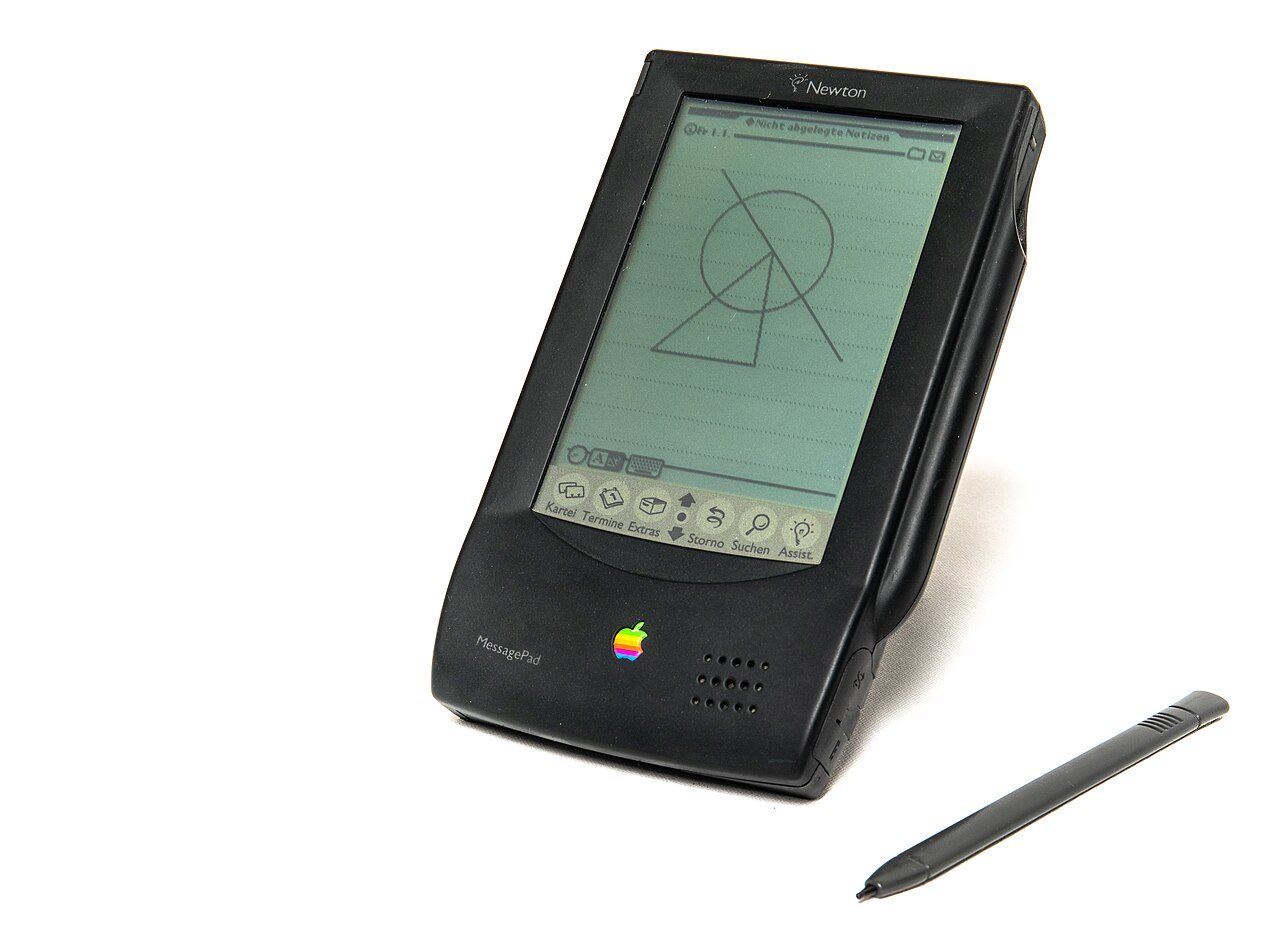
On August 2, 1993, Apple Computer began shipping the original MessagePad, the first device in a product line called Newton. It was a personal digital assistant with a touchscreen, handwriting recognition, and a stylus. It weighed 0.9 pounds, ran on four AAA batteries, and cost $699. Within six months, it had become one of the most ridiculed products in technology history. Within five years, it would be killed by the same man who had originally green-lit its development. And within fifteen years, the ideas it pioneered would generate more revenue than any product in human history.
The Apple Newton is not a failure story. Not exactly. It is the story of a product that was right about nearly everything, built at exactly the wrong time, and then buried by the one person who understood its potential better than anyone.
The Vision That Started in 1987
The Newton project did not begin as a product. It began as a research initiative inside Apple's Advanced Technology Group in 1987, during a period when Apple was still riding high on the Macintosh's success. The original concept came from Steve Sakoman, a hardware engineer who had previously worked on the HP 9000 series. Sakoman envisioned a tablet-sized computer that you could carry around and write on with a pen, something that would be as natural to use as a legal pad but with the processing power of a desktop.
John Sculley, Apple's CEO at the time, latched onto the idea with enormous enthusiasm. Sculley was the one who coined the term "personal digital assistant" during a keynote at the Consumer Electronics Show in January 1992. He described a device that would recognize your handwriting, manage your calendar, send faxes, and eventually connect to wireless networks. The audience was skeptical. The press was fascinated. And inside Apple, the Newton team was burning through money at an alarming rate.
By the time the MessagePad 100 shipped in August 1993, Apple had reportedly spent over $100 million on Newton development, with some estimates running much higher when you include the ARM chip development partnership with Acorn Computers and VLSI Technology, the Newton OS development, and the years of research that preceded the product.
The ARM Connection
Here is a detail that most people miss when they talk about the Newton: Apple co-created ARM. Not the chip inside the Newton specifically, but the company that made it. In 1990, Apple partnered with Acorn Computers and VLSI Technology to form Advanced RISC Machines Ltd., a joint venture specifically created to design low-power processors for mobile devices. Apple invested roughly $3 million for a significant stake in the new company. The Newton MessagePad 100 ran on an ARM 610 processor clocked at 20 MHz.
That $3 million investment would eventually become one of the most consequential bets in technology history. ARM processors now power virtually every smartphone on Earth. Apple's own M-series and A-series chips are built on ARM architecture. When Apple sold its ARM shares in 1998 (after Steve Jobs returned), the stake was worth approximately $800 million. The technology Apple helped create for the Newton became the foundation of the entire mobile computing industry.
Which brings us to the central irony of the Newton story. The product failed. The technology it spawned changed everything.
The Handwriting Problem
The Newton's handwriting recognition was supposed to be its defining feature. Apple licensed the core technology from a Russian company called Paragraph International, which had developed a system called Calligrapher. The idea was elegant: instead of forcing users to learn a special alphabet (which is what Palm would later do with Graffiti), the Newton would learn to read YOUR handwriting. Natural input. No compromises.
The reality was rough. The MessagePad 100's handwriting recognition was inconsistent, slow, and often comically wrong. Users would write "meeting" and the Newton would display "eating." They would write "lunch at noon" and get "launch at moon." The errors weren't occasional. They were frequent enough to make the feature unreliable for everyday use.
Garry Trudeau's Doonesbury comic strip ran a week-long series in August 1993 mocking the Newton's handwriting recognition. One strip showed a character writing "I am writing a test sentence" and the Newton displaying "Ian is writing a test sentence." The strips were syndicated to over 1,400 newspapers. For millions of Americans, this was their first introduction to the Newton, and it was as a punchline.
The Simpsons also took a shot, showing a bully's Newton translating "Beat up Martin" as "Eat up Martha." The joke aired in the 1994 episode "Lisa on Ice" and became one of the most referenced tech gags in television history.
Here is the thing about the handwriting recognition, though: it was a solvable problem. The Newton 2.0 operating system, released in 1996 with the MessagePad 2000, included dramatically improved recognition powered by a completely rewritten engine developed by Apple internally. Users who tried the later Newton models consistently reported that the handwriting recognition was excellent, sometimes eerily accurate. The technology got good. It just got good too late.
What the Newton Actually Did Well
Lost in the handwriting jokes is the fact that the Newton was genuinely innovative in ways that wouldn't become standard for over a decade. The MessagePad had a touchscreen interface with tappable icons, scrollable lists, and a concept Apple called "soups," which were basically structured databases that allowed different applications to share data seamlessly. Your contacts, calendar entries, and notes all lived in interconnected soups, so writing "Lunch with Sarah Tuesday" could automatically cross-reference your contacts and create a calendar entry.
The Newton also introduced "intelligent assistance," a feature where the device would try to understand context and take appropriate action. Tap on a phone number in your notes, and the Newton would offer to dial it. Write a date and time, and it would suggest creating a calendar entry. This was Siri in 1993, minus the voice recognition and cloud processing.
The MessagePad 2000, released in 1997, was an impressive piece of hardware by any standard. It ran on a 162 MHz StrongARM processor (an ARM derivative), had 5 MB of RAM, offered PC Card expansion slots, and could connect to the internet via modem. Users could browse the web, send email, and sync data with their Macs. The device was fast, the handwriting recognition worked well, and the software ecosystem had matured considerably. It was, by most accounts, a genuinely useful computer that fit in a large jacket pocket.
The problem was that by 1997, almost nobody was paying attention.
The Palm Pilot Changed the Equation
In March 1996, Palm Computing released the PalmPilot 1000 at a price of $299. It was smaller, lighter, and cheaper than any Newton model. More importantly, Palm had made a critical design decision that Apple had refused to make: instead of trying to recognize natural handwriting, Palm created Graffiti, a simplified character set that users had to learn. Each letter was a single stroke. It was less elegant than the Newton's approach, but it worked reliably from day one.
Jeff Hawkins, Palm's founder, famously carried a wooden block the size of the eventual PalmPilot in his shirt pocket for months before the product launched, pulling it out in meetings and pretending to use it. He was testing whether people would actually carry a device that size. The answer was yes. And his insistence on simplicity and reliability over ambition and sophistication turned out to be exactly what the market wanted.
The PalmPilot sold roughly 390,000 units by the end of 1996 alone and surpassed a million within two years. By 1998, Palm dominated the PDA market with roughly 70% market share. The Newton, which had been the category creator, was being outsold by a device that cost less than half as much and did fewer things but did them consistently.
Steve Jobs and the Mercy Killing
Steve Jobs returned to Apple in February 1997 as an advisor and became interim CEO in September of that year. Apple was in terrible shape. The company had posted a $1 billion loss in fiscal year 1997. It had too many products, too many projects, and not enough focus. Jobs famously drew a two-by-two grid on a whiteboard: consumer and professional across the top, desktop and portable down the side. Four products. Everything else had to go.
The Newton was one of the first casualties. On February 27, 1998, Apple announced the discontinuation of the entire Newton product line. Jobs also shut down the eMate 300, a Newton-based laptop aimed at the education market that had actually been selling reasonably well.
The decision was controversial inside Apple. Newton loyalists argued that the platform had finally matured, that the MessagePad 2000 and 2100 were excellent products, and that killing it now was throwing away years of investment. They had a point. The Newton OS 2.x was stable, the handwriting recognition worked, and there was a dedicated (if small) user community.
But Jobs saw something they didn't. The Newton represented a philosophy of computing that Jobs fundamentally disagreed with: the stylus. Jobs believed that fingers were the best input device humans would ever have. You didn't need a special tool to interact with a touchscreen. You just needed a screen that was good enough to respond to your fingers. That idea wouldn't become a product for another nine years, but when it did, it was called the iPhone.
The Price Problem
At $699, the original MessagePad was expensive by any consumer electronics standard of 1993. For context, a basic desktop PC cost around $1,500 at the time, and a Game Boy was $89.99. The MessagePad was asking consumers to pay nearly half the price of a full computer for a device that could take notes, manage contacts, and send faxes. The value proposition was thin for anyone who wasn't a traveling executive or an extremely dedicated early adopter.
Apple tried to address this with subsequent models. The MessagePad 100, released in early 1994, dropped to $499. The MessagePad 110 followed at $599 with a slimmer design. The MessagePad 120 dropped further to $499 and then $399 as Apple tried to find the price point where mainstream adoption would begin. It never really did. The Newton always remained a niche product, beloved by its users but unable to break into the mass market the way Apple needed it to.
The eMate 300, released in March 1997 at $799, represented an interesting pivot. It was a Newton-based laptop with a translucent green clamshell design that presaged the iMac G3's aesthetic by over a year. Targeted at K-12 education, the eMate was ruggedized, affordable (relative to laptops), and came with a full keyboard. Some schools bought them in quantity. It was arguably the most commercially viable Newton product, which makes its cancellation alongside the rest of the Newton line especially frustrating for the engineers who built it.
The Sales Reality
Apple shipped approximately 200,000 Newton devices across all models between 1993 and 1998. Some estimates run slightly higher, but the consensus among industry analysts places the total at roughly 200,000 to 300,000 units. For comparison, Apple sold 1.39 million iPhones in the first 74 days after that product launched in 2007.
The Newton was never a commercial success by any reasonable measure. At its peak, it captured perhaps 10% of the PDA market. The MessagePad models retailed between $699 and $999, pricing out casual buyers. The educational eMate 300 at $799 found some traction in schools but never reached volume. Apple's Newton division operated at a loss throughout its entire existence.
The Ideas That Survived
What makes the Newton remarkable is not what it accomplished in its lifetime but what it predicted about the future. Consider what the Newton offered in 1993 and compare it to what became standard in smartphones fifteen years later.
Touchscreen interface with tappable icons and gestures. The Newton had it. The iPhone perfected it. Intelligent assistant that interprets context and takes action. The Newton called it intelligent assistance. Apple later called it Siri. Handwriting and text recognition. The Newton pioneered it. Every smartphone now does it through the keyboard. App ecosystem with third-party developers. The Newton had NewtonScript and a developer community. The App Store made it a $100 billion business. Wireless data synchronization. The Newton could sync with desktop computers. iCloud made it seamless. An ARM processor designed for mobile computing. The Newton was the first Apple product to use one. Every iPhone, iPad, and Mac with Apple Silicon uses ARM descendants.
The Newton was, in many ways, a rough draft of the iPhone. It had the right ideas, the wrong technology, and terrible timing. The processors were too slow, the screens were too crude, the batteries lasted hours instead of days, and wireless networking was years away from being ubiquitous. Apple tried to build a 2007 product in 1993, and the gap was simply too wide.
The Doonesbury Effect
The cultural damage from the handwriting recognition jokes is hard to overstate. Garry Trudeau's Doonesbury strips ran from August 22 to August 27, 1993, less than three weeks after the MessagePad's launch. The strips were syndicated to over 1,400 newspapers and reached millions of readers. For many consumers, the Newton's identity was permanently fixed: it was the thing that couldn't read your handwriting.
Apple engineer Larry Yaeger, who worked on the Newton's handwriting recognition, later described the Doonesbury situation as devastating for the team. The software was version 1.0, released under enormous time pressure. The recognition algorithms improved dramatically with each update. But consumer technology operates on first impressions, and the Newton's first impression, amplified by one of America's most widely read comic strips, was that it didn't work.
Compare this to the Palm Pilot's launch in 1996. Jeff Hawkins deliberately avoided the natural handwriting problem entirely. By requiring users to learn Graffiti, a simplified stroke alphabet, Palm eliminated the recognition failure that had defined the Newton in the public imagination. Hawkins has said in interviews that watching the Newton's reception taught him the most important lesson of his career: a reliable interface that requires learning beats a natural interface that fails unpredictably.
What Happened to the Team
The Newton team didn't just disappear after Jobs shut the project down. Many of them went on to shape the future of mobile computing. Some joined Palm. Others stayed at Apple and contributed to the iPod, iPhone, and iPad projects. The ARM partnership that Apple initiated for the Newton became the foundation of the processor architecture that now dominates mobile computing worldwide.
Steve Sakoman, who originated the Newton concept, later co-founded Be Inc. and worked on BeOS, an operating system that Apple nearly acquired instead of NeXT (which would have meant no Steve Jobs return). The alternative history is dizzying.
Walter Smith, who wrote much of the NewtonScript programming language, went on to work at Microsoft. The Newton's data synchronization concepts influenced later cloud computing approaches. And the Calligrapher handwriting recognition technology from Paragraph International eventually found its way into Microsoft's Windows tablet software.
The Modern Parallels
The Newton story contains a lesson that the tech industry keeps relearning: being first and being right are not the same as being successful. Apple identified the correct future of personal computing in 1987. They spent six years and hundreds of millions of dollars building a version of that future. And the market rejected it, not because the vision was wrong, but because the technology and the price point and the execution weren't ready.
This is essentially what happened to Microsoft's tablet PC initiative in the early 2000s. Microsoft saw the tablet future clearly, released products that technically worked, and watched users shrug. Then Apple released the iPad in 2010 with the right screen, the right interface, and the right price, and sold 300,000 units on the first day.
The Newton also foreshadowed the current debate around AI assistants. In 1993, Apple tried to build a device that understood natural language input and took contextual action. The technology wasn't there. In 2011, Apple shipped Siri, which attempted the same thing with better technology. And in 2024, Apple shipped Apple Intelligence, another attempt at the same fundamental idea the Newton team was chasing three decades earlier: a computer that understands what you mean, not just what you type.
Frequently Asked Questions
How much did the Apple Newton cost?
The original MessagePad 100 launched at $699 in August 1993. Later models ranged from $799 to $999. The educational eMate 300 was priced at $799. For comparison, a PalmPilot 1000 cost $299 when it launched in 1996.
Why did Steve Jobs kill the Newton?
Jobs returned to Apple in 1997 and implemented a radical simplification strategy, cutting Apple's product line down to four core products. The Newton didn't fit that vision. Jobs also philosophically disagreed with stylus-based input, believing that fingers were the best interface for touchscreen devices.
Was the Newton's handwriting recognition really that bad?
The original MessagePad 100 had genuinely unreliable handwriting recognition that earned widespread mockery. However, later models running Newton OS 2.0 (starting with the MessagePad 2000 in 1997) had dramatically improved recognition that most users found accurate and useful. The technology got good, but the reputational damage was already done.
How many Newton devices did Apple sell?
Apple sold approximately 200,000 to 300,000 Newton devices across all models between 1993 and 1998. The product never achieved mass-market adoption.
Did the Newton lead to the iPhone?
Not directly, but the connections are significant. The Newton pioneered touchscreen interfaces, intelligent assistance, app ecosystems, and ARM-based mobile computing, all core iPhone technologies. Many Newton team members later worked on iPhone and iPad development. And Apple's investment in ARM Holdings, originally made for the Newton, created the processor architecture that powers every iPhone.
Can you still use an Apple Newton today?
Working Newton devices exist in the collector market, typically selling for $50 to $300 depending on model and condition. The Newton community maintains software archives and connectivity solutions, though the device's practical utility is limited by its age. It remains a popular item among retro tech collectors and Apple historians.