What Happened to Standalone GPS Devices: TomTom and the Smartphone Killer

In 2008, the global market for personal navigation devices shipped roughly 42 million units. By 2014, it had collapsed to under 18 million. Within a single product cycle, an entire category of consumer electronics had quietly stopped being a category. The brands that had defined it, Garmin and TomTom and Magellan, were either pivoting violently into other businesses or laying off staff in waves. The product had not gotten worse. It had just gotten free.

Most stories about the standalone GPS device get told as a one-line obituary. The smartphone killed it. That is true, but it leaves out the much more interesting question: why was the standalone GPS market so big in the first place, and why did it die that fast? The short answer is that GPS hardware spent twenty years as a closed, expensive, slow-evolving business that depended on three accidents of timing. When those accidents reversed, the market did not slow down. It vaporized.

The longer answer is a story about a US Air Force satellite system, a Korean Air Lines tragedy, a 21-second instruction signed by Bill Clinton, and a Dutch software company that bet the firm on Christmas 2004. To understand what happened, you have to start with the technology itself.

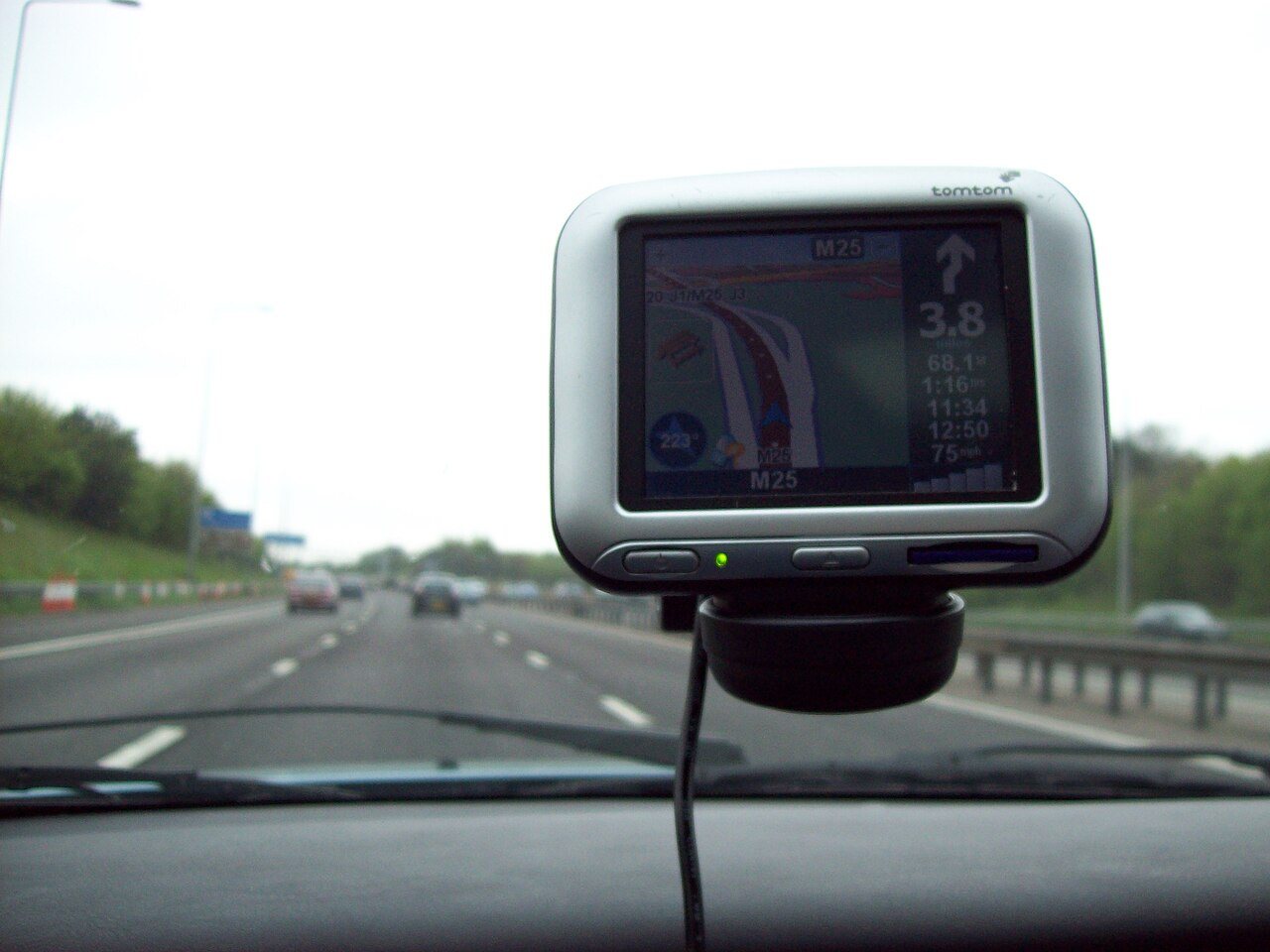
A TomTom Go 500 personal navigation device sitting on a desk
The TomTom Go, launched in 2004, was the device that made standalone GPS navigation a mass-market consumer product. Within four years, the global market for these devices peaked. Within ten, it was effectively over.

How a Cold War Satellite System Became a Consumer Product

The Global Positioning System started as a US military program in the 1970s. The first operational satellites went up in the late 1970s and early 1980s. The full constellation, 24 satellites in medium Earth orbit, did not reach initial operational capability until 1993 and full operational capability until 1995. For most of the system's first decade, it was a strictly military asset.

The pivot to civilian access happened because of a tragedy. On September 1, 1983, Korean Air Lines Flight 007, a Boeing 747 carrying 269 passengers, drifted off course on a flight from Anchorage to Seoul and was shot down by a Soviet Su-15 interceptor over the Sea of Japan. The plane had wandered into Soviet airspace because of a series of navigation errors made by the crew. President Reagan, in the wake of the incident, announced on September 16, 1983, that the GPS signal would be made available to civilian aircraft once the system was operational, with the goal of preventing similar navigation accidents.

That announcement set up the entire civilian GPS industry, but with a catch. The signal civilians could access was deliberately degraded. The military maintained a feature called Selective Availability, or SA, which intentionally added timing errors to the public GPS signal to prevent hostile actors from using it for precision guidance. With SA on, civilian GPS receivers were typically accurate to within about 100 meters, which is fine for telling you which highway you are on but not fine for turn-by-turn directions on city streets.

The first civilian GPS receivers were industrial tools. Magellan Systems Corporation, founded in 1986, shipped the NAV 1000 in 1989. It was a brick of a handheld receiver, weighed about a pound and a half, retailed for thousands of dollars, and could pull a position fix in roughly a minute. Customers were surveyors, fishermen, hikers with money, and military and aviation buyers. The category was a low-volume professional tool business through the early 1990s.

Garmin entered the market in 1989, founded by two engineers named Gary Burrell and Min Kao. The company name is a portmanteau of their first names. Garmin's pitch was simple. They could build a GPS receiver that was smaller, cheaper, and more reliable than what Magellan and the other early entrants were shipping. Their first commercial product was the GPS 100, a marine receiver that debuted in 1990, followed by the GPS 100AVD aviation panel-mount unit in 1991. The company spent most of the 1990s building specialty receivers for aviation, marine navigation, and outdoor recreation, all premium professional segments where customers would pay hundreds to thousands of dollars per unit.

The Decision That Cracked the Market Open

The GPS industry stayed niche through most of the 1990s for a single reason. Selective Availability made the consumer use case marginal. You could not give meaningful turn-by-turn driving directions to a car when your position fix was a hundred meters off. You needed accuracy on the order of meters, not the length of a city block.

That changed at midnight on May 1, 2000. President Bill Clinton signed an order ending Selective Availability for civilian GPS users. The decision was driven by several factors at once. The Federal Aviation Administration was lobbying for higher accuracy because they were starting to use GPS for civilian aviation. Differential GPS techniques had largely defeated SA in practice anyway, so the strategic value was eroding. And the consumer GPS market had finally grown large enough that the Pentagon could see the economic upside of making the signal more useful.

Within hours of the order taking effect, civilian GPS accuracy improved by roughly a factor of ten. Receivers that had been showing 100-meter circles of probable position were suddenly showing 10-meter circles. That is the difference between knowing you are somewhere on this block and knowing you are in the right driveway.

That single technical shift is the reason the standalone GPS market exists. Before May 1, 2000, you could not reasonably build a turn-by-turn car navigator for the consumer market. After May 1, 2000, you could. Garmin, Magellan, TomTom, and a long list of smaller competitors all built their consumer businesses on top of that one administrative decision.

TomTom and the Christmas 2004 Bet

TomTom is the company that turned consumer GPS from a niche aftermarket product into a mass consumer category. The company had been founded in Amsterdam in 1991 under the name Palmtop Software, originally building business applications for handheld devices like the Psion organizer. Through the 1990s, they pivoted slowly toward navigation software, releasing TomTom Navigator in 2002 as software you ran on a Palm or Pocket PC connected to a separate Bluetooth GPS receiver.

The Navigator was a bet on the smartphone-shaped future. It also was not really working. PDAs were a niche product, the user experience of pairing a Bluetooth receiver was painful, and most consumers did not own the underlying hardware. The category was bottlenecked by the customer needing to assemble the system themselves.

In 2004, TomTom made the opposite bet. Instead of selling navigation software for someone else's hardware, they would build their own dedicated navigation device with the software burned in. The TomTom Go launched in March 2004 at a price that worked out to roughly โ‚ฌ800 in the home market, with regional pricing close to ยฃ499 in the United Kingdom. It was the first mass-market all-in-one GPS car navigator. You bought one box, mounted it to your windshield with a suction cup, and it just worked. There was no pairing, no separate handheld, no software install. It was a navigation appliance.

The Go sold faster than TomTom could manufacture it. By Christmas 2004, the company was the talk of every consumer electronics buyer in Europe. The product hit American shelves in 2005. By 2007, TomTom revenue had grown from โ‚ฌ192 million in 2003 to โ‚ฌ1.74 billion. The company went public on the Amsterdam Stock Exchange in 2005, and at peak in 2007, its market capitalization was over โ‚ฌ5 billion. Garmin's stock, riding the same wave, peaked at over $120 a share in October 2007 with a market cap above $20 billion.

This is the moment everyone in the industry felt invincible. They had a product category that did not exist five years earlier and was now selling tens of millions of units a year at retail prices between $200 and $600. The hardware had healthy gross margins. The map data licensing was contained. The user base was growing globally. By every conventional metric, this was a great business.

The Map Data Wars

To understand what happened next, you have to understand the second pillar holding up the consumer GPS market. The hardware was a commodity. The proprietary moat was the map data. Two companies, Tele Atlas and Navteq, controlled essentially all of the high-quality, fully verified vector road map data for North America and Europe.

Tele Atlas was a Belgian-Dutch company, founded in 1984, that had spent two decades building a digital road network database. Navteq was an American company, founded in 1985 as Karlin and Collins and renamed Navigation Technologies, that had done the same on the other side of the Atlantic. Both companies had armies of survey vehicles, often actual cars driving every road in their coverage area, plus deals with public agencies and aerial photography vendors. The data was extraordinarily expensive to produce and basically impossible to recreate from scratch on a competitive timeline.

Every consumer GPS device licensed map data from one of these two vendors. TomTom favored Tele Atlas. Garmin favored Navteq. The map updates pushed to consumers cost real money, often $50 to $100 per annual update, and the underlying license fees the device makers paid to Tele Atlas and Navteq were a meaningful part of every device's cost structure.

In 2007, the slow consolidation of this layer turned into a war. On July 23, 2007, TomTom announced an agreed โ‚ฌ2 billion bid for Tele Atlas, planning to vertically integrate the map supplier into its navigation business. Just over two months later, on October 1, 2007, Nokia announced it would acquire Navteq for $8.1 billion, a stunning price for a company most consumers had never heard of. Garmin briefly counter-bid for Tele Atlas in late October, forcing TomTom to raise its offer. The bidding war eventually settled at roughly โ‚ฌ2.9 billion, and TomTom completed the Tele Atlas acquisition in mid-2008. Within a year, the two companies that controlled the world's road map data had been bought by their two biggest customers, Nokia on the device side and TomTom on the navigation side.

Garmin, having lost out on Navteq, was suddenly in a bad position. Their primary map vendor was now owned by a competitor in the smartphone business. They scrambled, eventually deepening a license deal with Navteq under Nokia, but the writing was already on the wall. The map data layer was no longer a neutral utility. It was being absorbed into vertically integrated platforms.

Google Walks In

The thing that actually killed the standalone GPS market was not a hardware competitor. It was a free software product from a company that had no traditional mapping business at all five years earlier.

Google Maps launched on the web in February 2005. The interactive panning and zooming behavior, which feels obvious now, was a new pattern at the time, lifted from a small startup called Where 2 Technologies that Google had acquired in 2004. Within a year, Google Maps was the dominant web-based mapping service. Google launched a mobile version, Google Maps for Mobile, in late 2005, initially as a Java app for feature phones and BlackBerry devices.

The category-killer move came on October 28, 2009, when Google announced free turn-by-turn navigation as part of Google Maps Navigation on Android 2.0. The feature shipped on the Motorola Droid, which launched on November 6, 2009. It included spoken turn-by-turn directions, traffic-aware routing, satellite imagery, and Street View, all built on top of Google's own map data, which the company had been quietly assembling since 2008 to reduce its dependence on Tele Atlas.

The day Google Maps Navigation shipped, the share prices of Garmin and TomTom dropped roughly 16 percent and 21 percent respectively. The stock market understood instantly what had just happened. Free, smartphone-based, traffic-aware navigation was now a default feature of Android. Apple would later ship its own native maps app on iPhone in 2012. The dedicated GPS device was now competing with a feature that came pre-installed on the phone in your pocket, for free, with always-on cell data and live traffic information that no offline GPS unit could match.

This is not a story about Google being smarter than Garmin and TomTom. It is a story about Google having a fundamentally different business model. Google did not need navigation to be profitable. Navigation was a feature that drove smartphone adoption, which drove search queries, which drove ad revenue. Google was effectively cross-subsidizing a product category that Garmin and TomTom had to charge $300 a unit for. There is no way to win that pricing fight when your competitor is treating your entire category as a marketing expense.

A Magellan Triton 2000 handheld GPS receiver in a rugged outdoor casing
The Magellan Triton 2000, a late 2000s outdoor handheld from the company that shipped the first commercial handheld GPS receiver in 1989. By the time the Triton series was on shelves, smartphones were already cannibalizing the in-car navigation market that had once been Magellan's growth engine.

The Collapse of the Mass-Market PND

The collapse of the personal navigation device, or PND, market did not happen all at once. It happened over about five years and looked, from the outside, like a textbook product cycle decline. Global PND shipments peaked at roughly 42 million units in 2008. They dropped to about 33 million in 2010. By 2014, the global figure was under 18 million units a year, and most of those sales were to commercial vehicle fleets, rental car operators, and a small population of older consumers who preferred a dedicated device.

TomTom's revenue followed the curve. The company peaked at โ‚ฌ1.74 billion in 2007, fell to โ‚ฌ1.27 billion by 2011, and continued declining steadily. The company started layoffs in 2010 and ran successive rounds of restructuring through the 2010s. The headcount fell from over 4,000 employees at peak to roughly 2,500 by the late 2010s.

Magellan was the first to break. The brand had been bought by Thales in 2001 and then sold to MiTAC International in 2008, partly to integrate with MiTAC's own Mio navigation business. Magellan kept shipping consumer GPS devices through the 2010s, but the brand was hollowed out, and the parent company eventually wound down active development on consumer devices, retreating into outdoor handhelds and OEM contracts.

The dedicated GPS device was now competing with a feature that came pre-installed on the phone in your pocket, for free, with always-on cell data and live traffic information that no offline GPS unit could match.

Why Garmin Survived and TomTom Got Smaller

Of the three companies, Garmin is the one that genuinely came out the other side intact, and the reason is structural. Garmin had spent the 1990s building specialty GPS hardware for aviation, marine, and outdoor recreation customers. The car navigator business was a profitable detour for the company in the 2000s, but it was never the core business. When the consumer market collapsed, Garmin still had its aviation and marine and outdoor lines, and it had spent enough on R and D in those segments that it had moats the smartphone could not breach.

The smartphone was a bad fit for a Cessna cockpit. It was a worse fit for a sport-fishing boat or a bicycle handlebar in pouring rain. Garmin's specialty hardware was rugged, had vastly better battery life, and integrated with avionics and marine instruments in ways a phone never could. Garmin also leaned into the fitness wearables market, launching the Forerunner running watches in 2003 and steadily expanding through the 2010s into the broader smartwatch category. By 2020, Garmin's fitness segment alone was generating more revenue than the company's entire business had in the early 2000s.

TomTom did not have those side businesses. The company had made a focused bet on consumer car navigation, and when the consumer car navigation market disappeared, there was no obvious adjacency to retreat into. The company has spent the last decade trying to pivot into B2B services, selling mapping data and ADAS components to automotive OEMs. The bet has been partly successful. TomTom is still listed in Amsterdam, still profitable in some years, and its automotive licensing business is real. But the company that hit a โ‚ฌ5 billion market cap in 2007 is now valued at a small fraction of that.

The lesson from Garmin and TomTom is not that one team made the right decision and the other made the wrong one. It is that they started with different exposure. Garmin had insurance against the consumer collapse because it had spent the 1990s in specialty markets. TomTom had no insurance, because TomTom had bet everything on the bull case for consumer car navigation in the years before Google Maps Navigation existed.

The Hidden Inheritance: Why Your Car Still Has a GPS Antenna

The standalone GPS as a consumer category is gone. The technology, however, is now everywhere. Every smartphone has a GPS receiver. Every modern car has built-in navigation, often supplied by Garmin or TomTom in the back end through automotive licensing deals. Every smartwatch worth buying has GPS. Every commercial fleet management system, every food delivery app, every ride-share platform, every fitness tracker, every drone, every kid's smartwatch with a parent-tracking feature, every photo with location metadata, every airline app showing your flight on a map. Every one of those is a GPS use case that did not exist as a consumer product when the NAV 1000 shipped at $3,000 in 1989.

The category that died was not GPS. It was the dedicated, single-purpose GPS device sitting on a dashboard. That product existed in a narrow window, roughly 2000 to 2010, when the technology was good enough for consumer turn-by-turn navigation but not yet integrated into the phone everyone was already carrying. The window was always going to close. The companies that thrived through it were the ones that recognized, early enough, that the dashboard device was a means, not the end.

The other lesson, the one about platforms, is harder. Tele Atlas and Navteq spent decades building map databases that looked like an unassailable moat. Two acquisitions closed in 2007 and 2008 worth a combined $11 billion locked those moats up under Nokia and TomTom. Within five years, both moats had been outflanked by Google, which built its own map dataset largely from Street View vehicles, satellite imagery, and crowdsourced corrections from billions of Android users. The thing that looked like the most defensible asset in the entire industry, proprietary high-resolution road data, turned out to be reproducible at scale by a company with a large enough mobile install base.

This is essentially the same story Apple and Spotify lived through with the music industry's licensing catalogs, that Netflix lived through with cable's content catalogs, and that any number of platforms have now lived through with mapping. When the underlying data is reproducible, the company with the larger distribution wins. The standalone GPS market was the first consumer electronics category to learn that lesson. It will not be the last.

Frequently Asked Questions

What was Selective Availability and why did it matter?

Selective Availability, or SA, was an intentional degradation of the public GPS signal that the US military maintained from the system's earliest operational years. With SA active, civilian GPS accuracy was generally limited to about 100 meters. President Bill Clinton ordered SA turned off effective May 1, 2000, which improved civilian accuracy by roughly a factor of ten and made consumer-grade turn-by-turn navigation viable for the first time. The standalone GPS device market essentially could not exist before that order.

When did the personal navigation device market peak?

Industry analyst figures put the global peak for personal navigation devices, or PNDs, at around 42 million units shipped in 2008. By 2014, that figure had fallen to under 18 million units a year, and most of the remaining volume was to commercial fleets, rental cars, and a smaller base of consumer holdouts. The peak-to-trough decline took roughly six years.

Why did TomTom buy Tele Atlas?

TomTom announced an agreed offer for Tele Atlas in July 2007 at โ‚ฌ2 billion, eventually completing the acquisition in mid-2008 at roughly โ‚ฌ2.9 billion after a bidding war with Garmin. The strategic logic was vertical integration. Map data was one of the most expensive recurring costs in TomTom's bill of materials, and owning the data supplier would protect TomTom's margins and lock out competitors. Months into the process, Nokia announced its own acquisition of Navteq, the other major Western road map vendor, for $8.1 billion. With Navteq about to be controlled by a smartphone competitor, TomTom's leadership believed it had no choice but to push the Tele Atlas deal through.

What killed the standalone GPS device?

The single biggest event was Google's launch of free, smartphone-based turn-by-turn navigation on Android 2.0, announced on October 28, 2009. The feature included spoken directions, traffic-aware routing, and full integration with Google Maps, all at no cost to the user. The day of the announcement, Garmin and TomTom shares both fell sharply. Within five years, the consumer market for dedicated GPS devices had been more than halved, and the trend continued through the 2010s as smartphone navigation matured.

Is Garmin still in business?

Yes, and Garmin is one of the rare consumer hardware companies that successfully escaped a collapsing core market. The company retreated from in-car consumer GPS during the 2010s and pivoted into specialty segments where smartphones are weak substitutes, including aviation, marine, outdoor handhelds, and especially fitness wearables and smartwatches. By the 2020s, Garmin's revenue and profit had grown well past their pre-collapse highs, with fitness wearables becoming the largest single business unit. Garmin trades on the New York Stock Exchange and is generally profitable.

What happened to Magellan?

Magellan, the company that shipped the first commercial handheld GPS in 1989, was acquired by Thales in 2001 and then sold to Taiwanese electronics manufacturer MiTAC International in 2008. MiTAC integrated Magellan with its existing Mio navigation business and continued to ship consumer GPS devices through the early 2010s, but the brand quietly faded from major retail channels. Magellan-branded products today are largely focused on outdoor handhelds and dash-cam style automotive accessories, a long way from the brand's late-1990s peak.

๐Ÿ“– What Happened to Standalone GPS Devices: TomTom and the Smartphone Killer
_ โ–ก ร—
← Back

What Happened to Standalone GPS Devices: TomTom and the Smartphone Killer

2026-05-10 by 404 Memory Found

In 2008, the global market for personal navigation devices shipped roughly 42 million units. By 2014, it had collapsed to under 18 million. Within a single product cycle, an entire category of consumer electronics had quietly stopped being a category. The brands that had defined it, Garmin and TomTom and Magellan, were either pivoting violently into other businesses or laying off staff in waves. The product had not gotten worse. It had just gotten free.

Most stories about the standalone GPS device get told as a one-line obituary. The smartphone killed it. That is true, but it leaves out the much more interesting question: why was the standalone GPS market so big in the first place, and why did it die that fast? The short answer is that GPS hardware spent twenty years as a closed, expensive, slow-evolving business that depended on three accidents of timing. When those accidents reversed, the market did not slow down. It vaporized.

The longer answer is a story about a US Air Force satellite system, a Korean Air Lines tragedy, a 21-second instruction signed by Bill Clinton, and a Dutch software company that bet the firm on Christmas 2004. To understand what happened, you have to start with the technology itself.

A TomTom Go 500 personal navigation device sitting on a desk
The TomTom Go, launched in 2004, was the device that made standalone GPS navigation a mass-market consumer product. Within four years, the global market for these devices peaked. Within ten, it was effectively over.

How a Cold War Satellite System Became a Consumer Product

The Global Positioning System started as a US military program in the 1970s. The first operational satellites went up in the late 1970s and early 1980s. The full constellation, 24 satellites in medium Earth orbit, did not reach initial operational capability until 1993 and full operational capability until 1995. For most of the system's first decade, it was a strictly military asset.

The pivot to civilian access happened because of a tragedy. On September 1, 1983, Korean Air Lines Flight 007, a Boeing 747 carrying 269 passengers, drifted off course on a flight from Anchorage to Seoul and was shot down by a Soviet Su-15 interceptor over the Sea of Japan. The plane had wandered into Soviet airspace because of a series of navigation errors made by the crew. President Reagan, in the wake of the incident, announced on September 16, 1983, that the GPS signal would be made available to civilian aircraft once the system was operational, with the goal of preventing similar navigation accidents.

That announcement set up the entire civilian GPS industry, but with a catch. The signal civilians could access was deliberately degraded. The military maintained a feature called Selective Availability, or SA, which intentionally added timing errors to the public GPS signal to prevent hostile actors from using it for precision guidance. With SA on, civilian GPS receivers were typically accurate to within about 100 meters, which is fine for telling you which highway you are on but not fine for turn-by-turn directions on city streets.

The first civilian GPS receivers were industrial tools. Magellan Systems Corporation, founded in 1986, shipped the NAV 1000 in 1989. It was a brick of a handheld receiver, weighed about a pound and a half, retailed for thousands of dollars, and could pull a position fix in roughly a minute. Customers were surveyors, fishermen, hikers with money, and military and aviation buyers. The category was a low-volume professional tool business through the early 1990s.

Garmin entered the market in 1989, founded by two engineers named Gary Burrell and Min Kao. The company name is a portmanteau of their first names. Garmin's pitch was simple. They could build a GPS receiver that was smaller, cheaper, and more reliable than what Magellan and the other early entrants were shipping. Their first commercial product was the GPS 100, a marine receiver that debuted in 1990, followed by the GPS 100AVD aviation panel-mount unit in 1991. The company spent most of the 1990s building specialty receivers for aviation, marine navigation, and outdoor recreation, all premium professional segments where customers would pay hundreds to thousands of dollars per unit.

The Decision That Cracked the Market Open

The GPS industry stayed niche through most of the 1990s for a single reason. Selective Availability made the consumer use case marginal. You could not give meaningful turn-by-turn driving directions to a car when your position fix was a hundred meters off. You needed accuracy on the order of meters, not the length of a city block.

That changed at midnight on May 1, 2000. President Bill Clinton signed an order ending Selective Availability for civilian GPS users. The decision was driven by several factors at once. The Federal Aviation Administration was lobbying for higher accuracy because they were starting to use GPS for civilian aviation. Differential GPS techniques had largely defeated SA in practice anyway, so the strategic value was eroding. And the consumer GPS market had finally grown large enough that the Pentagon could see the economic upside of making the signal more useful.

Within hours of the order taking effect, civilian GPS accuracy improved by roughly a factor of ten. Receivers that had been showing 100-meter circles of probable position were suddenly showing 10-meter circles. That is the difference between knowing you are somewhere on this block and knowing you are in the right driveway.

That single technical shift is the reason the standalone GPS market exists. Before May 1, 2000, you could not reasonably build a turn-by-turn car navigator for the consumer market. After May 1, 2000, you could. Garmin, Magellan, TomTom, and a long list of smaller competitors all built their consumer businesses on top of that one administrative decision.

TomTom and the Christmas 2004 Bet

TomTom is the company that turned consumer GPS from a niche aftermarket product into a mass consumer category. The company had been founded in Amsterdam in 1991 under the name Palmtop Software, originally building business applications for handheld devices like the Psion organizer. Through the 1990s, they pivoted slowly toward navigation software, releasing TomTom Navigator in 2002 as software you ran on a Palm or Pocket PC connected to a separate Bluetooth GPS receiver.

The Navigator was a bet on the smartphone-shaped future. It also was not really working. PDAs were a niche product, the user experience of pairing a Bluetooth receiver was painful, and most consumers did not own the underlying hardware. The category was bottlenecked by the customer needing to assemble the system themselves.

In 2004, TomTom made the opposite bet. Instead of selling navigation software for someone else's hardware, they would build their own dedicated navigation device with the software burned in. The TomTom Go launched in March 2004 at a price that worked out to roughly โ‚ฌ800 in the home market, with regional pricing close to ยฃ499 in the United Kingdom. It was the first mass-market all-in-one GPS car navigator. You bought one box, mounted it to your windshield with a suction cup, and it just worked. There was no pairing, no separate handheld, no software install. It was a navigation appliance.

The Go sold faster than TomTom could manufacture it. By Christmas 2004, the company was the talk of every consumer electronics buyer in Europe. The product hit American shelves in 2005. By 2007, TomTom revenue had grown from โ‚ฌ192 million in 2003 to โ‚ฌ1.74 billion. The company went public on the Amsterdam Stock Exchange in 2005, and at peak in 2007, its market capitalization was over โ‚ฌ5 billion. Garmin's stock, riding the same wave, peaked at over $120 a share in October 2007 with a market cap above $20 billion.

This is the moment everyone in the industry felt invincible. They had a product category that did not exist five years earlier and was now selling tens of millions of units a year at retail prices between $200 and $600. The hardware had healthy gross margins. The map data licensing was contained. The user base was growing globally. By every conventional metric, this was a great business.

The Map Data Wars

To understand what happened next, you have to understand the second pillar holding up the consumer GPS market. The hardware was a commodity. The proprietary moat was the map data. Two companies, Tele Atlas and Navteq, controlled essentially all of the high-quality, fully verified vector road map data for North America and Europe.

Tele Atlas was a Belgian-Dutch company, founded in 1984, that had spent two decades building a digital road network database. Navteq was an American company, founded in 1985 as Karlin and Collins and renamed Navigation Technologies, that had done the same on the other side of the Atlantic. Both companies had armies of survey vehicles, often actual cars driving every road in their coverage area, plus deals with public agencies and aerial photography vendors. The data was extraordinarily expensive to produce and basically impossible to recreate from scratch on a competitive timeline.

Every consumer GPS device licensed map data from one of these two vendors. TomTom favored Tele Atlas. Garmin favored Navteq. The map updates pushed to consumers cost real money, often $50 to $100 per annual update, and the underlying license fees the device makers paid to Tele Atlas and Navteq were a meaningful part of every device's cost structure.

In 2007, the slow consolidation of this layer turned into a war. On July 23, 2007, TomTom announced an agreed โ‚ฌ2 billion bid for Tele Atlas, planning to vertically integrate the map supplier into its navigation business. Just over two months later, on October 1, 2007, Nokia announced it would acquire Navteq for $8.1 billion, a stunning price for a company most consumers had never heard of. Garmin briefly counter-bid for Tele Atlas in late October, forcing TomTom to raise its offer. The bidding war eventually settled at roughly โ‚ฌ2.9 billion, and TomTom completed the Tele Atlas acquisition in mid-2008. Within a year, the two companies that controlled the world's road map data had been bought by their two biggest customers, Nokia on the device side and TomTom on the navigation side.

Garmin, having lost out on Navteq, was suddenly in a bad position. Their primary map vendor was now owned by a competitor in the smartphone business. They scrambled, eventually deepening a license deal with Navteq under Nokia, but the writing was already on the wall. The map data layer was no longer a neutral utility. It was being absorbed into vertically integrated platforms.

Google Walks In

The thing that actually killed the standalone GPS market was not a hardware competitor. It was a free software product from a company that had no traditional mapping business at all five years earlier.

Google Maps launched on the web in February 2005. The interactive panning and zooming behavior, which feels obvious now, was a new pattern at the time, lifted from a small startup called Where 2 Technologies that Google had acquired in 2004. Within a year, Google Maps was the dominant web-based mapping service. Google launched a mobile version, Google Maps for Mobile, in late 2005, initially as a Java app for feature phones and BlackBerry devices.

The category-killer move came on October 28, 2009, when Google announced free turn-by-turn navigation as part of Google Maps Navigation on Android 2.0. The feature shipped on the Motorola Droid, which launched on November 6, 2009. It included spoken turn-by-turn directions, traffic-aware routing, satellite imagery, and Street View, all built on top of Google's own map data, which the company had been quietly assembling since 2008 to reduce its dependence on Tele Atlas.

The day Google Maps Navigation shipped, the share prices of Garmin and TomTom dropped roughly 16 percent and 21 percent respectively. The stock market understood instantly what had just happened. Free, smartphone-based, traffic-aware navigation was now a default feature of Android. Apple would later ship its own native maps app on iPhone in 2012. The dedicated GPS device was now competing with a feature that came pre-installed on the phone in your pocket, for free, with always-on cell data and live traffic information that no offline GPS unit could match.

This is not a story about Google being smarter than Garmin and TomTom. It is a story about Google having a fundamentally different business model. Google did not need navigation to be profitable. Navigation was a feature that drove smartphone adoption, which drove search queries, which drove ad revenue. Google was effectively cross-subsidizing a product category that Garmin and TomTom had to charge $300 a unit for. There is no way to win that pricing fight when your competitor is treating your entire category as a marketing expense.

A Magellan Triton 2000 handheld GPS receiver in a rugged outdoor casing
The Magellan Triton 2000, a late 2000s outdoor handheld from the company that shipped the first commercial handheld GPS receiver in 1989. By the time the Triton series was on shelves, smartphones were already cannibalizing the in-car navigation market that had once been Magellan's growth engine.

The Collapse of the Mass-Market PND

The collapse of the personal navigation device, or PND, market did not happen all at once. It happened over about five years and looked, from the outside, like a textbook product cycle decline. Global PND shipments peaked at roughly 42 million units in 2008. They dropped to about 33 million in 2010. By 2014, the global figure was under 18 million units a year, and most of those sales were to commercial vehicle fleets, rental car operators, and a small population of older consumers who preferred a dedicated device.

TomTom's revenue followed the curve. The company peaked at โ‚ฌ1.74 billion in 2007, fell to โ‚ฌ1.27 billion by 2011, and continued declining steadily. The company started layoffs in 2010 and ran successive rounds of restructuring through the 2010s. The headcount fell from over 4,000 employees at peak to roughly 2,500 by the late 2010s.

Magellan was the first to break. The brand had been bought by Thales in 2001 and then sold to MiTAC International in 2008, partly to integrate with MiTAC's own Mio navigation business. Magellan kept shipping consumer GPS devices through the 2010s, but the brand was hollowed out, and the parent company eventually wound down active development on consumer devices, retreating into outdoor handhelds and OEM contracts.

The dedicated GPS device was now competing with a feature that came pre-installed on the phone in your pocket, for free, with always-on cell data and live traffic information that no offline GPS unit could match.

Why Garmin Survived and TomTom Got Smaller

Of the three companies, Garmin is the one that genuinely came out the other side intact, and the reason is structural. Garmin had spent the 1990s building specialty GPS hardware for aviation, marine, and outdoor recreation customers. The car navigator business was a profitable detour for the company in the 2000s, but it was never the core business. When the consumer market collapsed, Garmin still had its aviation and marine and outdoor lines, and it had spent enough on R and D in those segments that it had moats the smartphone could not breach.

The smartphone was a bad fit for a Cessna cockpit. It was a worse fit for a sport-fishing boat or a bicycle handlebar in pouring rain. Garmin's specialty hardware was rugged, had vastly better battery life, and integrated with avionics and marine instruments in ways a phone never could. Garmin also leaned into the fitness wearables market, launching the Forerunner running watches in 2003 and steadily expanding through the 2010s into the broader smartwatch category. By 2020, Garmin's fitness segment alone was generating more revenue than the company's entire business had in the early 2000s.

TomTom did not have those side businesses. The company had made a focused bet on consumer car navigation, and when the consumer car navigation market disappeared, there was no obvious adjacency to retreat into. The company has spent the last decade trying to pivot into B2B services, selling mapping data and ADAS components to automotive OEMs. The bet has been partly successful. TomTom is still listed in Amsterdam, still profitable in some years, and its automotive licensing business is real. But the company that hit a โ‚ฌ5 billion market cap in 2007 is now valued at a small fraction of that.

The lesson from Garmin and TomTom is not that one team made the right decision and the other made the wrong one. It is that they started with different exposure. Garmin had insurance against the consumer collapse because it had spent the 1990s in specialty markets. TomTom had no insurance, because TomTom had bet everything on the bull case for consumer car navigation in the years before Google Maps Navigation existed.

The Hidden Inheritance: Why Your Car Still Has a GPS Antenna

The standalone GPS as a consumer category is gone. The technology, however, is now everywhere. Every smartphone has a GPS receiver. Every modern car has built-in navigation, often supplied by Garmin or TomTom in the back end through automotive licensing deals. Every smartwatch worth buying has GPS. Every commercial fleet management system, every food delivery app, every ride-share platform, every fitness tracker, every drone, every kid's smartwatch with a parent-tracking feature, every photo with location metadata, every airline app showing your flight on a map. Every one of those is a GPS use case that did not exist as a consumer product when the NAV 1000 shipped at $3,000 in 1989.

The category that died was not GPS. It was the dedicated, single-purpose GPS device sitting on a dashboard. That product existed in a narrow window, roughly 2000 to 2010, when the technology was good enough for consumer turn-by-turn navigation but not yet integrated into the phone everyone was already carrying. The window was always going to close. The companies that thrived through it were the ones that recognized, early enough, that the dashboard device was a means, not the end.

The other lesson, the one about platforms, is harder. Tele Atlas and Navteq spent decades building map databases that looked like an unassailable moat. Two acquisitions closed in 2007 and 2008 worth a combined $11 billion locked those moats up under Nokia and TomTom. Within five years, both moats had been outflanked by Google, which built its own map dataset largely from Street View vehicles, satellite imagery, and crowdsourced corrections from billions of Android users. The thing that looked like the most defensible asset in the entire industry, proprietary high-resolution road data, turned out to be reproducible at scale by a company with a large enough mobile install base.

This is essentially the same story Apple and Spotify lived through with the music industry's licensing catalogs, that Netflix lived through with cable's content catalogs, and that any number of platforms have now lived through with mapping. When the underlying data is reproducible, the company with the larger distribution wins. The standalone GPS market was the first consumer electronics category to learn that lesson. It will not be the last.

Frequently Asked Questions

What was Selective Availability and why did it matter?

Selective Availability, or SA, was an intentional degradation of the public GPS signal that the US military maintained from the system's earliest operational years. With SA active, civilian GPS accuracy was generally limited to about 100 meters. President Bill Clinton ordered SA turned off effective May 1, 2000, which improved civilian accuracy by roughly a factor of ten and made consumer-grade turn-by-turn navigation viable for the first time. The standalone GPS device market essentially could not exist before that order.

When did the personal navigation device market peak?

Industry analyst figures put the global peak for personal navigation devices, or PNDs, at around 42 million units shipped in 2008. By 2014, that figure had fallen to under 18 million units a year, and most of the remaining volume was to commercial fleets, rental cars, and a smaller base of consumer holdouts. The peak-to-trough decline took roughly six years.

Why did TomTom buy Tele Atlas?

TomTom announced an agreed offer for Tele Atlas in July 2007 at โ‚ฌ2 billion, eventually completing the acquisition in mid-2008 at roughly โ‚ฌ2.9 billion after a bidding war with Garmin. The strategic logic was vertical integration. Map data was one of the most expensive recurring costs in TomTom's bill of materials, and owning the data supplier would protect TomTom's margins and lock out competitors. Months into the process, Nokia announced its own acquisition of Navteq, the other major Western road map vendor, for $8.1 billion. With Navteq about to be controlled by a smartphone competitor, TomTom's leadership believed it had no choice but to push the Tele Atlas deal through.

What killed the standalone GPS device?

The single biggest event was Google's launch of free, smartphone-based turn-by-turn navigation on Android 2.0, announced on October 28, 2009. The feature included spoken directions, traffic-aware routing, and full integration with Google Maps, all at no cost to the user. The day of the announcement, Garmin and TomTom shares both fell sharply. Within five years, the consumer market for dedicated GPS devices had been more than halved, and the trend continued through the 2010s as smartphone navigation matured.

Is Garmin still in business?

Yes, and Garmin is one of the rare consumer hardware companies that successfully escaped a collapsing core market. The company retreated from in-car consumer GPS during the 2010s and pivoted into specialty segments where smartphones are weak substitutes, including aviation, marine, outdoor handhelds, and especially fitness wearables and smartwatches. By the 2020s, Garmin's revenue and profit had grown well past their pre-collapse highs, with fitness wearables becoming the largest single business unit. Garmin trades on the New York Stock Exchange and is generally profitable.

What happened to Magellan?

Magellan, the company that shipped the first commercial handheld GPS in 1989, was acquired by Thales in 2001 and then sold to Taiwanese electronics manufacturer MiTAC International in 2008. MiTAC integrated Magellan with its existing Mio navigation business and continued to ship consumer GPS devices through the early 2010s, but the brand quietly faded from major retail channels. Magellan-branded products today are largely focused on outdoor handhelds and dash-cam style automotive accessories, a long way from the brand's late-1990s peak.

๐Ÿ“– What Happened to Standalone GPS Devices: TomTom and the Smartphone Killer

In 2008, the global market for personal navigation devices shipped roughly 42 million units. By 2014, it had collapsed to under 18 million. Within a single product cycle, an entire category of consumer electronics had quietly stopped being a category. The brands that had defined it, Garmin and TomTom and Magellan, were either pivoting violently into other businesses or laying off staff in waves. The product had not gotten worse. It had just gotten free.

Most stories about the standalone GPS device get told as a one-line obituary. The smartphone killed it. That is true, but it leaves out the much more interesting question: why was the standalone GPS market so big in the first place, and why did it die that fast? The short answer is that GPS hardware spent twenty years as a closed, expensive, slow-evolving business that depended on three accidents of timing. When those accidents reversed, the market did not slow down. It vaporized.

The longer answer is a story about a US Air Force satellite system, a Korean Air Lines tragedy, a 21-second instruction signed by Bill Clinton, and a Dutch software company that bet the firm on Christmas 2004. To understand what happened, you have to start with the technology itself.

A TomTom Go 500 personal navigation device sitting on a desk
The TomTom Go, launched in 2004, was the device that made standalone GPS navigation a mass-market consumer product. Within four years, the global market for these devices peaked. Within ten, it was effectively over.

How a Cold War Satellite System Became a Consumer Product

The Global Positioning System started as a US military program in the 1970s. The first operational satellites went up in the late 1970s and early 1980s. The full constellation, 24 satellites in medium Earth orbit, did not reach initial operational capability until 1993 and full operational capability until 1995. For most of the system's first decade, it was a strictly military asset.

The pivot to civilian access happened because of a tragedy. On September 1, 1983, Korean Air Lines Flight 007, a Boeing 747 carrying 269 passengers, drifted off course on a flight from Anchorage to Seoul and was shot down by a Soviet Su-15 interceptor over the Sea of Japan. The plane had wandered into Soviet airspace because of a series of navigation errors made by the crew. President Reagan, in the wake of the incident, announced on September 16, 1983, that the GPS signal would be made available to civilian aircraft once the system was operational, with the goal of preventing similar navigation accidents.

That announcement set up the entire civilian GPS industry, but with a catch. The signal civilians could access was deliberately degraded. The military maintained a feature called Selective Availability, or SA, which intentionally added timing errors to the public GPS signal to prevent hostile actors from using it for precision guidance. With SA on, civilian GPS receivers were typically accurate to within about 100 meters, which is fine for telling you which highway you are on but not fine for turn-by-turn directions on city streets.

The first civilian GPS receivers were industrial tools. Magellan Systems Corporation, founded in 1986, shipped the NAV 1000 in 1989. It was a brick of a handheld receiver, weighed about a pound and a half, retailed for thousands of dollars, and could pull a position fix in roughly a minute. Customers were surveyors, fishermen, hikers with money, and military and aviation buyers. The category was a low-volume professional tool business through the early 1990s.

Garmin entered the market in 1989, founded by two engineers named Gary Burrell and Min Kao. The company name is a portmanteau of their first names. Garmin's pitch was simple. They could build a GPS receiver that was smaller, cheaper, and more reliable than what Magellan and the other early entrants were shipping. Their first commercial product was the GPS 100, a marine receiver that debuted in 1990, followed by the GPS 100AVD aviation panel-mount unit in 1991. The company spent most of the 1990s building specialty receivers for aviation, marine navigation, and outdoor recreation, all premium professional segments where customers would pay hundreds to thousands of dollars per unit.

The Decision That Cracked the Market Open

The GPS industry stayed niche through most of the 1990s for a single reason. Selective Availability made the consumer use case marginal. You could not give meaningful turn-by-turn driving directions to a car when your position fix was a hundred meters off. You needed accuracy on the order of meters, not the length of a city block.

That changed at midnight on May 1, 2000. President Bill Clinton signed an order ending Selective Availability for civilian GPS users. The decision was driven by several factors at once. The Federal Aviation Administration was lobbying for higher accuracy because they were starting to use GPS for civilian aviation. Differential GPS techniques had largely defeated SA in practice anyway, so the strategic value was eroding. And the consumer GPS market had finally grown large enough that the Pentagon could see the economic upside of making the signal more useful.

Within hours of the order taking effect, civilian GPS accuracy improved by roughly a factor of ten. Receivers that had been showing 100-meter circles of probable position were suddenly showing 10-meter circles. That is the difference between knowing you are somewhere on this block and knowing you are in the right driveway.

That single technical shift is the reason the standalone GPS market exists. Before May 1, 2000, you could not reasonably build a turn-by-turn car navigator for the consumer market. After May 1, 2000, you could. Garmin, Magellan, TomTom, and a long list of smaller competitors all built their consumer businesses on top of that one administrative decision.

TomTom and the Christmas 2004 Bet

TomTom is the company that turned consumer GPS from a niche aftermarket product into a mass consumer category. The company had been founded in Amsterdam in 1991 under the name Palmtop Software, originally building business applications for handheld devices like the Psion organizer. Through the 1990s, they pivoted slowly toward navigation software, releasing TomTom Navigator in 2002 as software you ran on a Palm or Pocket PC connected to a separate Bluetooth GPS receiver.

The Navigator was a bet on the smartphone-shaped future. It also was not really working. PDAs were a niche product, the user experience of pairing a Bluetooth receiver was painful, and most consumers did not own the underlying hardware. The category was bottlenecked by the customer needing to assemble the system themselves.

In 2004, TomTom made the opposite bet. Instead of selling navigation software for someone else's hardware, they would build their own dedicated navigation device with the software burned in. The TomTom Go launched in March 2004 at a price that worked out to roughly โ‚ฌ800 in the home market, with regional pricing close to ยฃ499 in the United Kingdom. It was the first mass-market all-in-one GPS car navigator. You bought one box, mounted it to your windshield with a suction cup, and it just worked. There was no pairing, no separate handheld, no software install. It was a navigation appliance.

The Go sold faster than TomTom could manufacture it. By Christmas 2004, the company was the talk of every consumer electronics buyer in Europe. The product hit American shelves in 2005. By 2007, TomTom revenue had grown from โ‚ฌ192 million in 2003 to โ‚ฌ1.74 billion. The company went public on the Amsterdam Stock Exchange in 2005, and at peak in 2007, its market capitalization was over โ‚ฌ5 billion. Garmin's stock, riding the same wave, peaked at over $120 a share in October 2007 with a market cap above $20 billion.

This is the moment everyone in the industry felt invincible. They had a product category that did not exist five years earlier and was now selling tens of millions of units a year at retail prices between $200 and $600. The hardware had healthy gross margins. The map data licensing was contained. The user base was growing globally. By every conventional metric, this was a great business.

The Map Data Wars

To understand what happened next, you have to understand the second pillar holding up the consumer GPS market. The hardware was a commodity. The proprietary moat was the map data. Two companies, Tele Atlas and Navteq, controlled essentially all of the high-quality, fully verified vector road map data for North America and Europe.

Tele Atlas was a Belgian-Dutch company, founded in 1984, that had spent two decades building a digital road network database. Navteq was an American company, founded in 1985 as Karlin and Collins and renamed Navigation Technologies, that had done the same on the other side of the Atlantic. Both companies had armies of survey vehicles, often actual cars driving every road in their coverage area, plus deals with public agencies and aerial photography vendors. The data was extraordinarily expensive to produce and basically impossible to recreate from scratch on a competitive timeline.

Every consumer GPS device licensed map data from one of these two vendors. TomTom favored Tele Atlas. Garmin favored Navteq. The map updates pushed to consumers cost real money, often $50 to $100 per annual update, and the underlying license fees the device makers paid to Tele Atlas and Navteq were a meaningful part of every device's cost structure.

In 2007, the slow consolidation of this layer turned into a war. On July 23, 2007, TomTom announced an agreed โ‚ฌ2 billion bid for Tele Atlas, planning to vertically integrate the map supplier into its navigation business. Just over two months later, on October 1, 2007, Nokia announced it would acquire Navteq for $8.1 billion, a stunning price for a company most consumers had never heard of. Garmin briefly counter-bid for Tele Atlas in late October, forcing TomTom to raise its offer. The bidding war eventually settled at roughly โ‚ฌ2.9 billion, and TomTom completed the Tele Atlas acquisition in mid-2008. Within a year, the two companies that controlled the world's road map data had been bought by their two biggest customers, Nokia on the device side and TomTom on the navigation side.

Garmin, having lost out on Navteq, was suddenly in a bad position. Their primary map vendor was now owned by a competitor in the smartphone business. They scrambled, eventually deepening a license deal with Navteq under Nokia, but the writing was already on the wall. The map data layer was no longer a neutral utility. It was being absorbed into vertically integrated platforms.

Google Walks In

The thing that actually killed the standalone GPS market was not a hardware competitor. It was a free software product from a company that had no traditional mapping business at all five years earlier.

Google Maps launched on the web in February 2005. The interactive panning and zooming behavior, which feels obvious now, was a new pattern at the time, lifted from a small startup called Where 2 Technologies that Google had acquired in 2004. Within a year, Google Maps was the dominant web-based mapping service. Google launched a mobile version, Google Maps for Mobile, in late 2005, initially as a Java app for feature phones and BlackBerry devices.

The category-killer move came on October 28, 2009, when Google announced free turn-by-turn navigation as part of Google Maps Navigation on Android 2.0. The feature shipped on the Motorola Droid, which launched on November 6, 2009. It included spoken turn-by-turn directions, traffic-aware routing, satellite imagery, and Street View, all built on top of Google's own map data, which the company had been quietly assembling since 2008 to reduce its dependence on Tele Atlas.

The day Google Maps Navigation shipped, the share prices of Garmin and TomTom dropped roughly 16 percent and 21 percent respectively. The stock market understood instantly what had just happened. Free, smartphone-based, traffic-aware navigation was now a default feature of Android. Apple would later ship its own native maps app on iPhone in 2012. The dedicated GPS device was now competing with a feature that came pre-installed on the phone in your pocket, for free, with always-on cell data and live traffic information that no offline GPS unit could match.

This is not a story about Google being smarter than Garmin and TomTom. It is a story about Google having a fundamentally different business model. Google did not need navigation to be profitable. Navigation was a feature that drove smartphone adoption, which drove search queries, which drove ad revenue. Google was effectively cross-subsidizing a product category that Garmin and TomTom had to charge $300 a unit for. There is no way to win that pricing fight when your competitor is treating your entire category as a marketing expense.

A Magellan Triton 2000 handheld GPS receiver in a rugged outdoor casing
The Magellan Triton 2000, a late 2000s outdoor handheld from the company that shipped the first commercial handheld GPS receiver in 1989. By the time the Triton series was on shelves, smartphones were already cannibalizing the in-car navigation market that had once been Magellan's growth engine.

The Collapse of the Mass-Market PND

The collapse of the personal navigation device, or PND, market did not happen all at once. It happened over about five years and looked, from the outside, like a textbook product cycle decline. Global PND shipments peaked at roughly 42 million units in 2008. They dropped to about 33 million in 2010. By 2014, the global figure was under 18 million units a year, and most of those sales were to commercial vehicle fleets, rental car operators, and a small population of older consumers who preferred a dedicated device.

TomTom's revenue followed the curve. The company peaked at โ‚ฌ1.74 billion in 2007, fell to โ‚ฌ1.27 billion by 2011, and continued declining steadily. The company started layoffs in 2010 and ran successive rounds of restructuring through the 2010s. The headcount fell from over 4,000 employees at peak to roughly 2,500 by the late 2010s.

Magellan was the first to break. The brand had been bought by Thales in 2001 and then sold to MiTAC International in 2008, partly to integrate with MiTAC's own Mio navigation business. Magellan kept shipping consumer GPS devices through the 2010s, but the brand was hollowed out, and the parent company eventually wound down active development on consumer devices, retreating into outdoor handhelds and OEM contracts.

The dedicated GPS device was now competing with a feature that came pre-installed on the phone in your pocket, for free, with always-on cell data and live traffic information that no offline GPS unit could match.

Why Garmin Survived and TomTom Got Smaller

Of the three companies, Garmin is the one that genuinely came out the other side intact, and the reason is structural. Garmin had spent the 1990s building specialty GPS hardware for aviation, marine, and outdoor recreation customers. The car navigator business was a profitable detour for the company in the 2000s, but it was never the core business. When the consumer market collapsed, Garmin still had its aviation and marine and outdoor lines, and it had spent enough on R and D in those segments that it had moats the smartphone could not breach.

The smartphone was a bad fit for a Cessna cockpit. It was a worse fit for a sport-fishing boat or a bicycle handlebar in pouring rain. Garmin's specialty hardware was rugged, had vastly better battery life, and integrated with avionics and marine instruments in ways a phone never could. Garmin also leaned into the fitness wearables market, launching the Forerunner running watches in 2003 and steadily expanding through the 2010s into the broader smartwatch category. By 2020, Garmin's fitness segment alone was generating more revenue than the company's entire business had in the early 2000s.

TomTom did not have those side businesses. The company had made a focused bet on consumer car navigation, and when the consumer car navigation market disappeared, there was no obvious adjacency to retreat into. The company has spent the last decade trying to pivot into B2B services, selling mapping data and ADAS components to automotive OEMs. The bet has been partly successful. TomTom is still listed in Amsterdam, still profitable in some years, and its automotive licensing business is real. But the company that hit a โ‚ฌ5 billion market cap in 2007 is now valued at a small fraction of that.

The lesson from Garmin and TomTom is not that one team made the right decision and the other made the wrong one. It is that they started with different exposure. Garmin had insurance against the consumer collapse because it had spent the 1990s in specialty markets. TomTom had no insurance, because TomTom had bet everything on the bull case for consumer car navigation in the years before Google Maps Navigation existed.

The Hidden Inheritance: Why Your Car Still Has a GPS Antenna

The standalone GPS as a consumer category is gone. The technology, however, is now everywhere. Every smartphone has a GPS receiver. Every modern car has built-in navigation, often supplied by Garmin or TomTom in the back end through automotive licensing deals. Every smartwatch worth buying has GPS. Every commercial fleet management system, every food delivery app, every ride-share platform, every fitness tracker, every drone, every kid's smartwatch with a parent-tracking feature, every photo with location metadata, every airline app showing your flight on a map. Every one of those is a GPS use case that did not exist as a consumer product when the NAV 1000 shipped at $3,000 in 1989.

The category that died was not GPS. It was the dedicated, single-purpose GPS device sitting on a dashboard. That product existed in a narrow window, roughly 2000 to 2010, when the technology was good enough for consumer turn-by-turn navigation but not yet integrated into the phone everyone was already carrying. The window was always going to close. The companies that thrived through it were the ones that recognized, early enough, that the dashboard device was a means, not the end.

The other lesson, the one about platforms, is harder. Tele Atlas and Navteq spent decades building map databases that looked like an unassailable moat. Two acquisitions closed in 2007 and 2008 worth a combined $11 billion locked those moats up under Nokia and TomTom. Within five years, both moats had been outflanked by Google, which built its own map dataset largely from Street View vehicles, satellite imagery, and crowdsourced corrections from billions of Android users. The thing that looked like the most defensible asset in the entire industry, proprietary high-resolution road data, turned out to be reproducible at scale by a company with a large enough mobile install base.

This is essentially the same story Apple and Spotify lived through with the music industry's licensing catalogs, that Netflix lived through with cable's content catalogs, and that any number of platforms have now lived through with mapping. When the underlying data is reproducible, the company with the larger distribution wins. The standalone GPS market was the first consumer electronics category to learn that lesson. It will not be the last.

Frequently Asked Questions

What was Selective Availability and why did it matter?

Selective Availability, or SA, was an intentional degradation of the public GPS signal that the US military maintained from the system's earliest operational years. With SA active, civilian GPS accuracy was generally limited to about 100 meters. President Bill Clinton ordered SA turned off effective May 1, 2000, which improved civilian accuracy by roughly a factor of ten and made consumer-grade turn-by-turn navigation viable for the first time. The standalone GPS device market essentially could not exist before that order.

When did the personal navigation device market peak?

Industry analyst figures put the global peak for personal navigation devices, or PNDs, at around 42 million units shipped in 2008. By 2014, that figure had fallen to under 18 million units a year, and most of the remaining volume was to commercial fleets, rental cars, and a smaller base of consumer holdouts. The peak-to-trough decline took roughly six years.

Why did TomTom buy Tele Atlas?

TomTom announced an agreed offer for Tele Atlas in July 2007 at โ‚ฌ2 billion, eventually completing the acquisition in mid-2008 at roughly โ‚ฌ2.9 billion after a bidding war with Garmin. The strategic logic was vertical integration. Map data was one of the most expensive recurring costs in TomTom's bill of materials, and owning the data supplier would protect TomTom's margins and lock out competitors. Months into the process, Nokia announced its own acquisition of Navteq, the other major Western road map vendor, for $8.1 billion. With Navteq about to be controlled by a smartphone competitor, TomTom's leadership believed it had no choice but to push the Tele Atlas deal through.

What killed the standalone GPS device?

The single biggest event was Google's launch of free, smartphone-based turn-by-turn navigation on Android 2.0, announced on October 28, 2009. The feature included spoken directions, traffic-aware routing, and full integration with Google Maps, all at no cost to the user. The day of the announcement, Garmin and TomTom shares both fell sharply. Within five years, the consumer market for dedicated GPS devices had been more than halved, and the trend continued through the 2010s as smartphone navigation matured.

Is Garmin still in business?

Yes, and Garmin is one of the rare consumer hardware companies that successfully escaped a collapsing core market. The company retreated from in-car consumer GPS during the 2010s and pivoted into specialty segments where smartphones are weak substitutes, including aviation, marine, outdoor handhelds, and especially fitness wearables and smartwatches. By the 2020s, Garmin's revenue and profit had grown well past their pre-collapse highs, with fitness wearables becoming the largest single business unit. Garmin trades on the New York Stock Exchange and is generally profitable.

What happened to Magellan?

Magellan, the company that shipped the first commercial handheld GPS in 1989, was acquired by Thales in 2001 and then sold to Taiwanese electronics manufacturer MiTAC International in 2008. MiTAC integrated Magellan with its existing Mio navigation business and continued to ship consumer GPS devices through the early 2010s, but the brand quietly faded from major retail channels. Magellan-branded products today are largely focused on outdoor handhelds and dash-cam style automotive accessories, a long way from the brand's late-1990s peak.

00:00