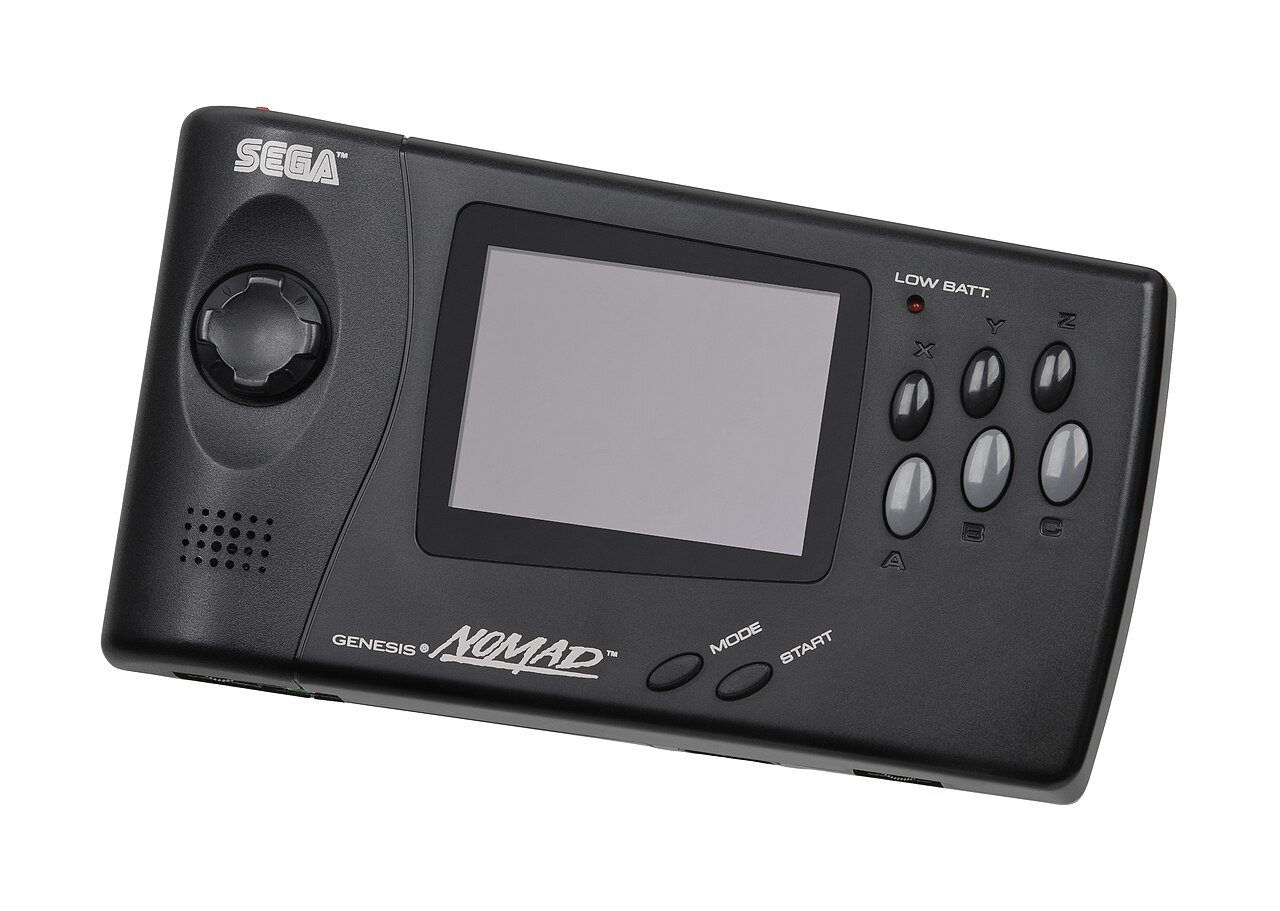
What exactly was the Sega Nomad?
Sega built the Nomad out of a machine that was never meant for store shelves. The Mega Jet was a Mega Drive squeezed into a controller body with no screen of its own, rented to passengers on Japan Air Lines flights so they could plug into the display built into the seat, and sold at retail in Japan in 1994.
Sega of America took that idea, added a 3.25-inch backlit color screen and a battery compartment, and shipped it in North America in October 1995 as the Sega Nomad. Sega's own materials also called it the Genesis Nomad.
The hardware was a real Genesis rather than a cut-down imitation. A Motorola 68000 ran the same code, the picture was the same 320 by 224 NTSC output, and cartridges slotted into the top. An audiovisual output let the Nomad drive a television, and a port on the bottom took a second pad for two-player games.
Sega's announcement of August 22, 1995 called the handheld "compatible with the library of over 600 Sega Genesis game cartridges" and promised limited distribution from October at a suggested retail price under $200. Wikipedia's entry records a launch price of $180, while Sega Retro gives an asking price of $179 in the October 1995 test markets.
Tom Kalinske, then president and CEO of Sega of America, said in that press release: "Millions of die-hard Genesis fans will now have the convenience of their favorite 16-bit games in the palm of their hands anytime or anyplace."
How long did six AA batteries actually last?
The Sega Nomad ran on six AA batteries, and the published figures do not agree. Wikipedia's entry gives about four hours. Giant Bomb says the handheld was capable of draining its batteries in two, and reviewers at the time landed between one and two hours with the screen bright and the sound up.
Either number was punishing in 1995. Six alkaline cells cost real money every couple of hours of play, and a cross-country flight could burn through two or three sets.
The Nomad also drew noticeably more power than the Sega Game Gear, which already had a reputation for eating batteries. Sega sold a rechargeable pack separately, and it never fixed the arithmetic. The machine built to free the Genesis from the television worked best plugged into a wall.
The screen added its own problem. Mid-1990s reviewers complained about motion blur during fast scrolling, the same flaw that dogged the Game Gear, though the Nomad's larger backlit panel handled it better. Wikipedia also notes that the Nomad was incompatible with several Genesis peripherals, so parts of the library Sega advertised did not behave the way they did on the console.
Was Sega selling too many machines at once in 1995?
The Nomad arrived at the worst possible moment in Sega's history. The company was still supporting the Genesis, the Game Gear, the Sega CD and the 32X when the Saturn arrived, and Wikipedia's account of the Nomad concludes that Sega's focus on the Saturn left the handheld under-supported.
Five months before the Nomad shipped, Sega had already lost the room. At the first E3 on May 11, 1995, Tom Kalinske announced that the Saturn was on sale that day at $399, with 30,000 units already shipped to Toys R Us, Babbage's, Electronics Boutique and Software Etc., roughly four months ahead of the September 2 date retailers had been given.
Sony's Steve Race then walked to the microphone, said "two ninety-nine", and walked off. The PlayStation had undercut the Saturn by $100 before a single Saturn game was reviewed.
The Sega Nomad was another bet on the 16-bit platform, placed in the year Sega's own leadership was moving past it. Retailers now had a 32-bit Sega console at $399, a cheaper Sony one at $299, and a $180 portable version of Sega's ageing 16-bit machine, all competing for the same shelf space and the same marketing money.
Is the Sega Nomad still made in 2026?
No. Sega discontinued the Nomad in 1999 after roughly 1 million units, and Wikipedia's entry calls it a commercial failure. The Game Boy was smaller, ran much longer on its batteries and had games built for a handheld, none of which was true of a machine running shrunken console games.
Sega had already tried to buy its way out of the problem. Sega Retro records a $100 price drop in the months after launch, and sales stayed sluggish anyway.
Blake Snow ranked the Nomad fifth on GamePro's "10 Worst-Selling Handhelds of All Time" in July 2007, faulting its timing, its advertising and its battery life.
Nothing has replaced it under the Sega name. Sega has not sold another handheld that takes Genesis cartridges since 1999, and there is no official reissue of the Nomad. Players who want Genesis games on the move use emulation handhelds or modern clone hardware instead, which is a different thing from a real cartridge in a real slot.
Where to find one today
The Sega Nomad is a collector item now rather than a bargain bin find. PriceCharting's completed sales show where the market settled in 2026: a tested unit with a power adapter went for $299.99 on October 1, another with an adapter for $270.00 on August 4, one bundled with a battery pack for $349.50, and a boxed example described as original and tested for $390.00 on July 16. A unit that needed a new screen still fetched $259.95.
Condition matters more than usual here. The electrolytic capacitors are three decades old, and a Nomad with dim video, distorted sound or no power at all is usually a recapping job rather than a dead machine. Original screens are dim and blurry even when healthy, and there is no simple drop-in modern panel the way there is for the Game Gear, so screen upgrades are aftermarket kits fitted by hand.
Budget for the battery problem too, because modern lithium packs replace the six AA compartment and run far longer than alkalines. Stone Age Gamer stocks Nomad parts, mods and battery packs.
Frequently Asked Questions
How much is a Sega Nomad worth in 2026?
A working Sega Nomad, the portable Genesis that Sega sold in North America from October 1995, generally trades between $260 and $390 in 2026. PriceCharting's completed sales include a tested unit with a power adapter at $299.99 on October 1, 2026 and a boxed example at $390.00 on July 16, 2026, well above the $180 the handheld cost new.
How long does the Sega Nomad battery last?
The Sega Nomad takes six AA batteries, and published figures range from about two hours to about four depending on the source, the screen brightness and the volume. Wikipedia's entry on the Genesis Nomad gives roughly four hours while Giant Bomb reports two, which is why modern lithium replacement packs are the usual fix for a handheld Sega discontinued in 1999.
Was the Sega Nomad ever sold outside North America?
No. Sega released the Nomad only in North America, from October 1995 until it was discontinued in 1999. Its Japanese ancestor, the screenless Mega Jet, was rented to Japan Air Lines passengers and sold at retail in Japan in 1994, but the battery-powered Nomad with its own 3.25-inch screen never shipped in Japan, Europe or Australia.