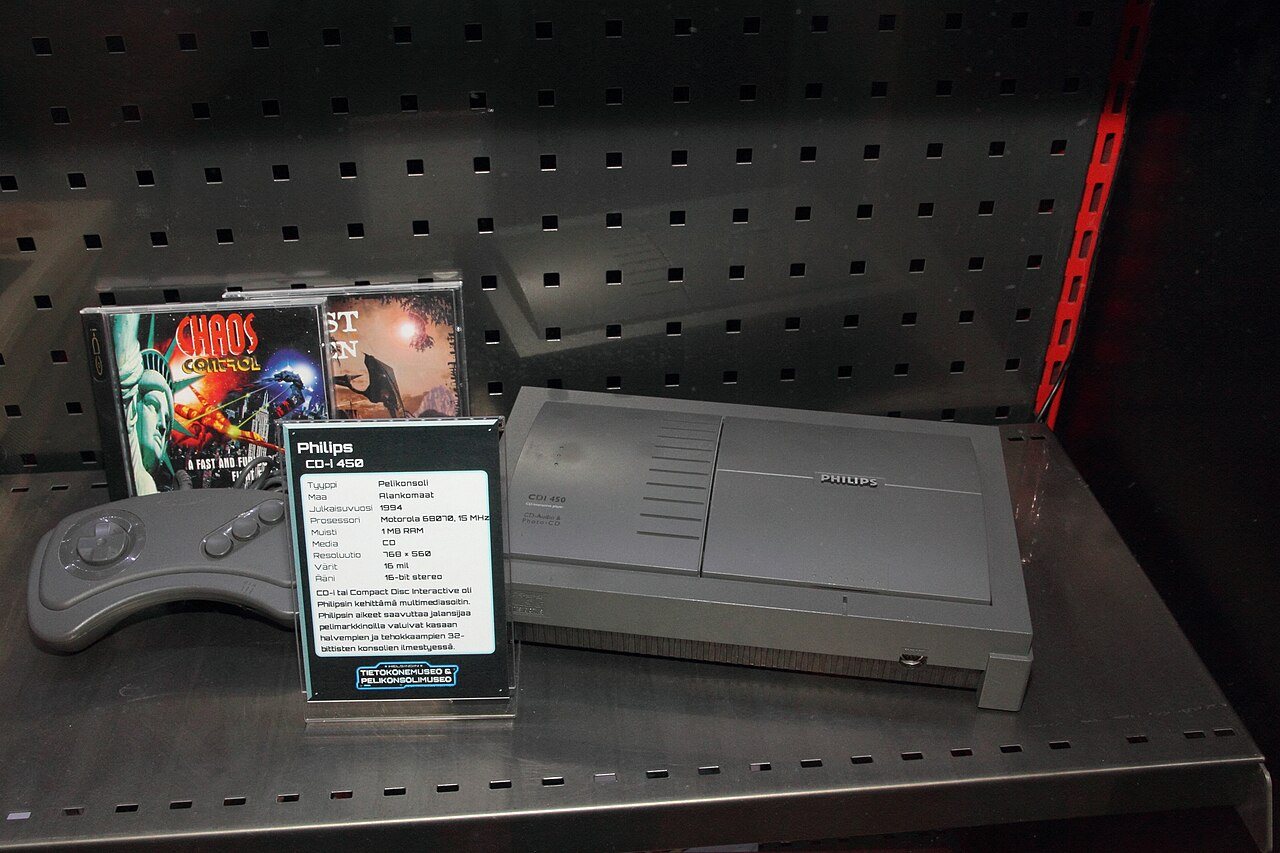
What was the Philips CD-i supposed to be?
Philips did not build the CD-i as a games machine. Compact Disc Interactive was sold as one black box that would handle music, reference discs, training material and children's titles on an ordinary television, and Philips advertised it as "The Imagination Machine" rather than as a console.
The first US player reached American stores on December 3, 1991. Reported pricing varies by model: most accounts put the entry player at about $700, while the first unit aimed squarely at consumers was quoted closer to $1,000. At $700 that is roughly $1,700 in 2026 dollars, and that was before a single disc.
Philips sold the hardware through audio dealers and department stores, next to CD players rather than in the toy aisle. Early players shipped with a multimedia remote instead of a gamepad, so anything that needed timing felt wrong from the first minute.
The strategy had a logic to it. One machine for music, video and software was a reasonable bet in 1991. What went wrong is that cheap PCs took the multimedia work and purpose-built consoles took the games, and the CD-i was left in the middle doing neither job well.
How Nintendo handed Philips the rights to Zelda and Mario
In May 1991, Nintendo of America's Howard Lincoln and Minoru Arakawa flew to Eindhoven and signed an agreement with Philips. Nintendo already had a 1988 CD-ROM deal with Sony on software terms it had come to regret, and Philips offered a way out of it.
Sony announced its Super Nintendo CD add-on, the Play Station, at the Summer Consumer Electronics Show in Chicago on June 1, 1991. The next morning Nintendo announced it would build its CD peripheral with Philips instead, and Sony learned about the switch from the audience. "Our engineers reached the conclusion that from a technical standpoint that it was better for Nintendo to work with Philips," Lincoln told The New York Times in 1991.
The Super NES CD-ROM never shipped. What survived was the side clause: Philips could use Nintendo characters on its own hardware. Three Zelda titles and one Mario title followed. Link: The Faces of Evil and Zelda: The Wand of Gamelon both arrived on October 10, 1993, Hotel Mario landed in 1994, and Zelda's Adventure followed later that year.
Nintendo kept its distance from all four. "Nintendo's only input was we ran the design document and character sketches past them for their approval," said Dale DeSharone, who ran the Zelda development at Animation Magic, in an interview published by Zelda Universe in 2013. Nintendo has never counted the games as canon.
Why the CD-i lost to the Sega CD and the PlayStation
The CD-i's best trick was video, and video cost extra. By 1993 Philips was selling a $250 Digital Video Cartridge that added a 32-bit RISC processor and 1 MB of RAM for MPEG-1 decoding, and most of the platform's strongest software needed it fitted.
Stack that up and the math stops working. A $700 player plus a $250 cartridge sat against the $299 Sega CD, which at least plugged into a Genesis the family already owned. The 3DO made the same expensive multimedia argument in 1993 and failed in the same way.
Then the price of entry collapsed underneath Philips. The Sega Saturn arrived in 1995 and the PlayStation followed in the United States that autumn, both built for games and both cheaper than a CD-i with the video cartridge installed.
Philips sold Philips Media to the French publisher Infogrames in 1996 and announced in 1998 that the CD-i was finished. Lifetime sales came to about 570,000 units worldwide, against tens of millions for the consoles it was measured against, and losses reported at close to $1 billion.
What a Philips CD-i costs in 2026, and which discs are worth money
A working Philips CD-i is a $225 to $300 machine in 2026. Sales records on PriceCharting put loose CD-i 450 consoles around $266 and complete boxed examples past $700, with CDI 210 units changing hands between $225 and $243 through 2025 and CDI 220 consoles listed near $300. A Magnavox-branded CD-i 450 with a controller sold for $299.99.
Condition on these players is mostly about the disc drive and the clock. CD-i hardware uses a battery-backed timekeeper chip that dies with age and stops some discs booting, which is why seller listings advertise a timekeeper fix as a selling point. Pay for the repaired unit.
The discs carry the real premium, and they are the Nintendo ones. Zelda: The Wand of Gamelon averages about $222 complete in box and about $496 sealed, with loose discs near $150. A Wata-graded 9.6 A+ sealed copy sold at Heritage Auctions in December 2025 for $6,875, the high end of anything this platform has produced.
Where to find one today. Budget $250 to $300 for a tested console with a controller, and more for a boxed set with the Digital Video Cartridge included. A retro hardware specialist is a safer route than an unknown seller for a 30-year-old optical drive, and Stone Age Gamer's catalog search is a reasonable place to start looking for players and accessories.
Does anyone still play CD-i games?
Yes, though mostly on something other than original hardware. Emulators cover a good part of the library, and the platform keeps a small homebrew scene that still cuts new discs for the players that survive.
The clearest sign of life is a new game. Arzette: The Jewel of Faramore, released on February 14, 2024, is a deliberate revival of the CD-i Zelda style, developed by Seedy Eye Software and published by Limited Run Games for Nintendo Switch, PlayStation 4, PlayStation 5, Xbox Series X and S, and Windows.
It is not a port of anything. Arzette was made with people from the originals: Rob Dunlavey, one of the artists on the CD-i games, painted backgrounds for it, and voice actors Jeffrey Rath and Bonniejean Wilbur returned for new roles. Hand-painted scenery and fully animated cutscenes are the whole point of the thing.
That is a strange afterlife for a box sold on encyclopedias and music videos. Philips wanted the CD-i remembered as a reference machine for the living room. It is remembered instead for four licensed Nintendo games made with almost no supervision, and for a 2024 tribute to the way they looked.
Frequently Asked Questions
Is the Philips CD-i worth anything in 2026?
Yes. A working Philips CD-i console typically sells for $225 to $300 in 2026, with loose CD-i 450 units around $266 and complete boxed examples past $700. The valuable items on the platform are its Nintendo-licensed discs: Zelda: The Wand of Gamelon averages about $222 complete and about $496 sealed, and a Wata 9.6 A+ sealed copy sold at Heritage Auctions in December 2025 for $6,875.
Why did the Philips CD-i fail?
The Philips CD-i failed because it cost about $700 at its United States launch in December 1991, needed a $250 Digital Video Cartridge to run its best software, and was underpowered for games against the $299 Sega CD and later the PlayStation. Philips discontinued the CD-i in 1998 after selling about 570,000 units worldwide, with losses reported at close to $1 billion.
What Zelda games came out on the Philips CD-i?
Three Zelda games reached the Philips CD-i: Link: The Faces of Evil and Zelda: The Wand of Gamelon, both released on October 10, 1993, and Zelda's Adventure in 1994. Philips also published Hotel Mario in 1994. All four came from a licence Nintendo granted Philips after their Super NES CD-ROM partnership collapsed, and Nintendo does not treat them as canon.