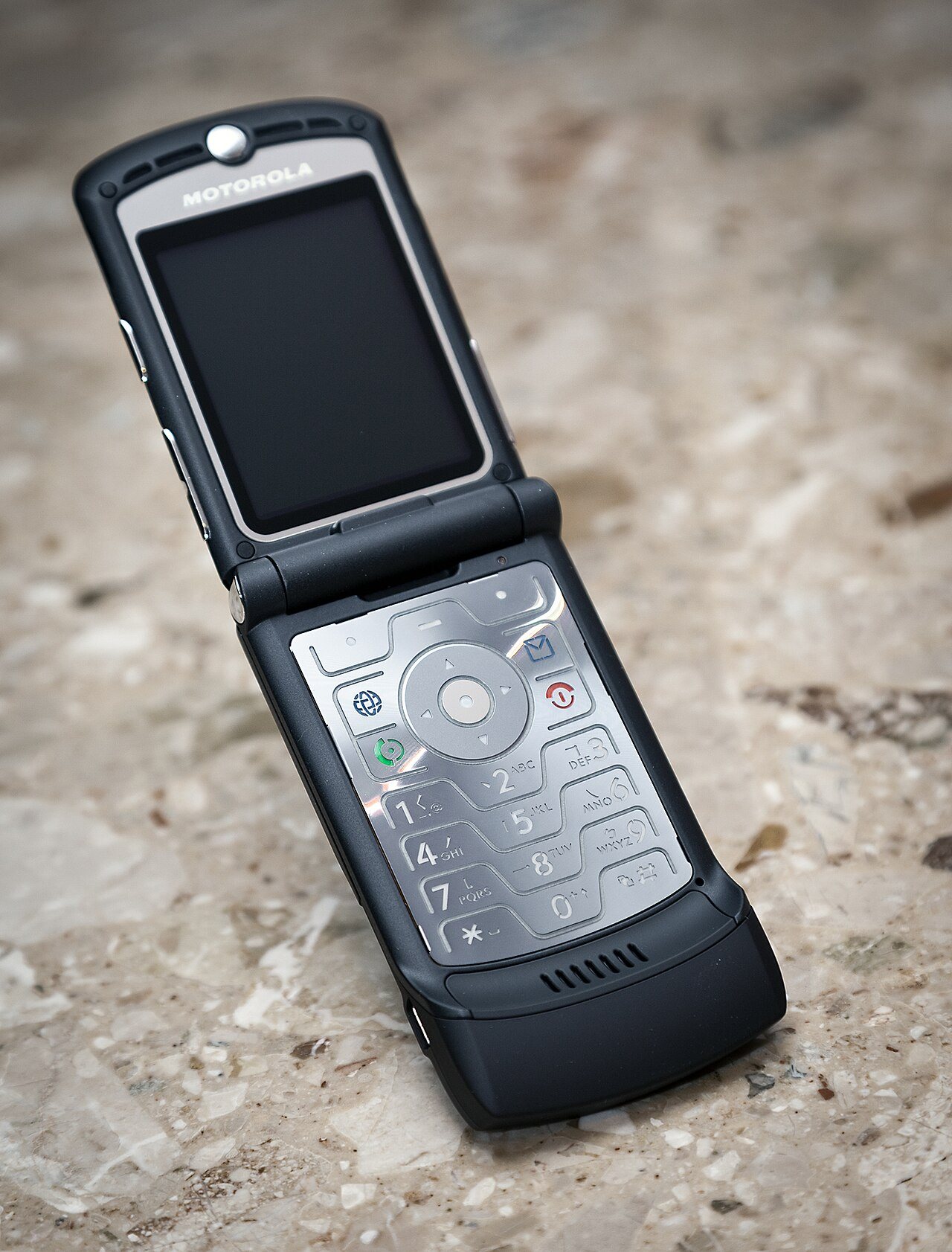
Picture this: November 2004. You walk into a Cingular Wireless store, the kind with the blue carpet and the little plastic phone displays screwed to the counter. You're there for an upgrade. Maybe you're rocking a Nokia 6600, maybe a Samsung flip of some kind. And then you see it. Sitting in its own little spotlight, angled just right, like it knows what it's doing. The Motorola RAZR V3.
You pick it up. It's thin. Not "thin for a phone" thin. Thin like a magazine. Thin like nothing you've ever held that could also make a phone call. You flip it open, and the keypad is flat metal, not raised plastic buttons. It feels like the future. It feels like something a secret agent would carry. You check the price tag: $499 on contract. You buy it anyway.
And for about three years, you were the coolest person in every room you walked into.
The Skunk Works Phone
Here's the thing about the RAZR that most people don't know: Motorola almost didn't make it. The phone was born out of a secret internal project, a skunk works operation led by a British designer named Roger Jellicoe. If that name sounds familiar, it should. Jellicoe was the guy behind the Motorola StarTAC, the iconic flip phone from 1996 that basically invented the clamshell form factor.
In the early 2000s, Jellicoe saw a concept model for an ultra-thin flip phone floating around Motorola's design labs. Most people in the company thought it was a novelty, something that looked cool in a mockup but couldn't be manufactured. Jellicoe thought otherwise. He assembled a small team and started building it in secret, nights and weekends, hiding prototype costs inside other project budgets. His boss, Tracey Koziol, ran interference with upper management so nobody would shut it down.
This is important context. The phone that would go on to sell 130 million units worldwide was, at one point, an unauthorized side project that its own company didn't believe in.
The Cingular Exclusive That Changed Everything
Part of what made the RAZR's launch so effective was a decision that seems counterintuitive: Motorola gave Cingular Wireless exclusive rights to sell it in the United States for the first two months. In November and December 2004, if you wanted a RAZR, you had to walk into a Cingular store. No T-Mobile. No Sprint. No Verizon. Just Cingular.
This drove people absolutely crazy, which was exactly the point. Exclusivity created scarcity, and scarcity created desire. People who were locked into contracts with other carriers were showing up at Cingular stores just to hold the phone. Forums were full of people debating whether it was worth paying an early termination fee to switch carriers for a phone. Some people did.
When the exclusivity window ended and other carriers started selling the RAZR in early 2005, demand exploded. Motorola couldn't make them fast enough. The single-supplier chemically etched keypad became a bottleneck. Motorola's manufacturing facilities in Tianjin, China, were running at full capacity, and they still couldn't keep up. For most of 2005, the RAZR was backordered at multiple retailers.
The price dropped over time, which only accelerated sales. By mid-2005, you could get a RAZR for $199 with a two-year contract, and by 2006, some carriers were offering it for $99 or even free with a plan. Each price drop brought in a new wave of buyers. The phone that had launched as a premium fashion accessory became the default choice for anyone who wanted a phone that looked good and worked well. It was everywhere. You'd see three or four of them at any given restaurant table.
The Sound of 2005
There's a sensory detail about the RAZR era that's hard to explain to anyone who wasn't there. The sound. Not the ringtone, though "Hello Moto" became its own cultural artifact. The sound of the flip.
In 2005 and 2006, you could walk into any public space, a coffee shop, a classroom, a bus, and hear RAZRs snapping open and shut. It was the ambient sound of the mid-2000s, the same way the iPhone keyboard click became the ambient sound of the late 2000s. People would flip their RAZRs open to check the time, even though the external display showed the time already. They'd flip them open and shut while waiting in line. It was fidgeting, but it was also a performance. Every snap was a tiny announcement: I have a RAZR.
The phone also had a specific weight to it. At 95 grams, it was heavier than you'd expect for something so thin. That weight made it feel substantial, premium. When you slid it into your jeans pocket, you knew it was there, not because it was bulky, but because it had presence. Modern phones are bigger and heavier, but they don't feel the same way. They're slabs. The RAZR was a mechanism.
Why It Felt Like Nothing Else
When the RAZR V3 launched in late 2004, the competition wasn't even playing the same game. Most phones at the time were thick plastic bricks with tiny screens and raised rubber keypads. The RAZR was 13.9 millimeters thin, about the width of a credit card on its edge, and it was made of aluminum. Not plastic with a metallic paint job. Actual aluminum. You could feel the cold metal when you picked it up, which sounds like a small thing, but it wasn't. Every other phone felt like a toy. The RAZR felt like a piece of industrial design.
The keypad was a single sheet of chemically etched, nickel-plated copper alloy, backlit so the numbers glowed through the metal. The internal antenna eliminated the stubby rubber nub that stuck out of every other flip phone. The hinge had this satisfying, precise action to it, not too loose, not too tight. You could flip it open with one hand, and you did, constantly, because it felt incredible.
And here's the part that really got people: it dropped the headphone jack and the proprietary charging port in favor of a single mini-USB connection. In 2004, that was radical. Most phones had their own weird charger that worked with exactly one model. The RAZR used a cable you probably already had sitting on your desk.
The Celebrity Phone
Motorola did something with the RAZR that no phone manufacturer had really done before. They marketed it like a fashion brand. This wasn't a tech product launch. It was a cultural moment.
They put the RAZR in the hands of celebrities. Paris Hilton was spotted with a pink RAZR bedazzled in Swarovski crystals. It showed up on red carpets, in music videos, in the pockets of NBA players and Hollywood actors. Motorola gave RAZRs to Oscar nominees. They didn't just advertise in tech magazines. They ran campaigns in Vogue.
The result was something that hadn't really happened before in the phone industry: a device became a status symbol. Not because it was expensive (though $499 wasn't cheap in 2004 dollars, roughly $800 today). Not because it had the best camera or the fastest data speeds, because it didn't. It was a status symbol because of how it made you look. Because of the snap when you closed it. Because of the way people's eyes went to it when you pulled it out of your pocket.
In the United States, the RAZR V3 was the best-selling cell phone in 2005, 2006, and 2007. Three consecutive years. No phone had ever done that before, and honestly, very few have done it since.
The Numbers Were Staggering
Let's talk about the sales trajectory, because it tells a story all by itself.
By the end of 2004, just a couple of months after launch, Motorola had moved 750,000 RAZRs. That number alone was generating a huge chunk of the company's quarterly revenue. By July 2006, the RAZR had crossed 50 million units sold. By late 2007, it hit 100 million. When production finally wound down, the total was somewhere north of 130 million units across all RAZR variants.
To put that in perspective: 130 million is more than the population of Japan. It's roughly the same number of original Game Boys that Nintendo sold over the Game Boy's entire 18-year lifespan. And Motorola did it in about four years.
By 2006, the RAZR was outselling the iPod. Think about that. In the mid-2000s, the iPod was the cultural product. The thing everyone wanted. And the RAZR was beating it.
And Then Motorola Did What Motorola Always Does
This is where it all falls apart, and honestly, this is the part that still frustrates me.
Motorola had the biggest hit in the phone industry. They had cultural dominance, brand recognition, and a loyal customer base that was waiting for whatever came next. And what did they do? They made the same phone again. And again. And again.
After the V3, Motorola released the V3i, the V3x, the V3xx, the RAZR2, the RAZR maxx. Each one was a minor iteration on the same basic design. A slightly better camera here, 3G support there, but nothing that recaptured the magic of the original. They milked the RAZR name until it meant nothing.
Meanwhile, the phone industry was changing fast. Nokia was pushing smartphone capabilities with Symbian. BlackBerry was dominating the business market. And in January 2007, Steve Jobs walked onto a stage in San Francisco and introduced the iPhone.
Motorola had nothing to compete with any of it. They had spent three years riding the RAZR wave instead of building the next thing. Their R&D pipeline was essentially empty. By 2007, they were losing market share to Samsung and LG. By 2008, the RAZR was no longer the best-selling phone in America. By 2009, Motorola's mobile division was hemorrhaging money.
The company that invented the cell phone, that created the flip phone, that built the single most iconic mobile device of the 2000s, was suddenly fighting for survival.
The Long Decline
What happened next reads like a cautionary tale they should teach in business schools. Actually, they probably do.
Motorola split into two companies in 2011: Motorola Mobility (phones) and Motorola Solutions (enterprise stuff like walkie-talkies and police radios). Almost immediately, Google swooped in and bought Motorola Mobility for $12.5 billion in 2012. Most analysts agreed that Google wasn't buying it for the phone business. They wanted Motorola's massive patent portfolio, roughly 17,000 patents and 7,500 pending applications, to use as a defensive shield in the smartphone patent wars.
Google ran Motorola Mobility for about two years, released a couple of decent phones like the Moto X and Moto G, and then sold the whole thing to Lenovo in 2014 for $2.91 billion. That's a loss of nearly $10 billion, if you're keeping score.
The brand that gave us the StarTAC, the RAZR, and the flip phone itself, was now a subdivision of a Chinese computer manufacturer. Roger Jellicoe's masterpiece led to a company that no longer exists as an independent entity.
The Warning Signs Everyone Ignored
In retrospect, you can trace the exact moment things started going sideways. It was 2006, and the RAZR was still selling like crazy. Motorola's stock was riding high, and CEO Edward Zander was taking victory laps in every tech publication that would have him. At that year's Consumer Electronics Show in Las Vegas, Motorola's booth was dominated by RAZR variants. Silver, black, pink, gold. Limited editions. Carrier exclusives. But if you looked past the displays and into the actual product pipeline, there was almost nothing else there.
The competitors weren't standing still. Nokia was pushing the N-series, phones with GPS navigation, music players, and 3.2 megapixel cameras that actually took decent photos. Samsung was experimenting with touchscreens and larger displays. LG had the Chocolate, a slider phone that was thin and sleek enough to compete with the RAZR on style while offering better features. And in South Korea and Japan, companies were already shipping phones with mobile TV tuners, contactless payment systems, and video calling.
Motorola, meanwhile, was releasing the RAZR V3xx, which was basically a RAZR with 3G. That was the big innovation. Faster data on the same four-year-old design. The phone that had once been the future was starting to look like the past, and Motorola's leadership either didn't see it or didn't care.
The financial collapse was swift. In Q4 2007, Motorola's mobile phone division posted a loss of $388 million. By 2008, they were losing over $400 million per quarter. The company that had sold 130 million RAZRs was now burning through cash at an alarming rate, and there was no next hit to stop the bleeding.
What the iPhone Revealed
When Steve Jobs unveiled the iPhone in January 2007, he did something brutal to the entire phone industry, but to Motorola in particular. He showed that the future of phones wasn't about being thin or having a cool hinge or looking good in your pocket. It was about being a computer that fit in your hand.
The original iPhone wasn't even that good by modern standards. No 3G, no app store, no GPS. But it had a full touchscreen, a real web browser, visual voicemail, and an interface that made every existing phone look like a relic. The RAZR, which had felt so futuristic three years earlier, suddenly looked like what it was: a dumb phone with a nice body.
Motorola tried to pivot. They eventually released the Droid in November 2009, a partnership with Verizon and Google that became the first major Android hit. The "Droid Does" campaign, with its explicit contrast to the iPhone ("iDon't"), actually worked for a while. But the Droid was a different company in spirit. The swagger, the cool factor, the cultural presence that the RAZR had commanded, none of that carried over. Motorola was now a budget Android manufacturer fighting for scraps in a market that Samsung was about to dominate.
The RAZR's Place in History
If you want to understand why the RAZR matters, beyond the nostalgia, beyond the impressive sales numbers, it's this: the RAZR V3 was the last phone that proved hardware design alone could make a product culturally dominant. Before the iPhone redefined what a phone was supposed to do, the RAZR proved that what a phone was supposed to be, the object itself, its weight, its texture, its proportions, could be enough.
Nobody buys a phone for its hinge anymore. Nobody chooses a device because of how it feels when you snap it shut. The RAZR existed in a window when phones were accessories as much as they were tools, when the physical experience of using a device mattered as much as what was on the screen. That window closed, and it's not coming back.
The RAZR also represents the clearest example of a trap that catches great hardware companies over and over again. You build something incredible. It sells beyond your wildest expectations. And instead of using that success to fund the next breakthrough, you milk it. You release the same thing with minor tweaks, year after year, while the world moves on without you. Motorola did it with the RAZR. Nokia did it with the N-series. BlackBerry did it with the Bold. The specific product changes, but the pattern never does.
The Nostalgia Factor
Here's what I think about sometimes. I still have my old RAZR V3, the silver one, sitting in a drawer. Every once in a while I pick it up and flip it open, and I swear the hinge still feels perfect. It's been almost twenty years, and that mechanical action is still the most satisfying thing I've ever done with a phone.
Modern smartphones are incredible. I'm not going to pretend otherwise. But they all feel the same. They're glass rectangles. The RAZR was something you interacted with physically. You flipped it open to answer a call. You snapped it shut to hang up. There was a ritual to it, a tactile pleasure that no touchscreen has ever replicated.
Motorola tried to bring it back, of course. They released a new foldable RAZR in 2019, and they've updated it several times since. Paris Hilton even did a special edition collaboration in 2025, pink with Swarovski crystals, bringing the whole thing full circle. But it's not the same. It can't be. The original RAZR wasn't just a phone. It was a moment. It was the last time a phone was cool because of what it was, not because of what apps it could run.
What the RAZR Really Meant
The Motorola RAZR V3 was the last great dumb phone. It represented the peak of an era when phones were designed to be beautiful objects first and computing devices second (or not at all). It proved that people would pay a premium for something that felt special in their hand, that looked good in their pocket, that made a statement about who they were.
It also proved that one great product isn't enough. That riding a hit into the ground instead of using it as a launchpad for the next innovation is the fastest way to lose everything. Motorola had the world in its hands, literally, and let it slip through.
If you owned a RAZR, you know what I'm talking about. That snap. That weight. That feeling of pulling it out and watching someone's eyes light up with recognition. Nothing in tech has felt quite like that since.
Frequently Asked Questions
How many Motorola RAZRs were sold in total?
Over 130 million RAZR V3 units were sold across all variants between 2004 and roughly 2008, making it one of the best-selling phones of all time.
How much did the original RAZR V3 cost?
The RAZR V3 launched at $499 with a Cingular Wireless contract in November 2004. Adjusted for inflation, that's roughly $800 in today's dollars.
Who designed the Motorola RAZR?
The RAZR was designed by a team led by Roger Jellicoe, the same British designer behind the iconic Motorola StarTAC. It was developed as a secret skunk works project within Motorola.
Why did Motorola decline after the RAZR's success?
Motorola relied too heavily on the RAZR brand and its variants instead of investing in next-generation smartphone technology. When the iPhone launched in 2007 and the smartphone era began, Motorola had nothing competitive to offer.
Does Motorola still make RAZR phones?
Yes. Motorola (now owned by Lenovo) revived the RAZR brand in 2019 as a foldable smartphone with a flexible display. They continue to release updated versions, though the modern RAZR is a very different product from the 2004 original.
What made the original RAZR so thin?
At 13.9mm thick, the RAZR V3 achieved its slim profile through an internal antenna (eliminating the external stub), an aluminum body instead of plastic, and a flat chemically etched nickel keypad instead of raised buttons.