In October 1997, Michael Dell was asked at a technology conference what he would do if he ran Apple Computer. His answer: "I'd shut it down and give the money back to the shareholders." At the time, this was not an unreasonable position. Apple had just posted its biggest losses in history. The company had burned through four CEOs in a few years. Its product line was a confusing mess of overlapping models with names like Performa 6400/180 and Power Macintosh 7300/200. Market share had cratered below 4%. Investors were fleeing. The narrative was settled: Apple was done.
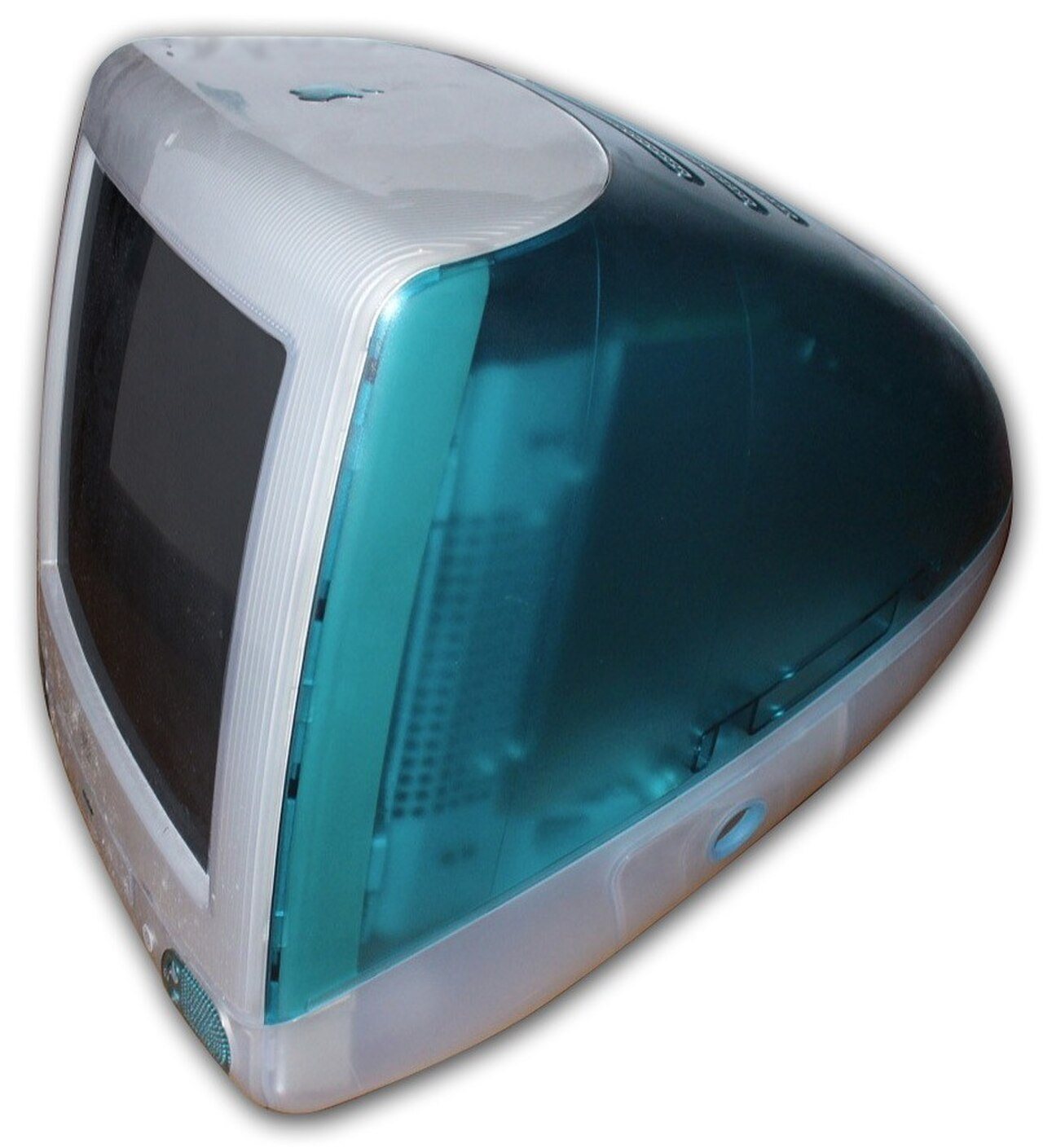
Ten months later, a translucent blue computer shaped like a gumdrop went on sale for $1,299. Within six weeks, Apple had sold 278,000 of them. Within five months, that number was 800,000. Apple went from losing $878 million in 1997 to posting a $414 million profit in 1998, its first positive year in three. The product was the iMac G3, and it didn't just save Apple from bankruptcy. It fundamentally changed what people expected a computer to look like, how they connected their peripherals, and what an industrial designer could achieve when a company actually listened to them.
The story of how this happened is not a simple tale of good design. It's a story about organizational dysfunction, one very specific hiring decision, a bet against the floppy disk, and the moment when a consumer electronics company decided that how something looked was just as important as what it could do.
The Company Steve Jobs Came Back To
To understand why the iMac mattered, you need to understand how bad things were at Apple in 1997. The company had acquired NeXT, Steve Jobs' post-Apple venture, in February 1997 for $429 million. The stated reason was that Apple needed NeXT's operating system technology. The unstated reason was that Apple needed Steve Jobs.
Jobs returned as an "advisor" in February 1997. By July, he had effectively taken control of the company as interim CEO (he wouldn't drop the "interim" label until January 2000). What he found was a company that had lost its way so completely that it was selling over a dozen different desktop models simultaneously, many of which differed only in minor configuration details. There were Performas, Power Macintoshes, Quadras, and various other product lines that even Apple employees struggled to keep straight.
Jobs famously drew a simple four-quadrant grid on a whiteboard: Consumer and Professional across the top, Desktop and Portable down the side. Four products. That's it. Everything else would be killed. The iMac was designed to fill the Consumer Desktop quadrant, and it needed to do more than just work. It needed to make people care about Apple again.
Jony Ive Had Been There the Whole Time
Here's a detail that gets overlooked in most retellings. Jonathan Ive had been at Apple since 1992. He became head of the Industrial Design Group in 1996, a full year before Jobs returned. He had been designing products at Apple for five years, producing competent but unremarkable work, because the company's leadership had never given design a seat at the strategic table.
Jobs changed that immediately. He recognized in Ive what Apple's previous CEOs had missed: a designer who understood materials, form, and emotion at an almost obsessive level. Jobs gave Ive something he'd never had at Apple before: direct access to the CEO and the authority to lead product aesthetics without being overruled by engineering or marketing.
The iMac design process started in late 1997. Ive and his team began with a clear mandate from Jobs: this computer needed to be approachable. It needed to look like nothing else on the market. It needed to make people want to touch it.
Bondi Blue and the Death of Beige
Every personal computer in 1998 was beige. Or light gray. Or off-white. This is not an exaggeration. Walk into any CompUSA, any Circuit City, any Best Buy in the spring of 1998 and you were looking at rows of identical putty-colored boxes. Dell, Compaq, HP, Gateway: they all looked like they came out of the same factory, because functionally, they did. Industrial design in the PC industry at that point meant deciding where to put the power button.
Ive's team went in the opposite direction entirely. The iMac G3 was egg-shaped, or more precisely, a teardrop. The case was made of translucent polycarbonate plastic, colored in a shade Ive called "Bondi Blue" after the Australian beach. The inspiration came from a piece of beach glass someone on the team brought to the office during early design meetings. The team experimented with solid plastic first, but it looked cheap. Translucent plastic, with the internal components visible as shadowy shapes behind the colored shell, created something that felt alive.
Jobs initially wasn't sold on the egg shape. He warmed to it over time, reportedly won over by its playfulness. This is an important detail because it illustrates something about the Jobs-Ive dynamic that would define Apple for the next fifteen years: Ive pushed, and Jobs, despite his reputation as a dictator, was willing to be pushed when the argument was good enough.
The iMac was also an all-in-one design, with the monitor, logic board, CD-ROM drive, modem, and speakers all housed in a single enclosure. This was not new for Apple (the original Macintosh from 1984 was also an all-in-one), but it was a deliberate counter to the PC industry's trend of separate towers, monitors, and tangled cable nests. You plugged in the power cord, connected the keyboard and mouse, and you were done. Apple's marketing leaned into this with the famous "three steps" ad: plug in, connect to the internet, there is no step three.
The Floppy Drive That Wasn't There
The iMac shipped without a floppy drive. In 1998, this was seen as borderline insane.
The 3.5-inch floppy disk had been the primary method of moving files between computers since the mid-1980s. Removing it from a consumer product, one explicitly targeted at home users and first-time computer buyers, struck many critics as arrogant. One reviewer called it "an astonishing lapse from Jobs." The reaction in tech media was sharp. How were people supposed to transfer files? What about all their existing floppies?
Jobs' counterargument was that the floppy was already obsolete, even if people hadn't realized it yet. The iMac included a 56k modem and an Ethernet port. Email attachments and network file sharing were the future. Writable CDs were coming. And the floppy's 1.44MB capacity was increasingly inadequate in a world of multi-megabyte files.
He was right, but the timing was aggressive. In 1998, most American households still had dial-up internet, if they had internet at all. Sending a file via email meant waiting minutes for an upload. The practical reality was that for many buyers, the lack of a floppy drive was genuinely inconvenient. Third-party USB floppy drives became a popular accessory for iMac owners, which is both an indictment and a validation of Jobs' bet: people bought the computer anyway, and the market for external floppy drives dried up within two years.
USB: The Port Nobody Cared About Until Apple Made Them
The iMac's other controversial hardware decision turned out to be even more significant in the long run. It had two USB 1.1 ports and nothing else for peripherals. No ADB ports (Apple's proprietary standard). No serial ports. No SCSI. No parallel. Just USB.
USB had been introduced in 1996 as a joint standard by Compaq, DEC, IBM, Intel, Microsoft, NEC, and Nortel. By 1998, it had been available for nearly three years and almost nobody was using it. PC manufacturers included USB ports on their machines but also kept all the legacy ports, so there was no incentive for peripheral makers to switch. It was a chicken-and-egg problem that the industry had been unable to solve for three years.
Apple solved it in a single product launch. The iMac had USB and nothing else. If you wanted to sell a printer, a scanner, a mouse, a keyboard, or any other peripheral to iMac owners, it had to be USB. What the entire PC industry couldn't accomplish in three years of gradual adoption, Apple accomplished overnight by simply removing the alternative.
Within months, the peripheral market transformed. USB devices flooded store shelves. And because USB was a universal standard, those devices worked with PCs too. The iMac didn't just popularize USB for Mac users. It catalyzed USB adoption for the entire computing industry. Every USB device you've ever plugged into a computer owes a small debt to a translucent blue gumdrop from 1998.
The Sales Numbers That Saved a Company
The iMac went on sale August 15, 1998. It was the number one selling desktop computer in American retail stores for its first three months. The 278,000 units sold in the first six weeks represented the strongest launch Apple had seen in years. A significant percentage of buyers, approximately 32% according to Apple's own surveys at the time, were first-time computer owners or people switching from Windows. The iMac was bringing entirely new customers into the Apple ecosystem.
Apple's fiscal year 1998 results told the story in financial terms. Revenue stabilized. The $878 million loss of 1997 flipped to a $414 million profit. The stock price, which had been in free fall, began its long climb upward. The iMac did not accomplish all of this alone (Jobs also slashed the product line, cut costs, and renegotiated distribution deals), but it was the centerpiece. It was the product that proved Apple could still make something people wanted.
Five Flavors and the Design Revolution
In January 1999, Apple replaced the original Bondi Blue iMac with five new colors: Blueberry, Strawberry, Tangerine, Grape, and Lime. This was not just a refresh. It was a statement about what computers could be. Personal computers had been sold as tools, like office equipment. The "fruit colors" iMac was being sold as a lifestyle product, something you chose because it reflected your personality.
The impact on the broader industry was immediate and, in retrospect, kind of funny. Within a year, translucent plastic started appearing everywhere. George Foreman grills, staple guns, desk lamps, alarm clocks, and yes, competing PCs all suddenly came in translucent blue, green, and orange. The trend was so pervasive that it became a visual shorthand for "late 1990s design." Ive and his team had created a design language so compelling that it leaked out of the computer industry entirely.
The iMac G3 continued to evolve through 2003, cycling through slot-loading drives, faster processors, new form factors, and increasingly creative color options (Graphite, Ruby, Sage, Indigo, Snow, Flower Power, Blue Dalmatian). The Flower Power and Blue Dalmatian models, released in 2001, are widely regarded as the low point of the line's design. Even great designers miss sometimes.
What the iMac G3 Actually Meant
The iMac G3's significance extends well beyond Apple's balance sheet. It established several principles that would define the next two decades of consumer electronics.
First, it proved that design could be a primary differentiator in technology products. Before the iMac, the conventional wisdom in the PC industry was that consumers bought on specs and price. The iMac demonstrated that a significant number of people would pay a premium for something that looked good and felt different. This insight would drive Apple's entire product strategy going forward, from the iPod to the iPhone to the Apple Watch.
Second, it showed that removing features could be as important as adding them. The no-floppy-drive decision was the prototype for Apple's later moves: removing the optical drive from the MacBook Air in 2008, removing the headphone jack from the iPhone 7 in 2016, removing ports from the MacBook in 2015. Not all of these decisions were equally justified, but the playbook was established with the iMac.
Third, it demonstrated that a single product could change a company's trajectory. Apple in early 1998 was a company most analysts expected to fail. Apple in early 1999 was a company with momentum, cash, and a design identity that made it the most talked-about brand in tech. One product did that. One translucent, floppy-drive-lacking, USB-only computer shaped like an egg.
Look, the iMac G3 wasn't a perfect machine. The original Bondi Blue model had a tray-loading CD-ROM drive that was prone to jams. The 233 MHz G3 processor was adequate but not exceptional. The 15-inch CRT display was standard for the era but nothing special. The built-in speakers were mediocre. As a pure computer, evaluated on specifications alone, there were better options available for $1,299 in 1998.
But that misses the point entirely. The iMac wasn't selling specifications. It was selling the idea that a computer could be delightful, that technology could have personality, that the object sitting on your desk could make you feel something beyond utilitarian satisfaction. That was the insight that saved Apple. And it started with a piece of beach glass, a stubborn designer, and a CEO who, for once, was willing to listen.
Frequently Asked Questions
When did the iMac G3 come out?
Steve Jobs unveiled the iMac G3 on May 6, 1998, and it shipped to customers on August 15, 1998. The original model came only in Bondi Blue. Five new colors (Blueberry, Strawberry, Tangerine, Grape, and Lime) were introduced in January 1999.
How much did the iMac G3 cost?
The original iMac G3 launched at $1,299. This was significantly cheaper than most comparably equipped Macintosh models at the time, which typically cost around $2,000 or more. The lower price point was central to its strategy of attracting first-time computer buyers.
Why didn't the iMac G3 have a floppy drive?
Steve Jobs argued that the floppy disk's 1.44MB capacity was already obsolete. The iMac included a modem and Ethernet for file transfer. The decision was controversial at the time but accelerated the industry's shift away from floppy disks. Third-party USB floppy drives were available for users who still needed one.
Did the iMac really save Apple?
It played a critical role. Apple went from losing $878 million in 1997 to earning a $414 million profit in 1998. The iMac sold 800,000 units in its first five months and was the top-selling desktop in US retail for three consecutive months. Combined with Jobs' restructuring of Apple's product line and operations, the iMac gave the company the financial breathing room and brand momentum it needed to survive.
Who designed the iMac G3?
Jonathan (Jony) Ive led the design as head of Apple's Industrial Design Group. Ive had been at Apple since 1992 but only gained significant creative authority after Steve Jobs returned in 1997. The iMac was the first major product of the Jobs-Ive collaboration that would define Apple's design language for the next two decades.
Why was the iMac G3 called "Bondi Blue"?
The color was named after Bondi Beach in Sydney, Australia. Jony Ive's design team was inspired by a piece of blue-green beach glass brought to the office during early design sessions. The translucent polycarbonate case was chosen because solid plastic prototypes looked cheap, while the see-through material created a sense of depth and personality.