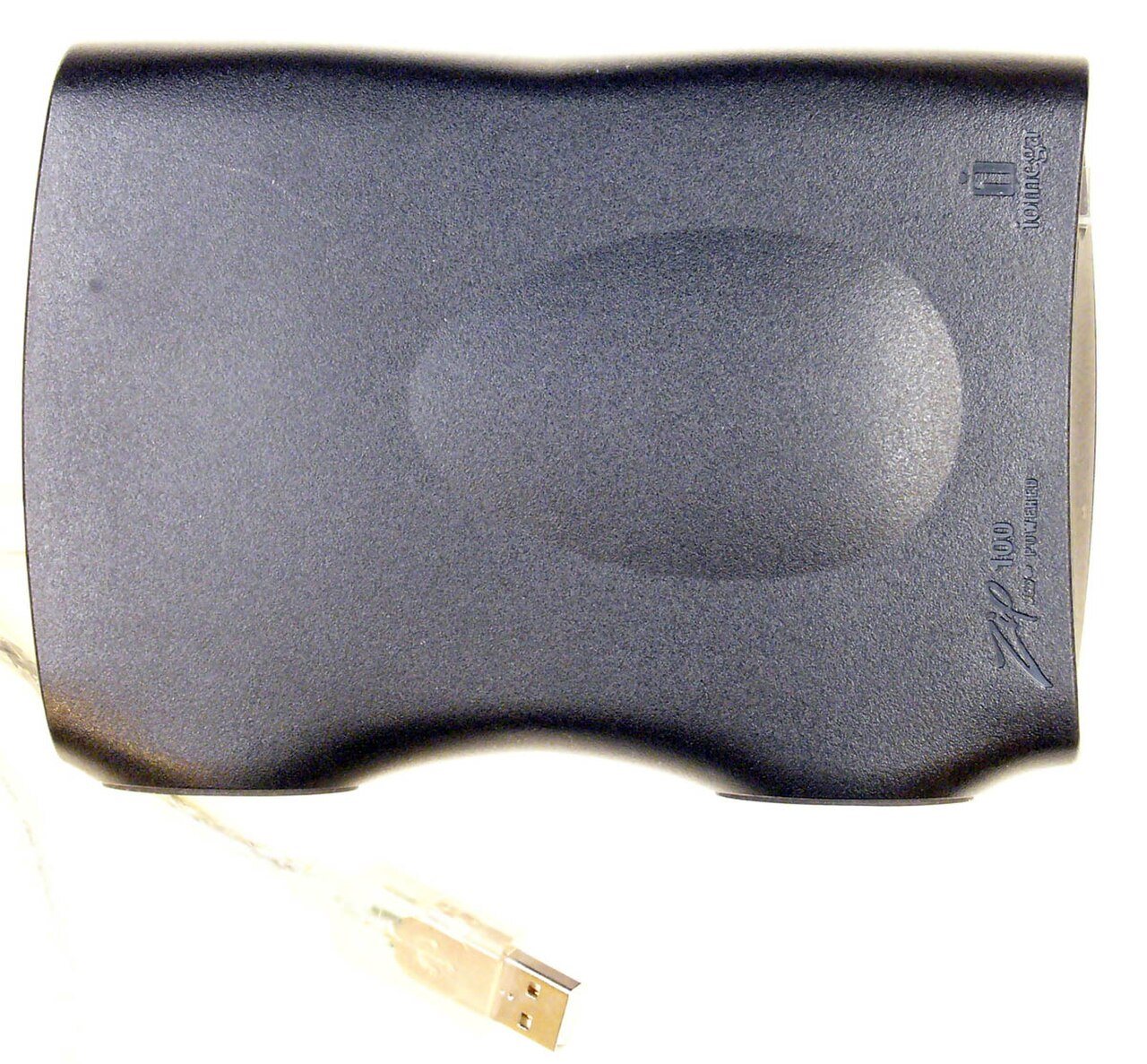
What did an Iomega Zip drive cost in 1995?
Iomega shipped the Zip 100 in March 1995 at $199 for the drive, with 100MB disks at $19.95 each. A standard floppy disk held 1.44MB, so one Zip disk did the work of roughly seventy of them.
The company behind it was not new. Iomega was founded on April 1, 1980 in Roy, Utah, and spent the 1980s selling the Bernoulli Box, a removable cartridge drive introduced in 1982 that found buyers in publishing and CAD work but never in living rooms.
The Zip drive was the first Iomega product a college student could afford. Design files, project folders and early MP3 collections moved between machines on one cartridge, at a time when email attachments were capped at a few megabytes and CD burners were studio equipment.
Sales followed at once. Iomega reported $362 million in revenue in 1995, the launch year. By the fiscal 1998 annual report it filed with the Securities and Exchange Commission, the company counted more than 21 million Zip drives shipped.
How did Iomega reach a $7 billion valuation?
Kim Edwards became president and chief executive of Iomega in January 1994 and backed the Zip project. The numbers that followed were the kind Wall Street builds legends on.
Revenue went from $362 million in 1995 to $1.2 billion in 1996, and to $1.7 billion in 1997, the figure Forbes used in its 1998 profile of Edwards. Market value moved the same way, from roughly $300 million in 1995 to nearly $7 billion by May 1996.
Iomega became one of the most heavily traded stocks of the mid-1990s and an early case of retail-investor mania, years before anyone used the phrase meme stock. Message boards traded tips on it the way they would trade tips on anything else twenty years later.
The peak did not hold. Edwards resigned under pressure in 1998, shortly after Iomega said it would report a first-quarter loss, ending a four-year run in which annual sales had gone from under $150 million to more than a billion. It is the same shape of story as Kodak losing the market it invented, compressed into three years instead of thirty.
What caused the Zip drive Click of Death?
The phrase was in print by January 1998. A failing Zip drive made a steady click as its read/write head hunted for track zero, struck its end stops, and came back misaligned.
The mechanism was cheap and clever. A linear actuator slid the head along a single thin steel rod on two sleeve bearings, and a small doughnut-shaped foam washer at the end of that rod cushioned the stop when power was cut. On drives built over a period of several months, that washer was left out to save production cost.
Without it, a sudden stop could damage the fragile suspension holding the head. A damaged drive then wrote bad alignment onto a disk, and that disk could misalign the head in the next drive it was pushed into. The fault spread from machine to machine, which is what turned an ordinary manufacturing defect into a story.
Steve Gibson of Gibson Research Corporation documented the problem in 1998 and reached a blunt conclusion: "Since the true cause of Click Death is a physically, electrically, or mechanically defective Zip or Jaz drive, the only possible 'cure' is the replacement of that drive."
Did Iomega get sued over the Click of Death?
Yes. A class action was filed in 1998 in the Superior Court of the State of Delaware, New Castle County, as Rinaldi v. Iomega Corp. The plaintiffs alleged that the drives and disks carried "a manufacturing and/or design defect" that caused failures and destroyed stored data.
Iomega's public position was that the problem was rare. By early 1999 the company said the Click of Death had affected "fewer than half of 1 percent of all Jaz and Zip users." Owners who had lost a thesis or a client's artwork did not find that figure reassuring.
The settlement arrived in 2001. As the Deseret News reported in April of that year, every United States customer who bought a Zip drive between January 1, 1995 and March 19, 2001 became eligible for rebates on Iomega products, plus free technical support for clicking problems and a donation of Iomega products and services to schools. Iomega admitted no wrongdoing.
The scale was unusual for a consumer hardware case. Plaintiffs' counsel said the suit involved more than 150,000 Iomega technical documents, and the class reached as many as 28 million Zip drive buyers.
What replaced the Zip drive?
Cheaper optical media came first. A blank CD-R held 650 to 700MB and read in any CD-ROM drive, and once CD-RW burners hit consumer prices in the late 1990s, a 100MB cartridge stopped making sense.
Iomega's own filings track the fall. Sales of Zip products were $984.8 million in 2000, down 18.1 percent from $1,202.6 million in 1999. Zip drive revenue alone fell 19.7 percent to $571.7 million, with units shipped down 27.8 percent. The company attributed the drop to lower Zip and Jaz sales, partly offset by its own CD-RW business.
Bigger cartridges did not rescue it. The Zip 250 arrived in 1999 at $199 and the Zip 750 in 2002 at $180, both after the market had moved on. USB flash drives then removed the last reason to own one: no drive to install, no cartridge, no clicking.
It was the trap that also caught Sony's MiniDisc. A proprietary cartridge with a licensing model loses to an open disc that costs pennies, however good the engineering is.
Is Iomega still in business in 2026?
No. Iomega does not exist as an independent company, and no product sold in 2026 carries the name. EMC Corporation announced its purchase on April 8, 2008: a cash tender offer of $3.85 a share, worth about $213 million, folding Iomega into a new consumer and small business division.
The name survived five more years. In 2013, EMC's joint venture with Lenovo rebranded the remaining network storage line as LenovoEMC, and that line was discontinued in 2018. EMC itself merged with Dell in 2016, so whatever is left of Iomega sits inside Dell Technologies today.
The hardware outlasted the company. Wikipedia dates the Zip range from 1995 to 2003, while the Museum of Obsolete Media puts the end of the Zip 250 and Zip 750 at 2006.
Where to find one today. Working Zip hardware still circulates among collectors: USB and parallel port externals, internal ATAPI units, and sealed boxes of 100MB disks. Buy a drive with its original power supply and cable, because the externals use a specific adapter and a bare unit is close to useless without it. Sellers list both drives and media on Etsy. Prices move with interface and condition rather than with any fixed rate, so compare several listings, and treat an untested drive as a gamble given the defect above.
Frequently Asked Questions
Is Iomega still in business in 2026?
Iomega is not in business as an independent company in 2026. EMC Corporation bought Iomega in April 2008 for about $213 million, the brand was replaced by LenovoEMC in 2013, that product line was discontinued in 2018, and EMC merged with Dell in 2016, leaving the remnants inside Dell Technologies.
What was the Zip drive Click of Death?
The Click of Death was a failure mode in Iomega Zip drives, named in print by January 1998, in which a misaligned read/write head struck its end stops and clicked. A defective Zip drive could damage a disk, and that disk could then misalign the head in the next drive, so the fault spread between machines.
How much did an Iomega Zip drive cost?
The Iomega Zip 100 drive launched in March 1995 at $199, with 100MB Zip disks at $19.95 each. Iomega later sold the Zip 250 in 1999 for $199 and the Zip 750 in 2002 for $180, both after CD-RW burners had undercut the format.