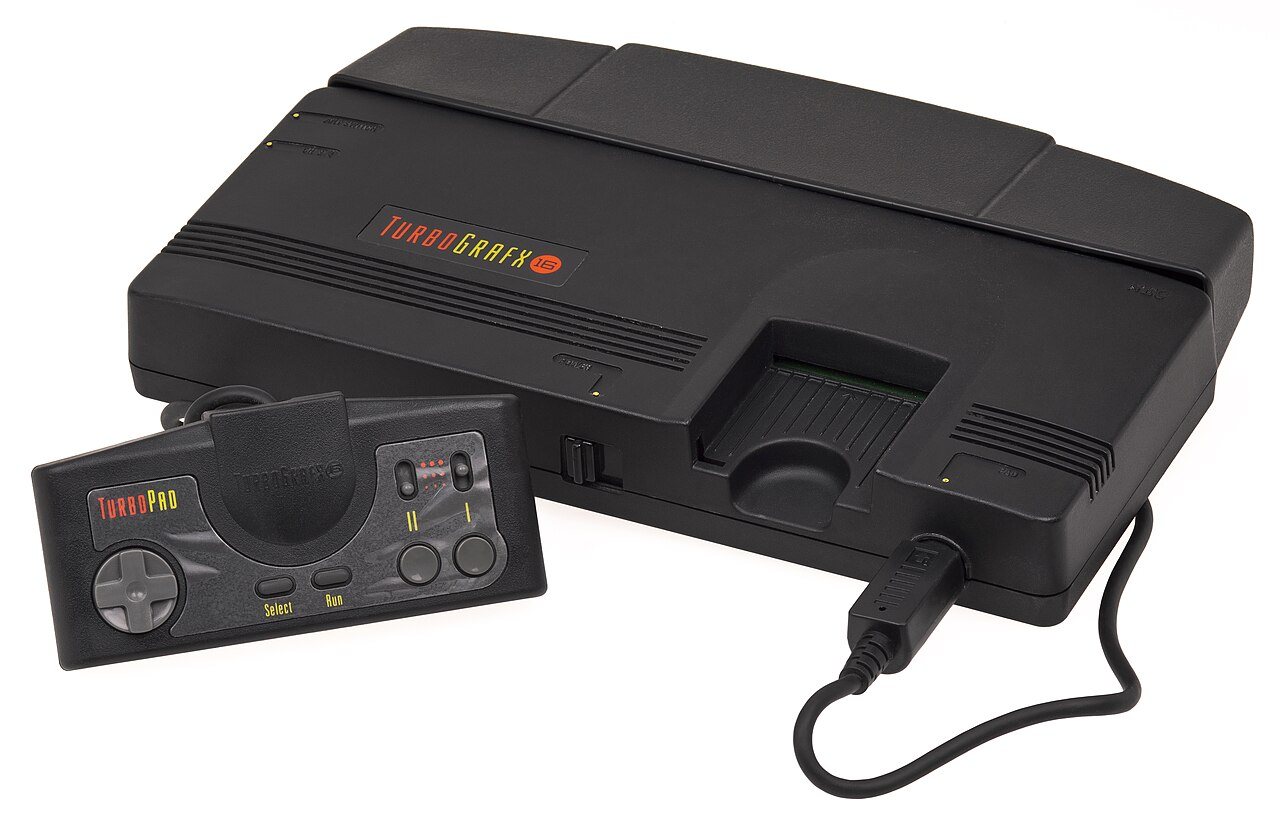
Picture this: 1989. You are 12 years old, you are standing in a Babbage's in a suburban mall, and you are looking at three boxes on the shelf. There is the Nintendo Entertainment System, which you already own, which everyone owns, and which is starting to feel a little stale because Super Mario Bros. 3 is still six months away. There is the brand-new Sega Genesis, which has Altered Beast in the box and a logo that says BLAST PROCESSING in letters so loud your eyes hurt. And there is this third thing. A small white slab the size of a paperback novel. The price tag says $199.95. The box says TurboGrafx-16 and below that, in tiny letters, it says by NEC and Hudson Soft.
You have never heard of NEC. You have never heard of Hudson Soft. The kid behind the counter at Babbage's has never heard of NEC or Hudson Soft either, and when you ask him what the games are like, he shrugs and points at a single demo cartridge labeled Keith Courage in Alpha Zones. You have also never heard of Keith Courage.
Reader, in the United States, you did not buy that console. Almost nobody did. Meanwhile, in Japan, the exact same machine had been the best-selling system in the country for two straight years. It had outsold the Famicom in stores. It had a CD-ROM attachment a full year before anyone in America knew what a CD-ROM attachment was. It had the most beloved shoot em up library of its generation. And in the United States, the entire run got compressed into a launch nobody remembers.
This is the story of the TurboGrafx-16. A machine that conquered Japan, fumbled America so hard it took 30 years to recover its reputation, and quietly invented half the stuff we now take for granted in console gaming. Pull up a chair. This one hurts.
Two Companies Walk Into a Bar: NEC, Hudson, and the Japanese 8-Bit Wars
To understand the TurboGrafx-16 you have to understand who built it, because the name on the box tells you almost nothing. NEC, or Nippon Electric Company, was one of the largest electronics conglomerates in Japan. They made PCs, monitors, semiconductors, and pretty much anything else that ran on electricity. They had basically zero experience making consumer game consoles. Hudson Soft, on the other hand, was one of the most successful third-party game developers in Japan, founded by brothers Yuji and Hiroshi Kudo in 1973 as a telecommunications company before they pivoted into games. Hudson made Bomberman. Hudson made Adventure Island. Hudson, crucially, was one of the very few outside companies that Nintendo allowed to develop for the Famicom.
By the mid-1980s, Hudson had designed a custom graphics chip they called the HuC6270, and they wanted to put it in a console. Nintendo, dominant and content, was not interested. Hudson took the chip to NEC. NEC had the manufacturing capacity and the retail relationships. Hudson had the technical chops and the game development pipeline. They shook hands, and on October 30, 1987, they launched the PC Engine in Japan.
The PC Engine, in Japan, was tiny. Roughly five inches square. White. Beautiful in a way that the Famicom never tried to be. Inside it had an 8-bit Hudson HuC6280 CPU running at 7.16 MHz, paired with a 16-bit graphics processor that could push 482 colors on screen from a palette of 512. To gamers in 1987 who had spent four years staring at the Famicom's color palette, the PC Engine was a generational leap. Games looked like arcade games. Sprites moved like arcade sprites. It made the Famicom look exactly as old as it was.
Japan responded the way you would expect. The PC Engine sold roughly 500,000 units in its first week. By 1989, NEC had moved 1.2 million PC Engines in Japan and more than 80,000 of an accessory you have never heard of called the CD-ROM2, the world's first CD-ROM gaming attachment. It outsold the Famicom in some Japanese months. Sega's Mega Drive, released in October 1988, was the third-place machine in its home country, behind the PC Engine in second and the Famicom in first. For a stretch, NEC and Hudson absolutely cooked.
That was the world the PC Engine lived in. Now we cross the Pacific.
How NEC Decided to Take on America
Here's where it all falls apart. By 1988, NEC was looking at this enormous hit they had on their hands in Japan and thinking, naturally, that they should bring it to the United States. The math seemed obvious. Sega was about to launch the Genesis in North America in August 1989. Nintendo was still milking the NES and would not have a 16-bit answer until the SNES landed in 1991. There was a window of nearly two years where there would be exactly two next-generation consoles fighting for the American living room. NEC wanted to be one of them.
So they redesigned the box. The Japanese PC Engine was a delicate, palm-sized, mostly-white machine that looked like a fancy stereo component. NEC's American marketing team took one look at that and decided no, American children do not want delicate. They want big and black and aggressive. So the TurboGrafx-16 was completely re-housed in a much larger black chassis, three times the size of the Japanese original. Same guts. Different shell. Marketing people thought it would sell better next to the big black Sega Genesis on a Toys R Us shelf.
They also renamed it. The PC Engine became the TurboGrafx-16. The 16 in the name was a reference to the 16-bit graphics processor, not the 8-bit CPU. Sega Genesis was openly advertising itself as a 16-bit machine on the strength of its 16-bit Motorola 68000 CPU. NEC wanted parity in the spec war on the side of the box, so they led with the 16 and quietly did not mention the rest. To a 12-year-old in line at Toys R Us, this was a real argument. The TurboGrafx-16 looked, in marketing terms, like an apples-to-apples competitor to the Genesis.
NEC of America, based in Chicago, was convinced it had a hit. So convinced, in fact, that they manufactured 750,000 units before launch. That was the bet. Three quarters of a million machines ready to ship for the 1989 holiday season.
NEC believed the TurboGrafx-16 was going to be the Genesis-killer. Sega believed the Genesis was going to be the Nintendo-killer. Nintendo, watching all of this from Kyoto, calmly kept printing money on the NES.
August 1989: The Two-Week Head Start That Mattered
The TurboGrafx-16 launched in test markets in New York City and Los Angeles in late August 1989. The Sega Genesis launched in those same test markets in mid-August 1989. Sega beat NEC to the punch by roughly two weeks. The wider US rollouts followed in the months after.
Two weeks does not sound like much. Two weeks is everything. By the time the TurboGrafx-16 hit New York shelves, Sega had already plastered the city with Genesis advertising. Magazines had already run their Genesis launch reviews. Babbage's clerks had already developed an opinion about which 16-bit console was the cool one. The 16-bit console war in America had a narrative before the TurboGrafx-16 had a press release.
And then NEC made the pack-in decision.
Sega launched the Genesis with Altered Beast, which was a port of a 1988 arcade game that everybody had played. Walk into an arcade in 1988, you saw an Altered Beast cabinet. You heard the digitized voice yelling "WELCOME TO YOUR DOOM." You shoved quarters into it. When you opened the Genesis box and Altered Beast was inside, you knew exactly what you were getting and exactly why it was cool. The arcade was on your TV.
NEC launched the TurboGrafx-16 with Keith Courage in Alpha Zones, a side-scrolling action game from Hudson Soft. Keith Courage was actually a localization of Mashin Eiyuden Wataru, an anime tie-in based on a kids' robot anime that had been hugely popular in Japan in 1988. In Japan, every kid recognized Wataru. In the United States, nobody had ever heard of Wataru. The localized version replaced the anime references with generic American sci-fi window dressing, and the result was a competent but anonymous platformer with a hero in a robot suit. Nobody in America walked out of Babbage's saying, "Did you see Keith Courage in Alpha Zones? I have to have this console."
This is the part where it all falls apart, by the way. Sega's choice was a known quantity. NEC's choice was a brand new IP nobody recognized. In a head-to-head purchase decision at the point of sale, the parent in the store had no reason to pick the TurboGrafx-16. The kid had no reason either. Six months in, NEC had sold a fraction of those 750,000 units it had pre-manufactured.
The CD Add-On That Was a Year Too Early
By 1990, the TurboGrafx-16 was already in trouble in the US. NEC's response was to roll out the technology that had crushed Japan in 1988: the CD-ROM attachment.
In December 1988, NEC and Hudson had released the CD-ROM2 in Japan for 57,300 yen, which was roughly $460 at the exchange rate of the time. It was, full stop, the first commercially released CD-ROM gaming attachment in the world. Genesis CD would not arrive until 1991, and the PlayStation 1 would not exist for another six years. The CD-ROM2 had games with full-motion video, redbook audio (which is a fancy way of saying actual recorded music coming off the disc, no chiptune), and voice acting. Ys Book I and II, the Falcom RPG, became one of the most-praised games of its generation because of what the CD format unlocked. People in Japan in 1989 were hearing voice acted RPG cutscenes in their bedrooms while American kids were still listening to MIDI versions of the Super Mario Bros. theme.
NEC brought the same technology to America as the TurboGrafx-CD in late 1989 and into 1990. The price was $399.95 for the add-on, on top of the $199.95 for the base console. That is roughly $950 in today's money, just to get a TurboGrafx-16 with a CD drive. For a 12-year-old in 1990 with a paper route, this was not a discretionary purchase. This was a college fund expenditure.
The technology was real. The library was real. Lords of Thunder, Gate of Thunder, the localized version of Ys Book I and II, all of these were genuine system sellers. But the price point made it a hobbyist machine in the United States. The CD player on the TurboGrafx-CD also doubled as a regular audio CD player, which NEC's marketing emphasized heavily. To no avail. Sega CD launched in 1992 at a similar price and bombed for the same reason. CD gaming in the early 1990s was a luxury hobby in the West. In Japan, where consumer electronics adoption ran faster and PCs were less common in homes, CD-ROM consoles were a different story.
HuCards, the Forgotten Format
The other thing that made the TurboGrafx-16 special, and that NEC barely marketed in the US, was the cartridge format. The PC Engine and TurboGrafx-16 did not use cartridges in the traditional sense. They used HuCards, which were credit-card-sized memory cards roughly the thickness of three quarters stacked together. You slid them into a slot on the top of the console. They were beautiful pieces of plastic engineering, and they were much cheaper to manufacture than NES or Genesis cartridges.
For a kid who had grown up shoving fat plastic NES cartridges into a toaster slot, the HuCard was a moment. You could fit ten or twelve HuCards in a CD case. You could fit a HuCard in your wallet. Visiting a friend's house with three games meant nothing more than slipping them into your jeans pocket. This is the kind of design detail that does not show up in spec sheets but lives forever in the muscle memory of people who actually used the machine.
The HuCard library on the TurboGrafx-16 in North America was much smaller than what existed in Japan. The PC Engine had several hundred HuCard releases over its lifetime in Japan. The TurboGrafx-16 in North America saw a much smaller fraction of that catalog. A staggering number of Japanese games never crossed the Pacific. Localization was expensive, the install base in the US was small, and many of the best PC Engine games were either too niche (shoot em ups) or too text-heavy (RPGs) for NEC's American team to want to invest in. A whole subculture of Japanese gaming that defined the late 1980s and early 1990s, the shoot em up renaissance and the dawn of the CD-ROM RPG, never got an English-speaking audience until the homebrew scene started translating them decades later.
The TurboExpress: Portable Gaming Before It Was Ready
In 1990, NEC did something nobody had ever done. They released the TurboExpress, a fully functional portable TurboGrafx-16 that played the same HuCards as the home console. Same chip. Same compatibility. A small color LCD. The launch price in the US was $249.99.
Think about that for a second. In 1990, you could put a Bonk's Adventure HuCard into a handheld and play the exact same game you would have played on the home console, in full color, on a screen the size of a 3 by 5 index card. This was witchcraft. The Game Boy was monochrome. The Lynx had its own custom library and a tiny install base. The TurboExpress was just the home console you could throw in a backpack.
It also chewed through six AA batteries in just a few hours, and the $249.99 launch price was roughly $605 in today's money, and the screen was so prone to dead pixels that the issue became infamous. Of course it failed commercially. But it was the first time anyone had pulled the trick of bringing a home console to a handheld form factor with full game compatibility, and the entire idea of "this is the same console, just smaller" was the road map Nintendo would eventually use for the Switch, Sony for the Vita, and Valve for the Steam Deck.
The TurboExpress, the TurboGrafx-CD, HuCards, the TurboGrafx-16 itself, all of these things in NEC's American lineup told the same story. Genuinely innovative hardware. Genuinely mispriced. Genuinely under-marketed. Genuinely too early.
The Final Years: Duo, Renaming, and Quiet Retreat
By 1992, NEC of America was openly losing the war. The Genesis was the cool 16-bit console. The Super Nintendo had finally launched in 1991 and was eating into the Sega install base. Nintendo and Sega were running multi-million-dollar Saturday morning cartoon ad campaigns at each other while NEC was running quarter-page ads in EGM magazine.
NEC tried one more swing. In 1992, they released the TurboDuo, a redesigned console that combined the TurboGrafx-16 and TurboGrafx-CD into a single chassis. It came with a stack of pack-in games. Ys Book I and II, Bonk's Adventure, Bonk's Revenge, Gate of Thunder, and others were bundled on a single CD called Super CD-ROM2. For somebody who walked into a store in 1992 with no prior knowledge of the platform, the TurboDuo was an excellent value. The games were great. The hardware was clean. The marketing was nonexistent.
By March 1991, NEC had sold roughly 750,000 TurboGrafx-16 consoles in the United States, which sounds like a lot until you remember that Sega had moved millions of Genesis units in roughly the same window. By 1994, NEC of America was effectively winding down its game console business. Continuing operations were handed off to Turbo Technologies Inc., a joint venture between NEC and Hudson, which kept the lights on for the dwindling install base.
The Japanese PC Engine kept going much longer. NEC released the PC-FX, a 32-bit successor, in Japan in 1994 to compete with the PlayStation and Saturn. It flopped hard. The era ended quietly. By the late 1990s, NEC and Hudson had both moved on. Lifetime sales in Japan for the PC Engine ecosystem and its add-ons hit roughly 11 million. Lifetime US sales, counting the TurboGrafx-16, TurboDuo, and TurboGrafx-CD together, came in at around 2.6 million according to industry estimates. For comparison, the Sega Genesis sold roughly 30 to 35 million units worldwide. The SNES sold roughly 49 million. The TurboGrafx-16 was the third console of the 16-bit generation in America, and the gap between third and second was a chasm.
Why It Lost: A Plain English Postmortem
People love to argue about why the TurboGrafx-16 failed in America, and the answers are messy because every step had a different villain. Here is what actually killed it, in order of damage:
1. NEC of America was the wrong team. The Chicago office had been NEC's PC hardware division. They had no experience selling consumer game consoles to American children, and it showed. The redesigned chassis was uglier. The advertising was anemic. The retail relationships were weak. By the time NEC of America understood the consumer gaming market, the war was already lost.
2. Sega's two-week head start. The Sega Genesis hit North American test markets in August 1989, two weeks before the TurboGrafx-16. Sega had Altered Beast in the box and a marketing budget Sony would later try to copy. By the time the TurboGrafx-16 launched, Sega had already defined what 16-bit meant in the American imagination.
3. The pack-in disaster. Keith Courage in Alpha Zones versus Altered Beast was not a fair fight. Sega was selling an arcade game your friend had played. NEC was selling a localized version of an anime nobody had heard of.
4. Software gap. The PC Engine had hundreds of titles in Japan. The TurboGrafx-16 in America had a much smaller fraction. The genres that defined the PC Engine, shoot em ups and CD-ROM RPGs, were exactly the genres American mainstream gaming was not ready for in 1990.
5. Pricing on the add-ons. The TurboGrafx-CD was $399.95 in 1990. The TurboExpress was $249.99 the same year. Both were great products. Both were priced for adults with disposable income, in a category that was overwhelmingly bought by parents for kids.
Pick whichever one you like. The honest answer is all five mattered, and they compounded. The TurboGrafx-16 did not fail because it was bad. It failed because it never had a clear identity in America the way it did in Japan, and the people running the American operation never figured out how to give it one.
The Legacy: Mini, Revival, and the Long Quiet
For roughly two decades, the TurboGrafx-16 was the forgotten console. Mention it to most American gamers born after 1985 and you got blank stares. Mention it to gamers in Japan and you got a small smile, because the PC Engine in Japan is remembered the way the SNES is remembered in America. A formative platform with a beloved library.
In 2020, Konami, which had absorbed the Hudson Soft library through its 2011 buyout and 2012 merger of Hudson into Konami Digital Entertainment, released the TurboGrafx-16 Mini in North America. It included a curated mix of HuCard and CD-ROM2 titles, including most of the PC Engine library Americans had never been allowed to play in 1989. The Mini was a quiet success. Retailers sold out. Collectors paid scalpers. The reviews were genuinely affectionate. A generation of younger gamers played Castlevania: Rondo of Blood, Dracula X, Snatcher, Soldier Blade, and finally understood what their older friends had been telling them for 30 years.
The Mini sold out and was not heavily restocked. As of 2026, the TurboGrafx-16 Mini is itself a collector's item. A retro reissue of a retro console that already had a retro reputation. Layers on layers.
The PC Engine in Japan is remembered the way the SNES is remembered in America. The TurboGrafx-16 in America is remembered as the box you saw on the shelf next to the Genesis and never picked up. Same machine. Two completely different stories.
What the TurboGrafx-16 Tells Us About Console Wars
You can win in Japan and lose in America with the same machine. You can have the better tech and the worse marketing and lose. You can be first to CD-ROM and lose. You can have the better library in Japanese and lose because you never translated half of it. The console wars are not won by the better console. They are won by the better product, where product means the box plus the games plus the marketing plus the retail plus the pack-in plus the price plus the brand plus everything else.
NEC shipped a great machine. NEC also shipped a redesigned chassis nobody loved, a pack-in game nobody recognized, and an add-on priced like a college textbook. Sega shipped a great machine and a marketing campaign that defined a generation. Two great machines, two wildly different fates.
The TurboGrafx-16 deserved better in America. Anyone who actually played it in 1990, anyone who unboxed a TurboDuo on Christmas 1992, anyone who heard the redbook audio score of Ys Book I and II in 1991 and thought wait, this is a video game, will tell you the same thing. The machine was real. The library was real. The history just got compressed into a footnote because the people selling it in Chicago did not know how to sell it.
Frequently Asked Questions About the TurboGrafx-16
When did the TurboGrafx-16 launch? The system launched in Japan as the PC Engine on October 30, 1987. NEC brought it to North American test markets in New York City and Los Angeles in late August 1989 as the TurboGrafx-16, with a wider US rollout in the months after. Launch retail price in the United States was $199.95.
Was the TurboGrafx-16 really 16-bit? Partially. The CPU, a Hudson HuC6280, was 8-bit and ran at 7.16 MHz. The graphics processor, the HuC6270, was 16-bit. NEC marketed the machine as 16-bit on the basis of the graphics chip, which let them compete with the Sega Genesis's 16-bit Motorola 68000 CPU on the spec sheet at retail.
How many TurboGrafx-16 units were sold in the United States? NEC reported approximately 750,000 TurboGrafx-16 consoles sold in the US by March 1991. Lifetime US sales including all variants, the TurboGrafx-CD, TurboDuo, and other repackaged editions, are estimated at roughly 2.6 million. By comparison, the Sega Genesis sold about 30 to 35 million units worldwide.
How did the TurboGrafx-16 do in Japan? Spectacularly. The PC Engine sold roughly 500,000 units in its first week in Japan and outsold the Famicom in stores during peak months. Total PC Engine ecosystem sales in Japan, including add-ons and variants, reached roughly 11 million units over the lifetime of the platform.
What was the TurboGrafx-CD? The TurboGrafx-CD was a CD-ROM attachment for the TurboGrafx-16, launched in North America around 1990 at $399.95. It was the first commercially released CD-ROM gaming attachment in the United States. The Japanese version, the CD-ROM2, had launched in December 1988, making it the first CD-ROM console add-on in the world.
What was the TurboExpress? Released in 1990 at $249.99, the TurboExpress was a portable TurboGrafx-16 that played the same HuCards as the home console. It had a small color LCD, full home-console compatibility, and only a few hours of battery life on six AAs. It was the first time any console manufacturer had pulled off direct hardware portability between a home and handheld system.
What were HuCards? HuCards were the cartridge format for the PC Engine and TurboGrafx-16. Roughly the size of a credit card and the thickness of three stacked quarters, they slid into a slot on top of the console. They were cheaper to manufacture than traditional cartridges and dramatically smaller, which made trading and traveling with them much easier than NES or Genesis carts.
What was Keith Courage in Alpha Zones? The pack-in game that came with every TurboGrafx-16 sold in North America at launch. It was a localization of Mashin Eiyuden Wataru, a Hudson Soft platformer based on a Japanese kids' anime that had no recognition in the United States. The localization stripped the anime references and rebranded it as a generic sci-fi action title. It is widely considered one of the weakest pack-in decisions in console history.
Are TurboGrafx-16 games playable today? Yes. Konami released a TurboGrafx-16 Mini in 2020 with a generous bundle of preloaded games covering both the American and Japanese libraries. The original hardware is also still functional and sought after by collectors. Loose HuCards and complete-in-box games trade actively on eBay, with rarer titles like Magical Chase and Dynastic Hero commanding prices in the hundreds to low thousands of dollars depending on condition.
Who owns the TurboGrafx-16 brand today? Konami completed its acquisition of Hudson Soft in 2011 and merged it into Konami Digital Entertainment in March 2012, bringing most of the original PC Engine and TurboGrafx-16 software library under Konami's ownership. NEC's home electronics division has been spun off and restructured several times since the 1990s, but the TurboGrafx-16 brand effectively lives on through Konami's reissues and digital storefront releases.
If you grew up in America in 1990 and you walked past that small white box on the Toys R Us shelf without picking it up, do not feel bad. Most kids did the same thing. The TurboGrafx-16 was the third option in a war fought by Sega and Nintendo, and the people running its American operation never gave you a reason to choose it. But the machine inside that box was the real deal, and Japan knew it for decades before America figured it out. Better late than never.