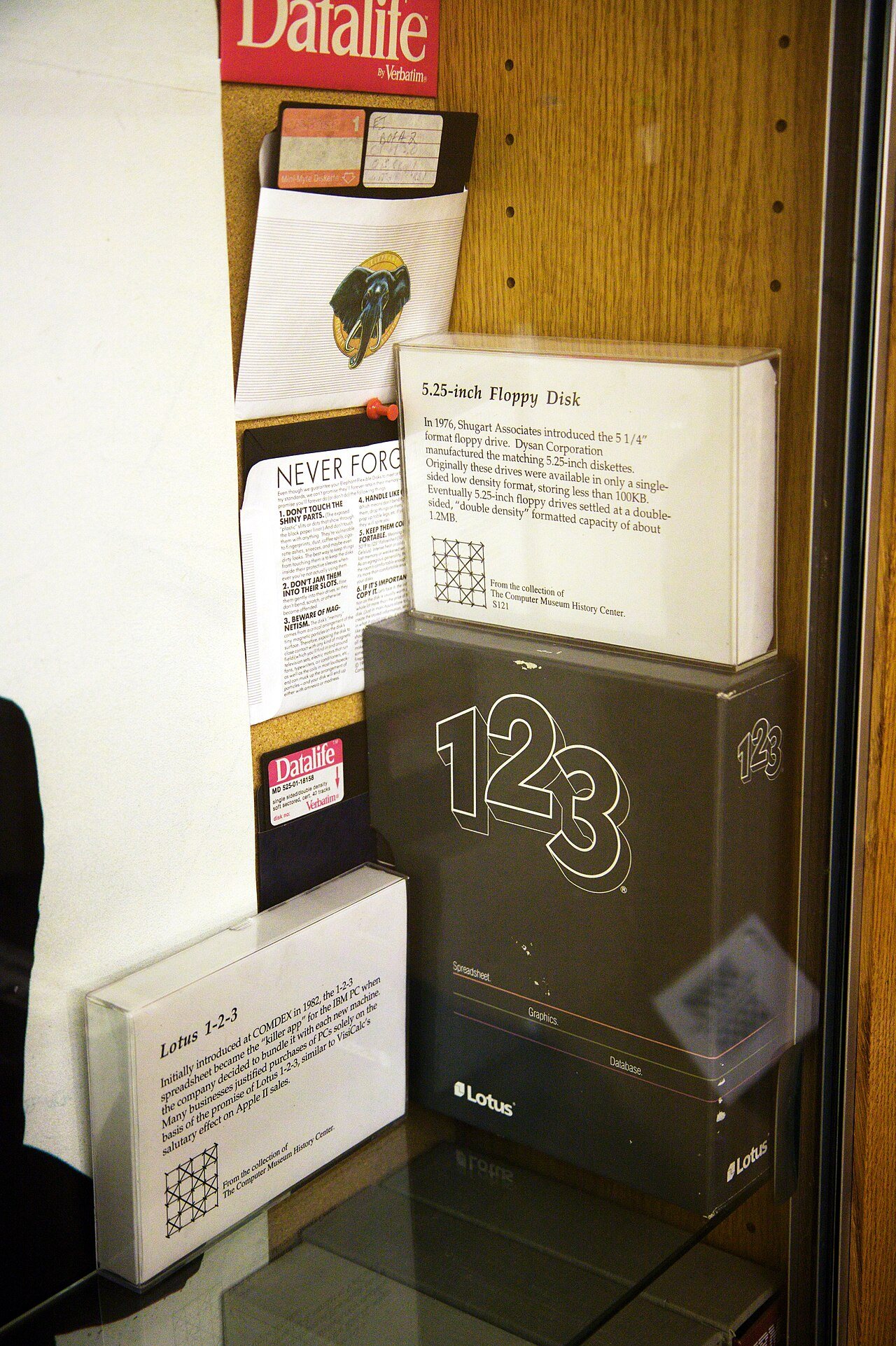
In 1983, the IBM Personal Computer was a curiosity. Businesses were buying them, but slowly, and mostly because someone in the C-suite had read an article about how computers were the future. The machines cost thousands of dollars. They ran a command-line operating system called DOS. They did not have mice. And frankly, most people had no idea what to do with one once it arrived on their desk.
Then Lotus 1-2-3 showed up, and suddenly everyone knew exactly what a personal computer was for.
Released on January 26, 1983, Lotus 1-2-3 generated $53 million in revenue in its first year. The following year, that number tripled to over $150 million. By 1984, Lotus Development Corporation was the largest independent software company in the world. The product was so dominant, so essential, that analysts started calling it the "killer application," a piece of software so compelling that it justified the purchase of an entire computer just to run it. That term, "killer app," was essentially invented to describe Lotus 1-2-3.
And then, over the course of about five years, Microsoft Excel ate it alive.
The Origin: A Programmer and a Meditation Teacher
The story of Lotus 1-2-3 begins with two very different people. Jonathan Sachs was a programmer who had been working at Data General and had already envisioned a new kind of spreadsheet, one that would be fast, powerful, and designed from the ground up for the IBM PC's hardware. Mitch Kapor was a former disc jockey and transcendental meditation teacher who had stumbled into software by writing two programs for VisiCorp: VisiTrend (a statistics tool) and VisiPlot (a charting tool). Kapor understood the business side. Sachs understood the code. Together, they founded Lotus Development Corporation in April 1982.
The name "1-2-3" referred to the program's three integrated functions: spreadsheet, charting, and database. This was the key innovation. VisiCalc, the original spreadsheet software that had put Apple II computers on business desks, could only do one thing. Lotus 1-2-3 could do three things in one program. You could build a financial model, generate a chart from it, and query a database, all without leaving the application.
Sachs wrote the entire program in assembly language, which meant it ran directly on the Intel 8088 processor without the overhead of a higher-level language. The result was software that felt fast. Recalculations that took VisiCalc several seconds happened almost instantly in 1-2-3. For accountants and financial analysts who spent their days manipulating numbers, the speed difference was not a nice-to-have. It was transformational.
The Product That Sold the PC
Here is the thing about Lotus 1-2-3 that is easy to understate from a modern perspective. It did not just succeed as a spreadsheet. It drove the entire personal computer market forward.
Before 1-2-3, businesses were still evaluating whether PCs were worth the investment. After 1-2-3, the question was settled. CFOs, controllers, and financial planners needed this software. It replaced weeks of manual calculation with a few hours of work. Companies started buying IBM PCs specifically to run Lotus 1-2-3, and then buying more PCs because the first ones were so useful. The PC went from a technological novelty to an essential business tool, and Lotus 1-2-3 was the primary reason.
By 1988, Lotus had sold approximately 3.5 million copies of 1-2-3, and an estimated eight million people were using the software. The company's annual revenue had grown to $468 million. Kapor, who had stepped down as CEO in 1986, had already become one of the wealthiest people in the software industry. Lotus 1-2-3 was not just the market leader. It was the market. Competitors like Borland's Quattro Pro and Microsoft's Multiplan barely registered.
There was even a secondary industry built around Lotus 1-2-3: books, training courses, templates, macro libraries, and add-on products. If you worked in a corporate office in the late 1980s, knowing how to use 1-2-3 was not optional. It was on your resume. Job postings listed "Lotus 1-2-3 proficiency" the way they now list "advanced Excel skills."
The Clone Wars: How Compatibility Became a Weapon
One detail that often gets overlooked is how Lotus 1-2-3's dominance created a de facto standard that competitors had to be compatible with. Every spreadsheet that came after 1-2-3 needed to read .WKS and .WK1 files. Every competing product had to support Lotus's keyboard shortcuts and menu structure, or risk being rejected by users who had spent years building muscle memory around them. Lotus 1-2-3 did not just have market share. It had behavioral lock-in.
Microsoft understood this perfectly. Early versions of Excel included a "Lotus 1-2-3 Help" feature that translated Lotus keystrokes into their Excel equivalents. If you typed a slash (the Lotus menu key) in Excel, it would intercept it and show you the corresponding Excel command. Microsoft was not just building a competing product. They were building an escape ramp, making it as painless as possible for Lotus users to switch.
Borland took a similar approach with Quattro Pro, which could emulate the entire Lotus 1-2-3 interface so convincingly that some users did not realize they had switched products. These compatibility layers were a direct acknowledgment of how deeply Lotus's interface had embedded itself into the workflow of millions of people.
This kind of behavioral lock-in is something modern software companies still compete over. When Google launched Sheets, they made sure it could import Excel files seamlessly. When Apple built Numbers, they prioritized Excel compatibility. The pattern established in the 1980s, where the dominant spreadsheet's file format becomes the lingua franca of business data, persists to this day. The only difference is that now the dominant format is .xlsx instead of .wk1.
The Lotus Legacy in Modern Software
Lotus 1-2-3 left fingerprints all over modern computing in ways that most people do not realize. The convention of using cell references like A1, B2, and C3 to identify spreadsheet cells was popularized by VisiCalc but cemented into universal practice by 1-2-3. The concept of a formula bar, where you could see and edit the contents of a cell, was a 1-2-3 innovation. The idea that a spreadsheet should automatically recalculate when you change a value, rather than requiring a manual refresh, was something Sachs optimized so aggressively in 1-2-3 that it became the expected behavior everywhere.
There is also a more subtle legacy. Lotus 1-2-3 proved that a single application could drive the adoption of an entire hardware platform. Before 1-2-3, the concept of a "killer app" did not really exist. After 1-2-3, every platform developer understood that hardware alone was not enough. You needed software that gave people a reason to buy the hardware. Apple learned this lesson with the Macintosh (which initially lacked a killer app and struggled until desktop publishing came along). Google learned it with Android (which needed Gmail, Maps, and YouTube to compete with the iPhone). The idea that software sells hardware, not the other way around, is one of the foundational insights of the technology industry. Lotus 1-2-3 was the proof of concept.
The Mistake That Changed Everything
In 1990, Microsoft released Windows 3.0. This was the version of Windows that actually worked. Previous versions had been slow, ugly, and mostly ignored by businesses. Windows 3.0 was different. It offered a graphical interface with overlapping windows, better memory management, and something that mattered enormously: the ability to run multiple applications simultaneously.
Microsoft had been preparing for this moment. They had released Excel for the Macintosh back in 1985, and Excel for Windows 2.0 in 1987. When Windows 3.0 hit, Excel was ready. It was a polished, graphical, mouse-driven spreadsheet that looked modern and felt intuitive. It could do everything Lotus 1-2-3 could do, and it did it in a visual environment that made DOS look like a relic.
Lotus, meanwhile, was caught flat-footed. They had dominated the DOS market so thoroughly that they treated the graphical interface as a distraction rather than a revolution. When Lotus finally released a Windows version of 1-2-3 in mid-1991, it was widely considered to be poorly executed. It was slow. It felt like a DOS program wearing a Windows costume rather than a native Windows application. Critics panned it. Users who tried it often went back to the DOS version, or started looking at Excel.
The real question is: why did Lotus wait so long? Look, this was not a startup with limited resources. This was a company with hundreds of millions in annual revenue and thousands of employees. The answer comes down to a classic innovator's dilemma. Lotus 1-2-3 for DOS was printing money. Their entire sales force, training infrastructure, and customer base was built around DOS. Investing heavily in a Windows version meant cannibalizing their own product. It meant telling their existing customers that the thing they had mastered was becoming obsolete.
Microsoft had no such hesitation. They had nothing to lose in the spreadsheet market and everything to gain. Excel for Windows was not a defensive play. It was an attack.
The Collapse Was Faster Than Anyone Expected
The numbers tell the story. In 1988, Lotus held over 70% of the spreadsheet market. By 1992, Excel had surpassed 1-2-3 in sales. By the mid-1990s, the shift was so complete that Lotus 1-2-3 had become an afterthought. The company tried to fight back with improved Windows versions, and Lotus 1-2-3 Release 4 for Windows in 1993 was actually a decent product. But by then, the momentum had shifted irreversibly. Excel had become the new default. Office managers who were setting up new PCs chose Microsoft Office because it bundled Word, Excel, and PowerPoint together. Lotus had its own suite, called Lotus SmartSuite, but it never gained equivalent traction.
There is a deeper lesson here about platform dependency. Lotus 1-2-3's dominance was built on DOS. It was optimized for DOS. Its macros were written in a DOS-specific command language. Its keyboard shortcuts (the famous slash-key menu system) were designed for a world without mice. When the platform shifted from DOS to Windows, all of those advantages became liabilities. Microsoft controlled both the operating system and the application. Lotus was building on someone else's foundation, and that someone else was also their biggest competitor.
This is essentially what happened to mobile app developers decades later when Apple or Google changed their platform rules overnight. The company that controls the platform has a structural advantage that is nearly impossible to overcome.
The IBM Acquisition
In June 1995, IBM launched a hostile takeover bid for Lotus Development Corporation. The initial offer was $60 per share. Lotus CEO Jim Manzi pushed back, and IBM raised the bid to $64.50 per share, valuing the company at $3.5 billion. It was, at the time, the largest software acquisition in history.
But IBM was not buying Lotus for 1-2-3. By 1995, the spreadsheet was already in steep decline. What IBM wanted was Lotus Notes, the company's groupware and email platform that had become dominant in corporate environments. Notes was the real prize, a communication and collaboration tool that large enterprises depended on. The spreadsheet that had made Lotus famous was essentially a legacy product by the time the acquisition closed.
Under IBM's ownership, Lotus 1-2-3 continued to be sold and updated, but with diminishing investment and shrinking market share. IBM eventually bundled it into Lotus SmartSuite and then gradually de-emphasized it. On June 11, 2013, IBM officially announced it would withdraw Lotus 1-2-3 from the market. The product that had defined an industry for a decade quietly disappeared from sale after a 30-year run.
What Lotus 1-2-3 Got Right (and Wrong)
The list of things Lotus 1-2-3 got right is long. It was fast. It was reliable. It integrated multiple functions before anyone else did. It created an entire ecosystem of training and support. It was, by any reasonable measure, a great product for its era.
The list of things it got wrong is shorter, but the items on it were fatal. Lotus underestimated the importance of graphical interfaces. They responded too slowly to Windows. They failed to leverage their dominant position into a broader application suite early enough. And they were, ultimately, building on a platform they did not control.
There is something deeply instructive about the Lotus story for anyone building software today. Market dominance is not permanent. Being the best product on the current platform does not guarantee you will be the best product on the next one. And the transition between platforms is where empires fall.
Excel did not beat Lotus 1-2-3 by being a better spreadsheet. Not initially. It beat Lotus 1-2-3 by being the right spreadsheet on the right platform at the right time. By the time Lotus caught up technically, the market had already decided.
The Lotus Look-and-Feel Lawsuit
There is a fascinating legal footnote to the Lotus story that reveals just how desperate the company became as its market position eroded. In 1990, Lotus sued Borland International, the maker of Quattro Pro, for copying the "look and feel" of Lotus 1-2-3's menu structure. Specifically, Lotus argued that Borland had replicated its slash-key menu hierarchy, the system where pressing "/" brought up a menu bar with commands like Worksheet, Range, Copy, Move, File, Print, Graph, Data, System, and Quit.
Lotus's argument was that this menu structure was a creative expression protected by copyright. Borland's counter was that it was a functional element, essentially a method of operation, and therefore not copyrightable. The case, Lotus Development Corp. v. Borland International, Inc., wound its way through the courts for years. In 1995, the First Circuit Court of Appeals ruled in Borland's favor, holding that the Lotus menu command hierarchy was an uncopyrightable method of operation. The Supreme Court took up the case but split 4-4 (Justice Stevens recused himself), which left the appeals court ruling in place.
The decision was hugely significant for the software industry. If Lotus had won, software companies could have effectively owned common interface conventions. The way you organize menus, the keyboard shortcuts you use, the structure of user interaction: all of it could have been locked down by whoever did it first. The ruling that these elements were functional rather than creative allowed the software industry to build on common conventions, which is why you can switch between competing applications today without having to completely relearn how menus work.
But the lawsuit also illustrated something about Lotus's strategic mindset. Instead of out-innovating the competition, they were trying to litigate them out of existence. That is rarely a sign of a healthy company.
What the Lotus Story Teaches About Platform Shifts
The pattern that destroyed Lotus 1-2-3 has repeated itself across the technology industry. A company dominates on one platform. A new platform emerges. The dominant company is slow to adapt because their entire business is optimized for the old platform. A competitor, unburdened by legacy, builds a superior product for the new platform and captures the market.
Blackberry dominated smartphones until the iPhone changed what a smartphone was. Kodak dominated photography until digital cameras changed what a camera was. Blockbuster dominated video rental until Netflix changed what renting a movie meant. In every case, the incumbent had the resources, the talent, and the market position to adapt. And in every case, they did not adapt fast enough.
Lotus had years of warning. Microsoft had been publicly committed to Windows since the mid-1980s. Excel for Windows shipped in 1987, a full three years before Windows 3.0 made the platform mainstream. Lotus could see where things were headed. They simply chose to believe that DOS would remain dominant longer than it did, and that their customers would stay loyal longer than they would.
The spreadsheet market today is worth billions of dollars annually. Microsoft Excel has between 750 million and one billion users worldwide. Google Sheets has carved out significant territory in the cloud-based segment. Neither product would exist in its current form without Lotus 1-2-3 laying the foundation. The irony is that Lotus proved spreadsheets were indispensable, and then let someone else reap the rewards of that proof for the next four decades.
Frequently Asked Questions
Was Lotus 1-2-3 the first spreadsheet program?
No. VisiCalc, created by Dan Bricklin and Bob Frankston, was the first commercial spreadsheet. It launched in 1979 for the Apple II. Lotus 1-2-3 built on VisiCalc's concept but added charting and database capabilities, ran much faster on IBM PC hardware, and quickly overtook VisiCalc in the market.
Can you still run Lotus 1-2-3 today?
Yes, through DOS emulators like DOSBox. The DOS versions of 1-2-3 run well in emulation. IBM withdrew the product from sale in 2013, so you cannot buy a new license, but copies circulate among retro computing enthusiasts and in software archives.
How much did Lotus 1-2-3 cost when it was new?
The original retail price in 1983 was $495, which is roughly equivalent to $1,500 in 2026 dollars. Business software was expensive in the 1980s, but companies considered it worthwhile because of the productivity gains.
What happened to Mitch Kapor after Lotus?
Kapor stepped down as CEO of Lotus in 1986 but remained on the board. He went on to co-found the Electronic Frontier Foundation (EFF) in 1990 with John Perry Barlow and John Gilmore. He also invested in several technology companies and became a prominent advocate for digital rights and internet freedom.
Why did IBM buy Lotus if 1-2-3 was already declining?
IBM paid $3.5 billion for Lotus primarily to acquire Lotus Notes, the company's groupware platform. Notes had become the dominant enterprise communication tool, and IBM wanted to establish a strong presence in the client-server computing market. The spreadsheet was a bonus, not the reason for the deal.