What Happened to WordPerfect? The Software Microsoft Had to Kill Twice

In 1992, WordPerfect Corporation employed over 4,000 people in Orem, Utah. The company's flagship product held roughly 85% of the DOS word processing market. Revenue had topped $700 million. The company had no debt, a customer support line that was free to call, and a user base so loyal that some of them are still using the software today.

By January 1996, WordPerfect had been sold twice. First to Novell for $1.4 billion. Then, barely two years later, to Corel for approximately $115 million in stock and cash. That's a 92% loss in value in 24 months. And the product that replaced it, Microsoft Word, had been around since 1983 without anyone caring very much.

The WordPerfect story is not about a bad product losing to a good one. It's about a great product that missed a platform shift by roughly 18 months, and what happens when your biggest competitor also controls the operating system you run on.

Screenshot of WordPerfect 5.1 for DOS showing the clean blue editing screen
WordPerfect 5.1 for DOS, released November 6, 1989. The clean blue screen and function key commands became the standard for professional document creation throughout the late 1980s and early 1990s.

Built at a University, Loved by Everyone

WordPerfect started where a lot of great software started in the late 1970s: at a university with a specific problem to solve. In 1979, computer science professor Alan Ashton and graduate student Bruce Bastian at Brigham Young University were contracted to write a word processing program for the city of Orem's Data General minicomputer. The program worked well enough that Ashton and Bastian decided to start selling it. They formed Satellite Software International, later renamed WordPerfect Corporation, and began adapting their software for the emerging IBM PC market.

The early word processing landscape was crowded. WordStar, released in 1978, was the first dominant player. MicroPro International had built it into the standard, and by the early 1980s it was the word processor most people thought of when they thought of typing on a computer. But WordStar had problems. The interface relied on complex control-key sequences. The company was slow to update for the IBM PC architecture. And crucially, MicroPro got distracted by an ill-fated rewrite called WordStar 2000 that alienated its existing users.

WordPerfect filled the vacuum. Version 4.2, released in 1986, was the breakthrough. It was fast, reliable, and available on seemingly every platform. WordPerfect ran on DOS, Unix, VMS, Data General, Amiga, and eventually dozens of other systems. The company's support for obscure platforms gave it an installed base that no competitor could match.

But the real magic was in the product itself. WordPerfect had two features that users loved with an almost irrational intensity: function key commands and Reveal Codes.

The Blue Screen and the F-Keys

If you used WordPerfect 5.1 for DOS, you remember the blue screen. Not the Blue Screen of Death. The calm, clean, cobalt blue editing environment where your cursor blinked and nothing distracted you. There were no toolbars. No menus cluttering the top of your screen. Just text and a status bar at the bottom telling you what page you were on.

Every function was mapped to a key combination built around the F1 through F12 function keys, modified by Shift, Alt, and Ctrl. F7 was Exit. Shift-F7 was Print. Alt-F7 handled columns and tables. Ctrl-F5 did text conversion. Users memorized these combinations until they became muscle memory, the way a pianist knows which key is which without looking. A skilled WordPerfect typist could format an entire legal brief without ever touching the mouse, because there was no mouse support to begin with. The keyboard template that shipped with the software, a cardboard strip you placed above your function keys, became one of the most iconic accessories in personal computing history.

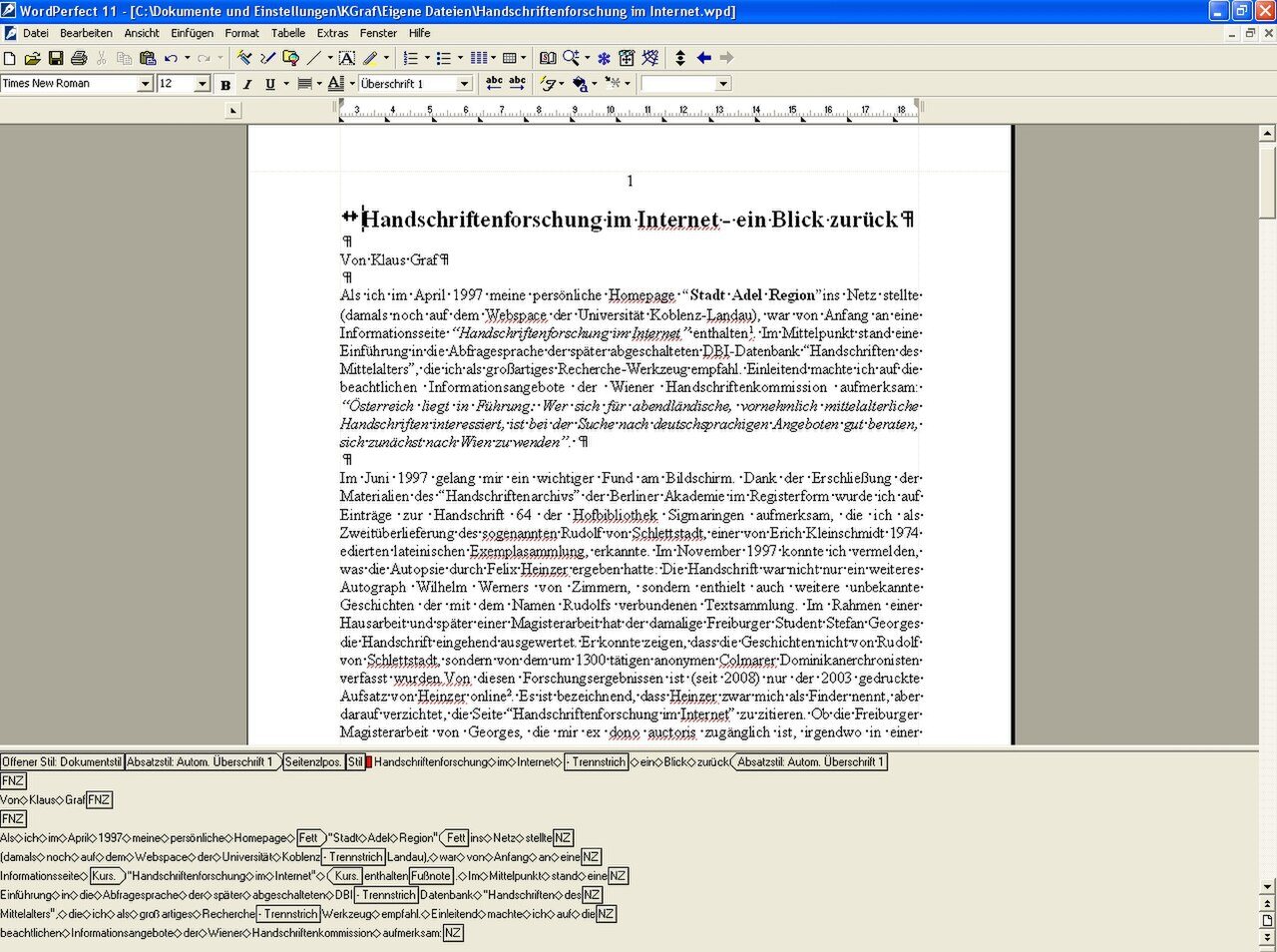
And then there was Reveal Codes. Press Alt-F3 and the screen split in half. The top showed your document as it would print. The bottom showed every hidden formatting instruction: bold tags, margin changes, tab settings, font switches. You could see exactly what was happening inside your document and fix formatting problems by deleting individual codes. This was enormously powerful. Microsoft Word, by contrast, treated formatting as an opaque layer. When something went wrong with your Word document's formatting, your options were essentially to guess, undo, or start over.

Reveal Codes is the single biggest reason WordPerfect is still used in law firms today. Lawyers deal with documents where precise formatting matters: court filings have exact margin requirements, contract sections need specific numbering hierarchies, and a misplaced page break can mean a rejected filing. Reveal Codes gave users total control. Nothing else came close.

The $700 Million Peak

By the early 1990s, WordPerfect Corporation was one of the most successful software companies in the world. The company reported revenue of $622 million in 1992, having grown rapidly through the late 1980s. At its peak, the company employed roughly 4,500 people at its Orem, Utah headquarters and offices worldwide. Revenue had been as high as $700 million before the slide began.

The company's culture was unusual for the software industry. WordPerfect was privately held, owned almost entirely by Ashton and Bastian. There was no board of outside directors pushing for quarterly results. The company offered free telephone support to all customers, a policy that was staggeringly expensive but built enormous goodwill. Calling WordPerfect's support line and actually getting a human who could solve your problem was, in the early 1990s, a remarkable experience.

Look, there's an argument to be made that this culture was part of the problem. The company operated more like a university department than a Silicon Valley startup. Decision-making was slow. There was no venture capital pressure to move fast. And when the market shifted, that leisurely pace became fatal.

The Windows Problem

Here is where the logic starts to break down, and where WordPerfect's story becomes a case study that business schools still teach.

Microsoft released Windows 3.0 in May 1990. It was the first version of Windows that people actually used. Within two years, Windows had become the dominant PC operating system. And Microsoft had a word processor ready for it: Word for Windows 2.0, released in 1991, was fast, attractive, and designed from the ground up for the graphical environment. It had toolbars. It had WYSIWYG formatting. It had mouse-driven menus. It looked like the future.

WordPerfect Corporation was late. Badly late. WordPerfect 5.1 for Windows shipped in late 1991, but it was buggy and had to be installed from DOS. The first stable version, WordPerfect 5.2 for Windows, didn't arrive until November 1992, more than two years after Windows 3.0 launched. And when it arrived, it was essentially a DOS application crammed into a Windows shell. The interface was clunky. Performance was poor. It didn't feel like a Windows application because, fundamentally, it wasn't one.

WordPerfect 6.0 for Windows, released in 1993, was supposed to fix everything. It was a ground-up rewrite for Windows. And it was a disaster. The application was buggy, slow, and required hardware specs that most users didn't have. It crashed frequently. Critics were brutal. Meanwhile, Microsoft Word for Windows was already on version 6.0 itself, polished, stable, and bundled into a new product called Microsoft Office that also included Excel and PowerPoint at a combined price that undercut buying those applications separately.

A Compaq Portable computer running WordPerfect 5.1
A Compaq Portable running WordPerfect 5.1, capturing the DOS-era computing environment where WordPerfect built its dominance. By the time Windows arrived, WordPerfect had optimized for a world that was disappearing.

The Bundling Strategy That Changed Everything

The real question is why WordPerfect couldn't recover. Other companies have been late to platform shifts and caught up. The answer involves Microsoft's most powerful competitive weapon, one that had nothing to do with code quality.

Microsoft Office, introduced in 1990, bundled Word, Excel, and PowerPoint together at a price significantly lower than buying each application separately. This was strategically devastating. WordPerfect Corporation sold a word processor. Microsoft sold a suite. Even if WordPerfect was a better word processor than Word, and many users believed it was, that advantage evaporated when the choice became "WordPerfect for $295 plus Lotus 1-2-3 for $495 plus a presentation program for $395" versus "Microsoft Office for $599 with everything included."

WordPerfect tried to respond with its own suite strategy, but the company didn't make a spreadsheet or a presentation program. It had to partner with Borland, whose Quattro Pro spreadsheet and Presentations software were capable but didn't integrate seamlessly. Microsoft's suite worked together. WordPerfect's collection felt like three different products taped together.

There was also the operating system question. Microsoft made Windows. Microsoft made Word. Critics, competitors, and eventually federal regulators raised the obvious concern: did Microsoft use its control of the operating system to disadvantage competitors? Were there API calls that Word could use that WordPerfect couldn't access? Were there early builds of Windows that Microsoft's own applications team got before outside developers?

Sold to Novell, Sold to Corel

By 1994, WordPerfect Corporation was in trouble. Market share was falling rapidly as businesses standardized on Microsoft Office. The free support line was hemorrhaging money. Revenue had dropped from its peak. Ashton and Bastian decided to sell.

Novell, the networking company based in nearby Provo, Utah, bought WordPerfect in June 1994 for approximately $1.4 billion, mostly in stock. Novell's CEO, Ray Noorda, had a vision of building a suite of products to compete with Microsoft: Novell's networking software plus WordPerfect plus other applications. It was an ambitious strategy. It was also poorly executed.

Novell didn't know how to run an application software business. The company struggled to integrate WordPerfect's development teams. Product releases slowed. The competitive gap with Microsoft Word widened. WordPerfect's market share continued to slide. Within 18 months, Novell decided to cut its losses.

On January 31, 1996, Corel Corporation, the Canadian company best known for CorelDRAW, announced it would acquire WordPerfect from Novell. The price was approximately $115 million in Corel stock and cash, plus licensing royalties. Novell had paid $1.4 billion less than two years earlier. The write-down was staggering.

The Lawsuit That Went Nowhere

Novell didn't go quietly. In November 2004, the company filed an antitrust lawsuit against Microsoft, alleging that Microsoft had deliberately undermined WordPerfect during the critical Windows 95 era. The central claim was that Microsoft had withdrawn support for certain APIs, specifically the namespace extension APIs, that WordPerfect needed to integrate with the Windows 95 shell, while keeping those APIs available for its own applications.

The case dragged on for years. When it finally went to trial in 2011, the jury deadlocked, reportedly 11 to 1 against Microsoft. But the judge granted Microsoft's motion for judgment as a matter of law, effectively dismissing the case. Novell appealed. The Tenth Circuit upheld the dismissal. In April 2014, the Supreme Court declined to hear the case. After a decade of litigation, Novell had nothing to show for it.

Whether Microsoft actually engaged in anticompetitive behavior specifically targeting WordPerfect is a question that was never definitively answered in court. What is clear is that Microsoft's control of both the operating system and a competing application gave it structural advantages that no pure-play application maker could overcome.

The Afterlife in Law Firms

Here is where the WordPerfect story takes an unexpected turn. The product didn't die. Under Corel, WordPerfect Office continued to be developed and sold. It found a permanent home in one specific industry: law.

There are law firms in the United States that use WordPerfect today. Not out of inertia or stubbornness, though there is some of that. They use it because Reveal Codes remains the most precise document formatting tool available in any word processor. Federal courts have specific formatting requirements. State courts have different ones. Immigration forms, patent filings, and appellate briefs all have exacting specifications. WordPerfect's ability to show you exactly what's happening inside your document, code by code, is genuinely superior to anything Microsoft Word offers.

The U.S. federal court system used WordPerfect as its standard for years. Some government agencies still do. Corel has maintained the product specifically for this market, releasing regular updates and ensuring compatibility with modern Windows versions. WordPerfect Office 2024 is a real product you can buy today.

Which brings us to the modern parallel. This is essentially what happened to BlackBerry, to Nokia, to any dominant platform player that gets disrupted. The technology doesn't vanish. It retreats to the niche where its specific strengths still matter, where the users who truly need it are willing to swim against the current. BlackBerry survived in government security circles. WordPerfect survived in legal document production. The mainstream moved on, but the specialists never left.

What WordPerfect Got Right (and What It Missed)

The lesson of WordPerfect is often simplified to "they were late to Windows." And that's true, but it's incomplete. Lots of companies have been late to platform transitions and survived. WordPerfect's real failure was a combination of three things happening simultaneously.

First, the platform shift. Windows replaced DOS, and WordPerfect's core strengths, the function keys, the keyboard-centric workflow, the clean blue screen, became liabilities in a mouse-driven graphical environment. The product's identity was tied to a computing paradigm that was ending.

Second, the bundling disadvantage. Microsoft could sell an integrated suite at a price that no standalone word processor could match. This wasn't about product quality. It was about market structure. WordPerfect could have been twice as good as Word and still lost, because "good enough plus Excel plus PowerPoint" beats "great" every time.

Third, the ownership transitions. Two acquisitions in two years destroyed organizational continuity. The best developers left. The product roadmap fractured. By the time Corel stabilized things, the market had moved on.

They weren't stupid. They built one of the best software products of the DOS era. They just didn't see that the era was ending, and by the time they did, the ground had already shifted beneath them.

Frequently Asked Questions

Is WordPerfect still available?
Yes. Corel WordPerfect Office is still actively developed and sold. The most recent version is WordPerfect Office 2024, available for Windows. It remains popular in legal, government, and academic settings.

Why do law firms still use WordPerfect?
The Reveal Codes feature, which shows all hidden formatting instructions in a document, gives users precise control over document formatting. This is essential for court filings and legal documents that must meet exact formatting specifications.

How much did Novell pay for WordPerfect?
Novell acquired WordPerfect Corporation in June 1994 for approximately $1.4 billion, primarily in Novell stock. Less than two years later, Novell sold WordPerfect to Corel for roughly $115 million, representing a loss of over 90% of its investment.

What was WordPerfect's peak market share?
WordPerfect held approximately 85% of the DOS word processing market at its peak in the late 1980s and early 1990s. The company's overall word processing market share, including Windows, was above 60% before the rapid decline began around 1993.

Did Microsoft cheat to beat WordPerfect?
Novell filed an antitrust lawsuit against Microsoft in 2004, alleging anticompetitive behavior during the Windows 95 era. The case ended in 2014 when the Supreme Court declined to hear Novell's appeal, leaving the question legally unresolved. The broader Microsoft antitrust case brought by the Department of Justice in 1998 did find that Microsoft had engaged in anticompetitive practices, though that case focused on browser competition rather than word processing specifically.

What happened to WordPerfect's founders?
Alan Ashton and Bruce Bastian each received approximately $700 million in Novell stock from the 1994 sale. Bastian became a prominent philanthropist in Utah. Ashton also pursued philanthropic activities and investments in the Utah area.

๐Ÿ“– What Happened to WordPerfect? The Software Microsoft Had to Kill Twice
_ โ–ก ร—
← Back

What Happened to WordPerfect? The Software Microsoft Had to Kill Twice

2026-04-04 by 404 Memory Found

In 1992, WordPerfect Corporation employed over 4,000 people in Orem, Utah. The company's flagship product held roughly 85% of the DOS word processing market. Revenue had topped $700 million. The company had no debt, a customer support line that was free to call, and a user base so loyal that some of them are still using the software today.

By January 1996, WordPerfect had been sold twice. First to Novell for $1.4 billion. Then, barely two years later, to Corel for approximately $115 million in stock and cash. That's a 92% loss in value in 24 months. And the product that replaced it, Microsoft Word, had been around since 1983 without anyone caring very much.

The WordPerfect story is not about a bad product losing to a good one. It's about a great product that missed a platform shift by roughly 18 months, and what happens when your biggest competitor also controls the operating system you run on.

Screenshot of WordPerfect 5.1 for DOS showing the clean blue editing screen
WordPerfect 5.1 for DOS, released November 6, 1989. The clean blue screen and function key commands became the standard for professional document creation throughout the late 1980s and early 1990s.

Built at a University, Loved by Everyone

WordPerfect started where a lot of great software started in the late 1970s: at a university with a specific problem to solve. In 1979, computer science professor Alan Ashton and graduate student Bruce Bastian at Brigham Young University were contracted to write a word processing program for the city of Orem's Data General minicomputer. The program worked well enough that Ashton and Bastian decided to start selling it. They formed Satellite Software International, later renamed WordPerfect Corporation, and began adapting their software for the emerging IBM PC market.

The early word processing landscape was crowded. WordStar, released in 1978, was the first dominant player. MicroPro International had built it into the standard, and by the early 1980s it was the word processor most people thought of when they thought of typing on a computer. But WordStar had problems. The interface relied on complex control-key sequences. The company was slow to update for the IBM PC architecture. And crucially, MicroPro got distracted by an ill-fated rewrite called WordStar 2000 that alienated its existing users.

WordPerfect filled the vacuum. Version 4.2, released in 1986, was the breakthrough. It was fast, reliable, and available on seemingly every platform. WordPerfect ran on DOS, Unix, VMS, Data General, Amiga, and eventually dozens of other systems. The company's support for obscure platforms gave it an installed base that no competitor could match.

But the real magic was in the product itself. WordPerfect had two features that users loved with an almost irrational intensity: function key commands and Reveal Codes.

The Blue Screen and the F-Keys

If you used WordPerfect 5.1 for DOS, you remember the blue screen. Not the Blue Screen of Death. The calm, clean, cobalt blue editing environment where your cursor blinked and nothing distracted you. There were no toolbars. No menus cluttering the top of your screen. Just text and a status bar at the bottom telling you what page you were on.

Every function was mapped to a key combination built around the F1 through F12 function keys, modified by Shift, Alt, and Ctrl. F7 was Exit. Shift-F7 was Print. Alt-F7 handled columns and tables. Ctrl-F5 did text conversion. Users memorized these combinations until they became muscle memory, the way a pianist knows which key is which without looking. A skilled WordPerfect typist could format an entire legal brief without ever touching the mouse, because there was no mouse support to begin with. The keyboard template that shipped with the software, a cardboard strip you placed above your function keys, became one of the most iconic accessories in personal computing history.

And then there was Reveal Codes. Press Alt-F3 and the screen split in half. The top showed your document as it would print. The bottom showed every hidden formatting instruction: bold tags, margin changes, tab settings, font switches. You could see exactly what was happening inside your document and fix formatting problems by deleting individual codes. This was enormously powerful. Microsoft Word, by contrast, treated formatting as an opaque layer. When something went wrong with your Word document's formatting, your options were essentially to guess, undo, or start over.

Reveal Codes is the single biggest reason WordPerfect is still used in law firms today. Lawyers deal with documents where precise formatting matters: court filings have exact margin requirements, contract sections need specific numbering hierarchies, and a misplaced page break can mean a rejected filing. Reveal Codes gave users total control. Nothing else came close.

The $700 Million Peak

By the early 1990s, WordPerfect Corporation was one of the most successful software companies in the world. The company reported revenue of $622 million in 1992, having grown rapidly through the late 1980s. At its peak, the company employed roughly 4,500 people at its Orem, Utah headquarters and offices worldwide. Revenue had been as high as $700 million before the slide began.

The company's culture was unusual for the software industry. WordPerfect was privately held, owned almost entirely by Ashton and Bastian. There was no board of outside directors pushing for quarterly results. The company offered free telephone support to all customers, a policy that was staggeringly expensive but built enormous goodwill. Calling WordPerfect's support line and actually getting a human who could solve your problem was, in the early 1990s, a remarkable experience.

Look, there's an argument to be made that this culture was part of the problem. The company operated more like a university department than a Silicon Valley startup. Decision-making was slow. There was no venture capital pressure to move fast. And when the market shifted, that leisurely pace became fatal.

The Windows Problem

Here is where the logic starts to break down, and where WordPerfect's story becomes a case study that business schools still teach.

Microsoft released Windows 3.0 in May 1990. It was the first version of Windows that people actually used. Within two years, Windows had become the dominant PC operating system. And Microsoft had a word processor ready for it: Word for Windows 2.0, released in 1991, was fast, attractive, and designed from the ground up for the graphical environment. It had toolbars. It had WYSIWYG formatting. It had mouse-driven menus. It looked like the future.

WordPerfect Corporation was late. Badly late. WordPerfect 5.1 for Windows shipped in late 1991, but it was buggy and had to be installed from DOS. The first stable version, WordPerfect 5.2 for Windows, didn't arrive until November 1992, more than two years after Windows 3.0 launched. And when it arrived, it was essentially a DOS application crammed into a Windows shell. The interface was clunky. Performance was poor. It didn't feel like a Windows application because, fundamentally, it wasn't one.

WordPerfect 6.0 for Windows, released in 1993, was supposed to fix everything. It was a ground-up rewrite for Windows. And it was a disaster. The application was buggy, slow, and required hardware specs that most users didn't have. It crashed frequently. Critics were brutal. Meanwhile, Microsoft Word for Windows was already on version 6.0 itself, polished, stable, and bundled into a new product called Microsoft Office that also included Excel and PowerPoint at a combined price that undercut buying those applications separately.

A Compaq Portable computer running WordPerfect 5.1
A Compaq Portable running WordPerfect 5.1, capturing the DOS-era computing environment where WordPerfect built its dominance. By the time Windows arrived, WordPerfect had optimized for a world that was disappearing.

The Bundling Strategy That Changed Everything

The real question is why WordPerfect couldn't recover. Other companies have been late to platform shifts and caught up. The answer involves Microsoft's most powerful competitive weapon, one that had nothing to do with code quality.

Microsoft Office, introduced in 1990, bundled Word, Excel, and PowerPoint together at a price significantly lower than buying each application separately. This was strategically devastating. WordPerfect Corporation sold a word processor. Microsoft sold a suite. Even if WordPerfect was a better word processor than Word, and many users believed it was, that advantage evaporated when the choice became "WordPerfect for $295 plus Lotus 1-2-3 for $495 plus a presentation program for $395" versus "Microsoft Office for $599 with everything included."

WordPerfect tried to respond with its own suite strategy, but the company didn't make a spreadsheet or a presentation program. It had to partner with Borland, whose Quattro Pro spreadsheet and Presentations software were capable but didn't integrate seamlessly. Microsoft's suite worked together. WordPerfect's collection felt like three different products taped together.

There was also the operating system question. Microsoft made Windows. Microsoft made Word. Critics, competitors, and eventually federal regulators raised the obvious concern: did Microsoft use its control of the operating system to disadvantage competitors? Were there API calls that Word could use that WordPerfect couldn't access? Were there early builds of Windows that Microsoft's own applications team got before outside developers?

Sold to Novell, Sold to Corel

By 1994, WordPerfect Corporation was in trouble. Market share was falling rapidly as businesses standardized on Microsoft Office. The free support line was hemorrhaging money. Revenue had dropped from its peak. Ashton and Bastian decided to sell.

Novell, the networking company based in nearby Provo, Utah, bought WordPerfect in June 1994 for approximately $1.4 billion, mostly in stock. Novell's CEO, Ray Noorda, had a vision of building a suite of products to compete with Microsoft: Novell's networking software plus WordPerfect plus other applications. It was an ambitious strategy. It was also poorly executed.

Novell didn't know how to run an application software business. The company struggled to integrate WordPerfect's development teams. Product releases slowed. The competitive gap with Microsoft Word widened. WordPerfect's market share continued to slide. Within 18 months, Novell decided to cut its losses.

On January 31, 1996, Corel Corporation, the Canadian company best known for CorelDRAW, announced it would acquire WordPerfect from Novell. The price was approximately $115 million in Corel stock and cash, plus licensing royalties. Novell had paid $1.4 billion less than two years earlier. The write-down was staggering.

The Lawsuit That Went Nowhere

Novell didn't go quietly. In November 2004, the company filed an antitrust lawsuit against Microsoft, alleging that Microsoft had deliberately undermined WordPerfect during the critical Windows 95 era. The central claim was that Microsoft had withdrawn support for certain APIs, specifically the namespace extension APIs, that WordPerfect needed to integrate with the Windows 95 shell, while keeping those APIs available for its own applications.

The case dragged on for years. When it finally went to trial in 2011, the jury deadlocked, reportedly 11 to 1 against Microsoft. But the judge granted Microsoft's motion for judgment as a matter of law, effectively dismissing the case. Novell appealed. The Tenth Circuit upheld the dismissal. In April 2014, the Supreme Court declined to hear the case. After a decade of litigation, Novell had nothing to show for it.

Whether Microsoft actually engaged in anticompetitive behavior specifically targeting WordPerfect is a question that was never definitively answered in court. What is clear is that Microsoft's control of both the operating system and a competing application gave it structural advantages that no pure-play application maker could overcome.

The Afterlife in Law Firms

Here is where the WordPerfect story takes an unexpected turn. The product didn't die. Under Corel, WordPerfect Office continued to be developed and sold. It found a permanent home in one specific industry: law.

There are law firms in the United States that use WordPerfect today. Not out of inertia or stubbornness, though there is some of that. They use it because Reveal Codes remains the most precise document formatting tool available in any word processor. Federal courts have specific formatting requirements. State courts have different ones. Immigration forms, patent filings, and appellate briefs all have exacting specifications. WordPerfect's ability to show you exactly what's happening inside your document, code by code, is genuinely superior to anything Microsoft Word offers.

The U.S. federal court system used WordPerfect as its standard for years. Some government agencies still do. Corel has maintained the product specifically for this market, releasing regular updates and ensuring compatibility with modern Windows versions. WordPerfect Office 2024 is a real product you can buy today.

Which brings us to the modern parallel. This is essentially what happened to BlackBerry, to Nokia, to any dominant platform player that gets disrupted. The technology doesn't vanish. It retreats to the niche where its specific strengths still matter, where the users who truly need it are willing to swim against the current. BlackBerry survived in government security circles. WordPerfect survived in legal document production. The mainstream moved on, but the specialists never left.

What WordPerfect Got Right (and What It Missed)

The lesson of WordPerfect is often simplified to "they were late to Windows." And that's true, but it's incomplete. Lots of companies have been late to platform transitions and survived. WordPerfect's real failure was a combination of three things happening simultaneously.

First, the platform shift. Windows replaced DOS, and WordPerfect's core strengths, the function keys, the keyboard-centric workflow, the clean blue screen, became liabilities in a mouse-driven graphical environment. The product's identity was tied to a computing paradigm that was ending.

Second, the bundling disadvantage. Microsoft could sell an integrated suite at a price that no standalone word processor could match. This wasn't about product quality. It was about market structure. WordPerfect could have been twice as good as Word and still lost, because "good enough plus Excel plus PowerPoint" beats "great" every time.

Third, the ownership transitions. Two acquisitions in two years destroyed organizational continuity. The best developers left. The product roadmap fractured. By the time Corel stabilized things, the market had moved on.

They weren't stupid. They built one of the best software products of the DOS era. They just didn't see that the era was ending, and by the time they did, the ground had already shifted beneath them.

Frequently Asked Questions

Is WordPerfect still available?
Yes. Corel WordPerfect Office is still actively developed and sold. The most recent version is WordPerfect Office 2024, available for Windows. It remains popular in legal, government, and academic settings.

Why do law firms still use WordPerfect?
The Reveal Codes feature, which shows all hidden formatting instructions in a document, gives users precise control over document formatting. This is essential for court filings and legal documents that must meet exact formatting specifications.

How much did Novell pay for WordPerfect?
Novell acquired WordPerfect Corporation in June 1994 for approximately $1.4 billion, primarily in Novell stock. Less than two years later, Novell sold WordPerfect to Corel for roughly $115 million, representing a loss of over 90% of its investment.

What was WordPerfect's peak market share?
WordPerfect held approximately 85% of the DOS word processing market at its peak in the late 1980s and early 1990s. The company's overall word processing market share, including Windows, was above 60% before the rapid decline began around 1993.

Did Microsoft cheat to beat WordPerfect?
Novell filed an antitrust lawsuit against Microsoft in 2004, alleging anticompetitive behavior during the Windows 95 era. The case ended in 2014 when the Supreme Court declined to hear Novell's appeal, leaving the question legally unresolved. The broader Microsoft antitrust case brought by the Department of Justice in 1998 did find that Microsoft had engaged in anticompetitive practices, though that case focused on browser competition rather than word processing specifically.

What happened to WordPerfect's founders?
Alan Ashton and Bruce Bastian each received approximately $700 million in Novell stock from the 1994 sale. Bastian became a prominent philanthropist in Utah. Ashton also pursued philanthropic activities and investments in the Utah area.

๐Ÿ“– What Happened to WordPerfect? The Software Microsoft Had to Kill Twice

In 1992, WordPerfect Corporation employed over 4,000 people in Orem, Utah. The company's flagship product held roughly 85% of the DOS word processing market. Revenue had topped $700 million. The company had no debt, a customer support line that was free to call, and a user base so loyal that some of them are still using the software today.

By January 1996, WordPerfect had been sold twice. First to Novell for $1.4 billion. Then, barely two years later, to Corel for approximately $115 million in stock and cash. That's a 92% loss in value in 24 months. And the product that replaced it, Microsoft Word, had been around since 1983 without anyone caring very much.

The WordPerfect story is not about a bad product losing to a good one. It's about a great product that missed a platform shift by roughly 18 months, and what happens when your biggest competitor also controls the operating system you run on.

Screenshot of WordPerfect 5.1 for DOS showing the clean blue editing screen
WordPerfect 5.1 for DOS, released November 6, 1989. The clean blue screen and function key commands became the standard for professional document creation throughout the late 1980s and early 1990s.

Built at a University, Loved by Everyone

WordPerfect started where a lot of great software started in the late 1970s: at a university with a specific problem to solve. In 1979, computer science professor Alan Ashton and graduate student Bruce Bastian at Brigham Young University were contracted to write a word processing program for the city of Orem's Data General minicomputer. The program worked well enough that Ashton and Bastian decided to start selling it. They formed Satellite Software International, later renamed WordPerfect Corporation, and began adapting their software for the emerging IBM PC market.

The early word processing landscape was crowded. WordStar, released in 1978, was the first dominant player. MicroPro International had built it into the standard, and by the early 1980s it was the word processor most people thought of when they thought of typing on a computer. But WordStar had problems. The interface relied on complex control-key sequences. The company was slow to update for the IBM PC architecture. And crucially, MicroPro got distracted by an ill-fated rewrite called WordStar 2000 that alienated its existing users.

WordPerfect filled the vacuum. Version 4.2, released in 1986, was the breakthrough. It was fast, reliable, and available on seemingly every platform. WordPerfect ran on DOS, Unix, VMS, Data General, Amiga, and eventually dozens of other systems. The company's support for obscure platforms gave it an installed base that no competitor could match.

But the real magic was in the product itself. WordPerfect had two features that users loved with an almost irrational intensity: function key commands and Reveal Codes.

The Blue Screen and the F-Keys

If you used WordPerfect 5.1 for DOS, you remember the blue screen. Not the Blue Screen of Death. The calm, clean, cobalt blue editing environment where your cursor blinked and nothing distracted you. There were no toolbars. No menus cluttering the top of your screen. Just text and a status bar at the bottom telling you what page you were on.

Every function was mapped to a key combination built around the F1 through F12 function keys, modified by Shift, Alt, and Ctrl. F7 was Exit. Shift-F7 was Print. Alt-F7 handled columns and tables. Ctrl-F5 did text conversion. Users memorized these combinations until they became muscle memory, the way a pianist knows which key is which without looking. A skilled WordPerfect typist could format an entire legal brief without ever touching the mouse, because there was no mouse support to begin with. The keyboard template that shipped with the software, a cardboard strip you placed above your function keys, became one of the most iconic accessories in personal computing history.

And then there was Reveal Codes. Press Alt-F3 and the screen split in half. The top showed your document as it would print. The bottom showed every hidden formatting instruction: bold tags, margin changes, tab settings, font switches. You could see exactly what was happening inside your document and fix formatting problems by deleting individual codes. This was enormously powerful. Microsoft Word, by contrast, treated formatting as an opaque layer. When something went wrong with your Word document's formatting, your options were essentially to guess, undo, or start over.

Reveal Codes is the single biggest reason WordPerfect is still used in law firms today. Lawyers deal with documents where precise formatting matters: court filings have exact margin requirements, contract sections need specific numbering hierarchies, and a misplaced page break can mean a rejected filing. Reveal Codes gave users total control. Nothing else came close.

The $700 Million Peak

By the early 1990s, WordPerfect Corporation was one of the most successful software companies in the world. The company reported revenue of $622 million in 1992, having grown rapidly through the late 1980s. At its peak, the company employed roughly 4,500 people at its Orem, Utah headquarters and offices worldwide. Revenue had been as high as $700 million before the slide began.

The company's culture was unusual for the software industry. WordPerfect was privately held, owned almost entirely by Ashton and Bastian. There was no board of outside directors pushing for quarterly results. The company offered free telephone support to all customers, a policy that was staggeringly expensive but built enormous goodwill. Calling WordPerfect's support line and actually getting a human who could solve your problem was, in the early 1990s, a remarkable experience.

Look, there's an argument to be made that this culture was part of the problem. The company operated more like a university department than a Silicon Valley startup. Decision-making was slow. There was no venture capital pressure to move fast. And when the market shifted, that leisurely pace became fatal.

The Windows Problem

Here is where the logic starts to break down, and where WordPerfect's story becomes a case study that business schools still teach.

Microsoft released Windows 3.0 in May 1990. It was the first version of Windows that people actually used. Within two years, Windows had become the dominant PC operating system. And Microsoft had a word processor ready for it: Word for Windows 2.0, released in 1991, was fast, attractive, and designed from the ground up for the graphical environment. It had toolbars. It had WYSIWYG formatting. It had mouse-driven menus. It looked like the future.

WordPerfect Corporation was late. Badly late. WordPerfect 5.1 for Windows shipped in late 1991, but it was buggy and had to be installed from DOS. The first stable version, WordPerfect 5.2 for Windows, didn't arrive until November 1992, more than two years after Windows 3.0 launched. And when it arrived, it was essentially a DOS application crammed into a Windows shell. The interface was clunky. Performance was poor. It didn't feel like a Windows application because, fundamentally, it wasn't one.

WordPerfect 6.0 for Windows, released in 1993, was supposed to fix everything. It was a ground-up rewrite for Windows. And it was a disaster. The application was buggy, slow, and required hardware specs that most users didn't have. It crashed frequently. Critics were brutal. Meanwhile, Microsoft Word for Windows was already on version 6.0 itself, polished, stable, and bundled into a new product called Microsoft Office that also included Excel and PowerPoint at a combined price that undercut buying those applications separately.

A Compaq Portable computer running WordPerfect 5.1
A Compaq Portable running WordPerfect 5.1, capturing the DOS-era computing environment where WordPerfect built its dominance. By the time Windows arrived, WordPerfect had optimized for a world that was disappearing.

The Bundling Strategy That Changed Everything

The real question is why WordPerfect couldn't recover. Other companies have been late to platform shifts and caught up. The answer involves Microsoft's most powerful competitive weapon, one that had nothing to do with code quality.

Microsoft Office, introduced in 1990, bundled Word, Excel, and PowerPoint together at a price significantly lower than buying each application separately. This was strategically devastating. WordPerfect Corporation sold a word processor. Microsoft sold a suite. Even if WordPerfect was a better word processor than Word, and many users believed it was, that advantage evaporated when the choice became "WordPerfect for $295 plus Lotus 1-2-3 for $495 plus a presentation program for $395" versus "Microsoft Office for $599 with everything included."

WordPerfect tried to respond with its own suite strategy, but the company didn't make a spreadsheet or a presentation program. It had to partner with Borland, whose Quattro Pro spreadsheet and Presentations software were capable but didn't integrate seamlessly. Microsoft's suite worked together. WordPerfect's collection felt like three different products taped together.

There was also the operating system question. Microsoft made Windows. Microsoft made Word. Critics, competitors, and eventually federal regulators raised the obvious concern: did Microsoft use its control of the operating system to disadvantage competitors? Were there API calls that Word could use that WordPerfect couldn't access? Were there early builds of Windows that Microsoft's own applications team got before outside developers?

Sold to Novell, Sold to Corel

By 1994, WordPerfect Corporation was in trouble. Market share was falling rapidly as businesses standardized on Microsoft Office. The free support line was hemorrhaging money. Revenue had dropped from its peak. Ashton and Bastian decided to sell.

Novell, the networking company based in nearby Provo, Utah, bought WordPerfect in June 1994 for approximately $1.4 billion, mostly in stock. Novell's CEO, Ray Noorda, had a vision of building a suite of products to compete with Microsoft: Novell's networking software plus WordPerfect plus other applications. It was an ambitious strategy. It was also poorly executed.

Novell didn't know how to run an application software business. The company struggled to integrate WordPerfect's development teams. Product releases slowed. The competitive gap with Microsoft Word widened. WordPerfect's market share continued to slide. Within 18 months, Novell decided to cut its losses.

On January 31, 1996, Corel Corporation, the Canadian company best known for CorelDRAW, announced it would acquire WordPerfect from Novell. The price was approximately $115 million in Corel stock and cash, plus licensing royalties. Novell had paid $1.4 billion less than two years earlier. The write-down was staggering.

The Lawsuit That Went Nowhere

Novell didn't go quietly. In November 2004, the company filed an antitrust lawsuit against Microsoft, alleging that Microsoft had deliberately undermined WordPerfect during the critical Windows 95 era. The central claim was that Microsoft had withdrawn support for certain APIs, specifically the namespace extension APIs, that WordPerfect needed to integrate with the Windows 95 shell, while keeping those APIs available for its own applications.

The case dragged on for years. When it finally went to trial in 2011, the jury deadlocked, reportedly 11 to 1 against Microsoft. But the judge granted Microsoft's motion for judgment as a matter of law, effectively dismissing the case. Novell appealed. The Tenth Circuit upheld the dismissal. In April 2014, the Supreme Court declined to hear the case. After a decade of litigation, Novell had nothing to show for it.

Whether Microsoft actually engaged in anticompetitive behavior specifically targeting WordPerfect is a question that was never definitively answered in court. What is clear is that Microsoft's control of both the operating system and a competing application gave it structural advantages that no pure-play application maker could overcome.

The Afterlife in Law Firms

Here is where the WordPerfect story takes an unexpected turn. The product didn't die. Under Corel, WordPerfect Office continued to be developed and sold. It found a permanent home in one specific industry: law.

There are law firms in the United States that use WordPerfect today. Not out of inertia or stubbornness, though there is some of that. They use it because Reveal Codes remains the most precise document formatting tool available in any word processor. Federal courts have specific formatting requirements. State courts have different ones. Immigration forms, patent filings, and appellate briefs all have exacting specifications. WordPerfect's ability to show you exactly what's happening inside your document, code by code, is genuinely superior to anything Microsoft Word offers.

The U.S. federal court system used WordPerfect as its standard for years. Some government agencies still do. Corel has maintained the product specifically for this market, releasing regular updates and ensuring compatibility with modern Windows versions. WordPerfect Office 2024 is a real product you can buy today.

Which brings us to the modern parallel. This is essentially what happened to BlackBerry, to Nokia, to any dominant platform player that gets disrupted. The technology doesn't vanish. It retreats to the niche where its specific strengths still matter, where the users who truly need it are willing to swim against the current. BlackBerry survived in government security circles. WordPerfect survived in legal document production. The mainstream moved on, but the specialists never left.

What WordPerfect Got Right (and What It Missed)

The lesson of WordPerfect is often simplified to "they were late to Windows." And that's true, but it's incomplete. Lots of companies have been late to platform transitions and survived. WordPerfect's real failure was a combination of three things happening simultaneously.

First, the platform shift. Windows replaced DOS, and WordPerfect's core strengths, the function keys, the keyboard-centric workflow, the clean blue screen, became liabilities in a mouse-driven graphical environment. The product's identity was tied to a computing paradigm that was ending.

Second, the bundling disadvantage. Microsoft could sell an integrated suite at a price that no standalone word processor could match. This wasn't about product quality. It was about market structure. WordPerfect could have been twice as good as Word and still lost, because "good enough plus Excel plus PowerPoint" beats "great" every time.

Third, the ownership transitions. Two acquisitions in two years destroyed organizational continuity. The best developers left. The product roadmap fractured. By the time Corel stabilized things, the market had moved on.

They weren't stupid. They built one of the best software products of the DOS era. They just didn't see that the era was ending, and by the time they did, the ground had already shifted beneath them.

Frequently Asked Questions

Is WordPerfect still available?
Yes. Corel WordPerfect Office is still actively developed and sold. The most recent version is WordPerfect Office 2024, available for Windows. It remains popular in legal, government, and academic settings.

Why do law firms still use WordPerfect?
The Reveal Codes feature, which shows all hidden formatting instructions in a document, gives users precise control over document formatting. This is essential for court filings and legal documents that must meet exact formatting specifications.

How much did Novell pay for WordPerfect?
Novell acquired WordPerfect Corporation in June 1994 for approximately $1.4 billion, primarily in Novell stock. Less than two years later, Novell sold WordPerfect to Corel for roughly $115 million, representing a loss of over 90% of its investment.

What was WordPerfect's peak market share?
WordPerfect held approximately 85% of the DOS word processing market at its peak in the late 1980s and early 1990s. The company's overall word processing market share, including Windows, was above 60% before the rapid decline began around 1993.

Did Microsoft cheat to beat WordPerfect?
Novell filed an antitrust lawsuit against Microsoft in 2004, alleging anticompetitive behavior during the Windows 95 era. The case ended in 2014 when the Supreme Court declined to hear Novell's appeal, leaving the question legally unresolved. The broader Microsoft antitrust case brought by the Department of Justice in 1998 did find that Microsoft had engaged in anticompetitive practices, though that case focused on browser competition rather than word processing specifically.

What happened to WordPerfect's founders?
Alan Ashton and Bruce Bastian each received approximately $700 million in Novell stock from the 1994 sale. Bastian became a prominent philanthropist in Utah. Ashton also pursued philanthropic activities and investments in the Utah area.

00:00