What Happened to HyperCard, the Apple Software That Quietly Invented the Web

In 1987, three years before Tim Berners-Lee wrote the first proposal for the World Wide Web, Apple was already shipping a tool that let ordinary users build clickable, multimedia documents and link them together. It came free on every new Macintosh. It was called HyperCard.

By 1992 it had been used to ship one of the best-selling computer games of all time, prototype consumer airline kiosks, run hospital records systems, build art installations, and teach a generation of kids that a computer was something you could make things with, not just something you bought software for. By 2004 Apple had quietly killed it. The web had won, and HyperCard was archived as the strange thing that came before.

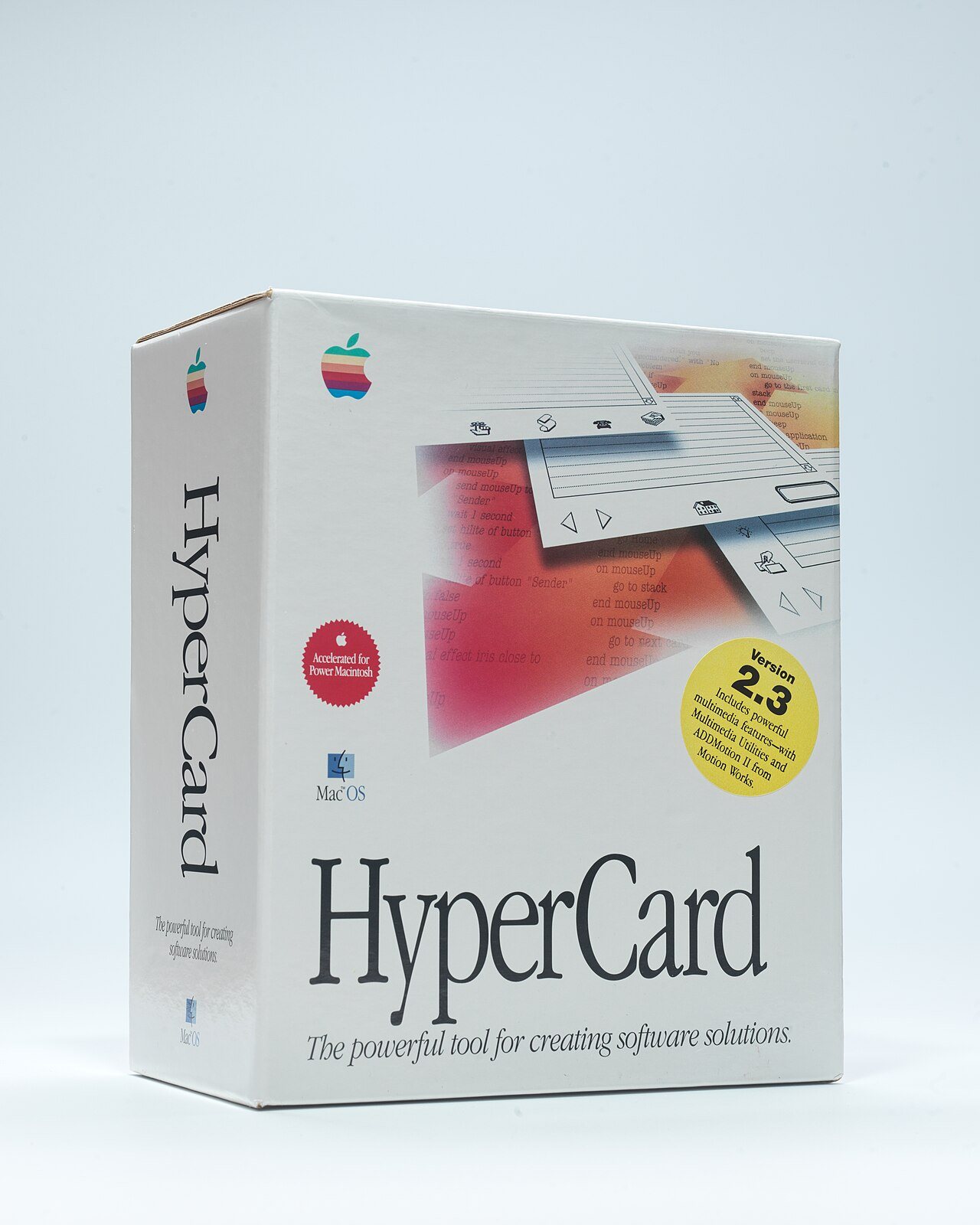
A boxed copy of HyperCard version 2.3 in its original packaging
HyperCard 2.3 in retail packaging. Earlier versions shipped free with every Macintosh.

The story of HyperCard is the story of what happens when a tool gets the user interface right twenty years before the infrastructure is ready. It's the story of an Apple engineer named Bill Atkinson, a hypertext theorist named Ted Nelson, and a company that didn't quite understand what it had built. And it's the story of a piece of software that quietly seeded the design vocabulary of every web page, every PowerPoint deck, and every mobile app you use.

The Engineer Who Wanted to Give It Away

Bill Atkinson was already a legend at Apple by the mid-1980s. He had written QuickDraw, the graphics library that drew everything you saw on the original Macintosh. He had built MacPaint. He had invented the marquee selection tool, the menu bar, and the double-click. If you used a Mac in 1985, you spent most of your time inside code Atkinson had written.

What he wanted to build next was different. Atkinson had become obsessed with the idea of hypertext, the concept that documents could link to each other and to other media, an idea Ted Nelson had been promoting since the 1960s with his Project Xanadu. Atkinson took an acid trip in 1985, came down with what he later described as a vision of a graphical tool for linking ideas, and immediately started prototyping it. The project was called WildCard internally.

By March 1985 the basic concept was working. By 1986 it had been renamed HyperCard for trademark reasons, and an engineer named Dan Winkler had joined to build HyperTalk, the scripting language that would turn HyperCard from a documentation tool into a programming environment for non-programmers.

Here's where the story gets interesting. Atkinson didn't want to sell HyperCard. He wanted Apple to give it away free with every Mac. He believed the value of the software was in the network effect of millions of users building stacks and sharing them, and the only way to seed that network was to ship it bundled with the hardware. Apple, predictably, balked. They wanted to sell it as a $49.95 product.

Atkinson's response, as he later told the story, was effectively to threaten to walk. He had enough leverage that the bluff worked. Apple agreed to ship HyperCard free with every new Macintosh starting on the day of its launch.

Atkinson would give HyperCard to Apple only if the company promised to release it for free on all Macs. That was the deal that made everything that followed possible.

HyperCard 1.0 launched on August 11, 1987, at the MacWorld Conference and Expo in Boston. The timing was deliberate. Apple wanted maximum press coverage, and they got it.

What HyperCard Actually Was

If you've never seen HyperCard, the easiest way to describe it is this: imagine PowerPoint, but every shape on the slide is clickable, every click can run a small program, and the program can do almost anything. Each document was called a stack. Each page in the stack was called a card. Cards could contain text, images, sound clips, buttons, and fields. Buttons could be wired up to do things: jump to another card, play a sound, run a script, query a database, dial a modem.

The scripting language, HyperTalk, was designed to read like English. A button might contain code that said something like:

on mouseUp
  go to card "Contents"
  play "chime"
end mouseUp

That's it. That's the program. A kid who had never written a line of code could read that and understand it. And critically, a kid who had never written a line of code could also write it. The barrier between user and programmer dissolved in a way that has, frankly, not really been recreated since.

Stacks could be saved as files and shared. By the late 1980s there was a thriving culture of HyperCard stack distribution: shareware authors selling stacks for $20 on bulletin board systems, schools distributing custom educational stacks on floppy disks, museums building interactive exhibits with stacks running on Mac kiosks. The Internet Archive estimates that hundreds of thousands of stacks were in circulation by the end of the 1980s, traded on floppies and over university networks.

Myst Was a HyperCard Stack

The killer app for HyperCard wasn't a productivity tool. It was a video game.

In 1991 two brothers in Spokane, Washington, Rand and Robyn Miller, were building children's educational software through their tiny company Cyan. Their early titles were HyperCard stacks distributed on floppy disks. They had a small but devoted audience.

The Millers decided their next project would be more ambitious. It would be an exploration game for adults, set on a mysterious island, with no instructions, no inventory, no death. Players would simply look around, click on things, and try to figure out what was happening. The game would be built entirely in HyperCard, with pre-rendered 3D imagery and QuickTime video clips triggered by clicks on specific spots on each card.

The game was Myst. It took the Miller brothers roughly two years to build. It shipped in September 1993 on CD-ROM, which was still a relatively new medium for consumer software. Myst became the best-selling PC game of the 1990s, holding that title until The Sims overtook it in 2002. It sold over six million copies. It spawned a franchise, a series of novels, and a cultural moment that defined what CD-ROM gaming could be.

And it was a HyperCard stack. The original Mac version of Myst ran inside HyperCard, with HyperTalk scripts driving every transition and every puzzle. Without Atkinson's tool, Myst as it existed simply could not have been made by two brothers in a basement in Spokane.

How HyperCard Influenced the Web

This is the part of the story that gets glossed over in most histories of the internet, because the relationship is indirect, but it's worth slowing down on.

Tim Berners-Lee wrote his first proposal for what became the World Wide Web in March 1989, while working at CERN in Switzerland. The proposal was for a hypertext system that would let researchers link documents across the institution's network. Berners-Lee was familiar with prior hypertext systems, including HyperCard, although his proposal cited a different system called ENQUIRE that he had built earlier.

The conceptual debt is hard to miss, however. The idea of clickable hot regions in a document. The idea of links that jump to other documents. The idea that anyone, not just programmers, should be able to author hypertext. All of this was in the air in 1989, and a lot of it was in HyperCard on every Mac in every research lab.

The more direct lineage runs through JavaScript. Brendan Eich, who designed JavaScript at Netscape in May 1995 in roughly ten days, has cited HyperTalk as a direct inspiration for the language's event-driven model. Look at a JavaScript event handler today:

button.addEventListener('click', function() { ... });

That is, structurally, a HyperTalk "on mouseUp" handler with different syntax. The whole pattern of "thing happens, run this code" came directly out of HyperCard into the web.

The same is true of the multimedia document metaphor that dominates web design. A web page is a card. A site is a stack. Links jump between cards. Buttons trigger actions. The vocabulary you use to design a website today is the vocabulary HyperCard formalized in 1987.

The Problem Was the Network

Here's the thing. HyperCard could not have become the web. It had one fatal limitation that nobody could have predicted in 1987 because the thing that exposed the limitation didn't exist yet.

HyperCard stacks were files. They lived on disks. If you wanted to share a stack with someone, you mailed them a floppy. Or you uploaded it to a BBS and they downloaded it. There was no concept of a stack that lived on a server and was rendered on demand by a client. There was no concept of a stack that could link to another stack on a different computer somewhere else in the world. HyperCard's hypertext was local.

The web's killer move, the one HyperCard never had, was the universal addressing scheme. The URL. The idea that any document anywhere could be referenced by a string of text and fetched on demand. That single insight is what made the web a global network and HyperCard a local tool.

By 1993 the web was emerging. Mosaic, the first popular graphical web browser, launched that year, and it took the multimedia interactive document metaphor HyperCard had pioneered and bolted it onto a global network. Suddenly the thing HyperCard had been doing on your hard drive could be done on a server in Switzerland and read from a workstation in California.

The race was over almost before HyperCard knew it had been entered. Web pages exploded. HTML, a simpler markup language with worse interactivity but unlimited reach, became the medium. HyperCard, which had been a candle in the dark, got blown out by sunrise.

The Stack Economy Nobody Remembers

One detail that history has largely forgotten is how much commerce flowed through HyperCard in its peak years. By 1990 there was a thriving secondary market for stacks. Shareware authors sold productivity stacks for $20 to $50 a copy through user groups and bulletin board systems. Companies like Voyager Company produced commercial stacks on CD-ROM that taught music history, walked you through Beethoven's Ninth Symphony, or explored the photographs of Ansel Adams. These were not toys. They were professional reference works, and they sold.

The 1989 Beethoven's Ninth Symphony CD-ROM, annotated by UCLA music instructor Robert Winter and published by Voyager, was widely cited as one of the first titles that proved CD-ROM could be a serious educational medium. It was built in HyperCard, with custom audio XCMDs used to drive a standard audio CD in the player. The interactive interface, the navigation, the audio synchronization, all of it ran on Atkinson's tool.

Universities used HyperCard for everything from course materials to research databases. The Smithsonian used it for kiosks. Air carriers used it to prototype check-in interfaces. Hospitals built patient record systems on it. The thing was so general that nobody quite knew how to categorize it, which was part of the problem when Apple tried to figure out how to market the product later.

The Marketing Identity Crisis

Look at how Apple positioned HyperCard over its life and you can see the company struggling to figure out what to call it. The 1987 launch materials described it as an "information construction kit." Later marketing called it a "software erector set." Later still it became a "multimedia authoring environment." The product never settled into a category that mainstream buyers understood, because the truth was that HyperCard didn't fit any existing category.

That ambiguity hurt sales when Apple started charging for it. People knew what a word processor was. They knew what a spreadsheet was. They didn't know what a "hypermedia authoring tool" was, and they weren't sure they needed one. The early '90s spreadsheet and word processor wars between Microsoft and Lotus and WordPerfect were comprehensible categories with clear competitors. HyperCard was a category of one, which sounds like an advantage but in practice meant Apple was educating the market rather than fighting for it.

This is the part where it's worth quoting Atkinson directly. In a 2002 interview with Wired's Leander Kahney, Atkinson said he regretted not figuring out the network piece himself. "I have realized over time that I missed the mark with HyperCard," he said. "I grew up in a box-centric culture at Apple. If I'd grown up in a network-centric culture, like Sun, HyperCard might have been the first web browser." The honesty of that admission is striking, and it captures the limitation cleanly. HyperCard was built for a world where computers were islands. The web was built for a world where they were not.

Apple Stopped Caring

The internal collapse of HyperCard at Apple is its own small tragedy. By the early 1990s, Apple had repeatedly tried to reposition the tool. They moved it from the Apple Personal Software division to Claris, the spin-off subsidiary that sold business software like FileMaker and ClarisWorks. Claris started charging for HyperCard, breaking Atkinson's original promise of free distribution with every Mac. Sales fell. The product languished.

By the mid-1990s Apple itself was in crisis. The company was losing money. Internal projects were getting cut. HyperCard, which had no clear path to revenue and no champion left at the executive level, was an obvious target. Updates slowed to a trickle. The last major update, HyperCard 2.4, shipped in 1998.

Steve Jobs returned to Apple that same year and started ruthlessly cutting product lines. He killed the Newton. He killed OpenDoc. He killed dozens of side projects to focus the company on the iMac and what would eventually become Mac OS X.

HyperCard didn't get killed outright, but it didn't get ported to Mac OS X either. When Apple transitioned from Mac OS 9 to Mac OS X in 2001, HyperCard was left behind. It still ran in the Classic compatibility layer, but it was clearly on its way out. Apple formally discontinued HyperCard in March 2004, twenty seven years after launch. Atkinson, in interviews after the fact, expressed sadness more than anger. He believed HyperCard could have evolved into something like Flash or even something like a native web authoring tool, but Apple never made that investment.

What HyperCard Tells Us

The real question isn't why HyperCard died. It's why nothing has really replaced it.

Think about what HyperCard offered: a tool that let anyone with a computer build a working interactive multimedia document and share it with anyone else. No coding bootcamp required. No npm install. No deployment pipeline. You opened HyperCard, you dragged buttons onto a card, you typed three lines of English-like script, and you had a working program.

The closest modern analogs are things like Notion, Airtable, and the various no-code platforms that have emerged in the last decade. They share HyperCard's core insight: that the right user interface can collapse the distance between user and programmer. But they all require you to be online, to have an account, to trust a company to keep your data alive. HyperCard ran on your machine. Your stacks were yours.

HyperCard slowly fell by the wayside to the growing World Wide Web. The web was bigger, more accessible, and infinitely more shareable. But it was also, in some ways, a step backward in expressiveness for the average user.

This is the part where the analysis starts to break down for me a little, because there's a real argument that we lost something when HyperCard died. The early web had "View Source." Anyone could see how a page was built. That feature is largely gone now, replaced by minified JavaScript and React component trees and build pipelines that mean you can't really see how anything is made anymore. HyperCard, by design, was always inspectable. You could click on a button, hit Edit, and see the script. The tool wanted you to learn it.

The numbers tell the story of an arc. Hundreds of thousands of stacks circulated in the late 1980s. Myst sold over six million copies. By the early 2000s, HyperCard had effectively been abandoned. As of 2026, it is studied as historical software, preserved by the Internet Archive, and emulated by hobbyist projects. There is no commercial successor.

Bill Atkinson speaking at an event celebrating 25 years of HyperCard
Bill Atkinson at the Berkeley Cybersalon event marking 25 years of HyperCard's release, August 2012.

The lesson, if there is one, is that the medium can outlive the tool. HyperCard the product is gone. The interaction model it pioneered, which is to say the model of building interactive multimedia by laying out clickable regions and wiring them to scripts, is the model that runs the entire web. Apple gave it away free for a decade and got, in return, an entire industry that learned how to think in HyperCard's vocabulary without ever knowing where the vocabulary came from.

Frequently Asked Questions

When did HyperCard launch?

HyperCard 1.0 was released on August 11, 1987, at the MacWorld Conference and Expo in Boston. It was bundled free with every new Macintosh.

Who created HyperCard?

HyperCard was created by Bill Atkinson, the same Apple engineer who built QuickDraw, MacPaint, and many of the original Macintosh user interface elements. Dan Winkler designed HyperTalk, the scripting language.

How much did HyperCard cost?

Initially, nothing. Atkinson negotiated with Apple to distribute it free with every new Mac. Later, when Apple moved the product to its Claris subsidiary, retail copies were sold at prices around $49.95 to $199 depending on the version. The free bundling stopped in the early 1990s.

Was Myst really built in HyperCard?

Yes. The original Macintosh version of Myst, released by Cyan in September 1993, was a HyperCard stack with HyperTalk scripts and QuickTime media. It went on to become the best-selling PC game of the 1990s with over six million copies sold.

When did Apple discontinue HyperCard?

HyperCard was officially withdrawn from sale by Apple in March 2004. The final substantive update, HyperCard 2.4, had shipped in 1998. It was never ported to Mac OS X.

What was HyperTalk?

HyperTalk was HyperCard's scripting language, designed to read like plain English. Scripts attached to buttons, fields, or cards could trigger actions when events like mouseUp or mouseDown fired. Brendan Eich, the creator of JavaScript, has cited HyperTalk as an inspiration.

Did HyperCard influence the World Wide Web?

Yes, although indirectly. HyperCard popularized the clickable hypertext document metaphor that became the foundation of web design, and its event-driven scripting model directly influenced JavaScript. Some accounts also credit it with influencing Robert Cailliau, who worked alongside Tim Berners-Lee on the early web at CERN.

Can you still run HyperCard today?

Not natively on modern Macs. HyperCard was a Classic Mac OS application and does not run on modern macOS. The Internet Archive has built a browser-based emulator that lets users explore archived stacks, and some hobbyist tools like Stacksmith and Decker attempt to recreate the HyperCard authoring experience for modern systems.

What is the legacy of HyperCard?

HyperCard's design vocabulary, including the card metaphor, clickable regions, and event-driven scripting, underpins the modern web, mobile apps, and presentation software. Its broader cultural legacy is the idea that ordinary users should be able to build interactive software without being programmers. That idea is alive in the no-code and low-code platforms that dominate consumer software development today.

๐Ÿ“– What Happened to HyperCard, the Apple Software That Quietly Invented the Web
_ โ–ก ร—
← Back

What Happened to HyperCard, the Apple Software That Quietly Invented the Web

2026-05-18 by 404 Memory Found

In 1987, three years before Tim Berners-Lee wrote the first proposal for the World Wide Web, Apple was already shipping a tool that let ordinary users build clickable, multimedia documents and link them together. It came free on every new Macintosh. It was called HyperCard.

By 1992 it had been used to ship one of the best-selling computer games of all time, prototype consumer airline kiosks, run hospital records systems, build art installations, and teach a generation of kids that a computer was something you could make things with, not just something you bought software for. By 2004 Apple had quietly killed it. The web had won, and HyperCard was archived as the strange thing that came before.

A boxed copy of HyperCard version 2.3 in its original packaging
HyperCard 2.3 in retail packaging. Earlier versions shipped free with every Macintosh.

The story of HyperCard is the story of what happens when a tool gets the user interface right twenty years before the infrastructure is ready. It's the story of an Apple engineer named Bill Atkinson, a hypertext theorist named Ted Nelson, and a company that didn't quite understand what it had built. And it's the story of a piece of software that quietly seeded the design vocabulary of every web page, every PowerPoint deck, and every mobile app you use.

The Engineer Who Wanted to Give It Away

Bill Atkinson was already a legend at Apple by the mid-1980s. He had written QuickDraw, the graphics library that drew everything you saw on the original Macintosh. He had built MacPaint. He had invented the marquee selection tool, the menu bar, and the double-click. If you used a Mac in 1985, you spent most of your time inside code Atkinson had written.

What he wanted to build next was different. Atkinson had become obsessed with the idea of hypertext, the concept that documents could link to each other and to other media, an idea Ted Nelson had been promoting since the 1960s with his Project Xanadu. Atkinson took an acid trip in 1985, came down with what he later described as a vision of a graphical tool for linking ideas, and immediately started prototyping it. The project was called WildCard internally.

By March 1985 the basic concept was working. By 1986 it had been renamed HyperCard for trademark reasons, and an engineer named Dan Winkler had joined to build HyperTalk, the scripting language that would turn HyperCard from a documentation tool into a programming environment for non-programmers.

Here's where the story gets interesting. Atkinson didn't want to sell HyperCard. He wanted Apple to give it away free with every Mac. He believed the value of the software was in the network effect of millions of users building stacks and sharing them, and the only way to seed that network was to ship it bundled with the hardware. Apple, predictably, balked. They wanted to sell it as a $49.95 product.

Atkinson's response, as he later told the story, was effectively to threaten to walk. He had enough leverage that the bluff worked. Apple agreed to ship HyperCard free with every new Macintosh starting on the day of its launch.

Atkinson would give HyperCard to Apple only if the company promised to release it for free on all Macs. That was the deal that made everything that followed possible.

HyperCard 1.0 launched on August 11, 1987, at the MacWorld Conference and Expo in Boston. The timing was deliberate. Apple wanted maximum press coverage, and they got it.

What HyperCard Actually Was

If you've never seen HyperCard, the easiest way to describe it is this: imagine PowerPoint, but every shape on the slide is clickable, every click can run a small program, and the program can do almost anything. Each document was called a stack. Each page in the stack was called a card. Cards could contain text, images, sound clips, buttons, and fields. Buttons could be wired up to do things: jump to another card, play a sound, run a script, query a database, dial a modem.

The scripting language, HyperTalk, was designed to read like English. A button might contain code that said something like:

on mouseUp
  go to card "Contents"
  play "chime"
end mouseUp

That's it. That's the program. A kid who had never written a line of code could read that and understand it. And critically, a kid who had never written a line of code could also write it. The barrier between user and programmer dissolved in a way that has, frankly, not really been recreated since.

Stacks could be saved as files and shared. By the late 1980s there was a thriving culture of HyperCard stack distribution: shareware authors selling stacks for $20 on bulletin board systems, schools distributing custom educational stacks on floppy disks, museums building interactive exhibits with stacks running on Mac kiosks. The Internet Archive estimates that hundreds of thousands of stacks were in circulation by the end of the 1980s, traded on floppies and over university networks.

Myst Was a HyperCard Stack

The killer app for HyperCard wasn't a productivity tool. It was a video game.

In 1991 two brothers in Spokane, Washington, Rand and Robyn Miller, were building children's educational software through their tiny company Cyan. Their early titles were HyperCard stacks distributed on floppy disks. They had a small but devoted audience.

The Millers decided their next project would be more ambitious. It would be an exploration game for adults, set on a mysterious island, with no instructions, no inventory, no death. Players would simply look around, click on things, and try to figure out what was happening. The game would be built entirely in HyperCard, with pre-rendered 3D imagery and QuickTime video clips triggered by clicks on specific spots on each card.

The game was Myst. It took the Miller brothers roughly two years to build. It shipped in September 1993 on CD-ROM, which was still a relatively new medium for consumer software. Myst became the best-selling PC game of the 1990s, holding that title until The Sims overtook it in 2002. It sold over six million copies. It spawned a franchise, a series of novels, and a cultural moment that defined what CD-ROM gaming could be.

And it was a HyperCard stack. The original Mac version of Myst ran inside HyperCard, with HyperTalk scripts driving every transition and every puzzle. Without Atkinson's tool, Myst as it existed simply could not have been made by two brothers in a basement in Spokane.

How HyperCard Influenced the Web

This is the part of the story that gets glossed over in most histories of the internet, because the relationship is indirect, but it's worth slowing down on.

Tim Berners-Lee wrote his first proposal for what became the World Wide Web in March 1989, while working at CERN in Switzerland. The proposal was for a hypertext system that would let researchers link documents across the institution's network. Berners-Lee was familiar with prior hypertext systems, including HyperCard, although his proposal cited a different system called ENQUIRE that he had built earlier.

The conceptual debt is hard to miss, however. The idea of clickable hot regions in a document. The idea of links that jump to other documents. The idea that anyone, not just programmers, should be able to author hypertext. All of this was in the air in 1989, and a lot of it was in HyperCard on every Mac in every research lab.

The more direct lineage runs through JavaScript. Brendan Eich, who designed JavaScript at Netscape in May 1995 in roughly ten days, has cited HyperTalk as a direct inspiration for the language's event-driven model. Look at a JavaScript event handler today:

button.addEventListener('click', function() { ... });

That is, structurally, a HyperTalk "on mouseUp" handler with different syntax. The whole pattern of "thing happens, run this code" came directly out of HyperCard into the web.

The same is true of the multimedia document metaphor that dominates web design. A web page is a card. A site is a stack. Links jump between cards. Buttons trigger actions. The vocabulary you use to design a website today is the vocabulary HyperCard formalized in 1987.

The Problem Was the Network

Here's the thing. HyperCard could not have become the web. It had one fatal limitation that nobody could have predicted in 1987 because the thing that exposed the limitation didn't exist yet.

HyperCard stacks were files. They lived on disks. If you wanted to share a stack with someone, you mailed them a floppy. Or you uploaded it to a BBS and they downloaded it. There was no concept of a stack that lived on a server and was rendered on demand by a client. There was no concept of a stack that could link to another stack on a different computer somewhere else in the world. HyperCard's hypertext was local.

The web's killer move, the one HyperCard never had, was the universal addressing scheme. The URL. The idea that any document anywhere could be referenced by a string of text and fetched on demand. That single insight is what made the web a global network and HyperCard a local tool.

By 1993 the web was emerging. Mosaic, the first popular graphical web browser, launched that year, and it took the multimedia interactive document metaphor HyperCard had pioneered and bolted it onto a global network. Suddenly the thing HyperCard had been doing on your hard drive could be done on a server in Switzerland and read from a workstation in California.

The race was over almost before HyperCard knew it had been entered. Web pages exploded. HTML, a simpler markup language with worse interactivity but unlimited reach, became the medium. HyperCard, which had been a candle in the dark, got blown out by sunrise.

The Stack Economy Nobody Remembers

One detail that history has largely forgotten is how much commerce flowed through HyperCard in its peak years. By 1990 there was a thriving secondary market for stacks. Shareware authors sold productivity stacks for $20 to $50 a copy through user groups and bulletin board systems. Companies like Voyager Company produced commercial stacks on CD-ROM that taught music history, walked you through Beethoven's Ninth Symphony, or explored the photographs of Ansel Adams. These were not toys. They were professional reference works, and they sold.

The 1989 Beethoven's Ninth Symphony CD-ROM, annotated by UCLA music instructor Robert Winter and published by Voyager, was widely cited as one of the first titles that proved CD-ROM could be a serious educational medium. It was built in HyperCard, with custom audio XCMDs used to drive a standard audio CD in the player. The interactive interface, the navigation, the audio synchronization, all of it ran on Atkinson's tool.

Universities used HyperCard for everything from course materials to research databases. The Smithsonian used it for kiosks. Air carriers used it to prototype check-in interfaces. Hospitals built patient record systems on it. The thing was so general that nobody quite knew how to categorize it, which was part of the problem when Apple tried to figure out how to market the product later.

The Marketing Identity Crisis

Look at how Apple positioned HyperCard over its life and you can see the company struggling to figure out what to call it. The 1987 launch materials described it as an "information construction kit." Later marketing called it a "software erector set." Later still it became a "multimedia authoring environment." The product never settled into a category that mainstream buyers understood, because the truth was that HyperCard didn't fit any existing category.

That ambiguity hurt sales when Apple started charging for it. People knew what a word processor was. They knew what a spreadsheet was. They didn't know what a "hypermedia authoring tool" was, and they weren't sure they needed one. The early '90s spreadsheet and word processor wars between Microsoft and Lotus and WordPerfect were comprehensible categories with clear competitors. HyperCard was a category of one, which sounds like an advantage but in practice meant Apple was educating the market rather than fighting for it.

This is the part where it's worth quoting Atkinson directly. In a 2002 interview with Wired's Leander Kahney, Atkinson said he regretted not figuring out the network piece himself. "I have realized over time that I missed the mark with HyperCard," he said. "I grew up in a box-centric culture at Apple. If I'd grown up in a network-centric culture, like Sun, HyperCard might have been the first web browser." The honesty of that admission is striking, and it captures the limitation cleanly. HyperCard was built for a world where computers were islands. The web was built for a world where they were not.

Apple Stopped Caring

The internal collapse of HyperCard at Apple is its own small tragedy. By the early 1990s, Apple had repeatedly tried to reposition the tool. They moved it from the Apple Personal Software division to Claris, the spin-off subsidiary that sold business software like FileMaker and ClarisWorks. Claris started charging for HyperCard, breaking Atkinson's original promise of free distribution with every Mac. Sales fell. The product languished.

By the mid-1990s Apple itself was in crisis. The company was losing money. Internal projects were getting cut. HyperCard, which had no clear path to revenue and no champion left at the executive level, was an obvious target. Updates slowed to a trickle. The last major update, HyperCard 2.4, shipped in 1998.

Steve Jobs returned to Apple that same year and started ruthlessly cutting product lines. He killed the Newton. He killed OpenDoc. He killed dozens of side projects to focus the company on the iMac and what would eventually become Mac OS X.

HyperCard didn't get killed outright, but it didn't get ported to Mac OS X either. When Apple transitioned from Mac OS 9 to Mac OS X in 2001, HyperCard was left behind. It still ran in the Classic compatibility layer, but it was clearly on its way out. Apple formally discontinued HyperCard in March 2004, twenty seven years after launch. Atkinson, in interviews after the fact, expressed sadness more than anger. He believed HyperCard could have evolved into something like Flash or even something like a native web authoring tool, but Apple never made that investment.

What HyperCard Tells Us

The real question isn't why HyperCard died. It's why nothing has really replaced it.

Think about what HyperCard offered: a tool that let anyone with a computer build a working interactive multimedia document and share it with anyone else. No coding bootcamp required. No npm install. No deployment pipeline. You opened HyperCard, you dragged buttons onto a card, you typed three lines of English-like script, and you had a working program.

The closest modern analogs are things like Notion, Airtable, and the various no-code platforms that have emerged in the last decade. They share HyperCard's core insight: that the right user interface can collapse the distance between user and programmer. But they all require you to be online, to have an account, to trust a company to keep your data alive. HyperCard ran on your machine. Your stacks were yours.

HyperCard slowly fell by the wayside to the growing World Wide Web. The web was bigger, more accessible, and infinitely more shareable. But it was also, in some ways, a step backward in expressiveness for the average user.

This is the part where the analysis starts to break down for me a little, because there's a real argument that we lost something when HyperCard died. The early web had "View Source." Anyone could see how a page was built. That feature is largely gone now, replaced by minified JavaScript and React component trees and build pipelines that mean you can't really see how anything is made anymore. HyperCard, by design, was always inspectable. You could click on a button, hit Edit, and see the script. The tool wanted you to learn it.

The numbers tell the story of an arc. Hundreds of thousands of stacks circulated in the late 1980s. Myst sold over six million copies. By the early 2000s, HyperCard had effectively been abandoned. As of 2026, it is studied as historical software, preserved by the Internet Archive, and emulated by hobbyist projects. There is no commercial successor.

Bill Atkinson speaking at an event celebrating 25 years of HyperCard
Bill Atkinson at the Berkeley Cybersalon event marking 25 years of HyperCard's release, August 2012.

The lesson, if there is one, is that the medium can outlive the tool. HyperCard the product is gone. The interaction model it pioneered, which is to say the model of building interactive multimedia by laying out clickable regions and wiring them to scripts, is the model that runs the entire web. Apple gave it away free for a decade and got, in return, an entire industry that learned how to think in HyperCard's vocabulary without ever knowing where the vocabulary came from.

Frequently Asked Questions

When did HyperCard launch?

HyperCard 1.0 was released on August 11, 1987, at the MacWorld Conference and Expo in Boston. It was bundled free with every new Macintosh.

Who created HyperCard?

HyperCard was created by Bill Atkinson, the same Apple engineer who built QuickDraw, MacPaint, and many of the original Macintosh user interface elements. Dan Winkler designed HyperTalk, the scripting language.

How much did HyperCard cost?

Initially, nothing. Atkinson negotiated with Apple to distribute it free with every new Mac. Later, when Apple moved the product to its Claris subsidiary, retail copies were sold at prices around $49.95 to $199 depending on the version. The free bundling stopped in the early 1990s.

Was Myst really built in HyperCard?

Yes. The original Macintosh version of Myst, released by Cyan in September 1993, was a HyperCard stack with HyperTalk scripts and QuickTime media. It went on to become the best-selling PC game of the 1990s with over six million copies sold.

When did Apple discontinue HyperCard?

HyperCard was officially withdrawn from sale by Apple in March 2004. The final substantive update, HyperCard 2.4, had shipped in 1998. It was never ported to Mac OS X.

What was HyperTalk?

HyperTalk was HyperCard's scripting language, designed to read like plain English. Scripts attached to buttons, fields, or cards could trigger actions when events like mouseUp or mouseDown fired. Brendan Eich, the creator of JavaScript, has cited HyperTalk as an inspiration.

Did HyperCard influence the World Wide Web?

Yes, although indirectly. HyperCard popularized the clickable hypertext document metaphor that became the foundation of web design, and its event-driven scripting model directly influenced JavaScript. Some accounts also credit it with influencing Robert Cailliau, who worked alongside Tim Berners-Lee on the early web at CERN.

Can you still run HyperCard today?

Not natively on modern Macs. HyperCard was a Classic Mac OS application and does not run on modern macOS. The Internet Archive has built a browser-based emulator that lets users explore archived stacks, and some hobbyist tools like Stacksmith and Decker attempt to recreate the HyperCard authoring experience for modern systems.

What is the legacy of HyperCard?

HyperCard's design vocabulary, including the card metaphor, clickable regions, and event-driven scripting, underpins the modern web, mobile apps, and presentation software. Its broader cultural legacy is the idea that ordinary users should be able to build interactive software without being programmers. That idea is alive in the no-code and low-code platforms that dominate consumer software development today.

๐Ÿ“– What Happened to HyperCard, the Apple Software That Quietly Invented the Web

In 1987, three years before Tim Berners-Lee wrote the first proposal for the World Wide Web, Apple was already shipping a tool that let ordinary users build clickable, multimedia documents and link them together. It came free on every new Macintosh. It was called HyperCard.

By 1992 it had been used to ship one of the best-selling computer games of all time, prototype consumer airline kiosks, run hospital records systems, build art installations, and teach a generation of kids that a computer was something you could make things with, not just something you bought software for. By 2004 Apple had quietly killed it. The web had won, and HyperCard was archived as the strange thing that came before.

A boxed copy of HyperCard version 2.3 in its original packaging
HyperCard 2.3 in retail packaging. Earlier versions shipped free with every Macintosh.

The story of HyperCard is the story of what happens when a tool gets the user interface right twenty years before the infrastructure is ready. It's the story of an Apple engineer named Bill Atkinson, a hypertext theorist named Ted Nelson, and a company that didn't quite understand what it had built. And it's the story of a piece of software that quietly seeded the design vocabulary of every web page, every PowerPoint deck, and every mobile app you use.

The Engineer Who Wanted to Give It Away

Bill Atkinson was already a legend at Apple by the mid-1980s. He had written QuickDraw, the graphics library that drew everything you saw on the original Macintosh. He had built MacPaint. He had invented the marquee selection tool, the menu bar, and the double-click. If you used a Mac in 1985, you spent most of your time inside code Atkinson had written.

What he wanted to build next was different. Atkinson had become obsessed with the idea of hypertext, the concept that documents could link to each other and to other media, an idea Ted Nelson had been promoting since the 1960s with his Project Xanadu. Atkinson took an acid trip in 1985, came down with what he later described as a vision of a graphical tool for linking ideas, and immediately started prototyping it. The project was called WildCard internally.

By March 1985 the basic concept was working. By 1986 it had been renamed HyperCard for trademark reasons, and an engineer named Dan Winkler had joined to build HyperTalk, the scripting language that would turn HyperCard from a documentation tool into a programming environment for non-programmers.

Here's where the story gets interesting. Atkinson didn't want to sell HyperCard. He wanted Apple to give it away free with every Mac. He believed the value of the software was in the network effect of millions of users building stacks and sharing them, and the only way to seed that network was to ship it bundled with the hardware. Apple, predictably, balked. They wanted to sell it as a $49.95 product.

Atkinson's response, as he later told the story, was effectively to threaten to walk. He had enough leverage that the bluff worked. Apple agreed to ship HyperCard free with every new Macintosh starting on the day of its launch.

Atkinson would give HyperCard to Apple only if the company promised to release it for free on all Macs. That was the deal that made everything that followed possible.

HyperCard 1.0 launched on August 11, 1987, at the MacWorld Conference and Expo in Boston. The timing was deliberate. Apple wanted maximum press coverage, and they got it.

What HyperCard Actually Was

If you've never seen HyperCard, the easiest way to describe it is this: imagine PowerPoint, but every shape on the slide is clickable, every click can run a small program, and the program can do almost anything. Each document was called a stack. Each page in the stack was called a card. Cards could contain text, images, sound clips, buttons, and fields. Buttons could be wired up to do things: jump to another card, play a sound, run a script, query a database, dial a modem.

The scripting language, HyperTalk, was designed to read like English. A button might contain code that said something like:

on mouseUp
  go to card "Contents"
  play "chime"
end mouseUp

That's it. That's the program. A kid who had never written a line of code could read that and understand it. And critically, a kid who had never written a line of code could also write it. The barrier between user and programmer dissolved in a way that has, frankly, not really been recreated since.

Stacks could be saved as files and shared. By the late 1980s there was a thriving culture of HyperCard stack distribution: shareware authors selling stacks for $20 on bulletin board systems, schools distributing custom educational stacks on floppy disks, museums building interactive exhibits with stacks running on Mac kiosks. The Internet Archive estimates that hundreds of thousands of stacks were in circulation by the end of the 1980s, traded on floppies and over university networks.

Myst Was a HyperCard Stack

The killer app for HyperCard wasn't a productivity tool. It was a video game.

In 1991 two brothers in Spokane, Washington, Rand and Robyn Miller, were building children's educational software through their tiny company Cyan. Their early titles were HyperCard stacks distributed on floppy disks. They had a small but devoted audience.

The Millers decided their next project would be more ambitious. It would be an exploration game for adults, set on a mysterious island, with no instructions, no inventory, no death. Players would simply look around, click on things, and try to figure out what was happening. The game would be built entirely in HyperCard, with pre-rendered 3D imagery and QuickTime video clips triggered by clicks on specific spots on each card.

The game was Myst. It took the Miller brothers roughly two years to build. It shipped in September 1993 on CD-ROM, which was still a relatively new medium for consumer software. Myst became the best-selling PC game of the 1990s, holding that title until The Sims overtook it in 2002. It sold over six million copies. It spawned a franchise, a series of novels, and a cultural moment that defined what CD-ROM gaming could be.

And it was a HyperCard stack. The original Mac version of Myst ran inside HyperCard, with HyperTalk scripts driving every transition and every puzzle. Without Atkinson's tool, Myst as it existed simply could not have been made by two brothers in a basement in Spokane.

How HyperCard Influenced the Web

This is the part of the story that gets glossed over in most histories of the internet, because the relationship is indirect, but it's worth slowing down on.

Tim Berners-Lee wrote his first proposal for what became the World Wide Web in March 1989, while working at CERN in Switzerland. The proposal was for a hypertext system that would let researchers link documents across the institution's network. Berners-Lee was familiar with prior hypertext systems, including HyperCard, although his proposal cited a different system called ENQUIRE that he had built earlier.

The conceptual debt is hard to miss, however. The idea of clickable hot regions in a document. The idea of links that jump to other documents. The idea that anyone, not just programmers, should be able to author hypertext. All of this was in the air in 1989, and a lot of it was in HyperCard on every Mac in every research lab.

The more direct lineage runs through JavaScript. Brendan Eich, who designed JavaScript at Netscape in May 1995 in roughly ten days, has cited HyperTalk as a direct inspiration for the language's event-driven model. Look at a JavaScript event handler today:

button.addEventListener('click', function() { ... });

That is, structurally, a HyperTalk "on mouseUp" handler with different syntax. The whole pattern of "thing happens, run this code" came directly out of HyperCard into the web.

The same is true of the multimedia document metaphor that dominates web design. A web page is a card. A site is a stack. Links jump between cards. Buttons trigger actions. The vocabulary you use to design a website today is the vocabulary HyperCard formalized in 1987.

The Problem Was the Network

Here's the thing. HyperCard could not have become the web. It had one fatal limitation that nobody could have predicted in 1987 because the thing that exposed the limitation didn't exist yet.

HyperCard stacks were files. They lived on disks. If you wanted to share a stack with someone, you mailed them a floppy. Or you uploaded it to a BBS and they downloaded it. There was no concept of a stack that lived on a server and was rendered on demand by a client. There was no concept of a stack that could link to another stack on a different computer somewhere else in the world. HyperCard's hypertext was local.

The web's killer move, the one HyperCard never had, was the universal addressing scheme. The URL. The idea that any document anywhere could be referenced by a string of text and fetched on demand. That single insight is what made the web a global network and HyperCard a local tool.

By 1993 the web was emerging. Mosaic, the first popular graphical web browser, launched that year, and it took the multimedia interactive document metaphor HyperCard had pioneered and bolted it onto a global network. Suddenly the thing HyperCard had been doing on your hard drive could be done on a server in Switzerland and read from a workstation in California.

The race was over almost before HyperCard knew it had been entered. Web pages exploded. HTML, a simpler markup language with worse interactivity but unlimited reach, became the medium. HyperCard, which had been a candle in the dark, got blown out by sunrise.

The Stack Economy Nobody Remembers

One detail that history has largely forgotten is how much commerce flowed through HyperCard in its peak years. By 1990 there was a thriving secondary market for stacks. Shareware authors sold productivity stacks for $20 to $50 a copy through user groups and bulletin board systems. Companies like Voyager Company produced commercial stacks on CD-ROM that taught music history, walked you through Beethoven's Ninth Symphony, or explored the photographs of Ansel Adams. These were not toys. They were professional reference works, and they sold.

The 1989 Beethoven's Ninth Symphony CD-ROM, annotated by UCLA music instructor Robert Winter and published by Voyager, was widely cited as one of the first titles that proved CD-ROM could be a serious educational medium. It was built in HyperCard, with custom audio XCMDs used to drive a standard audio CD in the player. The interactive interface, the navigation, the audio synchronization, all of it ran on Atkinson's tool.

Universities used HyperCard for everything from course materials to research databases. The Smithsonian used it for kiosks. Air carriers used it to prototype check-in interfaces. Hospitals built patient record systems on it. The thing was so general that nobody quite knew how to categorize it, which was part of the problem when Apple tried to figure out how to market the product later.

The Marketing Identity Crisis

Look at how Apple positioned HyperCard over its life and you can see the company struggling to figure out what to call it. The 1987 launch materials described it as an "information construction kit." Later marketing called it a "software erector set." Later still it became a "multimedia authoring environment." The product never settled into a category that mainstream buyers understood, because the truth was that HyperCard didn't fit any existing category.

That ambiguity hurt sales when Apple started charging for it. People knew what a word processor was. They knew what a spreadsheet was. They didn't know what a "hypermedia authoring tool" was, and they weren't sure they needed one. The early '90s spreadsheet and word processor wars between Microsoft and Lotus and WordPerfect were comprehensible categories with clear competitors. HyperCard was a category of one, which sounds like an advantage but in practice meant Apple was educating the market rather than fighting for it.

This is the part where it's worth quoting Atkinson directly. In a 2002 interview with Wired's Leander Kahney, Atkinson said he regretted not figuring out the network piece himself. "I have realized over time that I missed the mark with HyperCard," he said. "I grew up in a box-centric culture at Apple. If I'd grown up in a network-centric culture, like Sun, HyperCard might have been the first web browser." The honesty of that admission is striking, and it captures the limitation cleanly. HyperCard was built for a world where computers were islands. The web was built for a world where they were not.

Apple Stopped Caring

The internal collapse of HyperCard at Apple is its own small tragedy. By the early 1990s, Apple had repeatedly tried to reposition the tool. They moved it from the Apple Personal Software division to Claris, the spin-off subsidiary that sold business software like FileMaker and ClarisWorks. Claris started charging for HyperCard, breaking Atkinson's original promise of free distribution with every Mac. Sales fell. The product languished.

By the mid-1990s Apple itself was in crisis. The company was losing money. Internal projects were getting cut. HyperCard, which had no clear path to revenue and no champion left at the executive level, was an obvious target. Updates slowed to a trickle. The last major update, HyperCard 2.4, shipped in 1998.

Steve Jobs returned to Apple that same year and started ruthlessly cutting product lines. He killed the Newton. He killed OpenDoc. He killed dozens of side projects to focus the company on the iMac and what would eventually become Mac OS X.

HyperCard didn't get killed outright, but it didn't get ported to Mac OS X either. When Apple transitioned from Mac OS 9 to Mac OS X in 2001, HyperCard was left behind. It still ran in the Classic compatibility layer, but it was clearly on its way out. Apple formally discontinued HyperCard in March 2004, twenty seven years after launch. Atkinson, in interviews after the fact, expressed sadness more than anger. He believed HyperCard could have evolved into something like Flash or even something like a native web authoring tool, but Apple never made that investment.

What HyperCard Tells Us

The real question isn't why HyperCard died. It's why nothing has really replaced it.

Think about what HyperCard offered: a tool that let anyone with a computer build a working interactive multimedia document and share it with anyone else. No coding bootcamp required. No npm install. No deployment pipeline. You opened HyperCard, you dragged buttons onto a card, you typed three lines of English-like script, and you had a working program.

The closest modern analogs are things like Notion, Airtable, and the various no-code platforms that have emerged in the last decade. They share HyperCard's core insight: that the right user interface can collapse the distance between user and programmer. But they all require you to be online, to have an account, to trust a company to keep your data alive. HyperCard ran on your machine. Your stacks were yours.

HyperCard slowly fell by the wayside to the growing World Wide Web. The web was bigger, more accessible, and infinitely more shareable. But it was also, in some ways, a step backward in expressiveness for the average user.

This is the part where the analysis starts to break down for me a little, because there's a real argument that we lost something when HyperCard died. The early web had "View Source." Anyone could see how a page was built. That feature is largely gone now, replaced by minified JavaScript and React component trees and build pipelines that mean you can't really see how anything is made anymore. HyperCard, by design, was always inspectable. You could click on a button, hit Edit, and see the script. The tool wanted you to learn it.

The numbers tell the story of an arc. Hundreds of thousands of stacks circulated in the late 1980s. Myst sold over six million copies. By the early 2000s, HyperCard had effectively been abandoned. As of 2026, it is studied as historical software, preserved by the Internet Archive, and emulated by hobbyist projects. There is no commercial successor.

Bill Atkinson speaking at an event celebrating 25 years of HyperCard
Bill Atkinson at the Berkeley Cybersalon event marking 25 years of HyperCard's release, August 2012.

The lesson, if there is one, is that the medium can outlive the tool. HyperCard the product is gone. The interaction model it pioneered, which is to say the model of building interactive multimedia by laying out clickable regions and wiring them to scripts, is the model that runs the entire web. Apple gave it away free for a decade and got, in return, an entire industry that learned how to think in HyperCard's vocabulary without ever knowing where the vocabulary came from.

Frequently Asked Questions

When did HyperCard launch?

HyperCard 1.0 was released on August 11, 1987, at the MacWorld Conference and Expo in Boston. It was bundled free with every new Macintosh.

Who created HyperCard?

HyperCard was created by Bill Atkinson, the same Apple engineer who built QuickDraw, MacPaint, and many of the original Macintosh user interface elements. Dan Winkler designed HyperTalk, the scripting language.

How much did HyperCard cost?

Initially, nothing. Atkinson negotiated with Apple to distribute it free with every new Mac. Later, when Apple moved the product to its Claris subsidiary, retail copies were sold at prices around $49.95 to $199 depending on the version. The free bundling stopped in the early 1990s.

Was Myst really built in HyperCard?

Yes. The original Macintosh version of Myst, released by Cyan in September 1993, was a HyperCard stack with HyperTalk scripts and QuickTime media. It went on to become the best-selling PC game of the 1990s with over six million copies sold.

When did Apple discontinue HyperCard?

HyperCard was officially withdrawn from sale by Apple in March 2004. The final substantive update, HyperCard 2.4, had shipped in 1998. It was never ported to Mac OS X.

What was HyperTalk?

HyperTalk was HyperCard's scripting language, designed to read like plain English. Scripts attached to buttons, fields, or cards could trigger actions when events like mouseUp or mouseDown fired. Brendan Eich, the creator of JavaScript, has cited HyperTalk as an inspiration.

Did HyperCard influence the World Wide Web?

Yes, although indirectly. HyperCard popularized the clickable hypertext document metaphor that became the foundation of web design, and its event-driven scripting model directly influenced JavaScript. Some accounts also credit it with influencing Robert Cailliau, who worked alongside Tim Berners-Lee on the early web at CERN.

Can you still run HyperCard today?

Not natively on modern Macs. HyperCard was a Classic Mac OS application and does not run on modern macOS. The Internet Archive has built a browser-based emulator that lets users explore archived stacks, and some hobbyist tools like Stacksmith and Decker attempt to recreate the HyperCard authoring experience for modern systems.

What is the legacy of HyperCard?

HyperCard's design vocabulary, including the card metaphor, clickable regions, and event-driven scripting, underpins the modern web, mobile apps, and presentation software. Its broader cultural legacy is the idea that ordinary users should be able to build interactive software without being programmers. That idea is alive in the no-code and low-code platforms that dominate consumer software development today.

00:00