In February 1996, Eudora Owned Email. By 2006, It Was Dead.
Here's a number that feels impossible in retrospect: in February 1996, Eudora had 10 million users. By December 1996, that number had grown to 18 million. In 1995, Qualcomm, the company that owned Eudora, claimed 64.7 percent of all email software revenues. The year before, 1994, the company had generated $4.2 million in revenue. By 1996, that number had jumped to $33.7 million. Eudora wasn't just popular. Eudora was the category.
This was the internet's golden moment for a specific kind of software. Not web-based. Desktop-based. A program you installed on your computer. A tool that sat on your machine and handled one job: email. And Eudora didn't just do email. It taught people how to use email properly. It had features that seemed obvious once Eudora did them, and revolutionary before that. It had a search interface that actually worked. It had organizational tools that made sense. It had filters that could process mail automatically. It had a way of displaying threads that showed you what you were replying to.
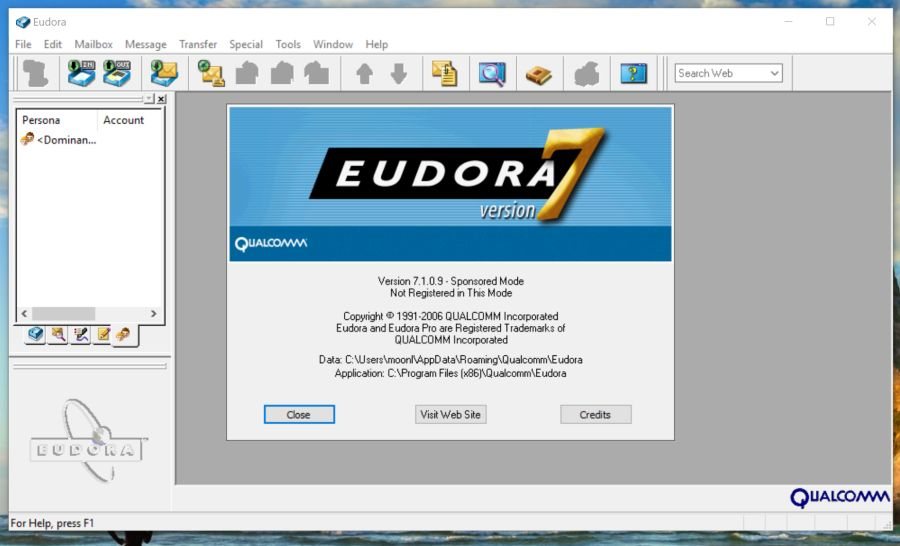
And then, slowly, it disappeared. The last Qualcomm version shipped on October 11, 2006. Version 7.1.0.9 for Windows. Version 6.2.4 for Mac. That was it. No new versions. No updates. Just discontinuation. Today, Eudora is remembered primarily by people who used it, which is to say it's almost entirely forgotten. This is the story of how the internet's first truly modern email client got replaced by webmail, and why that replacement feels inevitable in retrospect but was basically nobody's plan at the time.

Before Eudora, Email Clients Were a Disaster
You have to understand the baseline here. Before Eudora, email on personal computers was pretty rough. Email wasn't unified. You might check email from work on a different system than you checked email at home. There was no standardization. There were a bunch of competing protocols and terrible user interfaces. The experience of checking email was genuinely unpleasant. It required technical knowledge. It required patience.

And then in 1988, a graduate student named Steve Dorner at the University of Illinois Urbana-Champaign built Eudora. He built it for the Mac, because that's what he had access to. He built it with something like 50,000 lines of C code. And he named it after Eudora Welty, the Mississippi writer, specifically after her short story "Why I Live at the P.O." The tagline became "Bringing the P.O. to Where You Live," and if you think about it, that's actually a pretty good description of what email does.
Eudora worked. It had a clean interface. It had features that made sense once you saw them. It let you organize mail. It let you search. It let you set up filters so mail could be automatically processed and filed. These seem like obvious features now. In the early 1990s, they were not obvious. They were revelatory.
Dorner was working remotely from Illinois when Qualcomm licensed Eudora from the University of Illinois in 1991 and hired him to continue development. This is where the story gets interesting. Qualcomm is a telecom giant. They're in the business of networking, telecommunications, semiconductors. Email software seems like a weird thing for them to own. But they owned it, and they committed resources to it, and they built it into a dominant product through the 1990s.
The Three-Tier Model: Free, Sponsored, and Pro
One of the reasons Eudora became so dominant was their business model. They offered three tiers: Eudora Light, which was free. Eudora Pro, which was paid at $49.95. And Eudora Sponsored, which was free but showed advertising. This was a smart approach. It let everyone use the product. It got students using Eudora, which meant that when those students got jobs, they wanted to use Eudora at work. It let people try before they paid. And it gave Eudora users a choice about how they wanted to engage with the product.
By the late 1990s, Eudora had installed itself into the infrastructure of email. Businesses used it. ISPs recommended it. People used it at home and at work. Eudora's dominance wasn't fragile. It was structural. The revenue kept growing. The user base kept expanding. Eudora owned the segment of standalone email clients so completely that the question of what the second-place email client was seemed almost irrelevant.
Then, in 1999, the company started offering Eudora Sponsored, an ad-supported free version. This model had worked before, but ad-supported software was becoming more culturally sensitive. People didn't necessarily love the idea of advertisements in their email client. And by 2000, Eudora Sponsored had hit 1 million active users. Which sounds good until you realize it's 1 million people who would have been paying customers and instead were ad-supported users. The math got worse every year.
The real question is this: they weren't stupid. They just didn't see what was coming. Nobody did.
The Bundling Problem: How Microsoft Destroyed Eudora Without Really Trying
In 1997, Microsoft released Windows 95 with Outlook Express bundled in. Outlook Express was not as good as Eudora. It had fewer features. It was simpler, which was sometimes an advantage and sometimes a limitation. But it was free, and it came with Windows, and for a significant portion of computer users, having an email client pre-installed was enough. Why buy Eudora Pro when Outlook Express comes with your operating system?
This is essentially what every smartphone company did years later when they bundled email clients into iOS and Android. But in 1997, when it happened to Eudora, it was devastating. Eudora's install base started flattening. New users saw no reason to install a third-party email client when Windows came with one. Eudora's growth narrative broke. The user numbers that had been accelerating started stabilizing. The financial dynamics started shifting.
Qualcomm tried to adapt. They made Eudora more powerful, more feature-rich, more sophisticated. But sophisticated email clients are actually harder to use, and a lot of users just wanted simple email. And if they wanted simple email, why not use what came with their operating system?
Webmail Arrived and Changed Everything
Then Hotmail launched in 1996. This is where the logic starts to break down, at least from Qualcomm's perspective. Hotmail introduced the concept of email that you didn't need to install anything to access. You just went to a website. You logged in. You checked your email. You didn't need a client. You didn't need software. You just needed a web browser.
For people who checked email from multiple computers, webmail was enormously appealing. Eudora required you to set up email on each machine separately. Webmail just worked from any computer. For people with laptops who checked email on the road, webmail started looking like the future. You didn't need to download messages. You didn't need to manage storage. You just accessed your email from anywhere.
Hotmail grew incredibly fast. Microsoft bought Hotmail in 1997 and integrated it into their services. More competition in webmail launched. Yahoo Mail. AOL Mail. Webmail went from novelty to normal incredibly quickly. By the early 2000s, webmail was where email growth was happening. Desktop email clients were becoming artifacts of the previous era.
Gmail Arrived and Finished the Job
And then, in 2004, Google launched Gmail. Gmail was webmail, but it was webmail with conversation threading, powerful search, spam filtering that actually worked, and enough free storage that nobody ever needed to delete emails. Gmail was everything Eudora had been for the standalone client market, but delivered through a web browser instead of an application.
Gmail didn't kill Eudora overnight. But Gmail represented the end of an era. The real question is this: why would you use a desktop email client anymore? Why would you install software? Why wouldn't you just use Gmail? Gmail had everything. Search that worked. Organization that made sense. Accessibility from anywhere. No installation. No storage management. Just email.
Qualcomm's last version of Eudora shipped in October 2006, two years after Gmail's launch. It took two years for the company to acknowledge that the market had fundamentally changed. By then, it was already over. Email as a category had moved entirely to the web. Eudora was a remnant. An excellent remnant, but a remnant.
The Open Source Attempt: Too Late, Too Little
Qualcomm did try one more thing. They open-sourced Eudora as a project called Penelope, based on the Mozilla Thunderbird framework. The idea was that a community of developers could keep the software alive and relevant. But here's the thing: the market had already moved. Nobody was interested in developing or using a desktop email client anymore. The effort continued until around 2010, then was fully deprecated by 2013. The code was eventually donated to the Computer History Museum in 2018, where it sits as a historical artifact.
This is what happened to Eudora. Not a dramatic collapse. Not a technical failure. Just obsolescence. The email market shifted to webmail, and desktop clients became unnecessary. Eudora was the best desktop email client ever built. But desktop email clients stopped being relevant. The market didn't need the best desktop email client. It just needed email. And email, increasingly, existed on the web.
Why This Matters Now
Look at what happened: a company with dominant market position, a great product, significant revenue, and technical excellence got completely displaced because the category itself changed. This wasn't about execution. Qualcomm executed well. This was about the market fundamentally shifting from desktop software to web services. And once that shift happened, no amount of product quality could change the outcome.
This is a lesson that echoes through software constantly. Dominance in a shrinking market is just a slow decline. Eudora had 18 million users and owned 64.7 percent of email software revenue. And none of that mattered once email itself moved to the web. The category got disrupted. The leader in the old category got disrupted with it.
Eudora's legacy is weird because it's simultaneously huge and invisible. Eudora established conventions that every email client since has followed. Threading. Search. Filters. Good spam handling. Conversation views. Eudora did these things first and did them right. Gmail and every other email service since has built on Eudora's design language, probably without even realizing it. So Eudora won in design but lost in business. It taught the internet how to do email. And then it vanished.
The Transition Was Inevitable, But Not Obvious at the Time
This is the weird thing about Eudora's decline: there's no villain in this story. Qualcomm didn't make bad decisions. They made rational decisions based on available information. They controlled 64.7 percent of email software revenue. They had millions of users. Revenue was growing. And then the category itself shifted, and none of that mattered anymore. This happens in technology regularly, and it's almost always surprising to the people living through it.
The shift from desktop email to webmail wasn't obvious in 1996. Desktop email seemed like the natural evolution. You install software on your computer. It manages your email locally. You have control. You have privacy, sort of. You have your data on your machine. This seemed obviously superior to the idea of logging into a website to check email, which felt weird and fragile. It required internet connectivity every time. It meant your email was on someone else's servers.
But convenience beats theoretical concerns. Webmail was convenient. You could check email from any computer. You didn't need to set up clients on multiple machines. You didn't need to manage storage and downloads. It just worked. And as broadband internet became standard, the connectivity concern evaporated. As companies started offering more and more storage, the local storage argument disappeared. The advantages of desktop email just kept getting smaller.
By 2004, when Gmail launched, the outcome was already inevitable. Google didn't kill desktop email. Gmail just delivered the final blow to something that was already dying. Eudora's fate was sealed the moment webmail became practical. Which means it was sealed in the late 1990s, though nobody acknowledged it at the time.
What Qualcomm Got Right and Why It Still Didn't Matter
Qualcomm's business model decisions were actually quite good. The three-tier system worked. Free users who later paid. Corporate users who needed features. Students who became corporate users. The Sponsored tier created a revenue stream even when people didn't pay. From a pure business perspective, this was sound. And it worked. Eudora's revenue trajectory was upward through the 1990s and into the early 2000s.
The problem was that they were optimizing for a market that was disappearing. All the revenue in the world doesn't matter if the category you're dominating is being disrupted. This is the trap that every incumbent faces. You can be the best in a category. You can be profitable. You can be growing. And then the category itself becomes irrelevant, and all of your advantages become liabilities.
Sega faced this with arcades. Kodak faced this with film. Blockbuster faced this with video rental. Eudora faced this with desktop email. Dominance in an obsolete market is just a slow decline. You're still winning, right until you're not winning anymore. And by then, it's too late to reposition.
The Legacy: Eudora Defined What Email Should Be
Despite being completely forgotten by the general public, Eudora's influence on email design is massive and ongoing. Everything you expect from email, Eudora probably invented or popularized. Threading. Search. Filters. Spam handling. Organization. Conversation views. These seem obvious now because Eudora made them obvious. But they weren't obvious in 1988. Steve Dorner figured these things out and built them into Eudora, and every email system since has borrowed from that template.
Gmail's interface looks nothing like Eudora's, but Gmail's functionality is basically Eudora's design philosophy implemented for the web. Which is maybe the highest compliment you can pay a product: the category evolved to reflect your design decisions, even though everyone forgot you were the one who made them.
The Computer History Museum has Eudora's source code now. It sits there as a historical artifact, a reminder of when a company could own a category completely and still become irrelevant because the category itself became irrelevant. That's the real lesson of Eudora. Not that they made bad decisions. But that being the best at something that's becoming obsolete is the worst position you can be in.
The Business Model Mismatch: Charging for Software That Wanted to Be Free
One of the fundamental challenges Eudora faced was philosophical. The email client market wanted to move toward free. Outlook Express was free because it came with Windows. Netscape Navigator had an email client and it was free. The open source email clients were free. And then Eudora was charging $49.95 for Eudora Pro, or asking people to look at advertisements if they wanted the free version.
This positioned Eudora as a premium product in a market that was increasingly skeptical of premium pricing for commodity software. In 1995, when email was still somewhat exotic, people would pay $49.95 for a good email client. By 2000, when email was becoming ubiquitous, charging for email software seemed almost offensive. Why pay when you could get something free?
The Sponsored tier with advertising tried to bridge this gap, but advertising in software was becoming increasingly unpopular. People didn't like ads in their operating system. They didn't like ads in their applications. The ad-supported model worked for some software categories, but for something as personal as email, most users wanted it ad-free or free, not ad-supported. This left Eudora in an impossible position: charge for it and lose users to free alternatives, or offer it ad-supported and watch users complain about the ads.
Why Microsoft's Bundling Strategy Was So Devastatingly Effective
When Microsoft bundled Outlook Express with Windows 95, they weren't trying to destroy Eudora specifically. They were just including an email client with their operating system. But the effect was devastating. Every Windows computer came with an email client. Every computer manufacturer installed Windows. Every user who turned on a new computer saw Outlook Express sitting there, ready to use, with no need to install anything or pay any money.
This is the power of platform bundling. You don't need to make the best product. You just need to make a good enough product and bundle it with something that everyone needs. This strategy worked for Internet Explorer against Netscape. It worked for Outlook Express against every competing email client. And it set the stage for why Gmail, built on the platform of the web, would eventually dominate.
Qualcomm couldn't compete with this strategy because they weren't a platform company. They made software. They sold it to users. Microsoft was a platform company that used their platform to distribute software. Those are different games, and the platform company has structural advantages that a software company can't overcome. Eudora could be better than Outlook Express. It didn't matter. Outlook Express was already there. Already free. Already the default.
The Email Wars Were Fought on Three Different Battlefields and Nobody Noticed
The decline of Eudora actually happened across three distinct technology shifts, and it's easy to get confused about which one actually killed it. First, there was the shift from bundled email to free email clients. Outlook Express beat Eudora here because Microsoft could bundle for free. Second, there was the shift from desktop to webmail. Hotmail beat desktop clients because webmail didn't require installation. Third, there was the shift from free webmail to useful webmail. Gmail beat Hotmail and other webmail providers because Gmail actually worked well.
Eudora lost on the first battlefield. If they'd won there, they might have competed on the second. If they'd won on the second, they couldn't have competed on the third, because Gmail's advantages were in web infrastructure, not client software. But the first loss was decisive. Once Outlook Express had the installed base, Eudora's advantages evaporated. The trajectory was set. It just took a decade to complete.
The Open Source Attempt Was Noble and Doomed
When Qualcomm released Eudora as open source under the Penelope project, it was a genuinely interesting decision. They're acknowledging that the market for commercial email clients is gone. They're trying to keep the product alive through community contribution. They're being generous with intellectual property. And it failed completely, which tells you something about markets: open source only works when there's a market demand for the category. Nobody wanted an open source desktop email client because nobody wanted a desktop email client anymore.
The code was good. The product was still useful. But useful for a category that nobody cared about anymore is just irrelevance with good code. By 2010, when the open source effort was basically dead, Gmail had already won definitively. There was no market to capture. No users waiting to switch. No developers interested in maintaining a platform that was already obsolete.
Eudora's story ends not with a bang but with a museum donation. The Computer History Museum has the source code, preserved like all artifacts from eras that have fully passed. It's a fitting end. Not destroyed. Not forgotten. Just archived, with the understanding that this was important once, and now it's history.
FAQ: Questions About Eudora
Q: Was Eudora really used by 18 million people?
A: Yes, by December 1996. This was measured as installed base, not daily active users. But even accounting for that, Eudora had genuinely achieved dominant market position in desktop email clients. It was the clear market leader by a significant margin.
Q: Why didn't Eudora pivot to webmail?
A: Qualcomm did invest in webmail offerings, but they were always secondary to the desktop client. By the time they fully committed to webmail, Gmail had launched with better technology, better design, better infrastructure, and better funding. They couldn't compete. Sometimes being the leader in the previous category doesn't help you compete in the new one.
Q: Could Eudora still exist today?
A: Theoretically, yes. Thunderbird, which is based on the same Mozilla framework that the open source Eudora attempted to use, still exists and still has users. But nobody wants to use desktop email clients anymore. The ecosystem has moved entirely to web and mobile. A desktop-only email client can't compete with that reality.
Q: What made Eudora better than Outlook Express?
A: More features, better interface design, better search, better filtering, better organization tools. Outlook Express was simpler, which was sometimes an advantage. But Eudora was more powerful. The problem was that "simpler and free" beat "more powerful and paid" when the market had already shifted to webmail, which was even simpler.
Q: Did Steve Dorner continue working on email software after Eudora?
A: Dorner continued leading Eudora development at Qualcomm for many years. When desktop email clients became obsolete, so did the role. The transition from being the most important email software developer in the world to having an obsolete skill set happened very quickly.