What Happened to BlackBerry? The Phone That Ruled Before iPhone

2026-03-27 by 404 Memory Found

There was a time — and it wasn't that long ago — when seeing someone pull out a BlackBerry was like seeing them pull out a badge. It meant they were important. Executives, politicians, Wall Street traders, lawyers, journalists, celebrities — if you mattered, you had a BlackBerry. President Barack Obama famously fought the Secret Service to keep his. The devices were so addictive that the media coined a term for the compulsion: "CrackBerry." In 2006, Webster's New World College Dictionary named it the "Word of the Year."

Research In Motion, the Canadian company that made BlackBerry, wasn't just successful — it was dominant. At its peak, BlackBerry held over 50 percent of the U.S. smartphone market. The company's revenue hit approximately $20 billion a year. Its stock traded at nearly $150 a share. It employed thousands of engineers in Waterloo, Ontario, and was considered one of the most innovative technology companies on the planet.

Then Apple released the iPhone, and everything fell apart — not immediately, but with the slow, gathering inevitability of a glacier grinding a mountain into dust. Within six years of the iPhone's launch, BlackBerry's smartphone market share had fallen to effectively zero. The company that had defined mobile communication for a generation had been completely erased from the market it helped create.

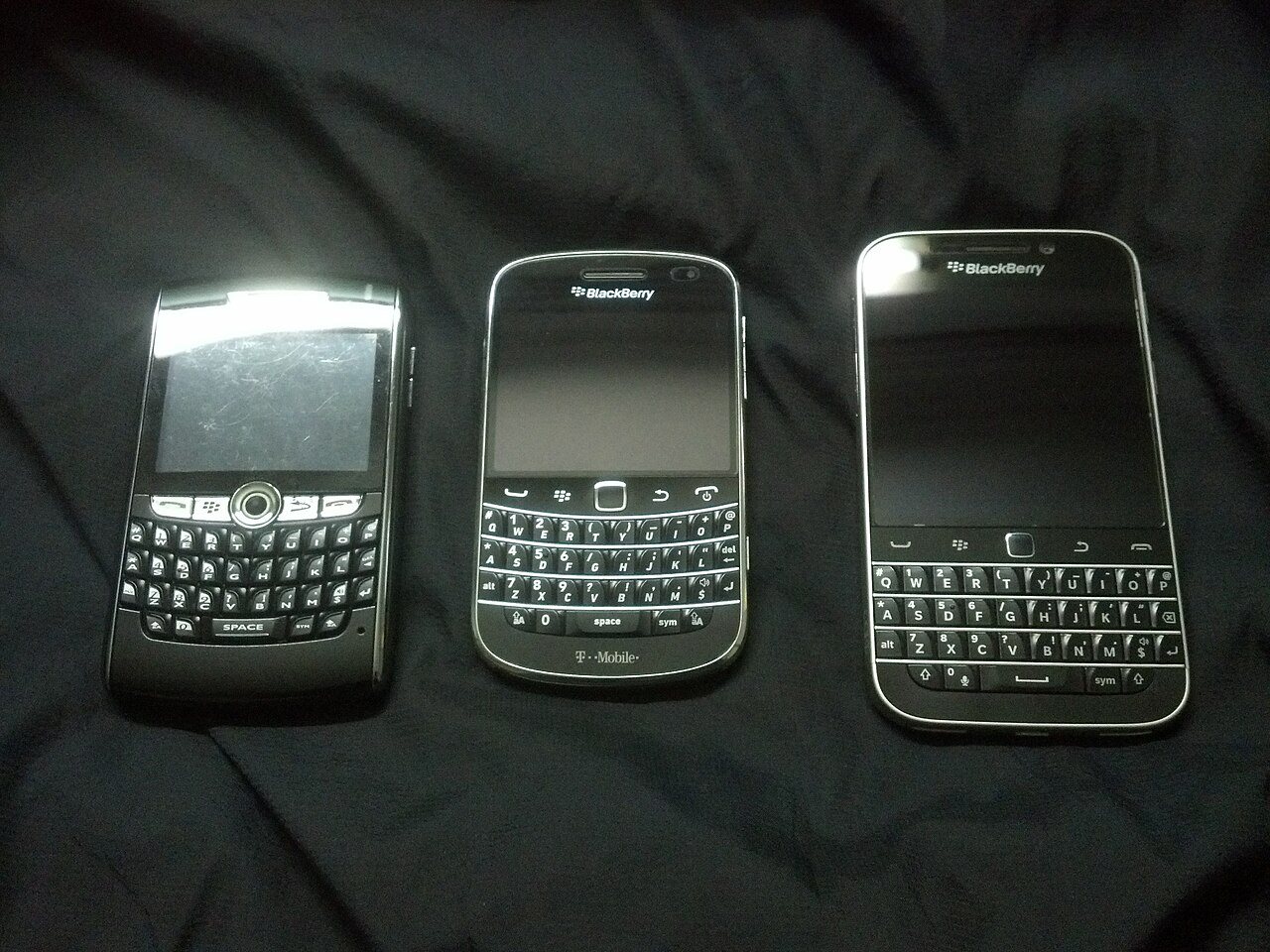
BlackBerry Bold 9900, one of the last iconic BlackBerry smartphones with the signature physical QWERTY keyboard
The BlackBerry Bold 9900 — one of the final iconic BlackBerry models, featuring the signature physical QWERTY keyboard that defined mobile communication for a generation.

Above a Bagel Shop in Waterloo

Research In Motion (RIM) was founded in 1984 by Mike Lazaridis, a 23-year-old electrical engineering student at the University of Waterloo in Ontario, Canada, along with his childhood friend Douglas Fregin. The company's first office was above a bagel shop in Waterloo — a detail that became part of Canadian tech mythology. Lazaridis dropped out of university just two months before graduating to pursue the company full-time, reportedly after winning a contract from General Motors.

For its first decade, RIM was a quiet, specialized company focused on wireless data technology. It built wireless point-of-sale terminals, developed barcode readers, and worked on wireless email infrastructure. The technology was niche, but Lazaridis was obsessed with a single question that would define the company's future: how do you efficiently transmit data over wireless networks?

In 1992, Jim Balsillie, a Harvard Business School graduate, invested $125,000 in RIM — reportedly remortgaging his house to do it — and joined as co-CEO. Balsillie brought something Lazaridis lacked: aggressive business instincts and a talent for deal-making. Together, the engineer and the dealmaker formed one of the most successful leadership duos in tech history.

The Pager That Changed Everything

RIM's breakthrough came in 1999 with the BlackBerry 850, a two-way pager with a tiny QWERTY keyboard that could send and receive email wirelessly. It wasn't a phone — you couldn't make calls on it — but it solved a problem that was becoming urgent for business professionals: how to stay connected to email while away from a desktop computer.

The timing was perfect. Email had become the dominant form of business communication, but in 1999, checking email meant sitting at a computer. Laptops existed but were heavy, expensive, and required a wired connection. RIM's insight was that people didn't need a full computer in their pocket — they just needed their inbox. The BlackBerry 850 delivered exactly that, with a keyboard small enough to type on with your thumbs and a wireless connection that kept messages flowing in real time using "push email" — a technology RIM pioneered that delivered new messages to the device instantly, rather than requiring the user to manually check.

The device spread through corporate America like wildfire, starting with Wall Street. Investment bankers and traders adopted it first, then lawyers, then executives across every industry. RIM's enterprise server software, BlackBerry Enterprise Server (BES), made it easy for corporate IT departments to deploy BlackBerry devices across entire organizations with centralized security and management. This was the key: RIM didn't just sell phones to individuals. It sold a complete, secure, managed communication platform to enterprises.

The Rise to Dominance

RIM introduced its first actual phone-capable device, the BlackBerry 5810, in 2002. It could make voice calls, though awkwardly — you needed a headset because the device had no built-in earpiece. The BlackBerry 6210 followed in 2003 with an integrated earpiece, and the transformation from pager to smartphone was complete.

The mid-2000s were BlackBerry's golden age. The Pearl (2006) was RIM's first consumer-focused device, sleek enough to compete with fashion phones. The Curve (2007) became one of the best-selling smartphones in history. The Bold 9000 (2008) was the flagship that cemented BlackBerry's reputation for premium build quality and the best physical keyboard ever put on a mobile device.

The numbers were staggering. RIM's revenue grew from $595 million in fiscal year 2005 to approximately $15 billion in fiscal year 2010, an increase of roughly 2,400 percent in five years. The stock price peaked at approximately $147.55 in June 2008. By September 2010, BlackBerry had approximately 22 million users in the United States alone, representing 37 percent of the 58.7 million American smartphones in use.

BlackBerry Messenger (BBM), the proprietary messaging service, became a cultural phenomenon in its own right. Before WhatsApp, before iMessage, before any other smartphone messaging app, BBM was how people communicated. In countries like Indonesia, Nigeria, and the UK, BBM's popularity was so intense that BlackBerry essentially became the dominant social network. Sharing your BBM PIN was the digital equivalent of exchanging phone numbers.

The iPhone Arrives — And RIM Laughs

On January 9, 2007, Steve Jobs walked onto the stage at Macworld and introduced the iPhone. The reaction inside RIM's Waterloo headquarters has been well documented: dismissal. Mike Lazaridis reportedly watched the keynote and focused on what the iPhone couldn't do. No physical keyboard. No enterprise email integration. No removable battery. The touchscreen keyboard was, in his view, unusable for serious email. "It's OK — we'll be fine," was the general sentiment.

Jim Balsillie was equally unconcerned. In a 2007 interview, he dismissed the iPhone's impact on RIM's enterprise stronghold. The logic wasn't unreasonable: the iPhone was expensive ($499 for the base model), it was locked to AT&T in the U.S., it didn't even have 3G connectivity at launch, and it had no app store. The device RIM should have feared was actually quite limited in its first incarnation.

The problem was that RIM confused the iPhone v1.0 with the iPhone as a platform. Apple's device improved dramatically with each generation. The App Store launched in July 2008 and fundamentally changed what a smartphone could be — suddenly it wasn't just about email, it was about everything. Meanwhile, Google's Android operating system launched in October 2008, creating a second touchscreen ecosystem that would further erode BlackBerry's position.

BlackBerry Curve 8520, the affordable consumer model that helped BlackBerry reach mass market adoption
The BlackBerry Curve 8520 — the affordable consumer model that helped BlackBerry reach mass-market adoption worldwide before the touchscreen revolution swept it away.

The Slow-Motion Collapse

BlackBerry's decline didn't happen overnight. In fact, RIM's revenue continued growing for several years after the iPhone launched. The company hit peak revenue of approximately $20 billion in fiscal year 2011 — four full years after the iPhone's introduction. But the growth was masking a fatal shift: BlackBerry was gaining lower-value customers in developing markets while hemorrhaging the high-value enterprise customers in North America and Europe who had been its core business.

In the United States, BlackBerry's installed base peaked at approximately 22 million users in September 2010, then began a rapid decline. Apple's installed base passed BlackBerry's in April 2011. By 2012, RIM's global smartphone market share had plummeted from about 20 percent to less than 5 percent.

RIM's response to the touchscreen revolution was catastrophically slow. The BlackBerry Storm, launched in November 2008 as RIM's first touchscreen device, was widely considered one of the worst smartphones ever made. Its "SurePress" clickable touchscreen was an awkward compromise that satisfied nobody — touchscreen users found it sluggish, and keyboard loyalists found it inferior to physical keys. The Storm's software was buggy, its browser was glacially slow, and its app ecosystem was virtually nonexistent.

The BlackBerry PlayBook tablet, launched in April 2011 to compete with the iPad, was another disaster. It shipped without native email, calendar, or contacts apps — core BlackBerry functionality — requiring users to tether it to a BlackBerry phone to access those features. The device was so poorly received that RIM eventually took a $485 million writedown on unsold PlayBook inventory.

The Leadership Crisis

As the business deteriorated, RIM's co-CEO structure became a liability. Lazaridis and Balsillie had complementary skills, but they increasingly disagreed on strategy. Lazaridis wanted to focus on engineering and the new BlackBerry 10 operating system. Balsillie pushed for deals and acquisitions, including a failed bid to buy an NHL hockey team (the Nashville Predators) that distracted from the company's mounting problems.

In January 2012, both Lazaridis and Balsillie stepped down as co-CEOs, replaced by Thorsten Heins, a German-born executive who had joined RIM in 2007. Heins inherited a company in freefall. On March 29, 2012, Balsillie resigned from the board entirely, and sold all his BlackBerry shares the following year. Lazaridis stepped down from the board on May 1, 2013.

Heins pinned the company's hopes on BlackBerry 10, a completely new operating system built on QNX technology that RIM had acquired in 2010 for $200 million. BB10 was supposed to be the platform that would make BlackBerry competitive again — a modern, touchscreen-first OS with the security and productivity features that had always been BlackBerry's strength.

BlackBerry 10: Too Little, Too Late

After years of delays that destroyed market confidence, RIM — which had officially rebranded itself as BlackBerry in January 2013 — finally launched BlackBerry 10 on January 30, 2013, alongside two new devices: the touchscreen Z10 and the keyboard-equipped Q10.

BlackBerry 10 was, by most accounts, actually a good operating system. It had an elegant gesture-based interface, strong multitasking, excellent keyboard prediction, and the enterprise security features BlackBerry was known for. The hardware was respectable. Some reviewers genuinely liked it.

But it was six years too late. By January 2013, Apple had sold over 500 million iOS devices. Android had captured the majority of the global smartphone market. The app ecosystem gap was insurmountable — BlackBerry 10 launched with roughly 70,000 apps compared to over 800,000 on iOS and 700,000 on Android. Developers had no incentive to build for a platform with negligible market share, and users had no incentive to buy a device with no apps. It was a death spiral from day one.

BlackBerry sold just 5.9 million smartphones in the quarter following the BB10 launch — far below expectations. By the third quarter of fiscal 2014, smartphone revenue had dropped to $1.2 billion, down from $3 billion the year before.

The Pivot: From Phones to Software

John Chen, a veteran tech executive, took over as CEO in November 2013 and began the painful process of transforming BlackBerry from a phone company into a software and security company. It was a radical pivot, but Chen saw clearly what others had been reluctant to admit: BlackBerry could not compete in hardware.

In 2016, BlackBerry stopped manufacturing its own smartphones entirely. It licensed the BlackBerry brand to TCL Communication, a Chinese electronics manufacturer, which produced Android-powered BlackBerry phones like the KeyOne (2017) and Key2 (2018) — devices that paired the iconic physical keyboard with Google's operating system. They were niche products that sold in small numbers.

TCL's license expired in August 2020 and was not renewed. A company called OnwardMobility briefly held the BlackBerry license with plans to release a 5G BlackBerry phone, but that venture collapsed in early 2022 without ever producing a device. On January 4, 2022, BlackBerry officially ended support for its legacy devices running BlackBerry OS and BlackBerry 10, cutting off services like BBM, phone calls, texting, and emergency calling on those devices.

In the last quarter of 2016, out of more than 432 million smartphones sold worldwide, only 207,900 were BlackBerry devices — effectively rounding to zero percent market share.

BlackBerry Today: The Software Afterlife

BlackBerry still exists as a company, though it bears almost no resemblance to the phone maker that once ruled mobile. Under John Chen's leadership, BlackBerry has pivoted to enterprise software and the Internet of Things (IoT). The company's QNX operating system — the same technology that powered BlackBerry 10 — is now embedded in over 255 million vehicles worldwide, running infotainment systems, instrument clusters, and advanced driver-assistance systems for automakers including BMW, Ford, and Honda.

BlackBerry also sells cybersecurity software under the Cylance brand (acquired for $1.4 billion in 2019) and enterprise endpoint management tools. Revenue has stabilized at around $500 million annually — a far cry from the $20 billion peak, but enough to keep the company alive.

The Waterloo campus is still there. The BlackBerry name still appears on the stock ticker (BB on the NYSE). But the phones are gone, the keyboards are gone, and the little red blinking notification light that once made millions of people reflexively reach for their pocket is gone forever.

Why BlackBerry Really Failed

BlackBerry's collapse is often reduced to "they didn't see the iPhone coming," but the reality is more nuanced:

  • They saw the threat but misunderstood it. RIM's leadership evaluated the iPhone based on its hardware specs and concluded it wasn't a serious competitor. What they missed was that Apple was building a platform — an ecosystem of hardware, software, services, and third-party apps that was greater than the sum of its parts.
  • The keyboard was a trap. BlackBerry's physical keyboard was genuinely superior for email, but it limited screen size. As smartphones became media consumption devices — for web browsing, video, apps, and games — the small screen became crippling. RIM couldn't abandon the keyboard without alienating its core users, but it couldn't keep the keyboard without falling behind.
  • Enterprise was a fortress that became a prison. BlackBerry's dominance in enterprise meant its entire culture, engineering, and business model were optimized for corporate IT departments. When the smartphone market shifted to consumer-driven, app-centric devices, BlackBerry simply didn't know how to compete in that world.
  • The co-CEO structure delayed critical decisions. Lazaridis and Balsillie's disagreements on strategy meant the company was slow to respond at exactly the moment speed was most critical. By the time unified leadership arrived under Heins and then Chen, it was far too late.
  • Software execution was disastrous. The BlackBerry Storm, the PlayBook, and the endless delays to BlackBerry 10 all demonstrated that RIM could not ship competitive software on time. In a market where Apple and Google were iterating annually, RIM's multi-year development cycles were fatal.

The Legacy of BlackBerry

For all its failures, BlackBerry's contributions to technology are permanent. It proved that mobile email could work. It pioneered push notifications. It demonstrated that smartphones could be essential business tools, not just gadgets. BBM was the template for every mobile messaging app that followed. And BlackBerry's enterprise security architecture influenced how every smartphone platform now handles corporate data.

There's a generation of professionals — roughly anyone who entered the workforce between 2000 and 2010 — for whom the BlackBerry was their first smartphone, their first experience with mobile email, their first taste of being truly connected. The little clicking sound of those tiny keys, the satisfying scroll of the trackball, the urgent blinking of the red notification light — these were the sounds and sensations of early 21st-century professional life.

The phones are gone. The company has moved on. But if you look closely at how the world communicates today — the push notifications, the instant messaging, the assumption that you're always reachable — you're looking at a world that BlackBerry built first.

FAQ

When was BlackBerry founded?
Research In Motion (RIM) was founded in 1984 by Mike Lazaridis and Douglas Fregin in Waterloo, Ontario, Canada. Jim Balsillie joined as co-CEO in 1992.

What was BlackBerry's peak market share?
In the United States, BlackBerry held approximately 50 percent of the smartphone market at its peak around 2007-2009, with about 22 million users by September 2010.

What was BlackBerry's highest revenue?
BlackBerry's annual revenue peaked at approximately $20 billion in fiscal year 2011.

What was BlackBerry's highest stock price?
RIM's stock price reached approximately $147.55 per share in June 2008.

Does BlackBerry still make phones?
No. BlackBerry stopped manufacturing its own phones in 2016. TCL produced licensed BlackBerry Android phones until 2020. The last attempt to revive BlackBerry phones, by OnwardMobility, collapsed in 2022 without producing a device.

What does BlackBerry do now?
BlackBerry is now a software company focused on cybersecurity (Cylance), enterprise IoT, and its QNX operating system, which powers automotive systems in over 255 million vehicles worldwide. Annual revenue is approximately $500 million.

When did BlackBerry phones stop working?
BlackBerry ended support for devices running BlackBerry OS and BlackBerry 10 on January 4, 2022, deactivating core services including phone calls and messaging on legacy devices.

Related Posts:
← Back to Blog

What Happened to BlackBerry? The Phone That Ruled Before iPhone | 404 Memory Found

📖 What Happened to BlackBerry? The Phone That Ruled Before iPhone

There was a time — and it wasn't that long ago — when seeing someone pull out a BlackBerry was like seeing them pull out a badge. It meant they were important. Executives, politicians, Wall Street traders, lawyers, journalists, celebrities — if you mattered, you had a BlackBerry. President Barack Obama famously fought the Secret Service to keep his. The devices were so addictive that the media coined a term for the compulsion: "CrackBerry." In 2006, Webster's New World College Dictionary named it the "Word of the Year."

Research In Motion, the Canadian company that made BlackBerry, wasn't just successful — it was dominant. At its peak, BlackBerry held over 50 percent of the U.S. smartphone market. The company's revenue hit approximately $20 billion a year. Its stock traded at nearly $150 a share. It employed thousands of engineers in Waterloo, Ontario, and was considered one of the most innovative technology companies on the planet.

Then Apple released the iPhone, and everything fell apart — not immediately, but with the slow, gathering inevitability of a glacier grinding a mountain into dust. Within six years of the iPhone's launch, BlackBerry's smartphone market share had fallen to effectively zero. The company that had defined mobile communication for a generation had been completely erased from the market it helped create.

BlackBerry Bold 9900, one of the last iconic BlackBerry smartphones with the signature physical QWERTY keyboard
The BlackBerry Bold 9900 — one of the final iconic BlackBerry models, featuring the signature physical QWERTY keyboard that defined mobile communication for a generation.

Above a Bagel Shop in Waterloo

Research In Motion (RIM) was founded in 1984 by Mike Lazaridis, a 23-year-old electrical engineering student at the University of Waterloo in Ontario, Canada, along with his childhood friend Douglas Fregin. The company's first office was above a bagel shop in Waterloo — a detail that became part of Canadian tech mythology. Lazaridis dropped out of university just two months before graduating to pursue the company full-time, reportedly after winning a contract from General Motors.

For its first decade, RIM was a quiet, specialized company focused on wireless data technology. It built wireless point-of-sale terminals, developed barcode readers, and worked on wireless email infrastructure. The technology was niche, but Lazaridis was obsessed with a single question that would define the company's future: how do you efficiently transmit data over wireless networks?

In 1992, Jim Balsillie, a Harvard Business School graduate, invested $125,000 in RIM — reportedly remortgaging his house to do it — and joined as co-CEO. Balsillie brought something Lazaridis lacked: aggressive business instincts and a talent for deal-making. Together, the engineer and the dealmaker formed one of the most successful leadership duos in tech history.

The Pager That Changed Everything

RIM's breakthrough came in 1999 with the BlackBerry 850, a two-way pager with a tiny QWERTY keyboard that could send and receive email wirelessly. It wasn't a phone — you couldn't make calls on it — but it solved a problem that was becoming urgent for business professionals: how to stay connected to email while away from a desktop computer.

The timing was perfect. Email had become the dominant form of business communication, but in 1999, checking email meant sitting at a computer. Laptops existed but were heavy, expensive, and required a wired connection. RIM's insight was that people didn't need a full computer in their pocket — they just needed their inbox. The BlackBerry 850 delivered exactly that, with a keyboard small enough to type on with your thumbs and a wireless connection that kept messages flowing in real time using "push email" — a technology RIM pioneered that delivered new messages to the device instantly, rather than requiring the user to manually check.

The device spread through corporate America like wildfire, starting with Wall Street. Investment bankers and traders adopted it first, then lawyers, then executives across every industry. RIM's enterprise server software, BlackBerry Enterprise Server (BES), made it easy for corporate IT departments to deploy BlackBerry devices across entire organizations with centralized security and management. This was the key: RIM didn't just sell phones to individuals. It sold a complete, secure, managed communication platform to enterprises.

The Rise to Dominance

RIM introduced its first actual phone-capable device, the BlackBerry 5810, in 2002. It could make voice calls, though awkwardly — you needed a headset because the device had no built-in earpiece. The BlackBerry 6210 followed in 2003 with an integrated earpiece, and the transformation from pager to smartphone was complete.

The mid-2000s were BlackBerry's golden age. The Pearl (2006) was RIM's first consumer-focused device, sleek enough to compete with fashion phones. The Curve (2007) became one of the best-selling smartphones in history. The Bold 9000 (2008) was the flagship that cemented BlackBerry's reputation for premium build quality and the best physical keyboard ever put on a mobile device.

The numbers were staggering. RIM's revenue grew from $595 million in fiscal year 2005 to approximately $15 billion in fiscal year 2010, an increase of roughly 2,400 percent in five years. The stock price peaked at approximately $147.55 in June 2008. By September 2010, BlackBerry had approximately 22 million users in the United States alone, representing 37 percent of the 58.7 million American smartphones in use.

BlackBerry Messenger (BBM), the proprietary messaging service, became a cultural phenomenon in its own right. Before WhatsApp, before iMessage, before any other smartphone messaging app, BBM was how people communicated. In countries like Indonesia, Nigeria, and the UK, BBM's popularity was so intense that BlackBerry essentially became the dominant social network. Sharing your BBM PIN was the digital equivalent of exchanging phone numbers.

The iPhone Arrives — And RIM Laughs

On January 9, 2007, Steve Jobs walked onto the stage at Macworld and introduced the iPhone. The reaction inside RIM's Waterloo headquarters has been well documented: dismissal. Mike Lazaridis reportedly watched the keynote and focused on what the iPhone couldn't do. No physical keyboard. No enterprise email integration. No removable battery. The touchscreen keyboard was, in his view, unusable for serious email. "It's OK — we'll be fine," was the general sentiment.

Jim Balsillie was equally unconcerned. In a 2007 interview, he dismissed the iPhone's impact on RIM's enterprise stronghold. The logic wasn't unreasonable: the iPhone was expensive ($499 for the base model), it was locked to AT&T in the U.S., it didn't even have 3G connectivity at launch, and it had no app store. The device RIM should have feared was actually quite limited in its first incarnation.

The problem was that RIM confused the iPhone v1.0 with the iPhone as a platform. Apple's device improved dramatically with each generation. The App Store launched in July 2008 and fundamentally changed what a smartphone could be — suddenly it wasn't just about email, it was about everything. Meanwhile, Google's Android operating system launched in October 2008, creating a second touchscreen ecosystem that would further erode BlackBerry's position.

BlackBerry Curve 8520, the affordable consumer model that helped BlackBerry reach mass market adoption
The BlackBerry Curve 8520 — the affordable consumer model that helped BlackBerry reach mass-market adoption worldwide before the touchscreen revolution swept it away.

The Slow-Motion Collapse

BlackBerry's decline didn't happen overnight. In fact, RIM's revenue continued growing for several years after the iPhone launched. The company hit peak revenue of approximately $20 billion in fiscal year 2011 — four full years after the iPhone's introduction. But the growth was masking a fatal shift: BlackBerry was gaining lower-value customers in developing markets while hemorrhaging the high-value enterprise customers in North America and Europe who had been its core business.

In the United States, BlackBerry's installed base peaked at approximately 22 million users in September 2010, then began a rapid decline. Apple's installed base passed BlackBerry's in April 2011. By 2012, RIM's global smartphone market share had plummeted from about 20 percent to less than 5 percent.

RIM's response to the touchscreen revolution was catastrophically slow. The BlackBerry Storm, launched in November 2008 as RIM's first touchscreen device, was widely considered one of the worst smartphones ever made. Its "SurePress" clickable touchscreen was an awkward compromise that satisfied nobody — touchscreen users found it sluggish, and keyboard loyalists found it inferior to physical keys. The Storm's software was buggy, its browser was glacially slow, and its app ecosystem was virtually nonexistent.

The BlackBerry PlayBook tablet, launched in April 2011 to compete with the iPad, was another disaster. It shipped without native email, calendar, or contacts apps — core BlackBerry functionality — requiring users to tether it to a BlackBerry phone to access those features. The device was so poorly received that RIM eventually took a $485 million writedown on unsold PlayBook inventory.

The Leadership Crisis

As the business deteriorated, RIM's co-CEO structure became a liability. Lazaridis and Balsillie had complementary skills, but they increasingly disagreed on strategy. Lazaridis wanted to focus on engineering and the new BlackBerry 10 operating system. Balsillie pushed for deals and acquisitions, including a failed bid to buy an NHL hockey team (the Nashville Predators) that distracted from the company's mounting problems.

In January 2012, both Lazaridis and Balsillie stepped down as co-CEOs, replaced by Thorsten Heins, a German-born executive who had joined RIM in 2007. Heins inherited a company in freefall. On March 29, 2012, Balsillie resigned from the board entirely, and sold all his BlackBerry shares the following year. Lazaridis stepped down from the board on May 1, 2013.

Heins pinned the company's hopes on BlackBerry 10, a completely new operating system built on QNX technology that RIM had acquired in 2010 for $200 million. BB10 was supposed to be the platform that would make BlackBerry competitive again — a modern, touchscreen-first OS with the security and productivity features that had always been BlackBerry's strength.

BlackBerry 10: Too Little, Too Late

After years of delays that destroyed market confidence, RIM — which had officially rebranded itself as BlackBerry in January 2013 — finally launched BlackBerry 10 on January 30, 2013, alongside two new devices: the touchscreen Z10 and the keyboard-equipped Q10.

BlackBerry 10 was, by most accounts, actually a good operating system. It had an elegant gesture-based interface, strong multitasking, excellent keyboard prediction, and the enterprise security features BlackBerry was known for. The hardware was respectable. Some reviewers genuinely liked it.

But it was six years too late. By January 2013, Apple had sold over 500 million iOS devices. Android had captured the majority of the global smartphone market. The app ecosystem gap was insurmountable — BlackBerry 10 launched with roughly 70,000 apps compared to over 800,000 on iOS and 700,000 on Android. Developers had no incentive to build for a platform with negligible market share, and users had no incentive to buy a device with no apps. It was a death spiral from day one.

BlackBerry sold just 5.9 million smartphones in the quarter following the BB10 launch — far below expectations. By the third quarter of fiscal 2014, smartphone revenue had dropped to $1.2 billion, down from $3 billion the year before.

The Pivot: From Phones to Software

John Chen, a veteran tech executive, took over as CEO in November 2013 and began the painful process of transforming BlackBerry from a phone company into a software and security company. It was a radical pivot, but Chen saw clearly what others had been reluctant to admit: BlackBerry could not compete in hardware.

In 2016, BlackBerry stopped manufacturing its own smartphones entirely. It licensed the BlackBerry brand to TCL Communication, a Chinese electronics manufacturer, which produced Android-powered BlackBerry phones like the KeyOne (2017) and Key2 (2018) — devices that paired the iconic physical keyboard with Google's operating system. They were niche products that sold in small numbers.

TCL's license expired in August 2020 and was not renewed. A company called OnwardMobility briefly held the BlackBerry license with plans to release a 5G BlackBerry phone, but that venture collapsed in early 2022 without ever producing a device. On January 4, 2022, BlackBerry officially ended support for its legacy devices running BlackBerry OS and BlackBerry 10, cutting off services like BBM, phone calls, texting, and emergency calling on those devices.

In the last quarter of 2016, out of more than 432 million smartphones sold worldwide, only 207,900 were BlackBerry devices — effectively rounding to zero percent market share.

BlackBerry Today: The Software Afterlife

BlackBerry still exists as a company, though it bears almost no resemblance to the phone maker that once ruled mobile. Under John Chen's leadership, BlackBerry has pivoted to enterprise software and the Internet of Things (IoT). The company's QNX operating system — the same technology that powered BlackBerry 10 — is now embedded in over 255 million vehicles worldwide, running infotainment systems, instrument clusters, and advanced driver-assistance systems for automakers including BMW, Ford, and Honda.

BlackBerry also sells cybersecurity software under the Cylance brand (acquired for $1.4 billion in 2019) and enterprise endpoint management tools. Revenue has stabilized at around $500 million annually — a far cry from the $20 billion peak, but enough to keep the company alive.

The Waterloo campus is still there. The BlackBerry name still appears on the stock ticker (BB on the NYSE). But the phones are gone, the keyboards are gone, and the little red blinking notification light that once made millions of people reflexively reach for their pocket is gone forever.

Why BlackBerry Really Failed

BlackBerry's collapse is often reduced to "they didn't see the iPhone coming," but the reality is more nuanced:

  • They saw the threat but misunderstood it. RIM's leadership evaluated the iPhone based on its hardware specs and concluded it wasn't a serious competitor. What they missed was that Apple was building a platform — an ecosystem of hardware, software, services, and third-party apps that was greater than the sum of its parts.
  • The keyboard was a trap. BlackBerry's physical keyboard was genuinely superior for email, but it limited screen size. As smartphones became media consumption devices — for web browsing, video, apps, and games — the small screen became crippling. RIM couldn't abandon the keyboard without alienating its core users, but it couldn't keep the keyboard without falling behind.
  • Enterprise was a fortress that became a prison. BlackBerry's dominance in enterprise meant its entire culture, engineering, and business model were optimized for corporate IT departments. When the smartphone market shifted to consumer-driven, app-centric devices, BlackBerry simply didn't know how to compete in that world.
  • The co-CEO structure delayed critical decisions. Lazaridis and Balsillie's disagreements on strategy meant the company was slow to respond at exactly the moment speed was most critical. By the time unified leadership arrived under Heins and then Chen, it was far too late.
  • Software execution was disastrous. The BlackBerry Storm, the PlayBook, and the endless delays to BlackBerry 10 all demonstrated that RIM could not ship competitive software on time. In a market where Apple and Google were iterating annually, RIM's multi-year development cycles were fatal.

The Legacy of BlackBerry

For all its failures, BlackBerry's contributions to technology are permanent. It proved that mobile email could work. It pioneered push notifications. It demonstrated that smartphones could be essential business tools, not just gadgets. BBM was the template for every mobile messaging app that followed. And BlackBerry's enterprise security architecture influenced how every smartphone platform now handles corporate data.

There's a generation of professionals — roughly anyone who entered the workforce between 2000 and 2010 — for whom the BlackBerry was their first smartphone, their first experience with mobile email, their first taste of being truly connected. The little clicking sound of those tiny keys, the satisfying scroll of the trackball, the urgent blinking of the red notification light — these were the sounds and sensations of early 21st-century professional life.

The phones are gone. The company has moved on. But if you look closely at how the world communicates today — the push notifications, the instant messaging, the assumption that you're always reachable — you're looking at a world that BlackBerry built first.

FAQ

When was BlackBerry founded?
Research In Motion (RIM) was founded in 1984 by Mike Lazaridis and Douglas Fregin in Waterloo, Ontario, Canada. Jim Balsillie joined as co-CEO in 1992.

What was BlackBerry's peak market share?
In the United States, BlackBerry held approximately 50 percent of the smartphone market at its peak around 2007-2009, with about 22 million users by September 2010.

What was BlackBerry's highest revenue?
BlackBerry's annual revenue peaked at approximately $20 billion in fiscal year 2011.

What was BlackBerry's highest stock price?
RIM's stock price reached approximately $147.55 per share in June 2008.

Does BlackBerry still make phones?
No. BlackBerry stopped manufacturing its own phones in 2016. TCL produced licensed BlackBerry Android phones until 2020. The last attempt to revive BlackBerry phones, by OnwardMobility, collapsed in 2022 without producing a device.

What does BlackBerry do now?
BlackBerry is now a software company focused on cybersecurity (Cylance), enterprise IoT, and its QNX operating system, which powers automotive systems in over 255 million vehicles worldwide. Annual revenue is approximately $500 million.

When did BlackBerry phones stop working?
BlackBerry ended support for devices running BlackBerry OS and BlackBerry 10 on January 4, 2022, deactivating core services including phone calls and messaging on legacy devices.

← Back to Blog
00:00