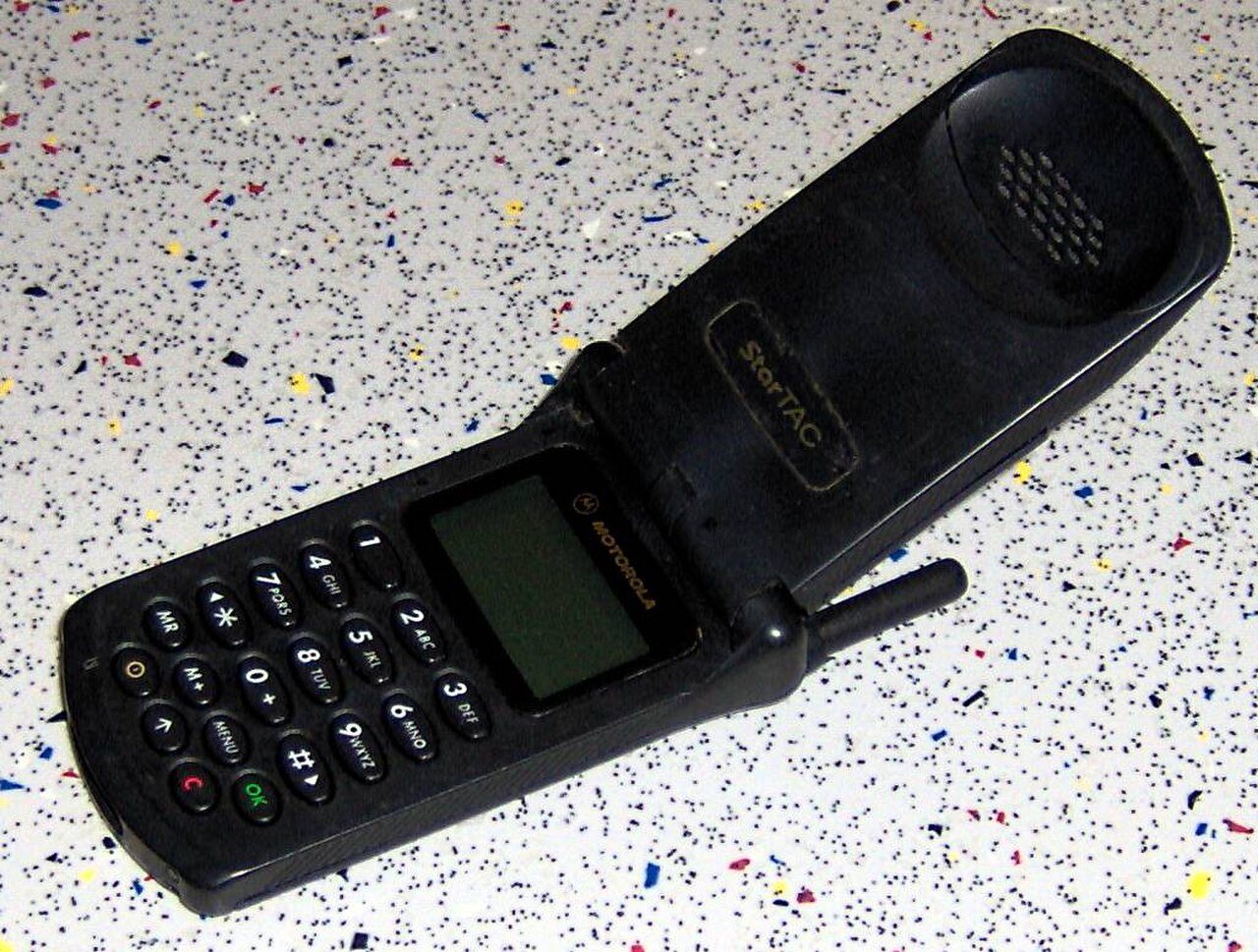
How Motorola got a cellular phone down to 3.1 ounces
Motorola introduced the StarTAC on January 3, 1996, as the successor to the MicroTAC, the flip phone it had been selling since 1989.
The launch release called it "the world's smallest and lightest cellular phone available today" and put it at about the size of a pager, 3.1 ounces in its lightest configuration. TIME later recorded the folded body at 3.7 inches by 2.1 inches by 0.75 inches.
The hinge was the real change. The MicroTAC's flip hung down from below the keypad, while the StarTAC folded up from above the display, so the finished phone closed into a single block small enough to disappear into a shirt pocket.
Two features did the rest of the work. The handset shipped with two lithium ion batteries and switched to the second one automatically when the first ran down, a system Motorola rated at up to four hours of continuous talk time or 47 hours of standby. The other was VibraCall, the setting that traded the audible ringer for a vibration so the phone could sit through a meeting without announcing itself.
Nothing else on an American carrier's shelf in 1996 did all of that at once.
Who actually paid full price for a StarTAC?
The StarTAC listed at $1,000 in the United States at launch. Very few people handed over that much.
Because of the price, the majority of StarTACs were bought with a carrier contract rather than directly from Motorola, with the carrier covering part of the handset cost in exchange for a service commitment. The sticker was also only the beginning, since monthly airtime was billed on top and the phone did nothing without it.
That split explains how one handset could be both a luxury object and a volume product. Motorola's own marketing leaned on the first idea, selling the StarTAC as a wearable cellular telephone rather than a pocket one, and the line is still described as the first fashionable cell phone.
How many sold is murkier than the price. Retrospective best-seller lists credit the StarTAC family with roughly 60 million units, but Wikipedia's list of best-selling mobile phones marks that figure as disputed, and Motorola never published an audited total for the line. Treat 60 million as an estimate that has been copied for 30 years, not a company number.
Was it really the first flip phone?
This is the claim that follows the StarTAC everywhere, and it depends on how the question is read.
TIME put it plainly in its 2010 gadget list, writing that "Not only was the StarTac the first clamshell mobile phone, it was also the first with a vibrate option." Peter Ha wrote that entry, and it ranked the phone 48th of 100.
The record is less tidy. NEC had been selling folding handsets on NTT Docomo's PDC Mova network in Japan years before 1996, starting with the TZ-804 in 1991, so the StarTAC was not the first clamshell to exist. What it was, clearly, is the first clamshell to sell in volume in the United States and the one that set the shape every later flip copied.
The vibrate claim holds up better. VibraCall was in the January 1996 launch material as a headline feature, at a moment when the alternative for a quiet room was carrying a pager as well as a phone.
Both of those ideas, the fold and the silent alert, went straight into the Motorola Razr V3 eight years later.
Does a StarTAC still make calls in 2026?
No. A StarTAC powers on, lights its display and keeps its contacts, and that is the end of it.
The reason is the networks, not the hardware. The first StarTACs were analog handsets, and American carriers finished retiring analog cellular service long ago. The digital StarTACs that followed used 2G, and that door closed this year as well. T-Mobile's network page states the position for the last holdout: "As of August 3, 2026, T-Mobile's 2G GSM network will be retired."
With that shutdown, no major United States carrier runs a network a StarTAC can register on, and carriers stopped activating non-LTE devices years earlier regardless of coverage.
So a StarTAC in 2026 is a desk object. It will charge if the battery still holds, the hinge still snaps, and the keypad still beeps. What it will not do is dial, which is the same wall that stops a Nokia 3310 working on an American SIM today.
Collectors buy them anyway, and the asking prices below reflect that.
How the 1996 sticker converts to 2026 money
Run the $1,000 list price through the Bureau of Labor Statistics consumer price index and it lands at about $2,150.
The arithmetic uses CPI-U, United States city average, all items, not seasonally adjusted: $1,000 multiplied by the October 2026 index reading of 337.511, divided by the 1996 annual average of 156.9. That is a multiplier of 2.15, so a 1996 dollar buys what about $2.15 buys now. The Bureau published the October 2026 reading on November 10, 2026.
Two caveats matter. The index tracks a household basket, so it says nothing about the gulf in capability between a 3.1 ounce voice phone and a 2026 handset. It also ignores sales tax and the service contract, both of which pushed the real cost of owning a StarTAC well past the shelf price.
For the same conversion applied to 40 other launch prices from the decade, see the 90s tech prices in 2026 dollars table.
Where to find one today
Working StarTACs are common, which keeps them cheap. Etsy sellers list a phone and charger lot from about $45, a tested StarTAC 3000 with its box and manual around $140, and a 6000E in the $110 range.
The exception is the StarTAC 70 Rainbow, which asks past $400 boxed. Lapel pins and dealer ephemera from the launch run $20 to $25.
Sellers rarely know which network a given unit was built for, and because none of them will connect in 2026 it makes little practical difference. What matters is cosmetic: a tight hinge, an intact battery door, a clean window over the display, and the belt clip and charger if you want the set complete. Ask for a photo of the phone both open and closed before paying.
Buy on condition of the hinge and the battery door, not on the listing photo of a lit screen, and assume any battery is dead. Browse vintage Motorola StarTAC phones on Etsy to see what sellers are asking this week.
Frequently Asked Questions
How much did the Motorola StarTAC cost in 1996?
The Motorola StarTAC listed at $1,000 in the United States when it launched on January 3, 1996, or about $2,150 in October 2026 dollars using the Bureau of Labor Statistics consumer price index. Most buyers paid less than list because carriers subsidized the handset in exchange for a service contract.
Does a Motorola StarTAC still work in 2026?
A Motorola StarTAC from 1996 still powers on, but it cannot make calls in 2026. The analog networks the first models used are gone, and T-Mobile retired the last major United States 2G GSM network on August 3, 2026, which removed the final network a digital StarTAC could use.
How much is a Motorola StarTAC worth today?
In November 2026, sellers ask roughly $45 to $140 for a used Motorola StarTAC, depending on whether the box, charger and manual are included. The boxed StarTAC 70 Rainbow is the outlier at more than $400, because the 1996 line sold in the tens of millions and ordinary units are not rare.