Why did Iridium fail?
Iridium failed because it sold a 1990 idea to a 1999 customer. The handset specification, the pricing and the subscriber forecasts all came from market work done by Motorola engineers at the start of the decade, when a business traveller landing in another country often had no way to use their phone at all.
By the time the network switched on in November 1998, ordinary cellular coverage had spread across most of the places those travellers actually went, and roaming agreements had filled in much of the rest.
The product made that gap obvious. An Iridium handset cost $3,000 and calls ran $3 to $8 a minute. The phone needed a clear view of the sky, which meant stepping outside a building and away from tall structures to place a call that a $50 handset could make from a hotel lobby for a fraction of the price.
The subscriber numbers followed. Iridium reported 10,294 subscribers for the first quarter of 1999 against an internal target of 27,000. By August the base had reached roughly 20,000, well under the 52,000 its loan covenants required. Nine months separated the first commercial call from the bankruptcy filing.
How a complaint from the Bahamas turned into 66 satellites
The idea started in 1985, when Motorola engineer Bary Bertiger was on holiday in the Bahamas and his wife could not reach her clients on her cellular phone. Bertiger, Raymond J. Leopold and Ken Peterson worked the problem into a design in late 1987, and Motorola patented it in 1988.
Their answer was to skip the towers entirely. Instead of a network of ground stations that stopped at the edge of the coverage map, a ring of low-orbit satellites would pass overhead everywhere on Earth, poles and oceans included, and hand calls between each other in space.
The first design called for 77 satellites, which is where the name came from: iridium is element 77 on the periodic table, and the constellation orbiting the planet looked like electrons around a nucleus. Engineers later worked out that 66 satellites would cover the globe. Element 66 is dysprosium, which did not have the same ring to it, so the name stayed.
Building it took about 11 years and roughly $5 billion. That is the number worth holding on to, because everything that happened after 1999 is a story about what that $5 billion turned out to be worth.
What did an Iridium phone cost in 1998?
Commercial service opened on 1 November 1998. The first call went from US Vice President Al Gore to Gilbert Grosvenor, chairman of the National Geographic Society and a descendant of Alexander Graham Bell, a piece of staging that told you exactly how the company saw itself.
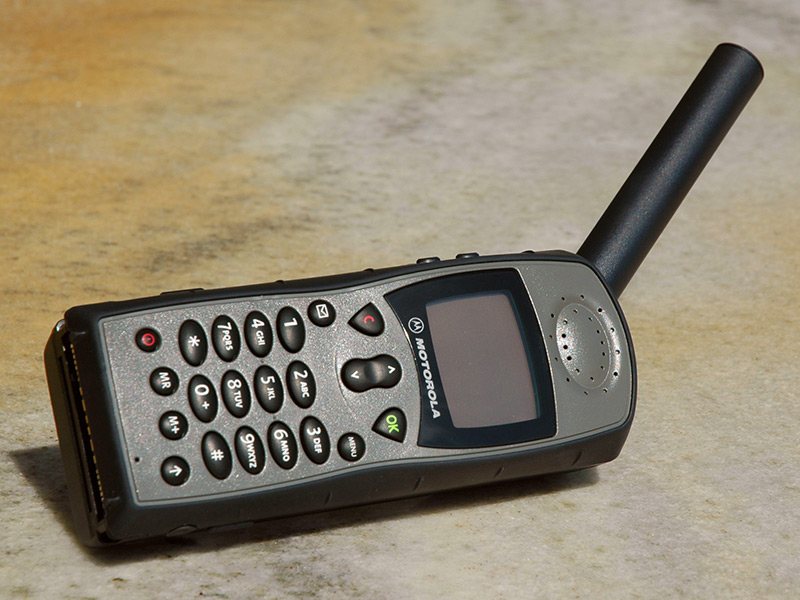
A handset cost $3,000. Airtime ran from $3 to $8 a minute depending on where the call went. The phone itself was a brick with a thick swivelling antenna, closer in size to a 1980s car phone than to the pocketable handsets that were selling by then. Motorola would spend the next few years proving it knew how to make small phones instead, a lesson that showed up in the Motorola RAZR V3.
The economics only worked for customers with no alternative: ships, oil rigs, remote mining sites, aid agencies, film crews and armies. Those customers existed, and Iridium still serves them. There were just never enough of them at those prices to service the debt on a $5 billion constellation.
The sales operation also had to explain, country by country, that a phone bought in one place could be used everywhere, which ran into local licensing rules and distribution partners who had little reason to hurry.
How fast did the collapse happen?
Fast enough that the satellites were still being commissioned while the company was running out of money. Chief executive Edward Staiano, who had come from Motorola, announced he was leaving in April 1999 after a disagreement with the board over strategy. The first quarter subscriber number, 10,294, was published the following month.
By the summer, Iridium was in default. Two days after missing payments on $1.5 billion of loans, on 13 August 1999, Iridium LLC filed for Chapter 11 protection in New York. Contemporary reports placed it among the 20 largest bankruptcies in United States history at that point.
The filing relieved the company of interest payments on about $5 billion of debt, which cut its costs sharply, but it could not manufacture subscribers. Attempts to restructure through 1999 and into 2000 failed to produce a buyer at anything close to the money spent.
What made this failure different from the dot-com collapses that followed is that Iridium had shipped. The technology worked. Calls connected from the middle of the Pacific. The thing that did not work was the arithmetic, in the same way it did not for Excite@Home's broadband bet.
How did $5 billion of satellites sell for $25 million?
Because the alternative was burning them. Motorola, which operated the constellation, had prepared to bring the satellites down through the atmosphere rather than keep paying to fly them for a company that no longer existed.
A group led by Dan Colussy, a former chief executive of UNC Inc, spent 2000 assembling a bid. In November 2000, US Bankruptcy Judge Cornelius Blackshear approved the sale of the 72 orbiting satellites to the Colussy group for $25 million. Three rival bids were rejected, including one for $100 million, because the bidders had not posted the required $1.5 million deposit.
The piece that made the numbers work was a customer. In December 2000 the Defense Information Systems Agency awarded a two-year, $72 million contract, worth $36 million a year, giving 20,000 government users unlimited airtime on the network. Commercial service relaunched on 30 March 2001 under the new owner.
So the constellation that cost about $5 billion to build changed hands for roughly half a cent on the dollar, kept flying, and has been in continuous service ever since.
Is Iridium still around in 2026?
Yes, and it is public. A special purpose acquisition company, GHL Acquisition Corp, bought Iridium Holdings on 29 September 2009 and renamed itself Iridium Communications, trading on Nasdaq as IRDM.
The original satellites are gone. Between January 2017 and 11 January 2019, SpaceX launched all 75 Iridium NEXT replacements across eight Falcon 9 missions, giving the company 66 active satellites plus nine in-orbit spares. The last of the original satellites was deorbited on 5 December 2019, which also ended the Iridium flares, the brief mirror-bright flashes the old antenna panels threw across the night sky at up to magnitude -8.
The business is unrecognisable from 1999. Iridium ended 2025 with 2,537,000 total billable subscribers and reported service revenue of $634.0 million for the year, most of it from tracking devices, ships, aircraft and machine-to-machine hardware rather than voice calls.
Putting satellite calling directly into ordinary phones has been harder. Qualcomm announced Snapdragon Satellite with Iridium at CES in January 2023, then terminated the agreement in November 2023 after handset makers declined to build the feature in.
Where to find one today
The original Motorola-built handsets turn up regularly on eBay. Recent listings ran from about $70 for parts-only units up to roughly $425 for a working 9505 with battery and antenna, which is a strange fate for a $3,000 phone that once needed a $5 billion network behind it. Dedicated hardware being swallowed by the phone in your pocket is the same arc that finished off standalone GPS units.
Frequently Asked Questions
Why did Iridium go bankrupt?
Iridium filed for Chapter 11 on 13 August 1999, two days after defaulting on $1.5 billion of loans, because it had signed up roughly 20,000 subscribers against loan covenants requiring 52,000. Ordinary cellular networks had expanded faster than the 1990 forecasts the business plan was built on, and $3,000 handsets with $3 to $8 per minute airtime could not compete with them.
How much did an Iridium satellite phone cost in 1998?
The handset cost $3,000 when commercial service began on 1 November 1998, and calls were billed at $3 to $8 a minute depending on the route. Used Motorola 9505 handsets now sell on eBay for roughly $70 to $425 depending on condition.
Is Iridium still in business today?
Yes. Iridium Communications trades on Nasdaq as IRDM, flies 66 active Iridium NEXT satellites launched by SpaceX between 2017 and 2019, and ended 2025 with 2,537,000 billable subscribers and $634.0 million in annual service revenue.