The honest answer: most discs are worth under $5
A box of LaserDiscs found in a garage is almost always a box of common titles, and common titles are close to worthless. Widescreen Review's 2025 survey of the market put many LaserDiscs at a dollar or less.
The value sits in a thin top layer. The same survey placed most genuinely collectible discs in the $20 to $50 range, which means ten good titles might come to $200 or $500 rather than a windfall.
That top layer is real, though. A small number of pressings have sold for hundreds of dollars, and one has reached a reported $5,700.
So the answer depends entirely on which discs are in the box. LaserDisc never had the mass-market second life that vinyl got, and it is not going to get one. What it has instead is a small group of buyers chasing a small group of pressings, closer to the market around Sony's MiniDisc than to anything on a store shelf.
Which titles carry real money, and why
Three things push a LaserDisc into three-figure territory: a late release date, a Japanese pressing, or extras that never moved to any later format.
Late releases are the easiest rule to apply. By 1999 the format was dying in the United States, so studios pressed small runs of big movies. Widescreen Review lists The Matrix at up to $160 and Star Wars: The Phantom Menace at up to $35, and puts Pulp Fiction near $999 at the top of its recorded sales.
The most expensive disc is the one that ended the format. Paramount released Martin Scorsese's Bringing Out the Dead on October 3, 2000, the last LaserDisc issued by a major studio in the United States. Japan kept pressing for another year, and in September 2001 the Hong Kong action film Tokyo Raiders became the last LaserDisc released anywhere. Copies have sold for as much as $5,700.
None of those are prices anyone should count on. They are ceilings set by a handful of collectors, and condition decides the rest.
Why so few Americans ever owned one
LaserDisc reached American stores in 1978 under the MCA DiscoVision name, with Jaws as the first movie released on the format in the United States.
The player was the obstacle. The Magnavox VH-8000, the first consumer LaserDisc player sold in the United States, cost $749 in 1978. A VHS deck was expensive too, but VHS could record and LaserDisc could not, the same practical advantage that had already decided the Betamax and VHS format war.
The result was a format for enthusiasts. By 1998, LaserDisc players were in about 2 percent of American households, roughly two million homes. In Japan, where players and discs were priced much closer to tape, they reached 10 percent of households in 1999.
That gap explains a lot about the market now. Japanese pressings are more numerous, they are often better mastered, and they carry titles that never got a release in the United States at all, which is why so many of the expensive discs are imports.
Does laser rot destroy the value?
Laser rot is the biggest risk in buying LaserDiscs unseen, and despite the name it has nothing to do with the laser. It is oxidation: the aluminum reflective layer loses its shine, the picture fills with speckles, and eventually the disc stops tracking.
The cause was manufacturing, not use. Impurities in the adhesive that bonded the two halves of a disc worked through the lacquer seal and attacked the metal underneath. A disc that was never played can rot just as readily as one played hundreds of times.
That gives collectors a pattern to work with. Double-sided discs rot and single-sided discs largely do not. Early MCA DiscoVision pressings from the late 1970s were badly affected, and Sony's DADC plant in Terre Haute, Indiana kept turning out rot-prone discs into the 1990s, after most other plants had fixed the problem.
For a buyer that means the pressing plant matters as much as the title on the sleeve. A rotted disc is worth nothing no matter what a clean copy sells for, which is why serious buyers ask for photographs of the playing surface before money changes hands.
The Criterion premium and the first commentary track
The Criterion Collection started on LaserDisc in 1984, and its discs still carry the strongest premium of any American label.
Criterion's King Kong release did something no home video edition had done before. For its 1984 LaserDisc of the 1933 film, the company recorded film historian Ronald Haver talking over the movie on a separate analog audio channel. "I'm going to take you on a lecture tour of King Kong as you watch the film," Haver says at the start of that 1984 commentary, which invented the bonus feature more than a decade before DVD existed.
Criterion expected the track to interest film students and almost nobody else. It became a standard instead, and Haver kept recording commentaries for the label.
That history is why Criterion LaserDiscs hold value even when the film itself is streaming. Some of those supplements were never carried over to later formats, so the disc is the only place the material exists. Owners who want the content rather than the object end up transferring it themselves, the same calculation people make with old VHS tapes.
Can you still play a LaserDisc in 2026?
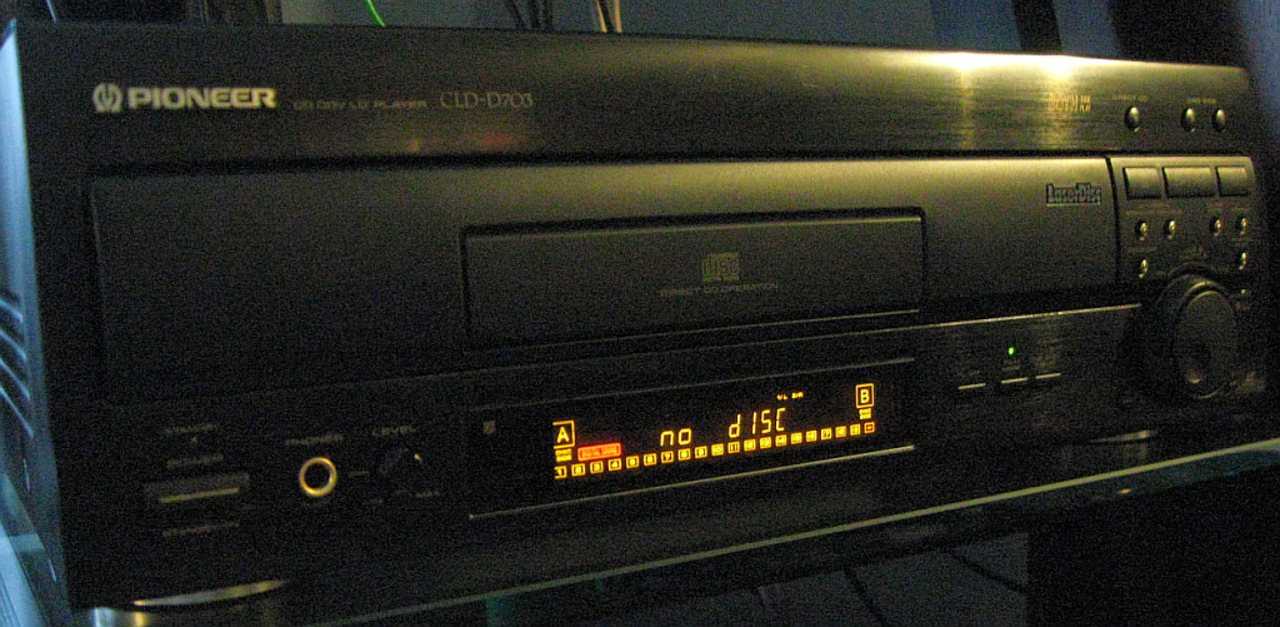
Yes, but only on hardware that has not been built since 2009. Pioneer announced on January 14, 2009 that it was ending LaserDisc player production after one final run of 3,000 units. The company's news release blamed supply rather than demand: "it has become difficult for Pioneer to procure the parts required to produce LD players."
Pioneer had shipped more than 9.5 million players worldwide by then, out of roughly 16.8 million LaserDisc players sold by all manufacturers. That is the entire installed base, and it has been shrinking through failure ever since.
Players are the real constraint on prices. Laser diodes dim, drive belts perish, and the loading mechanisms on older units are usually the first thing to fail. Every dead player removes a buyer from the disc market, which is part of why value concentrates in a few dozen titles instead of spreading across thousands of them.
Where to find one today: common LaserDiscs turn up for a few dollars, most collectible titles sit in that $20 to $50 band, and sealed or late-run pressings go well above it. The LaserDisc listings on Etsy are a reasonable place to start, and a working player is worth budgeting for separately.
Frequently Asked Questions
Are LaserDiscs worth anything in 2026?
Most LaserDiscs are worth very little. Widescreen Review's 2025 market survey found that many sell for a dollar or less, while genuinely collectible LaserDisc titles sit in the $20 to $50 range and a small number of scarce pressings reach the hundreds. Condition and the pressing plant matter as much as the film itself.
What is the most valuable LaserDisc?
Tokyo Raiders, a Hong Kong action film issued on LaserDisc in Japan in September 2001, is the highest priced title on Widescreen Review's 2025 list, with copies selling for as much as $5,700. It was the last LaserDisc released anywhere, which is exactly why so few of them exist.
Can you still buy a LaserDisc player?
Not a new one. Pioneer, which built more than 9.5 million of the roughly 16.8 million LaserDisc players ever sold, stopped production on January 14, 2009 after a final run of 3,000 units. Every LaserDisc player on the market in 2026 is second-hand, and laser diodes and loading mechanisms are the usual failure points.