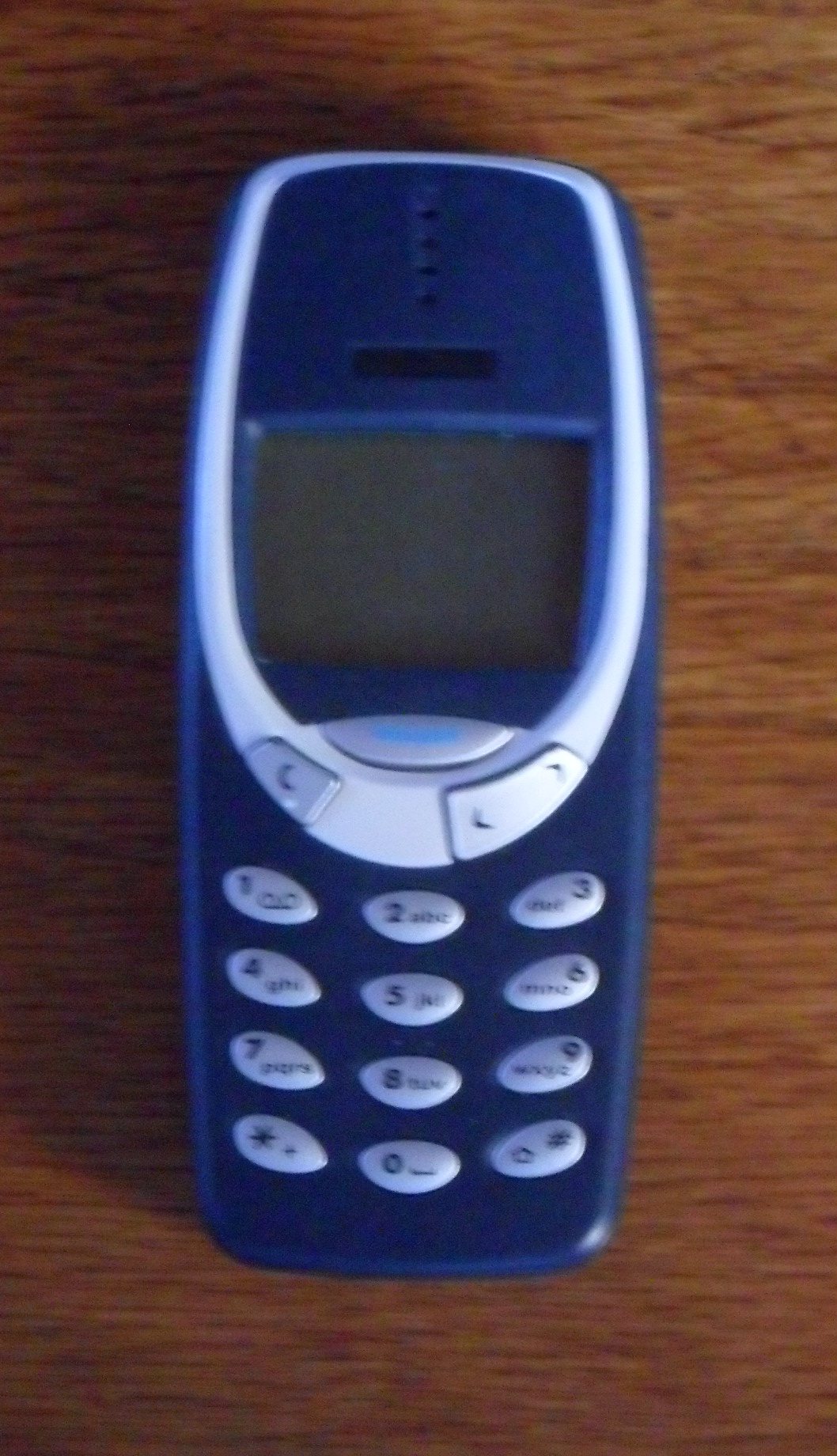
Picture this. It is the autumn of 2000, and you are standing in a Cingular Wireless kiosk at the mall, holding a Nokia 3310 in your palm for the first time. The thing is hilariously small by year 2000 standards. It feels solid in a way that feels expensive but also somehow casual. The screen is monochrome, the keypad has these chunky tactile buttons that click when you press them, and the back is some swappable plastic shell in a color you actually picked out. A salesperson is telling you the battery lasts a week. You are pretty sure he is exaggerating, but he is not. Nothing about this device looks like the future. Everything about this device feels indestructible.
Twenty-six years later, that exact same phone is still a meme. Still in drawers. Still in headlines whenever someone drops one and it survives a fall that would have shattered an iPhone into glittering pieces. The Nokia 3310 sold 126 million units, became the punchline of an internet joke that refuses to die, and got resurrected from the grave in 2017 because too many people would not let it go. This is the story of how a small Finnish company built a phone so good it accidentally turned into a cultural symbol, and then watched that exact symbol outlive the company itself.
Finland in 2000: When Nokia Owned the World
To understand the Nokia 3310, you have to understand what Nokia actually was in the year 2000. This was not some plucky underdog. This was the absolute peak of the company. Nokia held about 30 percent of the global mobile phone market that year, almost twice the share of its nearest competitor Motorola. At its peak, Nokia represented roughly 4 percent of Finland's entire GDP, 21 percent of total Finnish exports, and 70 percent of the market capitalization of the Helsinki stock exchange. Let that sink in for a second. One company. One small Northern European country. The kind of dominance you usually only see in textbook chapters about Standard Oil.
And the wild part? They were not famous for any one phone. They were famous for making phones that just worked. Reliable. Practical. The phone in your dad's coat pocket was a Nokia. The phone your aunt finally caved and bought was a Nokia. The phone every European kid was begging their parents for during high school was a Nokia. They had the supply chain locked down, the carrier relationships dialed, the hardware quality tuned to a level nobody else could match.
The 3310 was supposed to be a follow-up. Nothing more. The Nokia 3210 had launched in 1999 and absolutely crushed it, selling something like 160 million units over its lifetime. The 3310 was meant to be the iterative refresh. A little smaller, a little better screen, a little more polish, swappable covers, a slightly different vibe. Nokia announced it on September 1, 2000, and shipped it to retail in the fourth quarter. Retail price across Western Europe was somewhere in the 129 to 159 euro range, which translated to roughly $120 to $150 in American money at the time. Cheap enough to be an upgrade. Expensive enough to feel real.
And here is the thing that was different about it: it felt good in your hand. That sounds like marketing fluff but it is not. The 3310 was 113 grams. It fit in a pocket. The keypad had this satisfying click that you could feel through your thumb. The corners were rounded just enough to not jab into your thigh when you sat down. Whoever designed this phone was thinking about how you actually carried it, not just how it looked on a shelf.
The Indestructibility Was Not a Marketing Claim
Here is where the legend starts. The Nokia 3310 was not advertised as indestructible. Nokia did not run ads claiming it could survive a fall from a building. The whole "indestructible Nokia" thing was a folk legend that grew up over a decade because too many people had the same experience. They dropped the phone. The phone did not break. They dropped it again. The phone still did not break. They put it through the laundry, sat on it, ran it over with a bicycle, threw it across the room in frustration over a lost game of Snake. And the phone just kept working.
The reason for this is not magic. It is just good engineering and a complete absence of fragile components. The 3310 had no glass screen. The display was a tiny 84 by 48 pixel monochrome panel buried under a thick plastic window. There was no touchscreen to crack. No camera lens to scratch. The internal components were soldered to a stiff motherboard that fit inside a chassis with almost no air gaps, which meant nothing rattled loose when you dropped it. The plastic shell was thick. The battery was a brick. The whole device was basically a small block of polymer with some electronics in the middle.
Compare that to a modern phone, which is essentially a sandwich of two glass sheets glued together with a slab of aluminum in the middle and a battery designed to bend if you breathe on it wrong. The 3310 had nothing to break because Nokia engineers had built it for people who would drop it, not for people who would baby it. They expected real human use, including the kind of real human use where you fling it at a wall.
Snake II: The Mobile Game Before Mobile Gaming
If you owned a 3310, you played Snake II. There is no version of this story where you did not. The phone shipped with four games, technically. Pairs II was a memory match thing. Space Impact was a side-scrolling shooter. Bantumi was a digital version of an African strategy game most Americans had never heard of. But Snake II was the one. Snake II was the reason classes ran long and meetings dragged and people missed bus stops.
The original Snake had been on the Nokia 6110 since 1997. Snake II added more features. You had walls you could pass through. You had different mazes. You had bonus items that gave you extra points. You had four difficulty levels. The graphics were the same chunky black-on-grey blocks, but the gameplay was tighter. And because the 3310's screen had slightly better resolution than its predecessors, the game felt smoother.
If you were a teenager in 2001 and you got a 3310, you spent the first two weeks of ownership trying to beat your high score on Snake II. Then you spent the next year refusing to give your phone to anyone else because you knew they would mess up your save.
What Snake II actually did, beyond being addictive, was prove that mobile gaming was a real thing people wanted. This was years before the App Store. Years before mobile gaming was a market category anyone took seriously. Snake II was a game that came on your phone for free, and millions of people played it for hundreds of hours. The lesson Nokia could have taken from this was that mobile gaming was about to be massive. The lesson Nokia actually took was that they should keep including Snake II on phones. Which is, honestly, an extremely Nokia move.
Xpress-on Covers and the Customization Thing
One of the genuinely smart moves with the 3310 was the Xpress-on covers. The phone was designed so the front and back plastic shells could be swapped out by the user. You popped the back off to access the battery, and you could pop the front off too. This meant Nokia could sell you a new color shell for $20 instead of a new phone for $200, and it meant third-party manufacturers could sell you covers in literally any design imaginable.
And they did. By 2002, you could walk into a phone shop or a mall kiosk and buy a 3310 cover with the Tasmanian Devil on it, or a chrome metallic finish, or a faux-wood texture, or your favorite soccer team's logo, or a pattern of cartoon flames. It was the original phone case industry, and it was massive. People who could not afford a new phone could still feel like they had a new phone every few months. Teens who wanted their phone to feel like theirs could mod it without voiding the warranty. The customization layer turned the 3310 from a device into something more like a fashion accessory you happened to make calls on.
This was also genuinely innovative for the time. Most consumer electronics in 2000 were sealed black bricks designed to look the same forever. The 3310 said the opposite: this is yours, change it, make it weird. The lesson got lost over the next decade as smartphones moved toward sealed unibody designs, and we are only now getting back to anything close to that level of personalization through cases and skins.
The Battery Life Was the Actual Superpower
This is the part that hits hardest if you grew up on phones. The Nokia 3310 had a 900 mAh removable nickel metal hydride battery. Nokia rated it for up to 260 hours of standby and around 4.5 hours of talk time. In real-world use, where most people barely talked on the phone and mostly just had it sitting in their pocket waiting for a call, you got something like five to seven days of normal use between charges.
Five days. Seven days. On a 900 mAh battery from 2000. Compare that to a modern flagship smartphone, which has a 4,000 to 5,000 mAh battery, a chip designed in a 3 nanometer process, hardware-accelerated AI, and dies after about a day of moderate use. The 3310 was not running a multi-tasking operating system. It was not powering a 6.7 inch OLED display at 120 hertz. It was running a stripped-down proprietary Nokia OS called Series 20, which existed mostly to make calls, send SMS messages, run a calculator, and play Snake. The whole point was efficiency. The chip used almost no power. The display used almost no power. The radio modem was the most power-hungry part of the phone, and it was idle 99 percent of the time.
What this meant practically was that you forgot you needed to charge your phone. You charged it on Sunday night. You did not think about it again until the following Friday or Saturday when the low battery beep started. There was no anxiety about whether your phone would last the day. There was no carrying a charger to a coffee shop. There was no battery percentage living rent-free in your brain. The 3310 freed you from a problem we did not even realize we had until smartphones gave it back to us.
SMS and the Great Unanticipated Revolution
SMS messaging existed before the Nokia 3310. It had been part of the GSM standard since 1992. But it was the 3310 that made it a mass-culture phenomenon, because the 3310 was the phone everyone in your circle had. Once everyone has the same device, the network effect kicks in. And once you can fire off a 160-character message to anyone you know for the cost of a few cents, the way humans communicate fundamentally changes.
The 3310 had a few SMS innovations that mattered more than people gave them credit for. It supported predictive text input via T9, which made typing roughly twice as fast as multi-tap. It supported long messages by automatically chaining multiple SMS together up to a 459-character limit. It had a "chat" view that grouped messages from the same contact into a back-and-forth conversation, which is wild to think about because that interface is now the default everywhere and the 3310 was one of the first phones to do it.
You sent texts. Lots of texts. Coordinating where to meet. Asking your crush what they were doing. Confirming pizza orders. Telling your mom you were on the bus. Forwarding terrible jokes. The 3310 turned text messaging from a niche carrier feature into the default mode of communication for millions of people. The whole emotional shape of what mobile communication would become, the awkward silences, the typing-bubble anxiety, the carefully worded one-line message you sent to someone you liked, all of it can be traced back to a generation of people learning to type with their thumbs on a Nokia 3310 keypad.
The Decline: Color Screens, Cameras, and the End of an Era
So what killed the Nokia 3310? It was not one thing. It was the slow, inevitable march of feature creep that happens to every successful consumer product. Once color screens became affordable, customers wanted color screens. Once camera phones became viable, customers wanted cameras. Once polyphonic ringtones replaced monophonic ringtones, the 3310's tinny 35-tone library started to sound dated. The 3310 was a single-purpose device built when single-purpose was acceptable. The market wanted multi-purpose.
Nokia did what any company would do. They iterated. The 3310 was succeeded by the Nokia 3410 in 2002, which added a color-capable display and a primitive Java runtime for downloadable games. Then came the 3510 with GPRS support for early mobile internet. Then the 3530 with a color screen. Then a parade of variants: 3315, 3320, 3330, 3350, 3360, 3390, 3395. Each one slightly different, each one targeting a slightly different market, each one trying to be a 3310 with one more feature.
None of them caught on the way the original did. Nokia officially discontinued the 3310 in 2005 after roughly five years on the market, which is an absolutely insane lifespan for a consumer electronics product. By comparison, most phones today have a market life of about 18 months before they are end-of-lifed.
And here is the bigger thing. By 2007, when Apple announced the iPhone, Nokia was still the largest phone maker on Earth. They had something like 50 percent of the smartphone market. They had the supply chain, the carrier deals, the brand recognition, the engineering talent. And they completely failed to see what was coming. Nokia executives reportedly looked at the iPhone and said it was a niche product that would not appeal to mainstream users. Five years later, Nokia's mobile phone division was sold to Microsoft for $7.2 billion. By 2017, Nokia was no longer in the consumer phone business at all.
The 2017 Resurrection
Here is the part nobody saw coming. In 2016, a Finnish company called HMD Global, founded by ex-Nokia executives, acquired the rights to use the Nokia brand on phones. Their first big move was not some flagship Android device. It was a deliberate, almost theatrical resurrection of the Nokia 3310. They announced it at Mobile World Congress in Barcelona on February 26, 2017, and the response was wild. Tech journalists who had not written about Nokia in a decade suddenly had something to talk about. The internet flooded with nostalgia takes. The phone became a story before it had even shipped.
The new 3310 was not really the same phone. It had a 2.4 inch color screen. It had a 2 megapixel rear camera. It ran a feature phone OS called Series 30+ instead of the old Series 20. It had FM radio, an MP3 player, Bluetooth 3.0, and an Opera Mini browser that could pretend to load web pages on a 2G network. It also had Snake. Of course it had Snake. The whole point was the snake.
The launch was also an old-school marketing dream. Nostalgia journalism, Twitter takes, a wave of "remember when phones were like this" articles. The phone went on sale in May 2017 in Europe and Asia, sold out in many markets within weeks, and HMD Global later released a 3G variant on October 29, 2017, to address the original 2G-only design. Nokia branded feature phones, which had basically died as a category, suddenly had a market again. HMD sold around 13.5 million Nokia feature phones in the third quarter of 2017 alone, with the 3310 driving most of the press attention.
What this revival proved was something that had been hiding in plain sight. There is a real, persistent, possibly growing audience of people who do not want a smartphone. People who want to make calls and send texts and not get pulled into a notifications hellscape every time they sit down. The 3310 reissue gave that audience a product, and the product worked because the brand carried so much accumulated trust that you could essentially put a "made with feeling" sticker on a piece of plastic and people would buy it for what it represented.
Why the Nokia 3310 Still Matters in 2026
Here is what is interesting about the 3310 now, looking back. It was not a great phone in any modern sense. The screen was tiny and monochrome. The keypad was slow. The internet connection, when it eventually got one in later models, was barely functional. You could not do almost anything with it that you can do with a $200 Android phone today. By every objective metric, the 3310 was worse than what came after.
And yet. People still talk about it. People still buy them on eBay for $40 to $80 in working condition. There is an entire genre of internet meme dedicated to its toughness. The phone gets brought up in conversations about minimalism, about digital detox, about the way smartphones have changed our brains for the worse. The 3310 has become shorthand for a different relationship with technology. One where the device served you instead of the other way around.
That is the part Nokia accidentally got right. They built a phone for people who needed a phone, not a lifestyle. They built it tough because life is tough. They made the battery last a week because nobody likes charging. They put Snake on it because waiting in line is boring. Every design decision was about reducing friction in your day, not adding new things to your day. And then somewhere in the years that followed, the entire industry forgot that was the point. The Nokia 3310 still matters because it is a museum piece for a road not taken.
Frequently Asked Questions
When was the Nokia 3310 released and how many did it sell?
The Nokia 3310 was announced on September 1, 2000, and went on sale in the fourth quarter of that year. Over its production run from 2000 to 2005, it sold roughly 126 million units worldwide, making it one of the best-selling mobile phones in history.
Was the Nokia 3310 actually indestructible?
Not literally, but its reputation is mostly earned. The 3310 had no glass screen, no camera lens, a thick plastic shell, and very few internal components that could rattle loose. It survived drops, washing machines, and general abuse far better than the modern smartphones that replaced it. Nokia never marketed it as indestructible. The legend grew organically because so many users had the same experience.
How long did the Nokia 3310 battery last?
The original 3310 used a 900 mAh nickel metal hydride battery. Nokia rated it for up to 260 hours of standby and approximately 4.5 hours of talk time. In typical real-world use, most owners got five to seven days between charges, which is roughly five to seven times longer than a modern flagship smartphone.
What games came on the Nokia 3310?
The 3310 shipped with four built-in games: Snake II, Pairs II, Space Impact, and Bantumi. Snake II was by far the most popular and became a cultural touchstone for an entire generation of phone owners. It was an upgraded version of the original Snake that had launched on the Nokia 6110 in 1997.
Why did the Nokia 3310 get discontinued?
The 3310 was officially discontinued in 2005, after a roughly five-year market life that is almost unheard of for a consumer phone. The decline was driven by the rise of color screens, camera phones, polyphonic ringtones, and early mobile internet. Customers wanted devices with more features, and Nokia moved on to successors like the 3410, 3510, and 3530, none of which captured the same cultural moment.
What was the 2017 Nokia 3310 reissue?
In February 2017, HMD Global, a Finnish company that had licensed the Nokia phone brand, announced a modernized version of the 3310 at Mobile World Congress in Barcelona. The reissued phone had a 2.4 inch color screen, a 2 megapixel camera, an FM radio, an Opera Mini browser, and a redesigned version of Snake. It launched in May 2017 in Europe and Asia and sold out quickly, proving that there was a real market for simple, durable feature phones in the smartphone era.
Can you still buy a Nokia 3310 in 2026?
The 2017 HMD Global reissue and its 3G variant from later that year are still available through some retailers and on the secondary market. Original 2000 to 2005 era 3310 units are also widely available on eBay and similar marketplaces, typically priced between $40 and $80 in working condition, with collector-grade examples going for more.