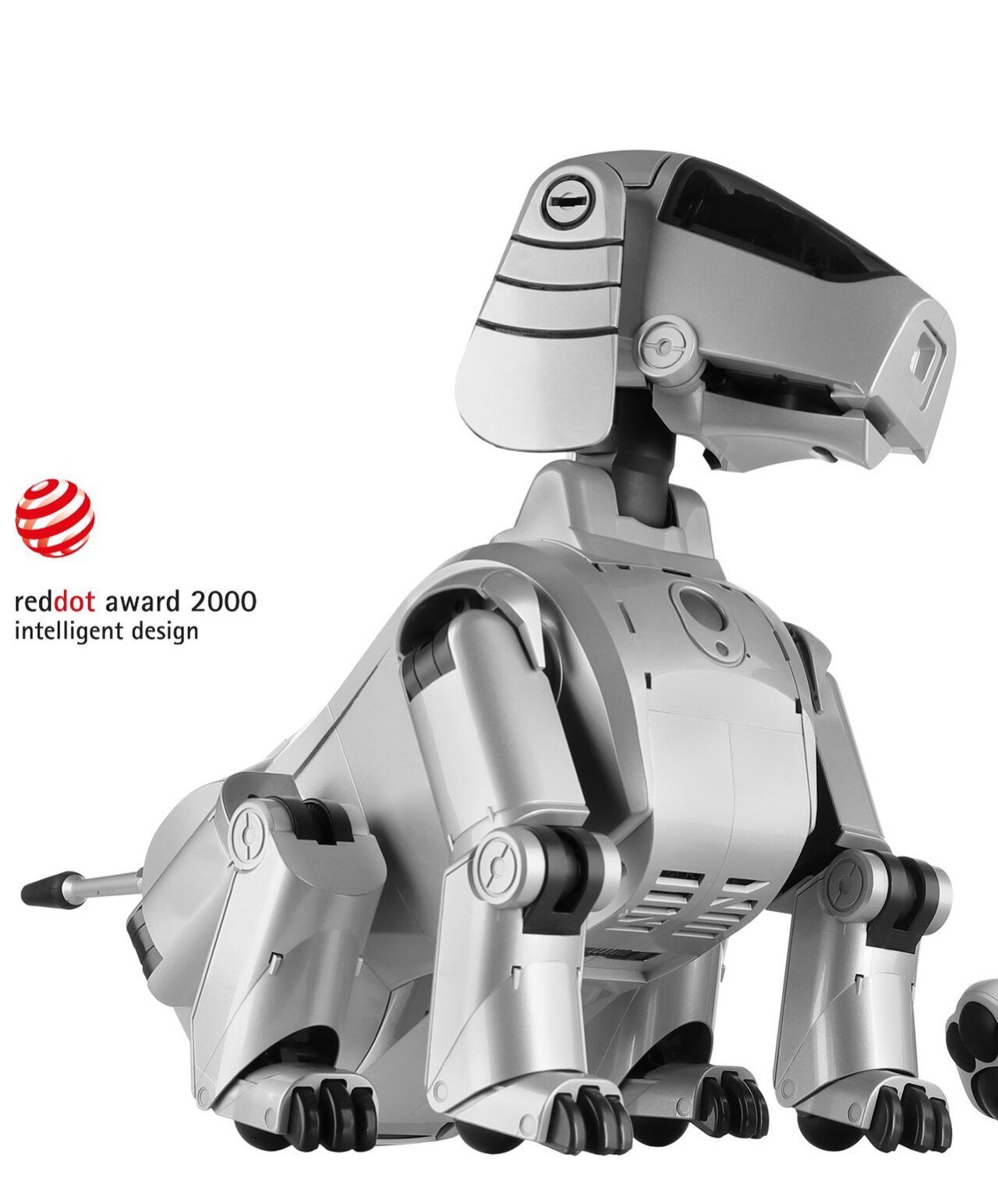
What did the first Aibo cost in 1999?
Sony put the ERS-110 on sale on June 1, 1999 at 250,000 yen in Japan and about $2,500 in the United States. That bought a beagle-shaped robot with a camera in its nose, microphones in its head and software written to give every unit a slightly different temperament depending on how its owner treated it.
The run was capped at 5,000 units, 3,000 for Japan and 2,000 for the American market, and the Japanese allocation sold out online in roughly 20 minutes. Nothing about the rollout was built for volume. Sony sold the robot over the web, in one batch, as a test of whether anyone would pay used-car money for a machine that chased a pink ball.
The name carried the pitch. Sony built it from "artificial intelligence robot," and aibo is also a Japanese word for partner, which is what the marketing promised buyers they were getting rather than a remote-control toy.
Nothing else on a 1999 shelf worked that way. A Tamagotchi was a keychain with three buttons. The Sony Aibo walked, learned its owner's voice and sulked when it was ignored.
Why did Sony stop making Aibo in 2006?
Four generations followed the ERS-110. The last of them, the ERS-7, arrived in late 2003 and looked less like a dog and more like a finished product, with a smooth shell, a face built from LEDs and wireless networking as standard equipment.
It was not enough. Sony was in a bad stretch in consumer electronics by the middle of the decade, and a company-wide clean-up in 2006 cut the robotics work along with several other side projects. More than 150,000 Aibos had sold between 1999 and that shutdown, AFP reported in 2026, and no sixth generation followed.
The bill arrived later. Sony ran a repair clinic for the surviving robots and then closed it in 2014, which left owners with no official parts, no diagnostics and no way to replace a failed joint except by taking one out of another Aibo. IEEE Spectrum described owners who "resort to cannibalizing some old Aibos to keep others running."
That mattered more than it would for a stereo. Owners had spent years training a machine built to develop its own habits, so a dead hip joint meant losing the particular robot rather than a replaceable model. Japanese owners started calling their broken units sick rather than faulty.
Why does a Japanese temple hold funerals for Aibos?
The parts shortage created one of the strangest afterlives in consumer electronics. A repair company called A-Fun, founded by former Sony engineer Nobuyuki Norimatsu, began fixing dead Aibos with components stripped from robots that could not be saved.
Norimatsu decided the donor robots deserved a send-off first. A-Fun takes them to Kofukuji, a 450-year-old Buddhist temple in Isumi, in Chiba prefecture east of Tokyo, where a priest chants sutras over rows of switched-off robot dogs before they are taken apart.
One service in 2018 covered 114 Aibos, and AFP reported that year that about 800 had been sent off in total. Owners send letters along with their robots. Some of the dogs arrive with name tags still attached.
"All things have a bit of soul," head priest Bungen Oi told AFP in 2018. The ceremony is not a joke at the owners' expense. It is a practical answer to the problem of dismantling something a household talked to every day for a decade.
Nobody held a service for a dead Sony Discman.
Who owns Aibo today, and where is it sold?
Sony owns Aibo outright and always has. The brand was never sold or licensed away during the 12 years between the 2006 shutdown and the 2018 revival, and the robot on sale in 2026 is designed, built and supported by Sony.
The revival was the ERS-1000, launched in Japan in January 2018: rounder than the old models, with oval eyes on OLED panels and a camera in its nose. It sold about 20,000 units in Japan in its first six months. The engineering answer to the 2006 complaint was the cloud, because the ERS-1000 keeps its learned behavior and its photographs on Sony's servers instead of only inside the body, which is also why it needs a paid plan to stay fully itself.
Then the map shrank. Sony said in late June 2026 that it would stop selling the ERS-1000 in Japan once existing stock ran out, part of a review of its future services, and AFP reported that the United States is now the only country where the robot is sold, at more than $3,000.
Support did not shrink with it. Sony said technical support, replacement parts and the cloud subscriptions that hold each robot's memories would be maintained, with no end date announced, which is the opposite of what owners got in 2006.
Is Sony working on a new Aibo?
It says so, without committing to a date. Asked in June 2026 whether a new generation was coming, Sony told AFP that "the aibo business will continue" and declined to give specifics.
A month later it did something more concrete. Kyodo reported on July 21, 2026 that Sony would lend prototype Aibos, together with beta development tools, to laboratories at the University of Tokyo and the University of California, Berkeley, for research that includes applied work on physical AI, with the findings fed into future products.
What the announcement left out is the part buyers care about. There was no price, no release date, no specification sheet and no promise that anything the labs build reaches the robots already sitting in living rooms.
Read together, the two 2026 announcements describe a handover rather than a shutdown. The consumer product that has been on sale since 2018 is winding down in its home market while the research line that produced it goes back to a university bench.
Where to find one today
A new ERS-1000 still sells through Sony in the United States at more than $3,000, so the affordable route is an old robot. Working ERS-7 units from 2003 sit at the top of the second-hand market, serviced second-generation ERS-210s in the middle, and untested parts units at the bottom. The 1999 ERS-110 is the scarcest of all, since Sony built only 5,000.
The weak point is always the battery. Original packs are long dead, and a rebuilt or recelled pack is the difference between a robot that walks and an ornament, so read what a seller says about the battery before anything else.
Units, chargers, replacement parts and reproduction accessories turn up on Etsy's Sony Aibo listings. Like the Segway, the Sony Aibo became collectible without ever becoming cheap.
Frequently Asked Questions
Is the Sony Aibo discontinued?
Partly. Sony stopped selling the ERS-1000 Sony Aibo in Japan from late June 2026, once remaining stock sold out, while sales in the United States continue at more than $3,000. Sony says technical support, replacement parts and cloud subscriptions for existing Aibos will be maintained, and in July 2026 it lent prototype Aibos to two university laboratories for research on a future model.
How much does a Sony Aibo cost in 2026?
A new Sony Aibo ERS-1000 sells for more than $3,000 in the United States, which is the only country where Sony still sells it in 2026. The first Sony Aibo, the ERS-110 of 1999, cost 250,000 yen in Japan and about $2,500 in the United States, and only 5,000 of them were built.
Who owns Aibo now?
Sony has owned the Sony Aibo brand outright since the ERS-110 launched in June 1999, and it was never sold or licensed to another company during the 12 years between the 2006 production shutdown and the 2018 ERS-1000 revival. Sony designs, sells and supports the robot in 2026.