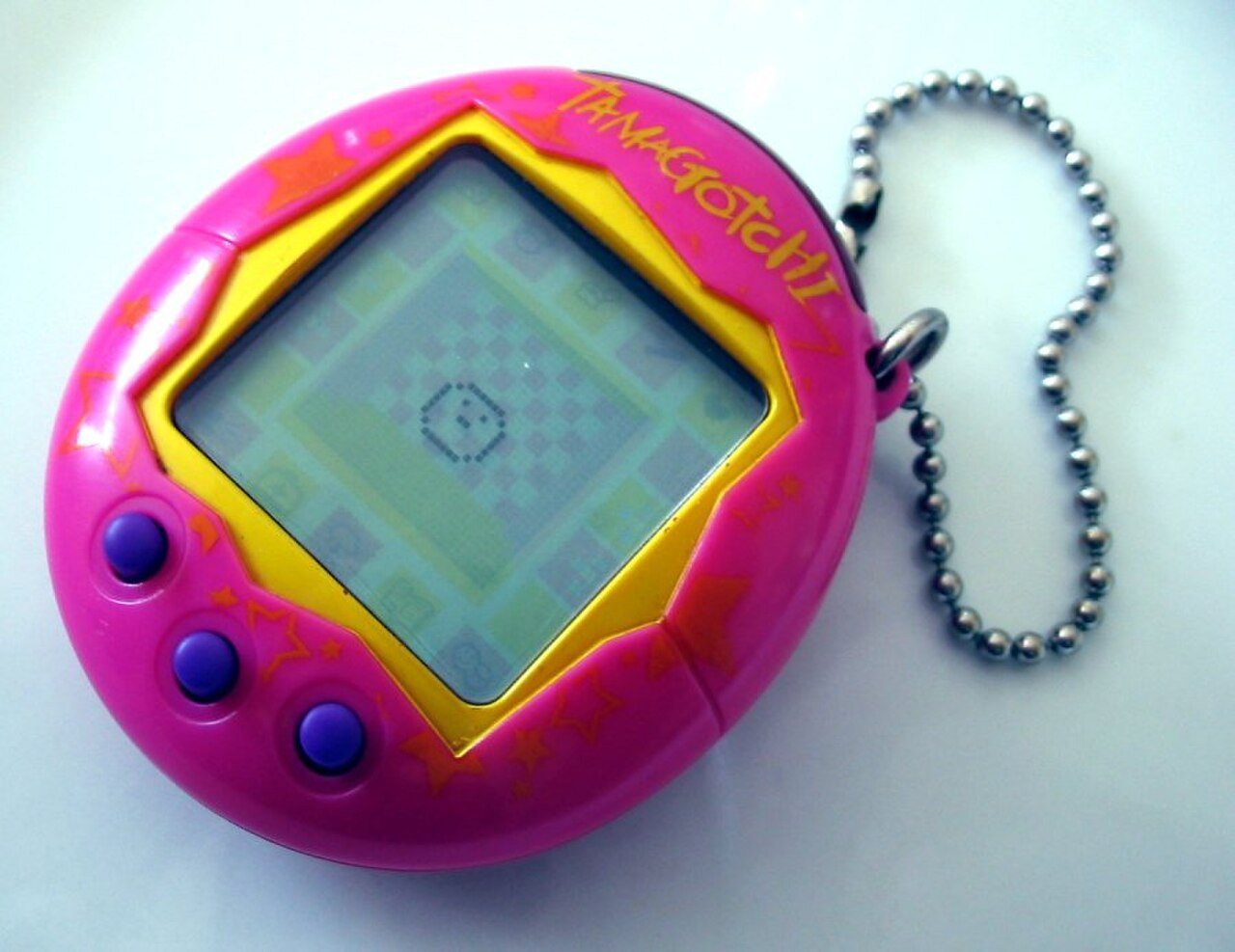
Who invented the Tamagotchi and why was it an egg?
The concept came from Akihiro Yokoi at the Japanese design studio WiZ, who wanted a pet a child could carry anywhere without keeping a real animal. He developed it with Aki Maita at Bandai, who ran the marketing and served as the public face of the toy through 1997.
The name is a compound of tamago, Japanese for egg, and the Japanese pronunciation of the English word watch. The shell shape was literal. A creature hatched on a liquid crystal screen, and three buttons ran the entire relationship: feed it, clean up after it, play with it, discipline it, put it to bed.
The design decision that drove everything else was the absence of a pause button. Neglect the creature for a few hours and it got sick. Neglect it longer and it died, with a small angel or a headstone on the screen and no way to undo it. Bandai put the original Tamagotchi on sale in Japan on November 23, 1996.
How fast did Tamagotchi sell in the United States?
Bandai brought the Tamagotchi to American stores on May 1, 1997, at $17.99. The price was doing real work: cheap enough to be an impulse buy at a checkout counter, expensive enough that a child treated it as a possession rather than a party favor.
The launch did not behave like a toy launch. The FAO Schwarz in San Francisco sold its entire stock of 3,000 units by 3 p.m. on the first day. The New York flagship moved 10,000 by noon the following day. Resellers were asking several times retail within weeks, and stores rationed units per customer.
The worldwide numbers ran past anything Bandai had modeled. Cumulative shipments passed 40 million within roughly two and a half years of the 1996 Japanese launch, split close to evenly between Japan and the rest of the world. For a keychain toy with a screen the size of a postage stamp, that put it in the sales bracket of a home console.
Why did schools confiscate Tamagotchi?
The toy had no pause, so a child who left it in a locker risked coming back to a dead pet. Tamagotchi went into classrooms instead, and it beeped whenever it wanted food, attention or cleaning. Teachers were losing lesson plans to it within weeks of the American launch.
Schools in Florida, Massachusetts and California banned them outright during 1997, and schools in the United Kingdom, Australia and Japan did the same. Confiscation created a second problem, because a device locked in a desk drawer would starve by the end of the day. Students set up informal rotas, handing pets to friends who had a free period.
Administrators ended up negotiating with parents rather than students. A dean at Hale Middle School in Woodland Hills, California, told the Deseret News in 1997 that the school required a note from home reading "I realize they are a disruption and I will keep them at home." That is close to the policy language American schools would write for mobile phones a decade later.
Did people really bury Tamagotchi in pet cemeteries?
Yes. In January 1997, two teenagers took their dead Tamagotchi, named Sid and Arty, to a pet cemetery at Pontsmill in Cornwall, England, and buried them in small wooden coffins. The owner, Terry Squires, fenced off a section of the field for digital pets after devices began arriving by post from Switzerland, Germany, France, Canada and the United States.
Online, memorial pages collected eulogies, ages at death and causes of death, in the tiled-background HTML of the period. A handful of them sit alongside the other 90s websites still online today, abandoned but intact.
Researchers gave the behavior a name. The Tamagotchi effect describes emotional attachment to a machine or a piece of software, and it remains the standard term for what happens when a device simulates dependency convincingly enough. The loop was crude: feed it and it grows, ignore it and it suffers. That was sufficient. The same mechanic later carried Neopets and most of the mobile pet games that followed.
Who owns Tamagotchi today?
Bandai owns it and still makes it. Bandai merged with Namco in 2005 to form what is now Bandai Namco Holdings, and Tamagotchi sits in the toy division. The brand has never been sold off or handed to a licensee.
The line nearly ended once. Bandai over-produced through 1998, retailers shipped stock back, and the company booked a loss of about 6 billion yen, roughly $38 million at the time, on inventory it could not move. Around 2.5 million unsold units were destroyed and the original run was wound down by 1999.
Connectivity brought it back. The Tamagotchi Connection added infrared trading between devices in 2004. The Tamagotchi Uni arrived in 2023 with a color screen, Wi-Fi and a shared online space, and Tamagotchi Paradise reached North America on August 1, 2025. Bandai reported cumulative worldwide shipments past 100 million units as of July 31, 2025, roughly 49 percent of them in Japan, 33 percent in the United States and 16 percent in Europe.
The institutions caught up the same year. The Strong National Museum of Play inducted Tamagotchi into the World Video Game Hall of Fame on May 8, 2025. Collections manager Kristy Hisert said it "provided players with feelings of connection, caring, and customization, a respite from competition and fighting games."
Where to find one today
A new device is the cheap route. Bandai lists Tamagotchi Paradise at $44.99 and Tamagotchi Uni at $59.99, both stocked by mainstream American retailers, so nobody has to hunt a 1997 unit to play one.
The vintage market is where the money goes. Loose originals from 1996 and 1997 commonly sell in the $40 to $50 range in 2026. Boxed examples run into the hundreds, and so do the Japan-only color runs that never shipped to North America. If you want a working unit rather than a shelf piece, check the battery contacts before buying, because corroded cells are the usual reason a clean-looking shell has a dead screen. Vintage units, cases and keychain hardware turn up on Etsy.
Frequently Asked Questions
Are Tamagotchis still made in 2026?
Yes. Bandai has kept Tamagotchi in production since 1996 and is running a 30th anniversary line through 2026. The current devices include Tamagotchi Paradise, which reached North America on August 1, 2025 at $44.99, and the Wi-Fi connected Tamagotchi Uni from 2023 at $59.99.
How many Tamagotchis have been sold worldwide?
Bandai reported that cumulative worldwide Tamagotchi shipments passed 100 million units as of July 31, 2025, a milestone it announced at the Tokyo Toy Show that August. Roughly 49 percent went to Japan and 33 percent to the United States. The first 40 million shipped within about two and a half years of the November 1996 Japanese launch.
How much is an original 1997 Tamagotchi worth?
A loose original Tamagotchi from 1996 or 1997 commonly sells for $40 to $50 in 2026, while boxed and sealed examples reach into the hundreds. The highest prices go to Japan-exclusive color runs and limited collaborations, not to the standard units that sold by the tens of millions in 1997.