What Happened to the 3DO, the $700 Console That Bombed

Picture this. It is October 1993. You are wandering through the electronics section at Sears on a Saturday afternoon with your dad, and you stop dead in front of a glass display case. Behind the glass is a sleek black console you have never seen before. It looks like something out of RoboCop. The price tag taped to the front says $699.99. You read it twice, just to make sure your eyes are working. Your dad reads it. You both look at each other. That is more than a month of rent in a lot of American cities in 1993. That is a used car. That is roughly two and a half Super Nintendos with a stack of games on top. And it is the price of a single console called the 3DO Interactive Multiplayer.

If you were a kid in the early 1990s, you probably saw a 3DO at some point. Maybe at a Babbage's. Maybe at an Electronics Boutique. Maybe in a magazine ad with the tagline about being twice as fast as anything else. And then one day, almost overnight, it was gone. Pulled from shelves. Quietly forgotten. By 1996, the company was out of the hardware business entirely.

The 3DO is one of the strangest stories in console gaming history. It was supposed to be the VHS of video games, a single open standard that everyone would build for and that would crush Nintendo and Sega. Instead, it became a cautionary tale about pricing, partnerships, and what happens when you bring a Mercedes to a Honda Civic fight. So what happened?

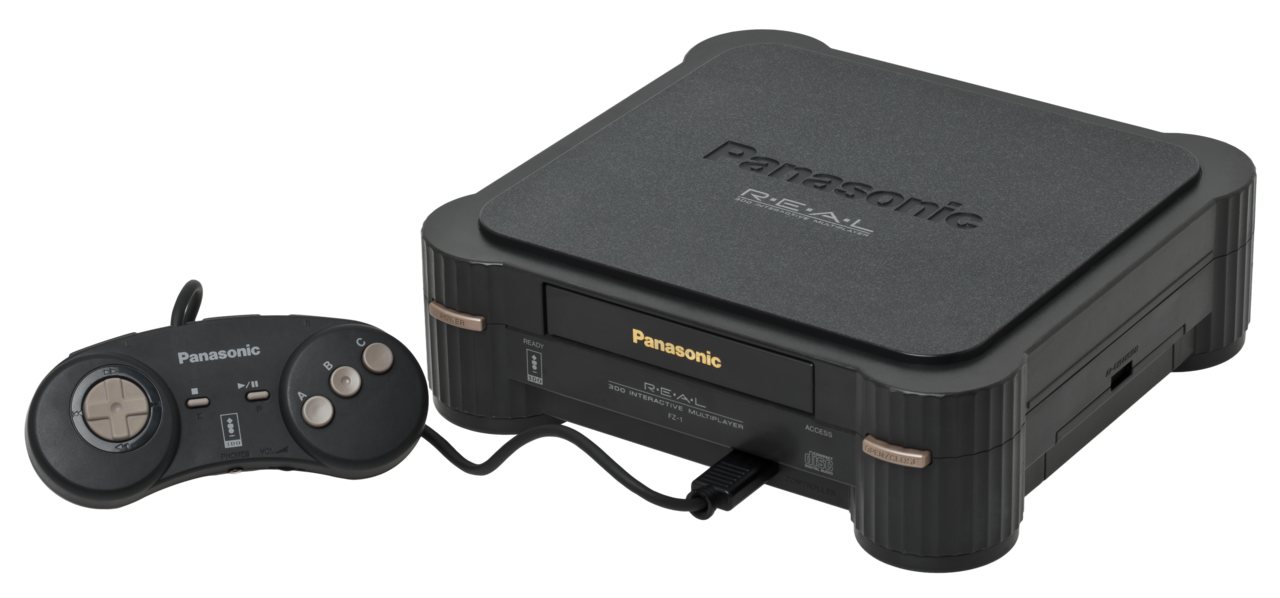
The Panasonic FZ-1 R.E.A.L. 3DO Interactive Multiplayer console with controller from 1993
The Panasonic FZ-1, the first 3DO model to hit American shelves in October 1993. It launched at $699.99 and was hyped as the most powerful home gaming console ever built.

How the 3DO Got Made: Trip Hawkins Bet His Career

To understand the 3DO, you have to understand Trip Hawkins. By 1991, Hawkins was already a legend in gaming. He founded Electronic Arts in 1982, built it into one of the most respected publishers in the business, and made a lot of people very rich along the way. He was the guy who pushed the idea that game developers should be treated like rock stars and movie directors. He was also restless. By the early 1990s, Hawkins had decided that the future of gaming was not in cartridges. It was in CD-ROMs, full-motion video, and a single open hardware standard that anyone could build.

So in 1991, Hawkins left EA and founded a new company called The 3DO Company. The pitch was wild. Instead of building hardware themselves like Nintendo or Sega, 3DO would design the console specifications and license them to manufacturers. Panasonic, Goldstar, Sanyo, and others would actually build and sell the boxes. 3DO would collect a small royalty on every game sold, similar to how Philips and Sony collected royalties on CD technology. The vision was that the 3DO platform would become the VHS of video games. One open standard. Many manufacturers competing on price and features. A massive shared library of titles. Game over for Sega and Nintendo.

It was a genuinely smart idea. On paper. Hawkins assembled an all-star roster of partners. Time Warner, Matsushita (which owned Panasonic), MCA, AT&T, and Electronic Arts itself all bought in. The press loved it. Major tech magazines wrote glowing previews. Investors threw money at the company. The 3DO Company went public in 1993 with a valuation that briefly made Trip Hawkins one of the most-watched executives in tech. And then the actual product launched.

The Launch: October 4, 1993

The Panasonic FZ-1 R.E.A.L. 3DO Interactive Multiplayer hit American shelves on October 4, 1993. The launch price was $699.99. To put that in context, in October 1993 you could buy a Sega Genesis with Sonic 2 for under $100. You could buy a Super Nintendo with Mario Kart for around $150. You could buy a fully working PC with a 486 processor for about $1,500. The 3DO was sitting in a price bracket that nobody had ever asked for. It was too expensive to be a toy and not powerful enough to be a workstation. It was the most awkward shelf placement in the history of consumer electronics.

And here is the thing. The hardware itself was actually impressive. The 3DO had a 32-bit ARM60 CPU, two custom video co-processors, a double-speed CD-ROM drive, and 2 MB of RAM with another 1 MB of video RAM. In 1993, that was a serious machine. It could render 3D polygons that would have made the Super Nintendo cry. It could play full-motion video at a quality that made you stop and watch. The launch lineup included Crash N Burn, a futuristic combat racing game that genuinely looked like nothing else on the market. For about ten minutes after you turned it on, it really did feel like the future.

The problem was the price. $699.99 in October 1993 dollars works out to roughly $1,500 today, adjusted for inflation. Imagine walking into a Best Buy in 2026 and seeing a new console with a price tag of $1,500. Now imagine that on the same shelf, there is a different console for $250 that has Mario on it. That is what the 3DO was up against.

Why the Price Was So High: The Open Standard Trap

Here is where the strategy started to eat itself. Sega and Nintendo could afford to sell consoles at a loss because they made the money back on game sales. Sony eventually used the same playbook with the PlayStation. The hardware was a Trojan horse for the software business. Sell the box cheap, take the loss, lock in the customer, and rake in the cash on $50 game cartridges for the next five years.

The 3DO Company could not do that. They did not own the manufacturing. Panasonic, Goldstar, and Sanyo were the ones building the actual hardware, and those companies needed to make a profit on every unit sold. They were not going to eat $200 per console out of the goodness of their hearts. So the price had to cover the manufacturing cost plus the manufacturer's margin plus the 3DO Company's royalty plus retailer markup. By the time you added it all up, $699.99 was actually a slim-margin number for everyone involved.

This is the part where it all falls apart. The brilliant open-standard strategy that was supposed to be the 3DO's biggest advantage was actually its biggest weakness. Hawkins thought he was building the VHS of gaming. What he had actually built was a console that was structurally incapable of being cheap. And in 1993, with a Genesis on every kid's Christmas list and a Super Nintendo on the rest of them, cheap was the only thing that mattered.

Trip Hawkins said in later interviews that the licensing model was the single biggest mistake of his career. He believed for years that an open standard could win the way VHS won. Looking back, he admitted that for a console to succeed, one company had to control hardware, software, and marketing as a single integrated effort. By the time he understood that, it was too late.

The Software Problem: A Library of B-Tier Games

Even if you could swallow the $699.99 price tag, the next problem was games. And this is where the 3DO really stumbled. The console had a CD-ROM drive, which meant it could store dramatically more data than a Super Nintendo cartridge. That should have been an advantage. Instead, it became a liability. Developers in 1993 did not really know what to do with that much storage. So they filled it with full-motion video.

If you bought a 3DO in 1993 or 1994, you ended up playing a lot of games that were basically interactive movies with grainy live-action footage. Night Trap. Plumbers Don't Wear Ties. Slam City with Scottie Pippen. There were good games on the system, sure. Road Rash on 3DO is genuinely a classic. Crash N Burn is fun. Star Control 2 was a beautiful port. But for every memorable title, there were ten games that felt like glorified PowerPoint presentations with bad acting. The library never reached critical mass.

Compare that to what was on Super Nintendo in the same window. Super Mario All-Stars came out in 1993. Donkey Kong Country dropped in November 1994 and sold over 9 million copies. Final Fantasy VI launched in 1994. Chrono Trigger was right around the corner. Sega Genesis had Sonic 3, Streets of Rage 3, Ecco the Dolphin, Phantasy Star IV. Nintendo and Sega were shipping all-time classics one after another. The 3DO was shipping a Putt-Putt Saves the Zoo CD-ROM and asking for $699.99.

The Saturn and PlayStation Show Up: 1994 to 1995

And then the real killers arrived. The Sega Saturn launched in Japan in November 1994 and in North America in May 1995. The Sony PlayStation launched in Japan in December 1994 and in North America in September 1995. Both consoles offered comparable or better 3D graphics performance than the 3DO. The Saturn launched at $399. The PlayStation launched at $299. And both companies had something the 3DO never had: a deep pipeline of exclusive games from established studios.

The PlayStation in particular was a knockout punch. Sony had been quietly courting third-party developers with developer-friendly tools and reasonable royalty rates. Within a year of launch, the PlayStation had Ridge Racer, WipEout, Tekken, and a roadmap that included Resident Evil, Tomb Raider, Final Fantasy VII, and Metal Gear Solid. The 3DO had nothing comparable. It had Gex.

The price gap is what really killed it, though. By the time the PlayStation hit American shelves in September 1995, the 3DO had been forced to drop its price to around $399. But the Panasonic FZ-1 was a year and a half old, the library was thin, and consumer awareness was already shifting toward Sony. Why would you spend $399 on a 3DO when you could spend $299 on a PlayStation with Ridge Racer in the box?

The M2 Project: A Sequel That Never Shipped

The 3DO Company saw the writing on the wall in 1994 and started developing a successor console called the M2. On paper, the M2 was incredible. It was supposed to deliver next-generation 3D graphics, a CD-ROM drive that was either an upgrade module for the existing 3DO or a standalone console, and performance that would have crushed both the Saturn and the early PlayStation. Magazines printed previews. Developers got dev kits. Hype was building.

And then, in late 1995, Matsushita bought the M2 rights from the 3DO Company for around $100 million. The 3DO Company took the cash and got out of the hardware business entirely. Matsushita sat on the M2 technology for a few years, used pieces of it in arcade boards and industrial products, and eventually let the project die. The console version of the M2 never shipped. To this day, prototype M2 dev units are some of the most valuable pieces of vaporware in gaming history.

You know what happened next? The 3DO Company pivoted. With the hardware business sold off, Trip Hawkins reinvented The 3DO Company as a third-party publisher. They put out games like Army Men, High Heat Major League Baseball, BattleTanx, and Might and Magic VII. Some of those titles sold reasonably well. None of them were enough to save the company. By 2003, the 3DO Company filed for Chapter 11 bankruptcy. Trip Hawkins paid roughly $405,000 at auction for the rights to a portfolio of old brands and patents. The Army Men franchise went to Take-Two. Might and Magic went to Ubisoft. High Heat Baseball ended up at Microsoft. The rest got scattered to the wind.

The Panasonic FZ-10 3DO Interactive Multiplayer, the second-generation top-loading model
The Panasonic FZ-10, released in 1994, was the cheaper, top-loading second-generation 3DO. It dropped the price toward $399, but by then the PlayStation was already on the way.

How Many 3DOs Actually Sold?

Estimates vary, but most sources put global sales of the 3DO platform at around 2 million units across all manufacturers over its entire lifespan. For comparison, the Sony PlayStation sold over 100 million units. The Super Nintendo sold roughly 49 million. Even the Sega Saturn, which is often called a commercial failure, sold somewhere around 9 million units. The 3DO was outsold by the Saturn by more than four to one. It was outsold by the PlayStation by fifty to one.

And here is the wild part. Despite all of that, the 3DO had its moment. Time magazine named it the 1993 Product of the Year. The hardware really was ahead of its time. The branding was sleek. The marketing was aggressive. There were genuine moments where it felt like the 3DO might actually become the open standard Hawkins promised. It just kept losing on the only number that mattered, which was the number on the price tag.

What the 3DO Got Right

It is easy to dunk on the 3DO in retrospect, but the console got some things right that the industry eventually copied. It pushed CD-ROM as the standard storage format for home consoles, which Sony and Sega both eventually adopted. It treated the console as a multimedia device that could play movies, music, and games, which is now exactly how the PlayStation 5 and Xbox Series X market themselves. It used a 32-bit ARM-based architecture at a time when most consoles were still on custom 16-bit chipsets, anticipating where the entire industry was headed.

And the open-standard idea was not crazy. It was just early. Twenty years later, Android would basically prove that an open hardware ecosystem with multiple manufacturers all building to a shared software platform could absolutely beat a vertically integrated competitor. Hawkins was not wrong about the model. He was wrong about the timing, the price, and the size of the developer community needed to make it work.

The Collector's Market Today

Today, the 3DO has a small but devoted collector following. A working Panasonic FZ-1 in good condition typically sells for $200 to $400 on the used market, with boxed units in mint condition fetching considerably more. Loose games range from a few dollars for the FMV junk titles up to several hundred dollars for rare imports and limited releases. Some of the system's exclusive games, particularly imports, command serious money. A complete-in-box copy of certain Japanese 3DO releases can cost more than the console did at launch, adjusted for inflation.

If you want to actually play 3DO games today, emulation is your friend. There are reasonable 3DO emulators available, and the entire library is small enough that you can sample everything worth sampling in a weekend. The good games hold up better than you might expect. The bad games are an extremely specific kind of bad that only existed in that 1993 to 1995 window when developers were still figuring out what to do with CD-ROM technology.

The Real Lesson

The 3DO is the console industry's reminder that hardware specs do not sell consoles. Price sells consoles. Software sells consoles. Brand recognition sells consoles. The 3DO had impressive hardware, and that hardware was almost completely irrelevant to its commercial fate. Trip Hawkins built a technically excellent product that died because it cost too much, shipped without enough good games, and tried to compete with companies that were willing to lose money on every box to win the long game.

If you owned a 3DO in 1993, you were either a journalist who got a review unit, a kid whose parents had genuinely lost their minds, or a serious gaming enthusiast who saved for two years and treated the console like a religious artifact. Most people just saw the price tag, walked past the display case at Sears, and went home with a Sega Genesis. The 3DO deserved better than that, in some ways. But the market does not care what something deserves. It only cares what something costs.

Frequently Asked Questions

When was the 3DO released and how much did it cost?

The 3DO Interactive Multiplayer launched in North America on October 4, 1993, with the Panasonic FZ-1 model. The launch price was $699.99 in the United States. By 1994 the price had dropped to around $499.99, and by 1995 the second-generation Panasonic FZ-10 was selling for closer to $399.99. None of those price points were competitive with the Sega Genesis, Super Nintendo, or eventually the Sony PlayStation.

Who made the 3DO console?

The 3DO Interactive Multiplayer was a hardware standard designed by The 3DO Company, founded by Electronic Arts founder Trip Hawkins in 1991. Unlike most consoles, the 3DO was manufactured by multiple licensees rather than the platform owner. The primary manufacturers were Panasonic (which made the FZ-1 and FZ-10), Goldstar (now LG), and Sanyo. Creative Labs also produced a 3DO-compatible expansion card for PCs called the 3DO Blaster.

Why did the 3DO fail?

The 3DO failed for a combination of reasons. The launch price of $699.99 was far too high for a mass-market gaming console. The licensing model meant manufacturers had to make a profit on every unit, which prevented the kind of below-cost pricing that Sega, Nintendo, and Sony used. The game library never reached critical mass and relied too heavily on shovelware full-motion video titles. And in 1995, the Sony PlayStation arrived with comparable hardware, a stronger software pipeline, and a launch price of $299, which effectively ended the 3DO's competitive viability.

How many 3DO consoles were sold?

Most industry estimates put total worldwide sales of the 3DO platform across all manufacturers at around 2 million units over its entire commercial lifespan from October 1993 to its discontinuation in 1996. By comparison, the Sega Saturn sold roughly 9 million units, the Nintendo 64 sold around 33 million, and the Sony PlayStation sold over 100 million units.

What happened to The 3DO Company after the console failed?

After exiting the hardware business in 1995 and 1996, the 3DO Company sold the rights to its M2 successor console technology to Matsushita (Panasonic) for a reported $100 million. The 3DO Company then pivoted into being a third-party game publisher, releasing franchises like Army Men, High Heat Major League Baseball, and Might and Magic. The company filed for Chapter 11 bankruptcy on May 28, 2003. Its game franchises were auctioned off to publishers including Microsoft, Take-Two Interactive, Namco, and Ubisoft.

Are 3DO games worth playing today?

The 3DO library has a handful of genuine standouts that are worth tracking down through emulation or original hardware. Road Rash, Crash N Burn, Need for Speed (the original 3DO version was the first release of the franchise), Star Control 2: The Ur-Quan Masters, and Gex are all considered classics or near-classics. The full-motion video titles from the era have aged poorly and are mostly of historical interest. The total game library is small enough, with most counts placing the worldwide total in the 250 to 300 range, that a dedicated collector can sample most of the best of it in a few weekends.

๐Ÿ“– What Happened to the 3DO, the $700 Console That Bombed
_ โ–ก ร—
← Back

What Happened to the 3DO, the $700 Console That Bombed

2026-05-07 by 404 Memory Found

Picture this. It is October 1993. You are wandering through the electronics section at Sears on a Saturday afternoon with your dad, and you stop dead in front of a glass display case. Behind the glass is a sleek black console you have never seen before. It looks like something out of RoboCop. The price tag taped to the front says $699.99. You read it twice, just to make sure your eyes are working. Your dad reads it. You both look at each other. That is more than a month of rent in a lot of American cities in 1993. That is a used car. That is roughly two and a half Super Nintendos with a stack of games on top. And it is the price of a single console called the 3DO Interactive Multiplayer.

If you were a kid in the early 1990s, you probably saw a 3DO at some point. Maybe at a Babbage's. Maybe at an Electronics Boutique. Maybe in a magazine ad with the tagline about being twice as fast as anything else. And then one day, almost overnight, it was gone. Pulled from shelves. Quietly forgotten. By 1996, the company was out of the hardware business entirely.

The 3DO is one of the strangest stories in console gaming history. It was supposed to be the VHS of video games, a single open standard that everyone would build for and that would crush Nintendo and Sega. Instead, it became a cautionary tale about pricing, partnerships, and what happens when you bring a Mercedes to a Honda Civic fight. So what happened?

The Panasonic FZ-1 R.E.A.L. 3DO Interactive Multiplayer console with controller from 1993
The Panasonic FZ-1, the first 3DO model to hit American shelves in October 1993. It launched at $699.99 and was hyped as the most powerful home gaming console ever built.

How the 3DO Got Made: Trip Hawkins Bet His Career

To understand the 3DO, you have to understand Trip Hawkins. By 1991, Hawkins was already a legend in gaming. He founded Electronic Arts in 1982, built it into one of the most respected publishers in the business, and made a lot of people very rich along the way. He was the guy who pushed the idea that game developers should be treated like rock stars and movie directors. He was also restless. By the early 1990s, Hawkins had decided that the future of gaming was not in cartridges. It was in CD-ROMs, full-motion video, and a single open hardware standard that anyone could build.

So in 1991, Hawkins left EA and founded a new company called The 3DO Company. The pitch was wild. Instead of building hardware themselves like Nintendo or Sega, 3DO would design the console specifications and license them to manufacturers. Panasonic, Goldstar, Sanyo, and others would actually build and sell the boxes. 3DO would collect a small royalty on every game sold, similar to how Philips and Sony collected royalties on CD technology. The vision was that the 3DO platform would become the VHS of video games. One open standard. Many manufacturers competing on price and features. A massive shared library of titles. Game over for Sega and Nintendo.

It was a genuinely smart idea. On paper. Hawkins assembled an all-star roster of partners. Time Warner, Matsushita (which owned Panasonic), MCA, AT&T, and Electronic Arts itself all bought in. The press loved it. Major tech magazines wrote glowing previews. Investors threw money at the company. The 3DO Company went public in 1993 with a valuation that briefly made Trip Hawkins one of the most-watched executives in tech. And then the actual product launched.

The Launch: October 4, 1993

The Panasonic FZ-1 R.E.A.L. 3DO Interactive Multiplayer hit American shelves on October 4, 1993. The launch price was $699.99. To put that in context, in October 1993 you could buy a Sega Genesis with Sonic 2 for under $100. You could buy a Super Nintendo with Mario Kart for around $150. You could buy a fully working PC with a 486 processor for about $1,500. The 3DO was sitting in a price bracket that nobody had ever asked for. It was too expensive to be a toy and not powerful enough to be a workstation. It was the most awkward shelf placement in the history of consumer electronics.

And here is the thing. The hardware itself was actually impressive. The 3DO had a 32-bit ARM60 CPU, two custom video co-processors, a double-speed CD-ROM drive, and 2 MB of RAM with another 1 MB of video RAM. In 1993, that was a serious machine. It could render 3D polygons that would have made the Super Nintendo cry. It could play full-motion video at a quality that made you stop and watch. The launch lineup included Crash N Burn, a futuristic combat racing game that genuinely looked like nothing else on the market. For about ten minutes after you turned it on, it really did feel like the future.

The problem was the price. $699.99 in October 1993 dollars works out to roughly $1,500 today, adjusted for inflation. Imagine walking into a Best Buy in 2026 and seeing a new console with a price tag of $1,500. Now imagine that on the same shelf, there is a different console for $250 that has Mario on it. That is what the 3DO was up against.

Why the Price Was So High: The Open Standard Trap

Here is where the strategy started to eat itself. Sega and Nintendo could afford to sell consoles at a loss because they made the money back on game sales. Sony eventually used the same playbook with the PlayStation. The hardware was a Trojan horse for the software business. Sell the box cheap, take the loss, lock in the customer, and rake in the cash on $50 game cartridges for the next five years.

The 3DO Company could not do that. They did not own the manufacturing. Panasonic, Goldstar, and Sanyo were the ones building the actual hardware, and those companies needed to make a profit on every unit sold. They were not going to eat $200 per console out of the goodness of their hearts. So the price had to cover the manufacturing cost plus the manufacturer's margin plus the 3DO Company's royalty plus retailer markup. By the time you added it all up, $699.99 was actually a slim-margin number for everyone involved.

This is the part where it all falls apart. The brilliant open-standard strategy that was supposed to be the 3DO's biggest advantage was actually its biggest weakness. Hawkins thought he was building the VHS of gaming. What he had actually built was a console that was structurally incapable of being cheap. And in 1993, with a Genesis on every kid's Christmas list and a Super Nintendo on the rest of them, cheap was the only thing that mattered.

Trip Hawkins said in later interviews that the licensing model was the single biggest mistake of his career. He believed for years that an open standard could win the way VHS won. Looking back, he admitted that for a console to succeed, one company had to control hardware, software, and marketing as a single integrated effort. By the time he understood that, it was too late.

The Software Problem: A Library of B-Tier Games

Even if you could swallow the $699.99 price tag, the next problem was games. And this is where the 3DO really stumbled. The console had a CD-ROM drive, which meant it could store dramatically more data than a Super Nintendo cartridge. That should have been an advantage. Instead, it became a liability. Developers in 1993 did not really know what to do with that much storage. So they filled it with full-motion video.

If you bought a 3DO in 1993 or 1994, you ended up playing a lot of games that were basically interactive movies with grainy live-action footage. Night Trap. Plumbers Don't Wear Ties. Slam City with Scottie Pippen. There were good games on the system, sure. Road Rash on 3DO is genuinely a classic. Crash N Burn is fun. Star Control 2 was a beautiful port. But for every memorable title, there were ten games that felt like glorified PowerPoint presentations with bad acting. The library never reached critical mass.

Compare that to what was on Super Nintendo in the same window. Super Mario All-Stars came out in 1993. Donkey Kong Country dropped in November 1994 and sold over 9 million copies. Final Fantasy VI launched in 1994. Chrono Trigger was right around the corner. Sega Genesis had Sonic 3, Streets of Rage 3, Ecco the Dolphin, Phantasy Star IV. Nintendo and Sega were shipping all-time classics one after another. The 3DO was shipping a Putt-Putt Saves the Zoo CD-ROM and asking for $699.99.

The Saturn and PlayStation Show Up: 1994 to 1995

And then the real killers arrived. The Sega Saturn launched in Japan in November 1994 and in North America in May 1995. The Sony PlayStation launched in Japan in December 1994 and in North America in September 1995. Both consoles offered comparable or better 3D graphics performance than the 3DO. The Saturn launched at $399. The PlayStation launched at $299. And both companies had something the 3DO never had: a deep pipeline of exclusive games from established studios.

The PlayStation in particular was a knockout punch. Sony had been quietly courting third-party developers with developer-friendly tools and reasonable royalty rates. Within a year of launch, the PlayStation had Ridge Racer, WipEout, Tekken, and a roadmap that included Resident Evil, Tomb Raider, Final Fantasy VII, and Metal Gear Solid. The 3DO had nothing comparable. It had Gex.

The price gap is what really killed it, though. By the time the PlayStation hit American shelves in September 1995, the 3DO had been forced to drop its price to around $399. But the Panasonic FZ-1 was a year and a half old, the library was thin, and consumer awareness was already shifting toward Sony. Why would you spend $399 on a 3DO when you could spend $299 on a PlayStation with Ridge Racer in the box?

The M2 Project: A Sequel That Never Shipped

The 3DO Company saw the writing on the wall in 1994 and started developing a successor console called the M2. On paper, the M2 was incredible. It was supposed to deliver next-generation 3D graphics, a CD-ROM drive that was either an upgrade module for the existing 3DO or a standalone console, and performance that would have crushed both the Saturn and the early PlayStation. Magazines printed previews. Developers got dev kits. Hype was building.

And then, in late 1995, Matsushita bought the M2 rights from the 3DO Company for around $100 million. The 3DO Company took the cash and got out of the hardware business entirely. Matsushita sat on the M2 technology for a few years, used pieces of it in arcade boards and industrial products, and eventually let the project die. The console version of the M2 never shipped. To this day, prototype M2 dev units are some of the most valuable pieces of vaporware in gaming history.

You know what happened next? The 3DO Company pivoted. With the hardware business sold off, Trip Hawkins reinvented The 3DO Company as a third-party publisher. They put out games like Army Men, High Heat Major League Baseball, BattleTanx, and Might and Magic VII. Some of those titles sold reasonably well. None of them were enough to save the company. By 2003, the 3DO Company filed for Chapter 11 bankruptcy. Trip Hawkins paid roughly $405,000 at auction for the rights to a portfolio of old brands and patents. The Army Men franchise went to Take-Two. Might and Magic went to Ubisoft. High Heat Baseball ended up at Microsoft. The rest got scattered to the wind.

The Panasonic FZ-10 3DO Interactive Multiplayer, the second-generation top-loading model
The Panasonic FZ-10, released in 1994, was the cheaper, top-loading second-generation 3DO. It dropped the price toward $399, but by then the PlayStation was already on the way.

How Many 3DOs Actually Sold?

Estimates vary, but most sources put global sales of the 3DO platform at around 2 million units across all manufacturers over its entire lifespan. For comparison, the Sony PlayStation sold over 100 million units. The Super Nintendo sold roughly 49 million. Even the Sega Saturn, which is often called a commercial failure, sold somewhere around 9 million units. The 3DO was outsold by the Saturn by more than four to one. It was outsold by the PlayStation by fifty to one.

And here is the wild part. Despite all of that, the 3DO had its moment. Time magazine named it the 1993 Product of the Year. The hardware really was ahead of its time. The branding was sleek. The marketing was aggressive. There were genuine moments where it felt like the 3DO might actually become the open standard Hawkins promised. It just kept losing on the only number that mattered, which was the number on the price tag.

What the 3DO Got Right

It is easy to dunk on the 3DO in retrospect, but the console got some things right that the industry eventually copied. It pushed CD-ROM as the standard storage format for home consoles, which Sony and Sega both eventually adopted. It treated the console as a multimedia device that could play movies, music, and games, which is now exactly how the PlayStation 5 and Xbox Series X market themselves. It used a 32-bit ARM-based architecture at a time when most consoles were still on custom 16-bit chipsets, anticipating where the entire industry was headed.

And the open-standard idea was not crazy. It was just early. Twenty years later, Android would basically prove that an open hardware ecosystem with multiple manufacturers all building to a shared software platform could absolutely beat a vertically integrated competitor. Hawkins was not wrong about the model. He was wrong about the timing, the price, and the size of the developer community needed to make it work.

The Collector's Market Today

Today, the 3DO has a small but devoted collector following. A working Panasonic FZ-1 in good condition typically sells for $200 to $400 on the used market, with boxed units in mint condition fetching considerably more. Loose games range from a few dollars for the FMV junk titles up to several hundred dollars for rare imports and limited releases. Some of the system's exclusive games, particularly imports, command serious money. A complete-in-box copy of certain Japanese 3DO releases can cost more than the console did at launch, adjusted for inflation.

If you want to actually play 3DO games today, emulation is your friend. There are reasonable 3DO emulators available, and the entire library is small enough that you can sample everything worth sampling in a weekend. The good games hold up better than you might expect. The bad games are an extremely specific kind of bad that only existed in that 1993 to 1995 window when developers were still figuring out what to do with CD-ROM technology.

The Real Lesson

The 3DO is the console industry's reminder that hardware specs do not sell consoles. Price sells consoles. Software sells consoles. Brand recognition sells consoles. The 3DO had impressive hardware, and that hardware was almost completely irrelevant to its commercial fate. Trip Hawkins built a technically excellent product that died because it cost too much, shipped without enough good games, and tried to compete with companies that were willing to lose money on every box to win the long game.

If you owned a 3DO in 1993, you were either a journalist who got a review unit, a kid whose parents had genuinely lost their minds, or a serious gaming enthusiast who saved for two years and treated the console like a religious artifact. Most people just saw the price tag, walked past the display case at Sears, and went home with a Sega Genesis. The 3DO deserved better than that, in some ways. But the market does not care what something deserves. It only cares what something costs.

Frequently Asked Questions

When was the 3DO released and how much did it cost?

The 3DO Interactive Multiplayer launched in North America on October 4, 1993, with the Panasonic FZ-1 model. The launch price was $699.99 in the United States. By 1994 the price had dropped to around $499.99, and by 1995 the second-generation Panasonic FZ-10 was selling for closer to $399.99. None of those price points were competitive with the Sega Genesis, Super Nintendo, or eventually the Sony PlayStation.

Who made the 3DO console?

The 3DO Interactive Multiplayer was a hardware standard designed by The 3DO Company, founded by Electronic Arts founder Trip Hawkins in 1991. Unlike most consoles, the 3DO was manufactured by multiple licensees rather than the platform owner. The primary manufacturers were Panasonic (which made the FZ-1 and FZ-10), Goldstar (now LG), and Sanyo. Creative Labs also produced a 3DO-compatible expansion card for PCs called the 3DO Blaster.

Why did the 3DO fail?

The 3DO failed for a combination of reasons. The launch price of $699.99 was far too high for a mass-market gaming console. The licensing model meant manufacturers had to make a profit on every unit, which prevented the kind of below-cost pricing that Sega, Nintendo, and Sony used. The game library never reached critical mass and relied too heavily on shovelware full-motion video titles. And in 1995, the Sony PlayStation arrived with comparable hardware, a stronger software pipeline, and a launch price of $299, which effectively ended the 3DO's competitive viability.

How many 3DO consoles were sold?

Most industry estimates put total worldwide sales of the 3DO platform across all manufacturers at around 2 million units over its entire commercial lifespan from October 1993 to its discontinuation in 1996. By comparison, the Sega Saturn sold roughly 9 million units, the Nintendo 64 sold around 33 million, and the Sony PlayStation sold over 100 million units.

What happened to The 3DO Company after the console failed?

After exiting the hardware business in 1995 and 1996, the 3DO Company sold the rights to its M2 successor console technology to Matsushita (Panasonic) for a reported $100 million. The 3DO Company then pivoted into being a third-party game publisher, releasing franchises like Army Men, High Heat Major League Baseball, and Might and Magic. The company filed for Chapter 11 bankruptcy on May 28, 2003. Its game franchises were auctioned off to publishers including Microsoft, Take-Two Interactive, Namco, and Ubisoft.

Are 3DO games worth playing today?

The 3DO library has a handful of genuine standouts that are worth tracking down through emulation or original hardware. Road Rash, Crash N Burn, Need for Speed (the original 3DO version was the first release of the franchise), Star Control 2: The Ur-Quan Masters, and Gex are all considered classics or near-classics. The full-motion video titles from the era have aged poorly and are mostly of historical interest. The total game library is small enough, with most counts placing the worldwide total in the 250 to 300 range, that a dedicated collector can sample most of the best of it in a few weekends.

๐Ÿ“– What Happened to the 3DO, the $700 Console That Bombed

Picture this. It is October 1993. You are wandering through the electronics section at Sears on a Saturday afternoon with your dad, and you stop dead in front of a glass display case. Behind the glass is a sleek black console you have never seen before. It looks like something out of RoboCop. The price tag taped to the front says $699.99. You read it twice, just to make sure your eyes are working. Your dad reads it. You both look at each other. That is more than a month of rent in a lot of American cities in 1993. That is a used car. That is roughly two and a half Super Nintendos with a stack of games on top. And it is the price of a single console called the 3DO Interactive Multiplayer.

If you were a kid in the early 1990s, you probably saw a 3DO at some point. Maybe at a Babbage's. Maybe at an Electronics Boutique. Maybe in a magazine ad with the tagline about being twice as fast as anything else. And then one day, almost overnight, it was gone. Pulled from shelves. Quietly forgotten. By 1996, the company was out of the hardware business entirely.

The 3DO is one of the strangest stories in console gaming history. It was supposed to be the VHS of video games, a single open standard that everyone would build for and that would crush Nintendo and Sega. Instead, it became a cautionary tale about pricing, partnerships, and what happens when you bring a Mercedes to a Honda Civic fight. So what happened?

The Panasonic FZ-1 R.E.A.L. 3DO Interactive Multiplayer console with controller from 1993
The Panasonic FZ-1, the first 3DO model to hit American shelves in October 1993. It launched at $699.99 and was hyped as the most powerful home gaming console ever built.

How the 3DO Got Made: Trip Hawkins Bet His Career

To understand the 3DO, you have to understand Trip Hawkins. By 1991, Hawkins was already a legend in gaming. He founded Electronic Arts in 1982, built it into one of the most respected publishers in the business, and made a lot of people very rich along the way. He was the guy who pushed the idea that game developers should be treated like rock stars and movie directors. He was also restless. By the early 1990s, Hawkins had decided that the future of gaming was not in cartridges. It was in CD-ROMs, full-motion video, and a single open hardware standard that anyone could build.

So in 1991, Hawkins left EA and founded a new company called The 3DO Company. The pitch was wild. Instead of building hardware themselves like Nintendo or Sega, 3DO would design the console specifications and license them to manufacturers. Panasonic, Goldstar, Sanyo, and others would actually build and sell the boxes. 3DO would collect a small royalty on every game sold, similar to how Philips and Sony collected royalties on CD technology. The vision was that the 3DO platform would become the VHS of video games. One open standard. Many manufacturers competing on price and features. A massive shared library of titles. Game over for Sega and Nintendo.

It was a genuinely smart idea. On paper. Hawkins assembled an all-star roster of partners. Time Warner, Matsushita (which owned Panasonic), MCA, AT&T, and Electronic Arts itself all bought in. The press loved it. Major tech magazines wrote glowing previews. Investors threw money at the company. The 3DO Company went public in 1993 with a valuation that briefly made Trip Hawkins one of the most-watched executives in tech. And then the actual product launched.

The Launch: October 4, 1993

The Panasonic FZ-1 R.E.A.L. 3DO Interactive Multiplayer hit American shelves on October 4, 1993. The launch price was $699.99. To put that in context, in October 1993 you could buy a Sega Genesis with Sonic 2 for under $100. You could buy a Super Nintendo with Mario Kart for around $150. You could buy a fully working PC with a 486 processor for about $1,500. The 3DO was sitting in a price bracket that nobody had ever asked for. It was too expensive to be a toy and not powerful enough to be a workstation. It was the most awkward shelf placement in the history of consumer electronics.

And here is the thing. The hardware itself was actually impressive. The 3DO had a 32-bit ARM60 CPU, two custom video co-processors, a double-speed CD-ROM drive, and 2 MB of RAM with another 1 MB of video RAM. In 1993, that was a serious machine. It could render 3D polygons that would have made the Super Nintendo cry. It could play full-motion video at a quality that made you stop and watch. The launch lineup included Crash N Burn, a futuristic combat racing game that genuinely looked like nothing else on the market. For about ten minutes after you turned it on, it really did feel like the future.

The problem was the price. $699.99 in October 1993 dollars works out to roughly $1,500 today, adjusted for inflation. Imagine walking into a Best Buy in 2026 and seeing a new console with a price tag of $1,500. Now imagine that on the same shelf, there is a different console for $250 that has Mario on it. That is what the 3DO was up against.

Why the Price Was So High: The Open Standard Trap

Here is where the strategy started to eat itself. Sega and Nintendo could afford to sell consoles at a loss because they made the money back on game sales. Sony eventually used the same playbook with the PlayStation. The hardware was a Trojan horse for the software business. Sell the box cheap, take the loss, lock in the customer, and rake in the cash on $50 game cartridges for the next five years.

The 3DO Company could not do that. They did not own the manufacturing. Panasonic, Goldstar, and Sanyo were the ones building the actual hardware, and those companies needed to make a profit on every unit sold. They were not going to eat $200 per console out of the goodness of their hearts. So the price had to cover the manufacturing cost plus the manufacturer's margin plus the 3DO Company's royalty plus retailer markup. By the time you added it all up, $699.99 was actually a slim-margin number for everyone involved.

This is the part where it all falls apart. The brilliant open-standard strategy that was supposed to be the 3DO's biggest advantage was actually its biggest weakness. Hawkins thought he was building the VHS of gaming. What he had actually built was a console that was structurally incapable of being cheap. And in 1993, with a Genesis on every kid's Christmas list and a Super Nintendo on the rest of them, cheap was the only thing that mattered.

Trip Hawkins said in later interviews that the licensing model was the single biggest mistake of his career. He believed for years that an open standard could win the way VHS won. Looking back, he admitted that for a console to succeed, one company had to control hardware, software, and marketing as a single integrated effort. By the time he understood that, it was too late.

The Software Problem: A Library of B-Tier Games

Even if you could swallow the $699.99 price tag, the next problem was games. And this is where the 3DO really stumbled. The console had a CD-ROM drive, which meant it could store dramatically more data than a Super Nintendo cartridge. That should have been an advantage. Instead, it became a liability. Developers in 1993 did not really know what to do with that much storage. So they filled it with full-motion video.

If you bought a 3DO in 1993 or 1994, you ended up playing a lot of games that were basically interactive movies with grainy live-action footage. Night Trap. Plumbers Don't Wear Ties. Slam City with Scottie Pippen. There were good games on the system, sure. Road Rash on 3DO is genuinely a classic. Crash N Burn is fun. Star Control 2 was a beautiful port. But for every memorable title, there were ten games that felt like glorified PowerPoint presentations with bad acting. The library never reached critical mass.

Compare that to what was on Super Nintendo in the same window. Super Mario All-Stars came out in 1993. Donkey Kong Country dropped in November 1994 and sold over 9 million copies. Final Fantasy VI launched in 1994. Chrono Trigger was right around the corner. Sega Genesis had Sonic 3, Streets of Rage 3, Ecco the Dolphin, Phantasy Star IV. Nintendo and Sega were shipping all-time classics one after another. The 3DO was shipping a Putt-Putt Saves the Zoo CD-ROM and asking for $699.99.

The Saturn and PlayStation Show Up: 1994 to 1995

And then the real killers arrived. The Sega Saturn launched in Japan in November 1994 and in North America in May 1995. The Sony PlayStation launched in Japan in December 1994 and in North America in September 1995. Both consoles offered comparable or better 3D graphics performance than the 3DO. The Saturn launched at $399. The PlayStation launched at $299. And both companies had something the 3DO never had: a deep pipeline of exclusive games from established studios.

The PlayStation in particular was a knockout punch. Sony had been quietly courting third-party developers with developer-friendly tools and reasonable royalty rates. Within a year of launch, the PlayStation had Ridge Racer, WipEout, Tekken, and a roadmap that included Resident Evil, Tomb Raider, Final Fantasy VII, and Metal Gear Solid. The 3DO had nothing comparable. It had Gex.

The price gap is what really killed it, though. By the time the PlayStation hit American shelves in September 1995, the 3DO had been forced to drop its price to around $399. But the Panasonic FZ-1 was a year and a half old, the library was thin, and consumer awareness was already shifting toward Sony. Why would you spend $399 on a 3DO when you could spend $299 on a PlayStation with Ridge Racer in the box?

The M2 Project: A Sequel That Never Shipped

The 3DO Company saw the writing on the wall in 1994 and started developing a successor console called the M2. On paper, the M2 was incredible. It was supposed to deliver next-generation 3D graphics, a CD-ROM drive that was either an upgrade module for the existing 3DO or a standalone console, and performance that would have crushed both the Saturn and the early PlayStation. Magazines printed previews. Developers got dev kits. Hype was building.

And then, in late 1995, Matsushita bought the M2 rights from the 3DO Company for around $100 million. The 3DO Company took the cash and got out of the hardware business entirely. Matsushita sat on the M2 technology for a few years, used pieces of it in arcade boards and industrial products, and eventually let the project die. The console version of the M2 never shipped. To this day, prototype M2 dev units are some of the most valuable pieces of vaporware in gaming history.

You know what happened next? The 3DO Company pivoted. With the hardware business sold off, Trip Hawkins reinvented The 3DO Company as a third-party publisher. They put out games like Army Men, High Heat Major League Baseball, BattleTanx, and Might and Magic VII. Some of those titles sold reasonably well. None of them were enough to save the company. By 2003, the 3DO Company filed for Chapter 11 bankruptcy. Trip Hawkins paid roughly $405,000 at auction for the rights to a portfolio of old brands and patents. The Army Men franchise went to Take-Two. Might and Magic went to Ubisoft. High Heat Baseball ended up at Microsoft. The rest got scattered to the wind.

The Panasonic FZ-10 3DO Interactive Multiplayer, the second-generation top-loading model
The Panasonic FZ-10, released in 1994, was the cheaper, top-loading second-generation 3DO. It dropped the price toward $399, but by then the PlayStation was already on the way.

How Many 3DOs Actually Sold?

Estimates vary, but most sources put global sales of the 3DO platform at around 2 million units across all manufacturers over its entire lifespan. For comparison, the Sony PlayStation sold over 100 million units. The Super Nintendo sold roughly 49 million. Even the Sega Saturn, which is often called a commercial failure, sold somewhere around 9 million units. The 3DO was outsold by the Saturn by more than four to one. It was outsold by the PlayStation by fifty to one.

And here is the wild part. Despite all of that, the 3DO had its moment. Time magazine named it the 1993 Product of the Year. The hardware really was ahead of its time. The branding was sleek. The marketing was aggressive. There were genuine moments where it felt like the 3DO might actually become the open standard Hawkins promised. It just kept losing on the only number that mattered, which was the number on the price tag.

What the 3DO Got Right

It is easy to dunk on the 3DO in retrospect, but the console got some things right that the industry eventually copied. It pushed CD-ROM as the standard storage format for home consoles, which Sony and Sega both eventually adopted. It treated the console as a multimedia device that could play movies, music, and games, which is now exactly how the PlayStation 5 and Xbox Series X market themselves. It used a 32-bit ARM-based architecture at a time when most consoles were still on custom 16-bit chipsets, anticipating where the entire industry was headed.

And the open-standard idea was not crazy. It was just early. Twenty years later, Android would basically prove that an open hardware ecosystem with multiple manufacturers all building to a shared software platform could absolutely beat a vertically integrated competitor. Hawkins was not wrong about the model. He was wrong about the timing, the price, and the size of the developer community needed to make it work.

The Collector's Market Today

Today, the 3DO has a small but devoted collector following. A working Panasonic FZ-1 in good condition typically sells for $200 to $400 on the used market, with boxed units in mint condition fetching considerably more. Loose games range from a few dollars for the FMV junk titles up to several hundred dollars for rare imports and limited releases. Some of the system's exclusive games, particularly imports, command serious money. A complete-in-box copy of certain Japanese 3DO releases can cost more than the console did at launch, adjusted for inflation.

If you want to actually play 3DO games today, emulation is your friend. There are reasonable 3DO emulators available, and the entire library is small enough that you can sample everything worth sampling in a weekend. The good games hold up better than you might expect. The bad games are an extremely specific kind of bad that only existed in that 1993 to 1995 window when developers were still figuring out what to do with CD-ROM technology.

The Real Lesson

The 3DO is the console industry's reminder that hardware specs do not sell consoles. Price sells consoles. Software sells consoles. Brand recognition sells consoles. The 3DO had impressive hardware, and that hardware was almost completely irrelevant to its commercial fate. Trip Hawkins built a technically excellent product that died because it cost too much, shipped without enough good games, and tried to compete with companies that were willing to lose money on every box to win the long game.

If you owned a 3DO in 1993, you were either a journalist who got a review unit, a kid whose parents had genuinely lost their minds, or a serious gaming enthusiast who saved for two years and treated the console like a religious artifact. Most people just saw the price tag, walked past the display case at Sears, and went home with a Sega Genesis. The 3DO deserved better than that, in some ways. But the market does not care what something deserves. It only cares what something costs.

Frequently Asked Questions

When was the 3DO released and how much did it cost?

The 3DO Interactive Multiplayer launched in North America on October 4, 1993, with the Panasonic FZ-1 model. The launch price was $699.99 in the United States. By 1994 the price had dropped to around $499.99, and by 1995 the second-generation Panasonic FZ-10 was selling for closer to $399.99. None of those price points were competitive with the Sega Genesis, Super Nintendo, or eventually the Sony PlayStation.

Who made the 3DO console?

The 3DO Interactive Multiplayer was a hardware standard designed by The 3DO Company, founded by Electronic Arts founder Trip Hawkins in 1991. Unlike most consoles, the 3DO was manufactured by multiple licensees rather than the platform owner. The primary manufacturers were Panasonic (which made the FZ-1 and FZ-10), Goldstar (now LG), and Sanyo. Creative Labs also produced a 3DO-compatible expansion card for PCs called the 3DO Blaster.

Why did the 3DO fail?

The 3DO failed for a combination of reasons. The launch price of $699.99 was far too high for a mass-market gaming console. The licensing model meant manufacturers had to make a profit on every unit, which prevented the kind of below-cost pricing that Sega, Nintendo, and Sony used. The game library never reached critical mass and relied too heavily on shovelware full-motion video titles. And in 1995, the Sony PlayStation arrived with comparable hardware, a stronger software pipeline, and a launch price of $299, which effectively ended the 3DO's competitive viability.

How many 3DO consoles were sold?

Most industry estimates put total worldwide sales of the 3DO platform across all manufacturers at around 2 million units over its entire commercial lifespan from October 1993 to its discontinuation in 1996. By comparison, the Sega Saturn sold roughly 9 million units, the Nintendo 64 sold around 33 million, and the Sony PlayStation sold over 100 million units.

What happened to The 3DO Company after the console failed?

After exiting the hardware business in 1995 and 1996, the 3DO Company sold the rights to its M2 successor console technology to Matsushita (Panasonic) for a reported $100 million. The 3DO Company then pivoted into being a third-party game publisher, releasing franchises like Army Men, High Heat Major League Baseball, and Might and Magic. The company filed for Chapter 11 bankruptcy on May 28, 2003. Its game franchises were auctioned off to publishers including Microsoft, Take-Two Interactive, Namco, and Ubisoft.

Are 3DO games worth playing today?

The 3DO library has a handful of genuine standouts that are worth tracking down through emulation or original hardware. Road Rash, Crash N Burn, Need for Speed (the original 3DO version was the first release of the franchise), Star Control 2: The Ur-Quan Masters, and Gex are all considered classics or near-classics. The full-motion video titles from the era have aged poorly and are mostly of historical interest. The total game library is small enough, with most counts placing the worldwide total in the 250 to 300 range, that a dedicated collector can sample most of the best of it in a few weekends.

00:00