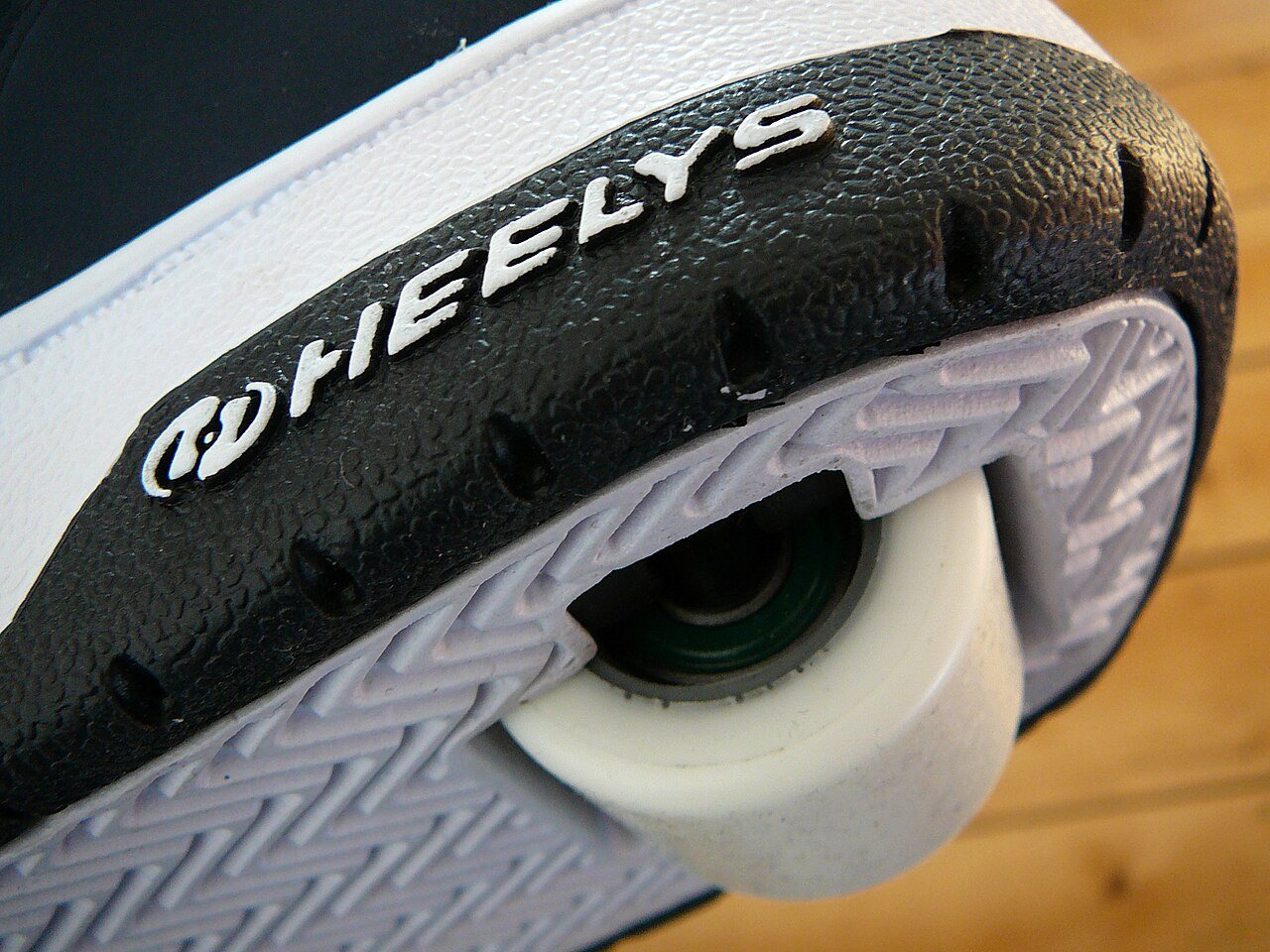
Who put the wheel in the heel, and when?
Roger Adams was a psychologist in his forties, on a 1998 vacation in California, when he watched skaters and cyclists roll past and decided a shoe ought to be able to do that on command. He went home, cut the heel out of a sneaker and fitted a wheel into the hole.
Skating was the family trade. Adams grew up in Tacoma, Washington, where his parents ran a roller rink, and at nine months old he was entered in the Guinness Book of World Records as the youngest person to roller skate.
He launched Heelys in 2000 through a company he set up as Heeling Sports Limited, based in Carrollton, Texas, just north of Dallas. The design was one wheel seated in a removable cassette in each heel, so a kid could walk normally, shift weight back and roll, then pop the wheel out with a plug when an adult objected.
Adams held the patents and made a fortune from them. He died of pancreatic cancer on March 24, 2026, at his home in Glenbrook, Nevada, at the age of 71, and the New York Times obituary that ran in April 2026 credited him with the invention outright.
How big did the wheeled-shoe boom actually get?
Enormous, and almost overnight. Heelys sold 1.4 million pairs in 2005 and 6.2 million pairs in 2006, an increase of 338.1 percent in a single year, according to the company's annual report for fiscal 2007.
Net sales followed the same curve, from $44.0 million in 2005 to $188.2 million in 2006. The shoes carried domestic retail price points of $49.99 to $89.99, which is roughly $80 to $145 in 2026 dollars.
The company took that momentum to the Nasdaq, pricing its initial public offering at $21.00 a share in December 2006 under the ticker HLYS. The stock rose sharply on its first day, and for about nine months Heelys looked like a footwear company rather than a craze.
It was a craze. Toy booms of that decade ran on the same fuel, a cheap object that other kids could see you had, which is exactly what drove the Beanie Babies bubble a decade earlier, and they tended to break the same way.
Why did schools start banning them?
Because children were rolling down hallways into other children. By August 21, 2006, the Deseret News reported that schools across Utah's Wasatch Front had banned athletic shoes with wheels in the heels, and that teachers at one elementary school had been arguing about a ban since 2003.
What ended the argument there was an injury. "We had an incident at school where a student was riding their Heelys and fell back and broke their arm," Reed Hodson, principal at Highland Elementary, told the Deseret News in 2006.
The bans spread through 2006 and 2007 across American school districts and shopping malls, usually on two grounds: collisions in crowded corridors, and wheel marks on gym floors. There was never a national rule, which is why the question still gets typed into search engines twenty years later.
The picture in 2026 is the same patchwork. Some districts prohibit all wheeled footwear, others allow the shoes as long as the wheels stay out and the heel plugs stay in, and the policy lives in each school's handbook rather than in state law.
How fast did the money disappear after 2007?
Faster than it arrived. Net sales were $183.5 million in 2007, essentially flat against 2006, then collapsed to $70.7 million in 2008 as retailers worked through inventory nobody wanted. Sales fell again in 2009, to $43.8 million.
That is a 62 percent drop in one year and a 77 percent drop in two, on a product whose tooling and distribution had been built for the 2006 number. The stock never recovered, and the company spent the next several years as a licensing operation with a large pile of cash and a shrinking business.
Sequential Brands Group bought it in a deal announced in December 2012. Because Heelys held so much cash, Sequential later put the net purchase price of the brand itself at about $5.5 million in 2013, which is what a name worth $188.2 million in annual sales six years earlier was finally traded for.
It is the standard shape of a novelty product that gets mistaken for a category, the same arc that turned the Segway from a world-changing invention into a mall-security vehicle.
Who makes Heelys now, and what do they cost?
BBC International owns the brand. Sequential Brands Group closed the sale of Heelys to BBC International on April 26, 2021 for $11 million in cash, and BBC International had already been the brand's core licensee since 2013, so the shoes never stopped shipping during the handover.
"We believe the brand is in great hands under BBC's leadership going forward," said William Sweedler, executive chairman of Sequential Brands Group, in the April 2021 announcement. Sequential itself filed for bankruptcy later that year, so the sale outlasted the seller.
Heelys are still made and still sold new in the United States in 2026, in one-wheel and two-wheel versions, through the brand's own site and mainstream chains such as Famous Footwear, Journeys and Walmart. Most current models list between about $60 and $75, which in real terms is close to what the mid-range pairs cost in 2007.
Where to find a pair today: new Heelys are the cheap route, at roughly $60 to $75 for a current model from a US retailer, and they come with the wheels and plugs in the box. Discontinued 2000s colorways, old wheel cassettes and Heelys-era merchandise turn up on Etsy's marketplace, which is the practical place to look for a pair in the original styling rather than a single listing that disappears.
They also outlasted most of what shared a shelf with them. Tamagotchi and Heelys are two of the very few 1990s and 2000s crazes you can still buy new, from the original brand, in a US store in 2026.
Frequently Asked Questions
Are Heelys still sold in 2026?
Yes. Heelys, the sneakers with a removable wheel in the heel that Roger Adams launched in 2000, are still manufactured and sold new in the United States in 2026, in both one-wheel and two-wheel models, with most current styles listing between about $60 and $75.
Why were Heelys banned in schools?
American schools began banning Heelys in 2006 and 2007 over hallway collisions, falls and marks left on gym floors. The Deseret News reported on August 21, 2006 that schools across Utah's Wasatch Front had prohibited them. There was never a national ban, and in 2026 the rule still varies by district, with many schools allowing the shoes only with the wheels removed.
Who owns Heelys now?
BBC International owns Heelys. It bought the brand from Sequential Brands Group for $11 million in cash in a sale that closed on April 26, 2021, after acting as the brand's core licensee since 2013. Sequential Brands Group had acquired Heelys, Inc. in a deal announced in December 2012.