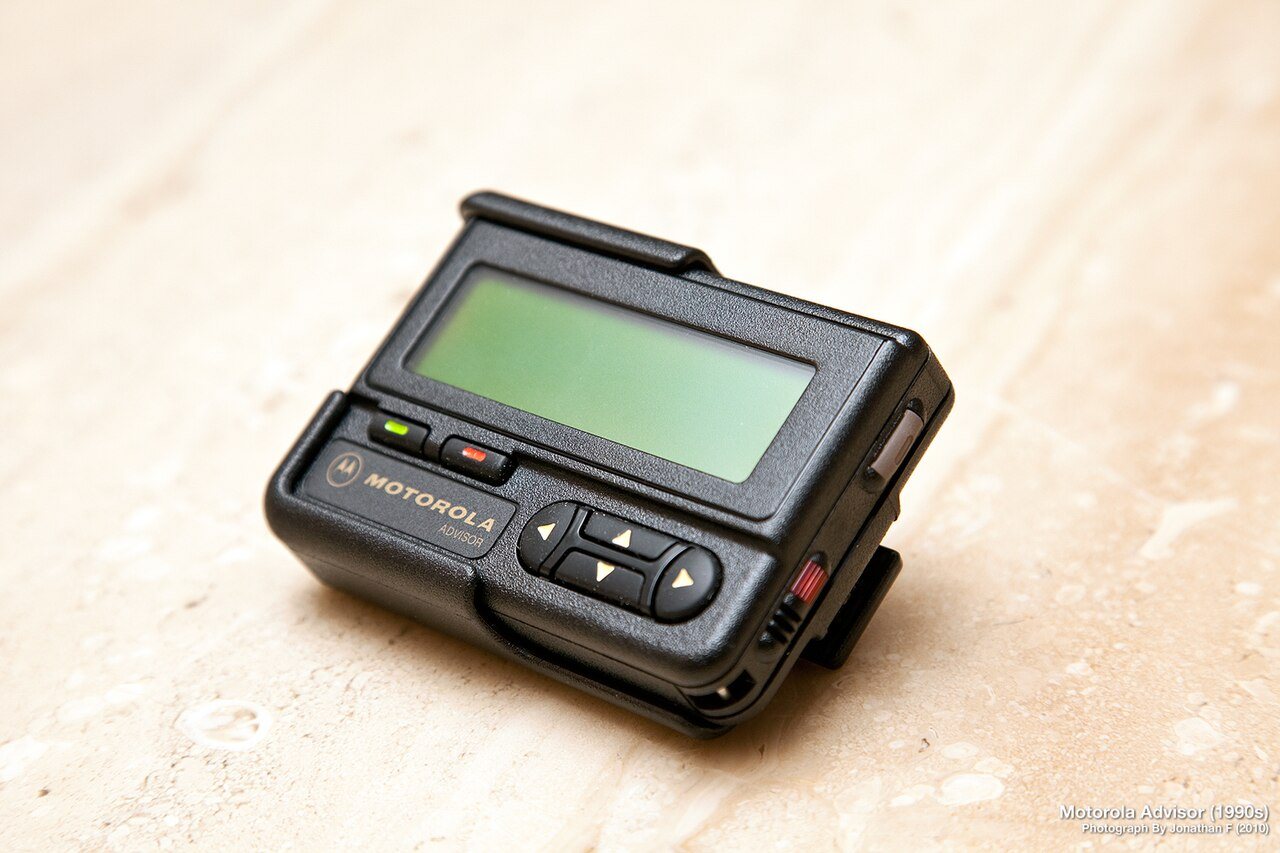
How many pagers are still in service in the United States?
Spok Holdings, the largest paging carrier left in the country, reported about 645,000 wireless units in service on June 30, 2026, down from about 694,000 a year earlier. Spok is publicly traded, so that count is filed with regulators rather than estimated by a trade group.
The slide is steady rather than sudden. The same company ended 2025 with about 675,000 units against about 720,000 at the end of 2024, and its annual report for 2025 told investors that "demand for wireless services will continue to decline for the foreseeable future in line with recent trends."
What has not happened is a shutdown. Paging revenue came to $16.0 million in the second quarter of 2026, down 6.9% from $17.2 million a year earlier, while average revenue per unit held at $8.20 a month. A shrinking network with flat per-unit pricing is what a business looks like when the customers who remain have nowhere else to go.
That 645,000 is a floor for the country rather than a census, because it counts only Spok. Other carriers run their own networks without filing subscriber numbers, and so do the fire departments and ambulance services that hold paging licenses of their own.
Why do hospitals still hand out pagers?
A national survey of 620 hospital-based clinicians, published in the Journal of Hospital Medicine in 2017, found that 495 of them, or 79.8%, had been issued a pager by their hospital. Of the same group, 304, or 49%, said the pager was still how patient care messages reached them most often.
The reason is the network before it is the habit. Paging runs on its own licensed spectrum with its own transmitters, and the message leaves every transmitter in the region at the same instant, a technique called simulcast. There is no handoff between towers and no data session to negotiate, so a basement corridor that kills a phone signal is an ordinary Tuesday for a pager.
The device helps too. A one-way pager only listens, which is why it runs for weeks on one battery and survives the floor of a trauma bay.
Christopher Peabody, an emergency physician at San Francisco General Hospital, gave NPR the short version in December 2023, calling pagers "the cockroaches of communication."
Who runs the paging network in 2026?
Spok Holdings is still independent, still listed on Nasdaq under SPOK, and now run out of Plano, Texas. No carrier bought it and no regulator wound it down. It has kept selling paging to the customers who will not leave, and built hospital software around them.
Two changes in 2026 are worth noting. In April the company announced a strategic realignment aimed at cutting operating costs, and in June it agreed to sell five regional narrowband licenses from its two-way paging inventory to Sensus USA for $8 million. That sale closed in July 2026.
Selling spectrum sounds like an exit. Spok frames it as right-sizing. Chief executive Vincent D. Kelly said in June 2026 that the deal "will not negatively impact our two-way subscribers, as we no longer require as many paging frequencies" to serve them, and that existing customers would move to other frequencies the company holds.
Fewer pagers need less air. What is left of the network is the part hospitals pay for, and it gets smaller every year by design as much as by attrition.
What pushed everyone else off the beeper
Paging was a mass-market product long before it was a hospital tool. USA Mobility, then one of the biggest carriers, told Computerworld that American paging subscribers peaked in 1998 at about 45 million before the long fall started.
Then cell phones got cheap. A device that could only tell you to call someone back had no answer to a device that let you make the call. Paging's late attempts to compete, alphanumeric screens and two-way models that could fire off a canned reply, walked the pager toward the phone at exactly the wrong moment.
The same curve flattened a lot of 1990s hardware. Payphones emptied out for the same reason, and the handsets that replaced both, among them the Nokia 3310, did everything a pager did plus the part that mattered.
What the phone could not copy was the thing nobody shopping for a phone cared about: a separate network that keeps working when the public one is overloaded. That turned out to be worth a business, just a much smaller one than paging had in 1998.
What it costs to keep a pager running in 2026
Paging is a subscription now rather than a purchase. Spok collected an average of $8.20 per unit per month in the second quarter of 2026, which is roughly what a hospital contract pays for each active pager. That figure has not moved in a year, while the number of units has.
The hardware usually belongs to the carrier, and it is not a 1998 beeper. Spok has added encrypted paging to the service, its answer to the long-standing complaint that an ordinary page travels in the clear and can be read by anyone with the right radio.
Where to find one today. Numeric and alphanumeric pagers from the 1990s turn up regularly as display pieces, props and desk objects, and the usual place to look is Etsy's vintage pager listings. Buying the plastic is the cheap part. Putting one back on a live network means a carrier contract, and $8.20 per unit per month is what Spok actually collected in 2026.
Who carries a pager besides doctors
Volunteer fire departments and ambulance squads still issue tone-and-voice pagers. Those sit on the department's own radio frequency and open the speaker when a dispatcher sends the alert tone, which is why a volunteer asleep at home gets woken by the call and not by a muted phone.
Utilities, industrial plants and some campus security teams keep paging for the same reason. Spok sells the service as critical messaging rather than as a cheaper phone, and the pitch is reliability in the conditions where the cellular network is the thing that broke.
For everyone else the pager function moved inside the phone and stayed there. The same consolidation absorbed the standalone GPS units that used to sit on windshields. A page is a push notification now, carried on the network everyone already pays for, which is exactly why the units Spok still runs belong to the people who cannot rely on it.
Frequently Asked Questions
Can you still buy a pager in 2026?
Yes. Paging service is still sold in the United States in 2026, and Spok Holdings, the largest US paging carrier, had about 645,000 units in service on June 30, 2026. Pagers are normally leased with a service contract rather than bought outright, and Spok collected an average of $8.20 per unit per month in the second quarter of 2026.
Why do doctors still use pagers instead of phones?
Paging runs on its own licensed network, and every transmitter in a region sends the same message at the same moment instead of handing a call between towers, so pages arrive in the parts of a hospital where cellular coverage does not. A national survey of 620 hospital clinicians published in the Journal of Hospital Medicine in 2017 found that 79.8% had been issued a pager and that 49% still received patient care messages by pager most often.
How many pagers are left in the United States?
Spok Holdings reported about 645,000 wireless units in service on June 30, 2026, down from about 694,000 a year earlier and about 675,000 at the end of 2025. That total covers only Spok, so it leaves out pagers run by other carriers and by fire and ambulance services on their own licensed frequencies, but Spok is the largest US paging carrier and the one that files the number publicly.