Why did Betamax lose to VHS?
Betamax lost to VHS on three things: tape length, price, and the number of factories building machines. Sony launched Betamax in Japan on May 10, 1975 with a recorder that held one hour of video. JVC answered on October 31, 1976 with the HR-3300, the first VHS deck, and its cassette held two.
One hour was enough for a sitcom. It was not enough for a film, a baseball game, or an evening out of the house. Sony had designed the format around a cassette small enough to slip into a coat pocket, and that choice locked in the running time before anyone knew what buyers would actually do with the machine.
Sony spent the rest of the war catching up. The SL-8200 arrived in 1977 with a half-speed mode that fit two hours onto an L-500 cassette. VHS decks were already recording four hours by then, and later six and eight. Every time Sony matched the number, the number had moved.
What a Betamax cost in 1976, and what VHS cost in 1977
The first stand-alone Betamax deck sold in the United States, the Sony SL-7200, reached stores in February 1976 at $1,295. Adjusted with the consumer price index, that is roughly $7,600 in 2026 money for a machine that recorded one hour at a time.
RCA announced its answer on August 23, 1977 and put it on sale that October. The SelectaVision VBT200 was built by Matsushita, ran VHS tapes, and recorded four hours. It sold for $1,000, and RCA advertised it with a line that made the entire argument in five words: four hours, $1,000, SelectaVision.
A shopper standing in a store in late 1977 was therefore looking at a $295 price gap and a four-to-two gap in recording time, both running the same direction. Sony's answer was that Beta looked slightly better. That is a hard sell against a cheaper box that can record a whole football game unattended.
How JVC's open licence beat Sony's closed one
Sony kept Betamax as a Sony product and licensed it narrowly. JVC treated VHS as a standard and licensed it to anyone willing to build it, including its parent company Matsushita, plus RCA, Sharp, Zenith, and Magnavox. The two formats were not really competing products. They were competing supply chains.
The gap shows up in the tape aisle. By 1984 roughly 40 companies were manufacturing VHS cassettes against 12 making Betamax cassettes. More manufacturers meant lower prices, more shelf space, and more rental stock, because video shops carried whatever the most customers could play at home.
Market share followed. Beta slipped to around 25 percent of VCR sales by 1981 and 7.5 percent by 1986. In 1988 Sony began selling VHS recorders under its own name, which settled the question without anyone using the word surrender. Sony would run the closed-format play again with MiniDisc, and would finally win one two decades later in the HD DVD fight, by signing up studios and hardware partners before the shooting started.
Was Betamax actually the better format?
Slightly, at first, and by less than the legend claims. At its original speed Betamax resolved 250 horizontal lines against 240 for VHS. Ten lines, on a 1977 television, across a living room.
Sony then traded that edge away on its own. The two-hour Beta II mode that answered VHS ran the tape at half speed and gave up picture quality to do it, so the setting nearly everyone actually used was no longer the sharper one.
Sony did eventually build the machine the legend describes. ED Beta, launched in 1988, recorded about 500 lines of luminance resolution and outclassed everything else on the consumer market. It shipped the same year Sony started making VHS decks, to a public that had stopped listening a decade earlier. The one place the engineering paid off was professional: Betacam, a broadcast derivative using a similar cassette shell, became standard equipment in television news long after consumer Beta was finished.
Did adult films really decide the format war?
This is the version everyone repeats, and it does not survive contact with the timeline. Sony did have rules about what it would attach its own name to, but that governed what Sony itself produced and distributed. It never stopped anyone from recording whatever they liked onto a blank Beta cassette, and adult titles were duplicated onto both formats, because distributors wanted revenue from both sets of owners.
The bigger problem with the story is that it is not needed. Beta was already losing on the two numbers buyers compared in the shop, and losing badly on the number of companies making tapes and decks. Two hours beat one, $1,000 beat $1,295, and 40 factories beat 12. Nothing about the format war requires a more colourful explanation than that.
The 1984 Supreme Court case Sony won
Universal City Studios and Walt Disney Productions sued Sony in Los Angeles federal court in 1976. Their argument was that a machine built to record television is a machine built to infringe copyright, and that Sony should be liable for what its customers did with it. They asked the court to stop the sale of the Betamax.
The case ran for eight years. On January 17, 1984 the Supreme Court ruled 5 to 4 for Sony in Sony Corp. of America v. Universal City Studios, 464 U.S. 417. Recording a broadcast at home to watch it later, which the court called time-shifting, was fair use, and a device capable of substantial non-infringing uses does not make its manufacturer a contributory infringer.
That holding outlasted the format by decades. It is the legal ground under the cassette deck, the CD burner, the DVR, and most of the recording hardware sold since. Sony lost the format and won the case that kept the entire home video business legal, including the VHS trade that had beaten it.
Where to find a Betamax today
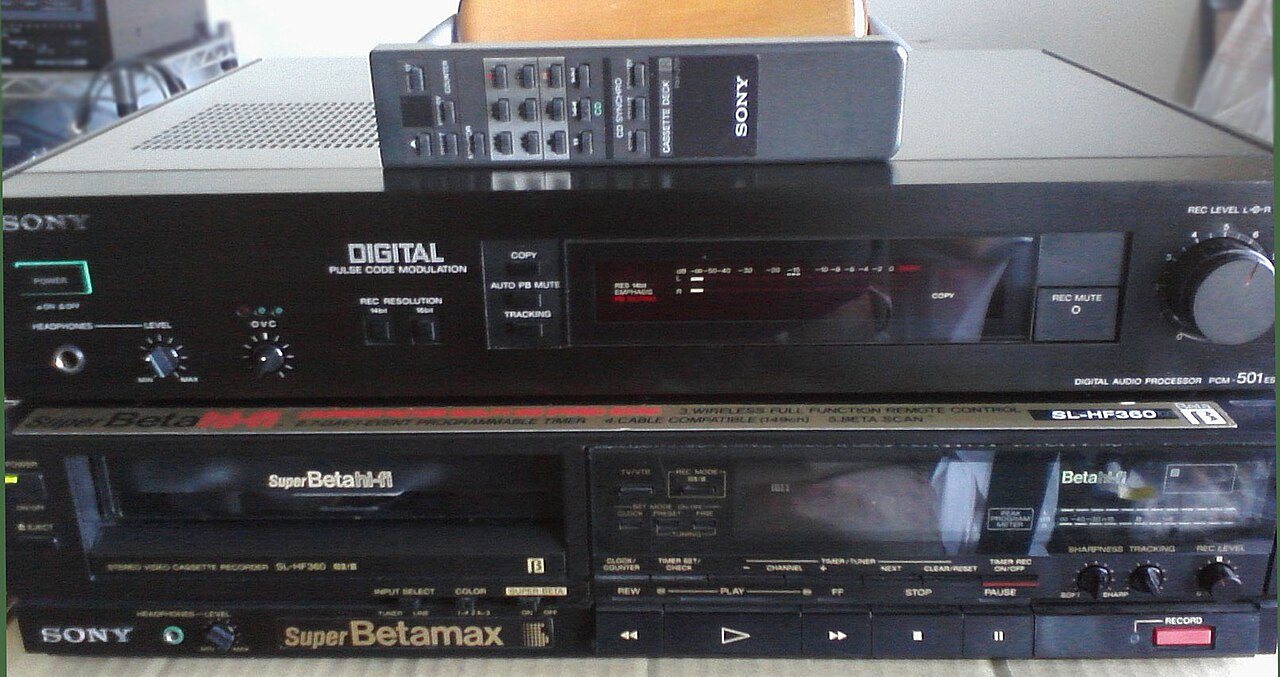
Working Sony Beta decks still turn up on eBay most weeks. Refurbished players commonly sell for about $50 to $200, while clean high-end Super Beta Hi-Fi machines are listed in the high hundreds and occasionally above $1,000. Tapes are cheap, generally a few dollars to around $20, with rare horror and cult titles reaching $50 and up. Check the belts and the loading tray before paying: forty-year-old rubber is the usual point of failure, and spare parts are scarce.
Frequently Asked Questions
Why did Betamax fail if the picture was better?
The picture advantage was 250 lines against 240 at Betamax's original speed, and Sony gave most of it back when it introduced the slower two-hour Beta II mode in 1977. Buyers were comparing a $1,295 one-hour Sony against a $1,000 four-hour RCA, and the tape length and price decided it.
When did Betamax stop being made?
Sony stopped manufacturing Betamax recorders in 2002, then kept producing blank Betamax cassettes for another fourteen years. The last tapes shipped in March 2016, roughly 41 years after the format launched in Japan.
Are Betamax tapes worth anything?
Most are not. Common blanks and mainstream titles sell for a few dollars to about $20, while scarce horror, sci-fi, and cult releases can reach $50 or more in good condition. The machines are usually worth more than the tapes, with refurbished decks typically listed between $50 and $200.