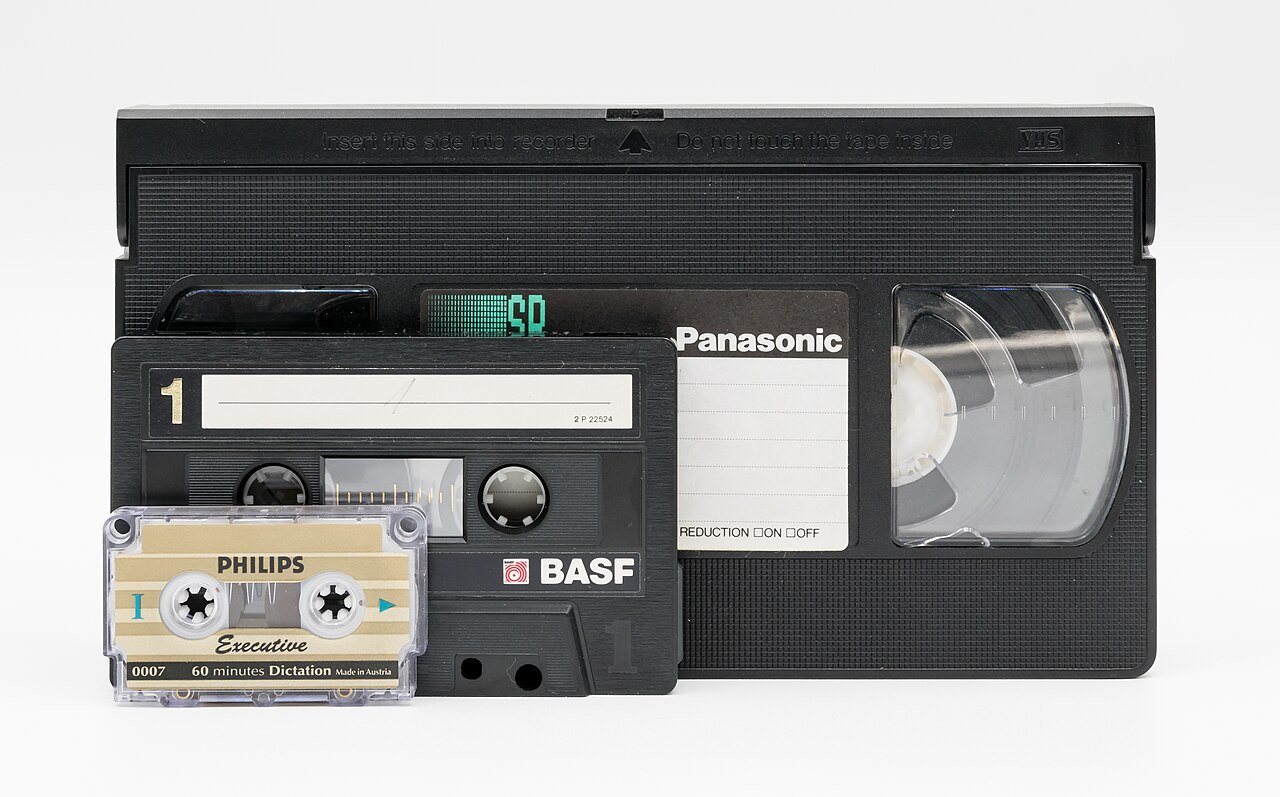
Are your tapes already too old to save?
Magnetic tape has a shelf life, and home video sat on the cheapest magnetic tape ever mass produced. Even a cassette filled on New Year's Eve 1999 is 26 years old in 2026.
The reference number comes from a 1995 document. In "Magnetic Tape Storage and Handling: A Guide for Libraries and Archives", written by John Van Bogart for the Commission on Preservation and Access, the verdict is flat: "thirty years appears to be the upper limit for magnetic tape products".
That ceiling assumes good storage. Van Bogart's estimates give videotape roughly 30 years at 68 degrees Fahrenheit and 50 percent relative humidity, about 10 years if the room runs at 76 degrees, and about 5 years at 80 percent humidity. A box in a Phoenix garage and a box in a basement closet are not the same box.
The damage is chemical as well as magnetic. The binder that glues magnetic particles to the polyester backing absorbs moisture and breaks down, which is what makes a neglected cassette squeal, shed brown dust and stick to the heads rather than simply look washed out.
None of that means a 1992 birthday tape is lost. It means the copy made in 2026 will be better than the copy made in 2031, and that the order of operations is capture first, tidy up later.
The cheap route: a used VCR and a USB capture stick
The do-it-yourself chain has four parts: a working deck, a capture device, a computer and free software.
Nobody has built a new VCR since Funai Electric shut its line at the end of July 2016. Funai once sold about 15 million VCRs a year worldwide and was down to 750,000 in its final year, and the end came from the supply chain rather than the customers. A Funai spokesman told AFP in 2016 that a supplier had quit, and that "we can't make them without that part".
So the deck is secondhand. Capture's 2026 buying guide puts working players at roughly $30 to $300, the low end being thrift shops and estate sales, the high end being sellers who service the transport and belts before shipping.
The capture device is the cheap part. The same guide puts useful USB capture hardware at about $30 to $80 and warns that the sub-$20 sticks introduce artifacts, audio drift and dropped frames that no amount of editing fixes afterward. The software can be free: OBS Studio records whatever the capture device sends it straight to an MP4 file.
Budget the time, not just the money. Every capture runs in real time, so a two-hour tape takes two hours, and 40 tapes is a month of evenings. Under roughly ten tapes, the math favors paying somebody. Over 30, the gear pays for itself on the first box.
What a digitized tape actually looks like on a 4K TV
VHS is an analog standard-definition format, and capturing it does not add detail that was never recorded. A clean transfer looks exactly like the tape looked in 1997 on a 27-inch tube, stretched across a screen four times the size.
That is the honest baseline, and it is worth setting before spending money. A $200 capture card does not produce a sharper image than a $50 one; it produces a more faithful one, with fewer dropped frames and audio that stays in sync across a three-hour recording.
The bigger quality lever is the deck. A player with clean heads and working tracking control recovers detail that a rattling thrift-store unit turns into noise, which is why professional shops keep rooms full of serviced machines.
Cleanup, if it happens at all, happens after capture. Save the raw file first, then experiment with deinterlacing or noise reduction on a copy. Home video was never broadcast quality, and it was never meant to be watched on the hardware that replaced the DVR generation that followed the VCR.
Hi8, VHS-C and MiniDV are three different jobs
The word "tapes" hides at least four formats in the average shoebox, and they do not all take the same route.
VHS and S-VHS play in a standard deck. VHS-C, the compact cassette used by camcorders, does not: it needs a motorized full-size adapter, or the original camcorder, and the adapters fail more often than the tapes do.
Video8 and Hi8 are analog, like VHS, but they only play in an 8mm camcorder, so the camcorder becomes the deck and its analog output feeds the same capture chain.
MiniDV is the exception, because MiniDV was already digital. A MiniDV camcorder connected over FireWire or i.Link hands the computer the recorded data rather than a re-recorded picture, which is the one home format that transfers without a generation of loss. The catch in 2026 is the connector: FireWire ports vanished from laptops years ago, and adapters are a hunt of their own.
Store-bought movie tapes are a separate question and rarely worth digitizing. Nearly everything Hollywood released on VHS is on disc or streaming, and the last Blockbuster still keeps a wall of them for anyone who misses the format.
What mail-in services charge, and who does the work
Capture's 2026 guide puts professional digitizing at $15 to $30 a tape, which is where the DIY math stops making sense for small collections. Mail-in kits are sold by item count rather than per tape, so the quoted price covers a box of a fixed size whether it arrives full or half empty.
Legacybox is the name most Americans have seen, usually in a holiday ad. It runs out of Chattanooga, Tennessee, where founders Nick Macco and Adam Boeselager started the business in 2009 after transferring tapes to DVD as college students. Macco told the Chattanooga Times Free Press in 2026 that the plant holds "the largest working collection of VCRs in the world", which is less of a boast than a job requirement.
Comparison shopping is narrower than it looks. Legacybox, Southtree and Kodak Digitizing are brands of the same Chattanooga company, AMB Media, and the Kodak name is used under a trademark license. Eastman Kodak is not the company handling the tapes.
Set expectations on speed. Reviewers in 2026 report waits of roughly three months for standard processing, longer around the holidays, and that clock starts when the box arrives at the factory rather than when it is ordered. Anyone with a deadline, a memorial or an anniversary should send the box early or drive to a local shop instead.
Where to find one today: mail-in digitizing kits are priced by the number of items, and the per-item price drops as the kit gets bigger, so it pays to gather everything in the house before ordering. Prices and kit sizes are listed at Legacybox. Whichever route wins, label the box, count the tapes and photograph the labels before anything ships, because a handwritten "Christmas 94" is the only index that exists.
Frequently Asked Questions
How much does it cost to digitize VHS tapes in 2026?
Doing it at home in 2026 costs about $30 to $80 for a USB capture device plus roughly $30 to $300 for a secondhand VCR, after which every tape is free apart from the time. Mail-in services such as Legacybox charge in the range of $15 to $30 a tape, sold as fixed-size kits rather than per cassette.
Can you still buy a VCR in 2026?
Not a new one. Funai Electric, the last manufacturer, ended VCR production at the end of July 2016 after selling 750,000 units in its final year, down from about 15 million a year at the peak. Every VCR available in 2026 is used or refurbished, and working decks run roughly $30 to $300.
Do VHS tapes go bad if you never play them?
Yes. VHS tapes degrade in storage because the binder holding the magnetic particles absorbs moisture and breaks down. The 1995 CLIR guide by John Van Bogart estimates about 30 years of life at 68 degrees Fahrenheit and 50 percent humidity, dropping to about 10 years at 76 degrees and about 5 years at 80 percent humidity.