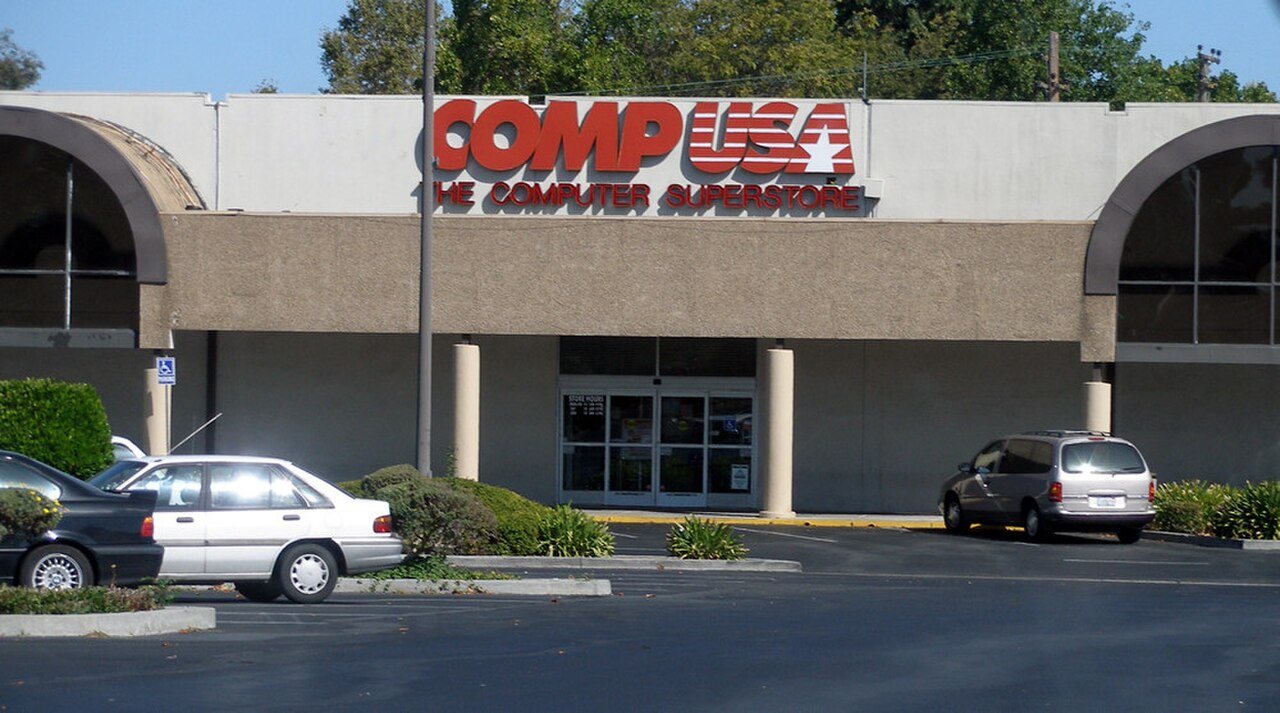
Is CompUSA still around in 2026?
No. There is no CompUSA store anywhere in the United States, and there has not been one since 2008. The chain's last 103 locations were sold in December 2007 to Specialty Equity LLC, an affiliate of the Boston restructuring firm Gordon Brothers Group, which ran store-closing sales through the holidays and emptied the buildings after.
The name outlived the stores by five years. Systemax, the parent company of TigerDirect, bought the CompUSA brand and website in January 2008 and put the logo back on retail stores and an online shop. That ended in the fourth quarter of 2012, when Systemax folded its United States consumer business into the TigerDirect name and wrote the CompUSA brand off its books.
Type compusa.com into a browser in 2026 and you do not reach a store. The domain resolves to a hosting error page. The CompUSA trademarks, on the other hand, are still live at the United States Patent and Trademark Office, registered to a company that does not sell computers.
How big did CompUSA actually get?
Bigger than most people remember. The business started in 1984 as Soft Warehouse, Inc., was incorporated in Delaware in 1988, and operated under the Soft Warehouse name until March 1991. After that it was CompUSA, run out of offices on North Dallas Parkway in Dallas, with common stock on the New York Stock Exchange under the ticker CPU.
By the close of fiscal 1999 on June 26 of that year, CompUSA ran 211 computer superstores across 42 states. Net sales for the year were $6.32 billion, up 19.6 percent from $5.29 billion the year before. That is the high-water mark in the company's own SEC filings, and it is why the chain shows up in so many first-PC stories: for a stretch in the late 1990s there was one within driving distance of most American metro areas.
Some of that reach was bought rather than built. On August 31, 1998, CompUSA acquired Computer City from Tandy Corporation for roughly $175 million, taking on 96 stores in the United States. It closed 55 of them, reopened 37 as CompUSA superstores by fiscal year end, and sold seven Canadian locations to Future Shop for about $7 million. This was the same period in which Gateway was opening its own storefronts and Best Buy was scaling nationally. Selling personal computers in a warehouse still looked like a growth industry.
What did Carlos Slim do with CompUSA?
He bought it, then spent years paying for it. The Mexican financier Carlos Slim Helu took his first stake in CompUSA in 1999 and took the whole company private the next year in an $800 million buyout, which is why the detailed public filings stop after fiscal 1999.
Ownership was never the problem. Margin was. PC prices fell year after year, and the profit in consumer electronics moved toward flat-panel televisions, where Circuit City and Best Buy were already cutting each other's prices. CompUSA cycled through several chief executives and several turnaround plans, including a late attempt to aim the stores at gadget buyers and small-business customers rather than at everyone.
In the spring of 2007 the company closed more than half its stores and took a $440 million cash infusion to restructure around the ones that were left. That bought roughly nine months. By December the owner had stopped funding it.
Why did CompUSA shut down in December 2007?
Because the smaller CompUSA still lost money. With 103 stores left after the spring cuts, the company was sold in December 2007 to Specialty Equity LLC, the Gordon Brothers affiliate, and those stores went straight into holiday liquidation sales rather than a Christmas selling season.
Gordon Brothers is a restructuring and liquidation firm, not a retailer, and it treated CompUSA as a parts bin. It shopped individual stores in strong retail markets, the CompUSA TechPro technical-services business, and the CompUSA.com online operation as separate lots, and left it to whoever bought each piece to decide whether the CompUSA name came with it.
That is what makes the ending different from the chains it competed against. There was no drawn-out Chapter 11, no reorganization plan, no fight over the whole company. A liquidator bought it in one December transaction, and the warehouse-sized stores, the same format Fry's Electronics built its business on, went dark over the following weeks.
Who owns the CompUSA name in 2026?
Systemax moved first. It bought CompUSA's e-commerce business for $18.9 million in cash on January 10, 2008, then took sixteen retail store leases and their fixtures for about $11.7 million during February and March. Most of what it paid for was the name itself: $17.0 million of the purchase was booked as trademarks and trade names and $8.0 million as domain names.
The revival was real for a while. The deal gave Systemax 29 retail storefronts across North America and Puerto Rico, run next to its TigerDirect business, and CompUSA-branded operations produced $63.0 million of sales in the third quarter of 2008 and $139.4 million over the first nine months of that year.
Then Systemax decided one consumer brand was enough. In the fourth quarter of 2012 it concluded that its North American consumer business would work better consolidated under TigerDirect, and wrote off the intangible assets and goodwill of CompUSA and Circuit City together, about $35.3 million. Systemax finished 2012 with 41 retail stores, 17 of them in Florida and 6 in Texas.
The paperwork survived all of it. The COMPUSA.COM trademark, registration number 2582709, filed February 12, 1999 and registered June 18, 2002, is listed at the USPTO as live and was renewed in January 2023. The owner of record is Source Brand Group, LLC of New York. Somebody is still paying to keep the name, and nobody is selling computers with it.
If you want something with the logo on it, the only supply is retail debris. Employee polo shirts with the embroidered CompUSA logo, 1990s store charge cards, plastic shelf talkers and the occasional piece of store signage turn up on Etsy and at estate sales, usually from former staff or from people who cleared out a closing location. Prices move with condition and sentiment, and none of it is scarce enough to treat as an investment.
Frequently Asked Questions
When did CompUSA close?
CompUSA sold its remaining 103 stores in December 2007 to Specialty Equity LLC, an affiliate of Gordon Brothers Group, and those stores ran closing sales through the holidays before shutting in 2008. More than half the chain had already closed in the spring of 2007, alongside a $440 million cash infusion that failed to turn the business around.
Did TigerDirect buy CompUSA?
Systemax, which owned TigerDirect, bought CompUSA's e-commerce business for $18.9 million in January 2008 and sixteen store leases for about $11.7 million over the next two months. It ran CompUSA as a separate brand until the fourth quarter of 2012, when it consolidated its United States consumer operations under TigerDirect and wrote off roughly $35.3 million of CompUSA and Circuit City intangibles.
Does compusa.com still work?
Not as a store. The address loads a hosting error page rather than a shop, and no CompUSA retail site has operated there for years. The COMPUSA.COM trademark itself is still registered and active, held by Source Brand Group, LLC and renewed in January 2023, so the name is owned rather than abandoned.