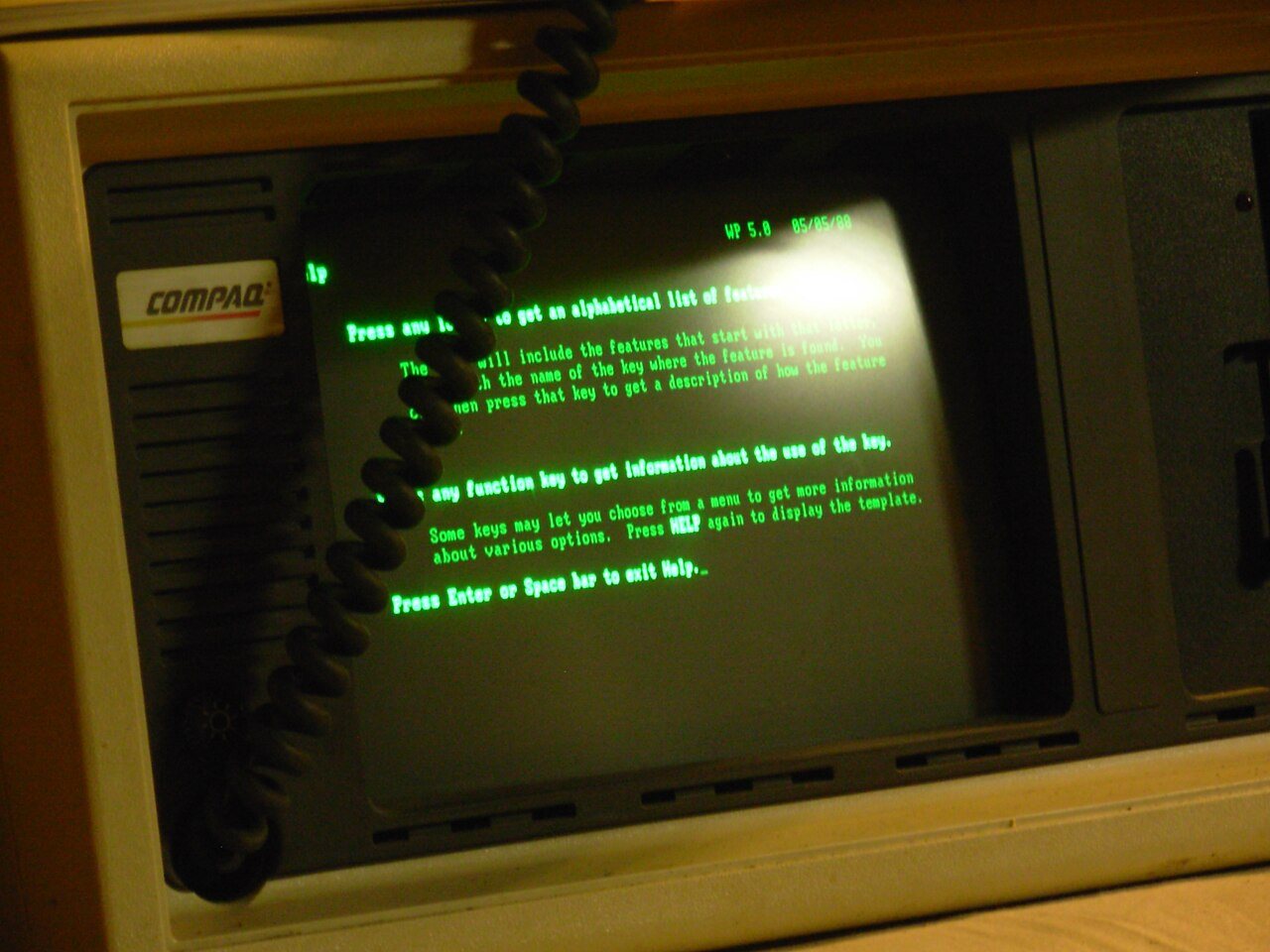
What was Compaq, and why did it matter?
Compaq Computer Corporation was founded in February 1982 by Rod Canion, Jim Harris and Bill Murto, three managers who had just walked out of Texas Instruments. The plan they sketched over pie in Houston was simple and expensive: build a portable machine that ran every piece of software written for the IBM PC, without copying a line of IBM's code.
The obstacle was the BIOS, the small program that tells an IBM PC how to talk to its own hardware. Compaq solved it with a clean-room project. One team studied IBM's BIOS and wrote a specification of what it did. A second team, which had never seen IBM's code, wrote fresh software to match that specification.
The Compaq Portable was announced in November 1982 and shipped in March 1983 at $2,995 with a single 360 KB floppy drive, or $3,590 with two. It ran Lotus 1-2-3, which was the only compatibility test most business buyers cared about. The entire PC clone industry starts at that machine.
How did Compaq get so big so fast?
In 1983, its first full year of production, Compaq shipped 53,000 portables and booked more than $111 million in revenue, the largest first year any American company had recorded to that point.
In 1986 it joined the Fortune 500 in its fourth year of existence, faster than any company before it. That September it shipped the Deskpro 386, the first personal computer built around Intel's 32-bit 80386 processor. IBM, which was supposed to set the pace for the standard it had created, did not ship a 386 machine of its own until the PS/2 Model 80 in August 1987.
That was the moment the PC standard stopped belonging to IBM. Compaq decided what a PC was, and the rest of the industry followed.
Buyers noticed. In the first half of 1994 Compaq held 10.4 percent of the world PC market against IBM's 8.5 percent, which made a twelve-year-old company the largest PC maker on earth. It got there with premium engineering sold through a dealer network that earned a healthy margin on every box. Both halves of that sentence became the problem.
What went wrong in 1991?
Cheap clones got good. Dell, Gateway and AST were shipping machines that ran the same software for hundreds of dollars less, and buyers stopped paying extra for the Compaq badge.
After sales of $3.6 billion and profits of $455 million in 1990, Compaq posted a $70 million loss in the third quarter of 1991, the first quarterly loss in its history. Canion cut about 1,400 jobs and asked the board for eighteen months to build a low-cost line.
He did not get them. Chairman Ben Rosen had quietly commissioned his own team to find out how cheaply a Compaq could be built, and on October 25, 1991 the board replaced Canion with chief operating officer Eckhard Pfeiffer. Co-founder Jim Harris resigned two weeks later.
Pfeiffer cut prices hard and went after ordinary shoppers. On August 27, 1993 Compaq launched the Presario at $1,399, a complete machine with a monitor and a modem in the box, stacked in electronics stores rather than sold by a reseller. More than 100,000 went out in sixty days, and the line brought in $500 million before the year ended.
Why did buying Digital Equipment backfire?
Pfeiffer wanted Compaq to be a full-service computer company rather than a box shop, so on January 26, 1998 he agreed to buy Digital Equipment Corporation for $9.6 billion, the largest acquisition the computer industry had seen. Digital shareholders received $30 in cash and about 0.945 Compaq shares for each share they held.
The deal closed in June 1998 at an aggregate purchase price of $9.1 billion, and the accounting was brutal. Compaq wrote off roughly $3.2 billion of purchased in-process technology, booked $393 million in restructuring charges, and accrued $1.1 billion for separation benefits covering about 19,700 employees worldwide.
It also bought a culture that did not fit. Digital sold minicomputers and services to engineers through its own sales force. Compaq sold consumer PCs through retailers. Revenue climbed from roughly $25 billion in 1997 to $31 billion in 1998, and the profits went missing on the way.
Early in 1999 Compaq warned that first-quarter earnings would miss expectations. On April 19, 1999 the board pushed out Pfeiffer along with chief financial officer Earl Mason. Rosen ran the company himself until Michael Capellas took the job.
How did Dell beat Compaq at its own game?
Dell built each machine after the customer ordered it and sold it direct. No dealer markup, no warehouse full of last quarter's configurations, no third party's margin to protect.
Compaq could not copy that without wrecking the thousands of resellers who carried its products, so for years it half-copied it and the price gap stayed open. Selling beige boxes was a fine business until beige boxes became interchangeable, a point Apple made loudly with the iMac G3 in 1998.
Dell passed Compaq as the largest PC seller in the United States in the third quarter of 1999. Worldwide it took the lead in the first quarter of 2001, holding 13 percent of the market to Compaq's 12 percent. Dell's shipments that quarter rose 30 percent to 4.1 million units. Compaq's fell 4.7 percent.
Compaq was not a small company in 2001. It was a slow one, in a market that had stopped paying for anything except cost.
What happened when HP bought Compaq?
On September 3, 2001 Hewlett-Packard announced it would buy Compaq in an all-stock deal worth about $25 billion. Walter Hewlett, an HP director and the son of one of its founders, opposed it and ran a proxy campaign against his own board.
Shareholders approved the merger by a narrow margin at the vote on March 19, 2002. Hewlett contested the result in Delaware court, lost, and the deal closed on May 3, 2002.
On June 4, 2002 HP said it would cut 15,000 jobs from a combined workforce of roughly 150,000, with 10,000 going by that November and 5,000 more in 2003. The Compaq name lived on for another decade on budget desktops and Presario laptops, until HP retired the brand in 2013.
It survives as a licence. HP owns the trademark and rents it out, which is why Compaq-branded televisions sell in India and Compaq-branded laptops sell in Brazil, made by companies with no connection to Houston.
Where to find one today. Original 1983 Compaq Portables show up on eBay most weeks. Untested or parts-only units are the cheapest way in, working examples that still boot from a floppy typically run a few hundred dollars, and complete systems with the original carry case and manuals get listed in four figures. Presario desktops from the 1990s are far more common and often sell for little more than the cost of shipping them.
Frequently Asked Questions
Is Compaq still around?
Not as a company. Compaq was absorbed into Hewlett-Packard on May 3, 2002, and HP stopped putting the name on its own products in 2013. HP still owns the trademark and licenses it to other manufacturers, so new Compaq-branded televisions and laptops are sold in markets including India and Brazil.
How much did the first Compaq computer cost?
The Compaq Portable shipped in March 1983 at $2,995 with one 360 KB floppy drive, or $3,590 with two. Compaq sold 53,000 of them that year for more than $111 million in revenue, the biggest first year of any American company at the time.
Why did HP buy Compaq?
HP wanted scale in PCs and servers to compete with Dell and IBM, and Compaq had become cheap enough to buy after years of falling margins. The all-stock deal was worth about $25 billion when it was announced in September 2001, and HP cut 15,000 jobs after it closed in May 2002.