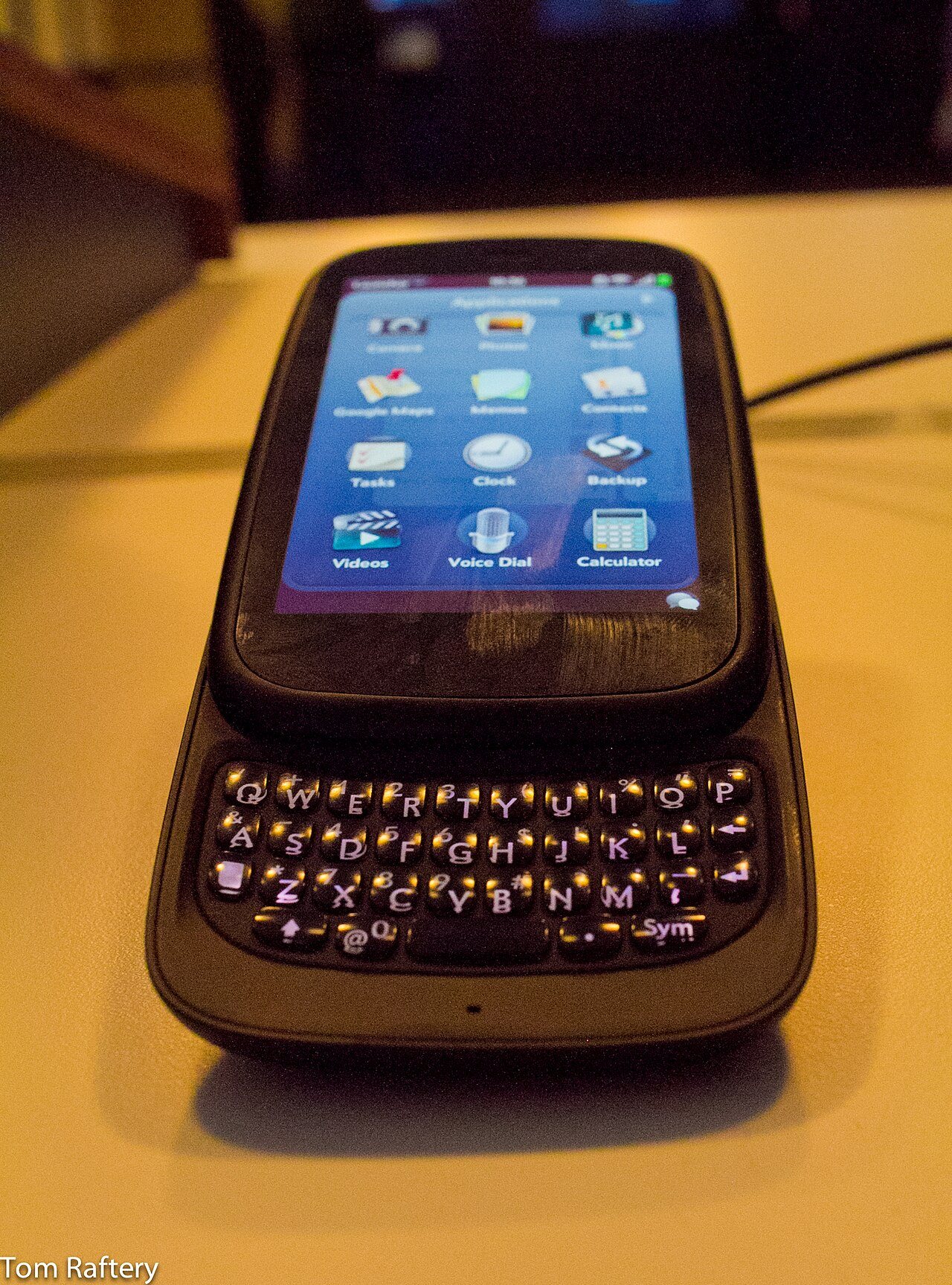
Is Palm still a company in 2026?
No. Palm stopped being an independent business on July 1, 2010, the day Hewlett-Packard completed its purchase of the company. Everything that carried the name after that was owned by somebody else.
Three pieces of Palm went three different ways. The hardware and phone business was shut down by HP in August 2011. The webOS software was sold to LG Electronics in February 2013. The Palm trademark itself was sold in October 2014 to a holding company tied to the Chinese electronics maker TCL, which still owns it.
So the status today is split. Palm the company is gone, Palm the name is dormant under a Chinese owner, and Palm's software is alive under a third company, running television sets.
Who owns Palm now?
TCL. In October 2014, HP sold the Palm trademark to Wide Progress Global Limited, a shelf company controlled by Nicolas Zibell, at the time a regional president at TCL. TCL confirmed the purchase publicly on January 6, 2015 and talked about building a team in Silicon Valley to work out what to do with the name.
What it did with the name took another three and a half years, and then it stopped. A single Palm-branded Android phone was unveiled on October 15, 2018, built by TCL, with Golden State Warriors guard Stephen Curry attached as an investor and the face of the launch.
Since then, nothing. Palm's own store at palm.com is still online in 2026, still describing that 3.3-inch phone in the present tense, with no product available to buy. The trademark is maintained. The company behind it is a portfolio line item.
What did HP get for $1.2 billion?
HP announced the deal on April 28, 2010: $5.70 a share in cash, an enterprise value of roughly $1.2 billion. Todd Bradley, who ran HP's Personal Systems Group, said Palm's operating system was "an ideal platform to expand HP's mobility strategy." The deal closed on July 1, 2010.
What HP bought was a company that had already been through four owners and two identities. Palm was founded in 1992 by Jeff Hawkins, with Donna Dubinsky and Ed Colligan, sold to U.S. Robotics in 1995, absorbed into 3Com in 1997, spun back out as a public company on March 1, 2000, split into a software arm and a hardware arm in 2002 and 2003, and reassembled in 2005 when the hardware side paid $30 million for the other half of its own trademark. That history is the subject of our piece on the rise and fall of the Palm Pilot.
By 2010 the good part was the software. webOS launched with the Palm Pre on June 6, 2009 on Sprint, and reviewers liked its card-based multitasking well enough that HP bought the company mostly to get it.
Why HP killed webOS in 13 months
On August 18, 2011, HP announced it would end production and support of Palm and webOS devices. That was less than 14 months after the acquisition closed and roughly 16 months after HP told investors it was buying its way into the smartphone business.
The accounting caught up in November. In its fiscal 2011 results, released November 21, 2011, HP excluded $3.3 billion in after-tax costs, or $1.56 per diluted share, tied to winding down the webOS device business plus the related goodwill impairment, amortization, restructuring and acquisition charges. The fourth quarter alone carried $2.1 billion of that.
For a company that had spent the previous decade digesting its purchase of Compaq, it was a familiar shape of problem: buy a strong brand, inherit a losing platform war, discover the war is already over. Apple and Android had taken the market by 2011, and the same squeeze was already flattening BlackBerry.
Where webOS ended up: LG television sets
On February 25, 2013, LG Electronics announced it had acquired webOS from HP. The deal covered the source code, the documentation, the engineering team and the related websites, plus licenses to HP patents originally filed by Palm covering operating system and user interface work. LG also took over stewardship of the Open webOS and Enyo open source projects, and picked up HP's Sunnyvale and San Francisco research sites.
HP kept the Palm cloud assets: the source code, the staff, the infrastructure and the contracts behind Palm's online services. Neither company expected the deal to move its numbers, and neither disclosed a price.
LG's plan was smart TVs, and that is where webOS still lives. LG has since turned it into a licensing business, selling the platform to other television manufacturers under the webOS Hub name. Palm's software now ships on sets made by companies that never sold a handheld.
The 2018 Palm phone was a $349 accessory
The one product that used the Palm name in the smartphone era was strange by design. Announced October 15, 2018 and sold from November through Verizon, the Palm phone had a 3.3-inch screen, ran Android, and could not be bought unlocked at first. It cost $349 up front, or about $15 a month financed, and it needed a Verizon Connected Device plan at $10 a month plus the carrier's NumberShare feature so it could borrow your real phone number.
In other words, it was a $349 second phone for the kind of person who already owned a first phone. Reviewers struggled to explain who that was, the idea did not spread, and no Palm phone has followed it in the seven years since.
Where to find one today: nothing Palm-branded is sold new, so the secondhand market on eBay.com is the only route, where the small model turns up unlocked, boxed, or as a carrier-locked Verizon unit. Use the launch price as the anchor, $349 in November 2018, and check the battery, because a cell that small, sitting in a drawer since 2019, is the part that fails first.
Frequently Asked Questions
Does Palm still make phones?
No. The last Palm-branded phone was the 3.3-inch Android device sold from November 2018, and no successor has been announced. TCL owns the trademark and has kept it dormant.
What happened to webOS after HP gave up?
LG Electronics bought it on February 25, 2013, including the source code, the engineers and the patent licenses, and moved it into smart TVs. LG now sells it to other television makers under the webOS Hub name, which is why webOS is still shipping in 2026 while the Palm brand sits idle.
How much did HP lose on Palm?
HP paid about $1.2 billion in 2010 and shut the hardware business on August 18, 2011. In its fiscal 2011 results HP set aside $3.3 billion in after-tax costs for the wind-down and the related impairment, amortization and restructuring charges.