What was Furby, exactly?
Furby was a hamster-sized robot covered in fur that blinked, wiggled its ears, spoke a made-up language called Furbish, and appeared to learn English the longer you played with it. Tiger Electronics showed it at the American International Toy Fair in February 1998 and put it in stores that October at a suggested price of $35.
The idea came from Dave Hampton, an electronics engineer, and Caleb Chung, a toy designer and former street performer. Hampton had watched the Tamagotchi craze of 1997 and wanted a pet you could actually touch. The pair built the prototype in about nine months, and Hasbro, which had bought Tiger Electronics earlier in 1998, put its distribution muscle behind it.
Inside the fur was a single motor driving cams for the eyes, ears, mouth and body, a small microcontroller with about 80 KB of program memory, a light sensor, a tilt sensor, touch switches on the back and belly, a microphone that detected loud sounds, and an infrared port so two Furbys could "talk" to each other.
Why did every store sell out in 1998?
Tiger built the launch around scarcity, on purpose or not. Furby arrived in stores in October 1998 with limited stock, television news ran segments on parents queuing before dawn, and by December the toy had become the year's hard-to-find gift, the way Cabbage Patch Kids had been in 1983 and Tickle Me Elmo in 1996.
About 1.8 million Furbys sold in the last three months of 1998. On the secondary market the $35 toy routinely changed hands for $100, and newspaper reports from that December cited asking prices of $300 for rare colours. The following year Tiger shipped 14 million, and by the end of 2000 total sales had passed 40 million units. For a toy whose only real trick was talking, that put it among the best-selling electronic toys of the decade.
Adjusted for inflation, the $35 sticker is about $68 today. That makes Furby cheaper in real terms than most of the 90s gadgets people remember as expensive, which is part of why parents bought three or four of them.
Did Furby actually learn English?
No. Every Furby left the factory with the same vocabulary: roughly 200 words, about half of them Furbish ("kah" for me, "may-may" for love, "u-nye" for you) and half English. The English words were unlocked gradually by an internal counter that advanced with play time, so a Furby that had been switched on for a few weeks used more English than one fresh from the box. Owners read this as learning, and Tiger's marketing let them.
The infrared port added to the illusion. Two Furbys placed face to face exchanged short signals and appeared to hold a conversation, and a "sick" Furby could catch a sneeze from another. None of it involved recording or processing speech. The microphone only measured volume, so the toy could react to a clap or a shout.
Why did the NSA ban Furby?
In January 1999 an internal memo circulated at the National Security Agency's headquarters at Fort Meade, Maryland, warning staff not to bring Furbys into the building. The memo, reported by the BBC and American newspapers on 13 January 1999, described the toy as having an embedded chip that could record and repeat what it heard, and asked anyone who found one on the premises to contact the security office.
The fear was that a Furby carried home from a classified area might replay fragments of what it had overheard. Tiger Electronics responded within days. Roger Shiffman, the company's president, said Furby had no recording capability at all: it could not store audio, and everything it said was pre-programmed. The NSA never withdrew the memo, and the story ran for weeks, which was the best advertising the toy ever got.
Whether the memo reflected a real assessment or an over-cautious security officer was never confirmed. What is certain is that a toy with less processing power than a graphing calculator became, for a month, the most famous piece of "surveillance equipment" in America.
What happened to Furby after the craze?
Demand fell as fast as it rose. By 2000 stores were discounting the original, Tiger released Furby Babies and licensed variants, and by 2001 the line was quietly wound down. Hasbro brought it back in 2005 as the larger Emoto-Tronic Furby with better voice recognition, but sales were modest.
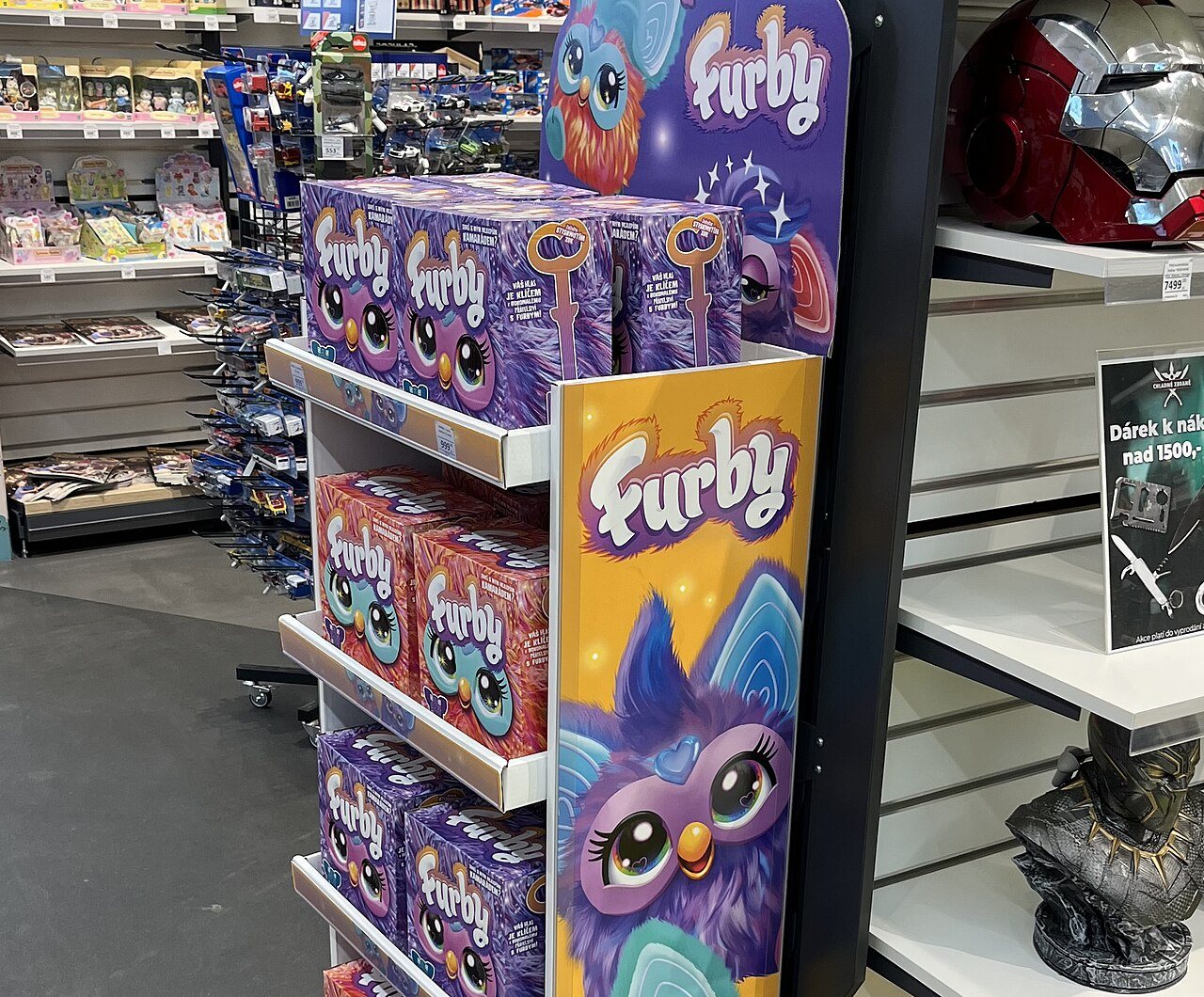
The 2012 relaunch was the one that stuck. Hasbro replaced the plastic eyes with small LCD screens, added a companion app for phones and tablets, and sold it at $54 during another strong Christmas. Furby Boom followed in 2013 and Furby Connect, with Bluetooth, in 2016. In 2023, for the 25th anniversary, Hasbro released a new Furby at $69.99 with five voice-activated modes and, this time, no app. It is still on sale.
Where to find an original Furby today
The 1998 and 1999 Furbys are cheap and common. Working examples typically list on eBay for $20 to $80 depending on colour and condition, with boxed or unusual editions asking more. Buyers should ask whether the motor still runs through a full cycle: the cam mechanism is the first thing to fail, and a Furby that only blinks is a Furby that needs surgery. The batteries are four AA cells in the base, so nothing exotic is required to wake one up.
Frequently Asked Questions
Could Furby record conversations?
No. The original Furby had a microphone that only measured loudness, so it could react to noise, but it had no memory for audio and no way to play anything back. Everything it said was stored in its read-only program memory at the factory.
How much was a Furby in 1998?
The suggested retail price was $35, roughly $68 in 2026 money. During the shortage in December 1998, resellers regularly asked $100, and some rare colours were advertised at $300.
Is Furby still being made?
Yes. Hasbro relaunched Furby in 2023 for its 25th anniversary at $69.99, following earlier revivals in 2005, 2012, 2013 and 2016. Original 1998 units are no longer produced but are easy to find second-hand.