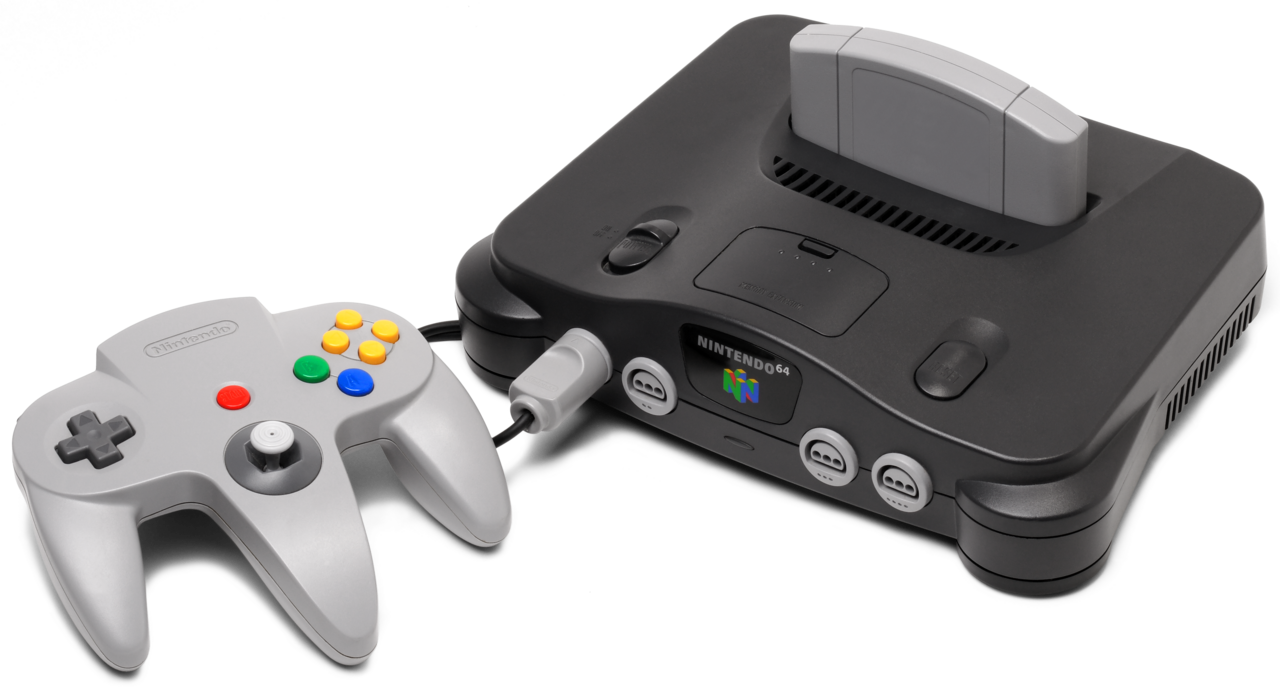
What a console, a controller and the cables cost in 2026
PriceCharting, which tracks completed sales rather than asking prices, puts a loose Nintendo 64 console at roughly $65 to $105 in 2026, depending on which of its snapshots you read. Add the original box and the figure moves to about $140. A genuinely complete package with box, inserts and manual sits near $200.
Individual sold listings run under the guide. Tested working consoles bundled with a controller and the right cables have changed hands for $35 to $94, which in plain dollars is less than the $199.99 Nintendo charged on September 29, 1996.
Two parts decide whether a cheap console is a good one. The original controller's analog stick wears down with use, and a worn stick drifts in menus and in Super Mario 64. The console also needs its power brick and a composite or S-Video cable, and the listings at the bottom of the market are exactly the ones that leave those out.
Where to find one today
Tested hardware costs more than the loose guide price, and for a 1996 console that is usually money well spent. Stone Age Gamer's Nintendo 64 section stocks consoles, controllers and replacement parts, which beats gambling on an untested unit at the $35 end of the range.
Why one ClayFighter cartridge outprices every console
The expensive part of this system is not the system. ClayFighter Sculptor's Cut, which Blockbuster handed out as a rental exclusive in 1998 and then sold off to customers once the promotion ended, sits at about $1,232 loose and $5,824 complete on PriceCharting in 2026.
That single cartridge, with no box and no manual, costs more than a dozen complete consoles. It is the clearest sign of where the Nintendo 64 market went: the hardware stayed cheap because 32.93 million of them were built, while the short print runs kept climbing.
The pattern repeats below that top price. Late releases, licensed sports titles with small runs and the games Blockbuster stocked for rental rather than sale are the ones that cost real money, while the titles that sold millions can be had for a few dollars.
So the honest answer for most people holding an old console in a closet in 2026 is that the box of cartridges is worth checking first, and the console itself is worth about what a new controller for a current system costs.
How 460,000 units in four weeks set today's supply
Nintendo put the console in US stores on September 29, 1996 with two games, Super Mario 64 and Pilotwings 64. By October 24, 1996, UPI reported that Nintendo of America had sold 460,000 of them at $200 each.
Then the shelves emptied. Stores ran short through November and December 1996, and Nintendo of America told reporters late that month that it expected to pass 1.6 million systems in the United States by December 31.
Peter Main, Nintendo of America's executive vice president of sales and marketing, told The Seattle Times in December 1996 that those three months made the console "easily the fastest selling system ever." He added that it was selling at three times the rate of its nearest competitor a year earlier.
All of that matters to a buyer three decades later. A console that moved 20.63 million units in the Americas left a deep second-hand pool, and that supply is the reason gray plastic consoles have stayed flat in price while the rare cartridges have not.
Did 1996 reviewers think the hardware earned its $199.99?
GameSpot reviewed Super Mario 64 on December 1, 1996 and scored it 9.4, calling it a game that "rewards the curious, the original, and in some cases the bludgeoningly stubborn and tenacious." The launch lineup was two games deep, and one of them carried the console.
The hardware's selling point was the analog stick in the middle of the controller, which gave players fine control of a character in three dimensions instead of eight fixed directions. Nintendo's second selling point was the cartridge. Game Paks loaded instantly where CD consoles stopped to read a disc.
The cost of that choice shows in the catalog. The Nintendo 64 shipped a library of 388 games across its life, small for a console of its era, because cartridges were expensive to manufacture and held a fraction of what a CD held.
The library did produce the system's anchors, and GoldenEye 007 in 1997 is the one that sold consoles to people who had already bought Super Mario 64.
When Nintendo stopped making it, and what replaced it
Nintendo discontinued the Nintendo 64 worldwide on April 30, 2002. Lifetime sales came to 32.93 million units, 20.63 million of them in the Americas, so roughly 63 percent of every Nintendo 64 ever built was sold in this hemisphere.
Its replacement was the GameCube, which reached US stores in late 2001 and moved Nintendo to a small optical disc. Nothing about the Nintendo 64 is supported now: there is no warranty service, no first-party repair and no new hardware.
What Nintendo does still sell is the software. A rotating set of Nintendo 64 games runs on the Nintendo Switch through the Expansion Pack tier of Nintendo Switch Online, emulated, with save states and a wireless controller that copies the 1996 shape.
That is the real fork for anyone pricing this out in 2026. The subscription is the cheap way to play the big titles, and the hardware is the only way to play a cartridge you already own on the console it was cut for.
Frequently Asked Questions
How much is a Nintendo 64 worth in 2026?
A loose Nintendo 64 console runs about $65 to $105 in 2026 on PriceCharting's tracked sales, around $140 with its original box and close to $200 for a complete package with inserts and manual. Individual tested consoles sold with a controller and cables have gone for as little as $35, well under the $199.99 the console cost at its US launch on September 29, 1996.
Is the Nintendo 64 still supported by Nintendo?
No. Nintendo discontinued the Nintendo 64 worldwide on April 30, 2002, and there is no repair service, warranty or new hardware for it in 2026. Nintendo still licenses the games, and a rotating selection of Nintendo 64 titles is playable on the Nintendo Switch through the Expansion Pack tier of Nintendo Switch Online.
What is the most expensive Nintendo 64 game?
ClayFighter Sculptor's Cut, a 1998 Blockbuster rental exclusive, is the most expensive standard Nintendo 64 release, at roughly $1,232 for the cartridge alone and $5,824 complete on PriceCharting in 2026. That is more than a dozen complete consoles, which is the clearest example of how the Nintendo 64 market split between cheap hardware and scarce cartridges.