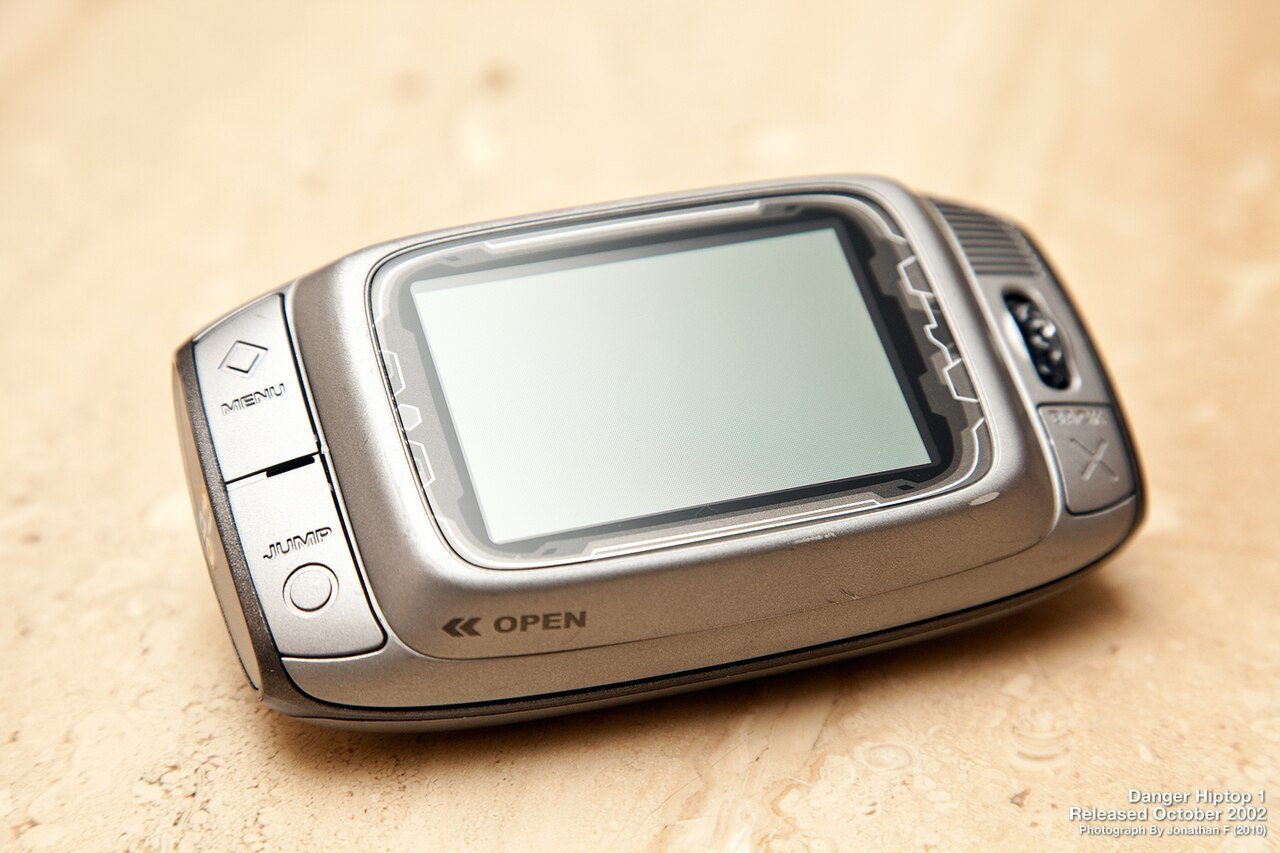
What was the Danger Hiptop, and what did it cost in 2002?
Danger, Inc. was founded on December 9, 1999 by Andy Rubin, Joe Britt and Matt Hershenson, engineers out of Apple, WebTV and Philips. Their product was the Hiptop, a hinged slab whose screen swiveled a quarter turn to uncover a full QWERTY keyboard.
T-Mobile put it on sale nationwide on October 1, 2002 under its own name, the T-Mobile Sidekick. The price was $199 after a $50 mail-in rebate, on an introductory plan of $39.99 a month that bundled unlimited data with 200 anytime minutes and 1,000 weekend minutes.
Flat-rate data was the whole pitch. One monthly fee covered email, a real web browser and instant messaging, including AOL Instant Messenger, on a keyboard built for typing rather than for dialing.
The decision that defined the Sidekick, and later destroyed it, was where the data lived. Contacts, calendars, notes and photos sat on Danger's servers and mirrored down to the handset, so a lost phone was a minor problem. Danger also ran a software Catalog, a downloadable app store that shipped years before Apple's.
Rubin did not stay to see any of it. He left Danger in 2003 and co-founded Android, Inc., which Google bought in 2005.
How many people actually carried a Sidekick?
Danger filed to go public in 2007, and that filing is the only hard count of its users. The Form S-1 told the Securities and Exchange Commission that subscribers on Danger-enabled devices rose "from approximately 136,000 as of September 30, 2004 to approximately 923,000 as of September 30, 2007." Nearly all of them were T-Mobile customers.
The same filing describes a company that never turned that base into profit: $56.4 million in revenue for the year ended September 30, 2007, against an accumulated deficit of $188.1 million. Danger sold itself to Microsoft before the offering reached the market.
So the Sidekick was never a mass-market phone the way the Motorola Razr V3 was. What the subscriber count misses is who was carrying one. The Sidekick landed with American teenagers and with the music industry at the moment both were living on MySpace and in chat windows, and unlimited typing was worth more to that crowd than a camera or a thin profile.
It also produced one of the first celebrity data leaks. Someone broke into T-Mobile's systems in January 2005 and pulled Paris Hilton's Sidekick account, and her address book, notes and photos went online that February. A Massachusetts teenager pleaded guilty and, as The Register reported in September 2005, was sentenced to 11 months in a juvenile facility.
Why did Microsoft buy Danger in 2008?
Microsoft announced the purchase on February 11, 2008 at Mobile World Congress in Barcelona and closed it that April. Neither company disclosed the price. The figure reported at the time, and repeated ever since, was around $500 million, which neither side confirmed.
Danger's staff went into a group called Premium Mobile Experiences and onto a project codenamed Pink. Pink shipped in May 2010 as the Kin, a pair of social phones aimed at the same young audience the Sidekick already had, and Microsoft withdrew them weeks later.
The purchase pointed Danger's engineering somewhere new. Microsoft wanted the platform rebuilt on a Windows CE kernel instead of the Java-based system Danger had running, and the original Sidekick line was wound down in favor of the Kin.
That left two awkward years. Through 2008 and 2009 the Sidekick was a product whose owner was busy replacing it, still serving hundreds of thousands of handsets from a data center Microsoft had inherited rather than designed. Microsoft later conceded that the data center was not "updated to run on Microsoft technology."
What caused the 2009 Sidekick data loss?
In the first days of October 2009 Sidekick data service failed and stayed broken for about two weeks. An estimated 800,000 users in the United States lost access to email, contacts, calendars and photos. The Register reported that the trigger was remedial work by the contractor Hitachi Data Systems on the storage area network holding Sidekick user data.
On October 10, 2009, T-Mobile told Sidekick owners that content no longer on their handsets "almost certainly has been lost as a result of a server failure at Microsoft/Danger," and rated the chance of recovery extremely low. For a platform sold on the premise that the server held the safe copy, that sentence ended the argument.
A class action filed in November 2009 alleged that a backup had been halted so the storage upgrade could proceed. That account came from an unnamed insider and was never established in court. Microsoft's own explanation was a failure that struck the main database and its backup at the same time.
Most of the data came back. Microsoft said on October 15, 2009 that it had recovered most, if not all, customer data, and T-Mobile resumed selling the phone on November 17. Owners with permanent losses were offered a $100 customer appreciation voucher, and the class action settled in 2011 with gift cards, small checks or free downloads.
When did T-Mobile stop selling the Sidekick?
T-Mobile pulled the Sidekick LX and the Sidekick 2008 from retail, care, telesales and its website on July 2, 2010, days after Microsoft killed the Kin. RCR Wireless News reported the withdrawal that week, with T-Mobile still promising support to existing owners.
The real ending came on May 31, 2011, when Danger's cloud services were switched off after almost nine years. T-Mobile announced the date on March 1, 2011 and offered export tools and in-store transfers so owners could get their contacts out first. After that date a Sidekick could still place a call, but email, messaging, the browser and the synced account were gone, because none of it had ever run on the phone.
T-Mobile reused the name once. The Sidekick 4G, built by Samsung as the SGH-T839, went on sale on April 20, 2011 running Android 2.2, with a five-row keyboard under a 3.5-inch touchscreen. It kept the hinge and the name and almost nothing else. T-Mobile discontinued it in 2012, less than a year in, while telling The Verge that retiring the 4G did not mean it was discontinuing the Sidekick line.
Who owns the Sidekick and Danger today?
Microsoft still owns what Danger became. The company was absorbed in 2008, the Kin was withdrawn in 2010, and Danger has not traded as a separate business since. T-Mobile US kept the Sidekick name and has put it on nothing since the Sidekick 4G in 2011. No Sidekick sits in any carrier lineup as of October 2026, and no manufacturer has announced one.
The last thread holding the original hardware to a network snapped this year. T-Mobile retired its 2G GSM network on August 3, 2026, the final 2G shutdown among the three large US carriers, after AT&T in 2017 and Verizon in 2020. The first Sidekicks were GPRS and EDGE devices, so they have nothing left to register on, which puts them where the Nokia 3310 already sits.
What circulates in 2026 is fan work rather than product news: concept renders of a swivel phone with 5G and USB-C, and clips of the old keyboard action. T-Mobile has announced no revival, and a real one would be a new phone wearing an old name, since nothing in the 2002 design has a network or a server left to reach.
Where to find one today
Original Sidekick and Sidekick II handsets still change hands among collectors, as display pieces rather than as phones. Rough, untested units go cheaply; a clean working one with its box asks well into three figures, and rare colors ask more. Collector marketplaces such as Etsy's T-Mobile Sidekick listings are the practical place to look.
Frequently Asked Questions
Can you still use a T-Mobile Sidekick in 2026?
No. The T-Mobile Sidekick kept its owner's email, contacts, calendar and browsing on Danger's servers, and those servers were switched off on May 31, 2011. T-Mobile then retired the 2G GSM network the original handsets used on August 3, 2026, so a surviving Sidekick in 2026 powers on as a collectible with no service to join.
Why was the T-Mobile Sidekick discontinued?
Microsoft bought Danger, Inc., the company behind the T-Mobile Sidekick, in 2008 and moved its engineers onto a replacement phone, the Kin. T-Mobile stopped selling the original Sidekick on July 2, 2010, and the Danger cloud service the phone depended on was shut down on May 31, 2011, which left the hardware unable to do most of what it had been sold to do.
What replaced the T-Mobile Sidekick?
Microsoft replaced the Sidekick platform with the Kin, which it launched in May 2010 and withdrew weeks later. T-Mobile then put the name on the Samsung-built Sidekick 4G, an Android 2.2 phone released on April 20, 2011 and dropped in 2012. After that the keyboard-phone market the Sidekick had opened went to Android handsets and the iPhone.