Why Sony built a card that only Sony devices wanted
Sony launched Memory Stick in October 1998, a flash card roughly the size of a stick of chewing gum in a hard plastic shell.
CompactFlash and SmartMedia already existed, and both had groups of companies behind them. Sony built its own format anyway.
The first cards held 4 MB and 8 MB, and the original Memory Stick never went past 128 MB. That ceiling looked generous in 1998. By 2002 it was a problem Sony had made for itself.
A second design choice mattered more than capacity. Sony sold a parallel MagicGate line with copy protection built into the card, because the same corporation owned a record label and a film studio and wanted its storage to have an opinion about what went on it.
The result was a format with one real sponsor. Sony cameras, camcorders, Walkman players, Clie organizers and VAIO laptops took Memory Stick, and almost nothing else did. Buy a Sony camera and you did not get a choice of card, which is exactly what Sony wanted and exactly why the rest of the industry standardized on something else.
What a Memory Stick cost when it was new
Memory Stick was never cheap. On August 1, 2001, almost three years after launch, Sony cut prices across the line and published the new figures.
"Memory Stick media in 8MB, 16MB, 32MB, 64MB and 128MB capacities are available for around $25, $35, $50, $80 and $150, respectively," Sony's announcement of August 1, 2001 said, as reported by MacTech that day.
Those were the reduced prices. A 128 MB card at $150 works out to more than a dollar per megabyte, and $25 for 8 MB is more than three dollars per megabyte.
The MagicGate versions cost more again on the same day: $69.95 for 32 MB, $99.95 for 64 MB and $169.95 for 128 MB. Buyers paid a premium for copy protection designed to limit what they could do with their own files.
Numbers like that land better next to the rest of the era, which is what our list of 1990s tech prices in today's dollars is for.
How Memory Stick PRO and the PSP kept the format alive
Sony's answer to the 128 MB wall arrived at CES on January 9, 2003. Memory Stick PRO, developed jointly with SanDisk, shipped in 256 MB, 512 MB and 1 GB capacities and carried twice the connectors of the original card.
At the same show Sony sold a stopgap worth remembering. Memory Stick Select put two separate 128 MB partitions on one card with a physical switch to flip between them. A company only ships hardware like that when its own specification is the obstacle.
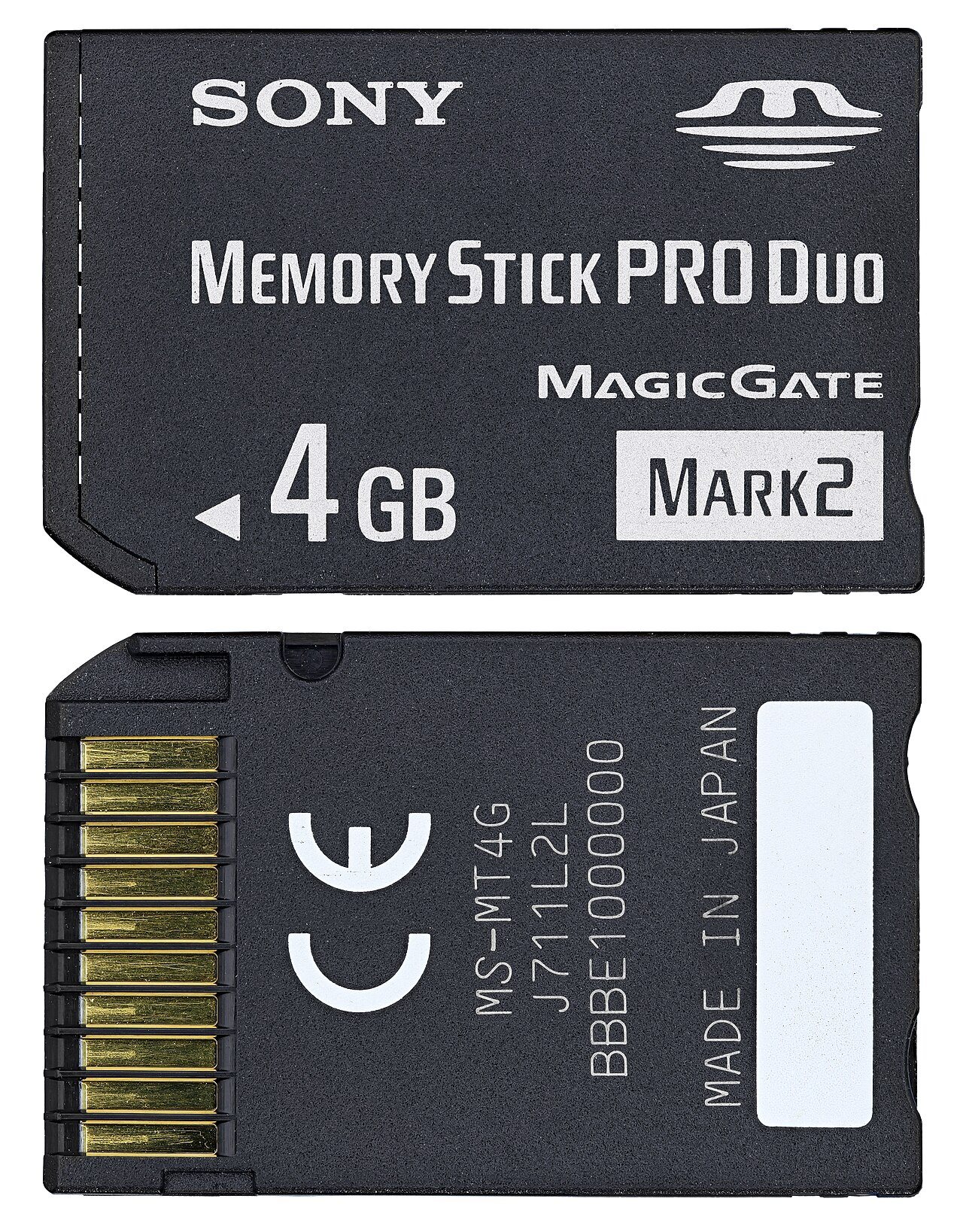
Then the cards shrank. Memory Stick Duo, and after it Memory Stick PRO Duo, cut the stick down to a size that fit a phone or a handheld, and Sony's PSP turned PRO Duo into a card millions of American households owned without ever choosing it.
SanDisk was pleased with the arrangement. "The Memory Stick PRO format co-developed with Sony has become a highly successful product line for us," SanDisk chief executive Eli Harari said in the joint Sony and SanDisk press release of September 30, 2005.
That release introduced one more size. Memory Stick Micro, or M2, was about a quarter the area of a PRO Duo and roughly 1.2 mm thick, with a theoretical ceiling of 32 GB. Sony's Akira Kubota framed it as continuity: "Sony's collaboration with SanDisk Corporation has continued to develop since our initial announcement of the joint Memory Stick PRO format development in 2003."
M2 is also the reason a PSP Go will not read a PRO Duo card. Sony changed the slot on its own handheld line inside five years.
When Sony quietly gave up on its own format
Sony never published an end-of-life notice for Memory Stick, so the tidy discontinuation date most people search for does not exist. The surrender is still easy to date.
At CES in January 2010, Sony said its new digital cameras and camcorders would accept SD and SDHC cards alongside Memory Stick, and it started selling SD cards under its own brand. That removed the format's only real advantage, which was that Sony hardware accepted nothing else.
Capacity stopped moving at about the same time. The largest Memory Stick Sony released was a 32 GB card on August 21, 2009. Sony and SanDisk had already specified a Memory Stick XC extension in January 2009 that reached 2 TB on paper, and nothing close to that size ever reached buyers.
So the 2026 answer is no. Memory Stick is not in production, no current Sony camera or handheld uses one, and the cards survive as second-hand stock and leftover retail inventory.
Sony's card business has kept shrinking since. On March 27, 2026, Sony Japan suspended orders for nearly all of its SD and CFexpress cards "due to the global shortage of semiconductors (memory) and other factors," as Digital Camera World reported in 2026. The company that built a proprietary card to lock buyers in now has trouble shipping the open standard that beat it.
What reading an old stick costs in 2026
Getting files off one needs a slot and very little money. A multi-format USB card reader that explicitly lists Memory Stick PRO Duo support will mount the card on Windows or macOS, and a Sony camera or camcorder connected over USB does the same job.
Photos written by a Sony camera are ordinary JPEG files in ordinary folders, so nothing proprietary stands in the way. MagicGate audio is the exception, because the protection was tied to the device that wrote it.
The cards themselves are cheap. PriceCharting's PSP accessory guide puts a complete 4 GB Memory Stick PRO Duo at $12.12 and a sealed one at $21.00, an 8 GB card at $14.00 complete and $24.00 new, and a 16 GB card at $13.12 complete and $22.30 new.
A 16 GB card selling for less than an 8 GB card is what a dead format's pricing looks like. Sony's other orphaned medium went the other way: collectors pushed up prices after the company stopped making MiniDisc media.
Where to find one today
Genuine Sony cards are worth the small premium over unbranded ones, because a PSP or a 2006 camera will refuse a card it does not like. Stone Age Gamer's Memory Stick listings cover PRO Duo cards and the handhelds that take them, which beats gambling on an untested card at the bottom of the market.
Frequently Asked Questions
Are Memory Stick cards still made in 2026?
No. Sony never issued a formal discontinuation notice for Memory Stick, but it added SD and SDHC support to its cameras and camcorders at CES in January 2010 and stopped advancing the format after the 32 GB card of August 21, 2009. In 2026 the cards are sold only second-hand or as leftover retail stock.
How do you read a Memory Stick PRO Duo on a computer?
Use a multi-format USB card reader that explicitly lists Memory Stick PRO Duo, or connect a Sony camera or camcorder that takes the card over USB. Photos written by Sony cameras are standard JPEG files, so no Sony software is needed in 2026, and only MagicGate copy-protected audio stays tied to the device that recorded it.
What is the difference between a Memory Stick and an SD card?
Memory Stick was Sony's own format, launched in October 1998 and capped at 128 MB in its first version, while SD was an open standard backed by many manufacturers. Sony began shipping SD and SDHC support in its own cameras in January 2010, and SD, SDHC and SDXC cards are what replaced Memory Stick across every Sony camera line.